Think of two coffee shops on the same street. They sell similar coffee at similar prices, yet one always has a line and the other is half empty. People in the line will tell you the coffee is better, but what they're really describing is everything around it, from the name and the cups to the way the staff talk, the music, the Instagram account and the feeling of being in the right place. That's branding.
This guide explains what branding is in plain words, how it differs from a logo or from marketing, the elements every brand needs and the main types of branding. Then it walks you through building a brand step by step in 2027, with a brand guidelines template, a touchpoint audit, examples from well-known companies, ways to measure your brand and the mistakes to avoid. It's written for small businesses, online stores and creators, so everything here works without an agency budget.
What is branding?
Branding is the process of shaping how people see, remember and feel about a business, a product or a person. It covers what you stand for, who you serve, how you sound and how you look, and it makes all of those consistent everywhere people meet you.
A brand is the result of that work. It's the set of ideas and feelings people have in mind when they hear your name. You don't fully control it, because it lives in your customers' heads, but branding is how you influence it on purpose.
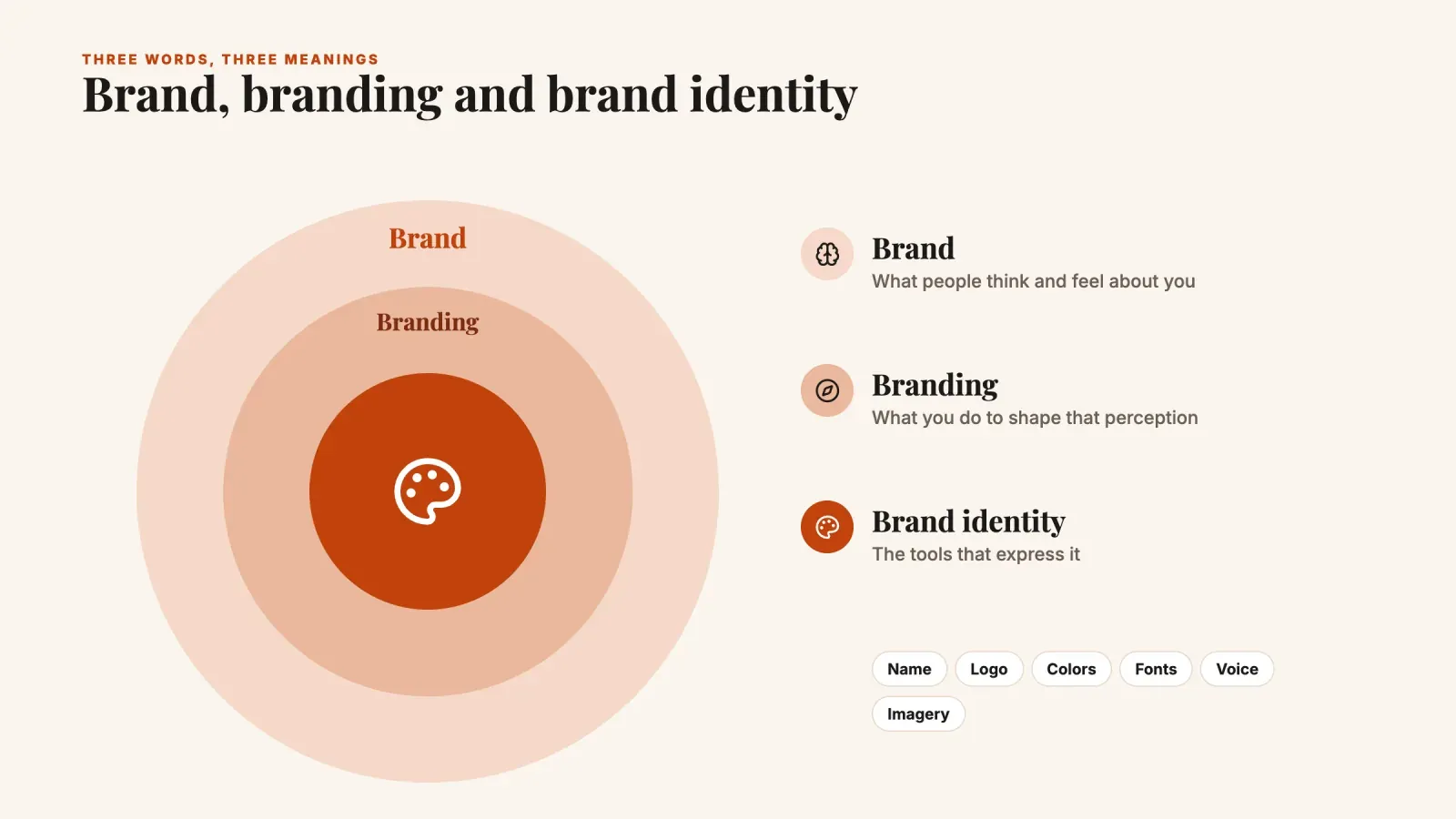
A simple way to remember the difference.
- Brand. What people think and feel about you.
- Branding. What you do to shape that perception.
- Brand identity. The tools you use to express it, such as your name, logo, colors, fonts, voice and imagery.
Branding vs logo vs marketing
These three words get mixed up all the time, which leads small businesses to spend money in the wrong place.
| | What it is | Question it answers | Example |
|---|---|---|---|
| Logo | A symbol that identifies you | How do people recognize us? | The Nike swoosh |
| Branding | Who you are and how you show up everywhere | Why should people choose us and remember us? | Nike's focus on athletes and "Just Do It" |
| Marketing | The actions that bring in customers | How do we reach people and get them to buy? | A campaign for a new running shoe |
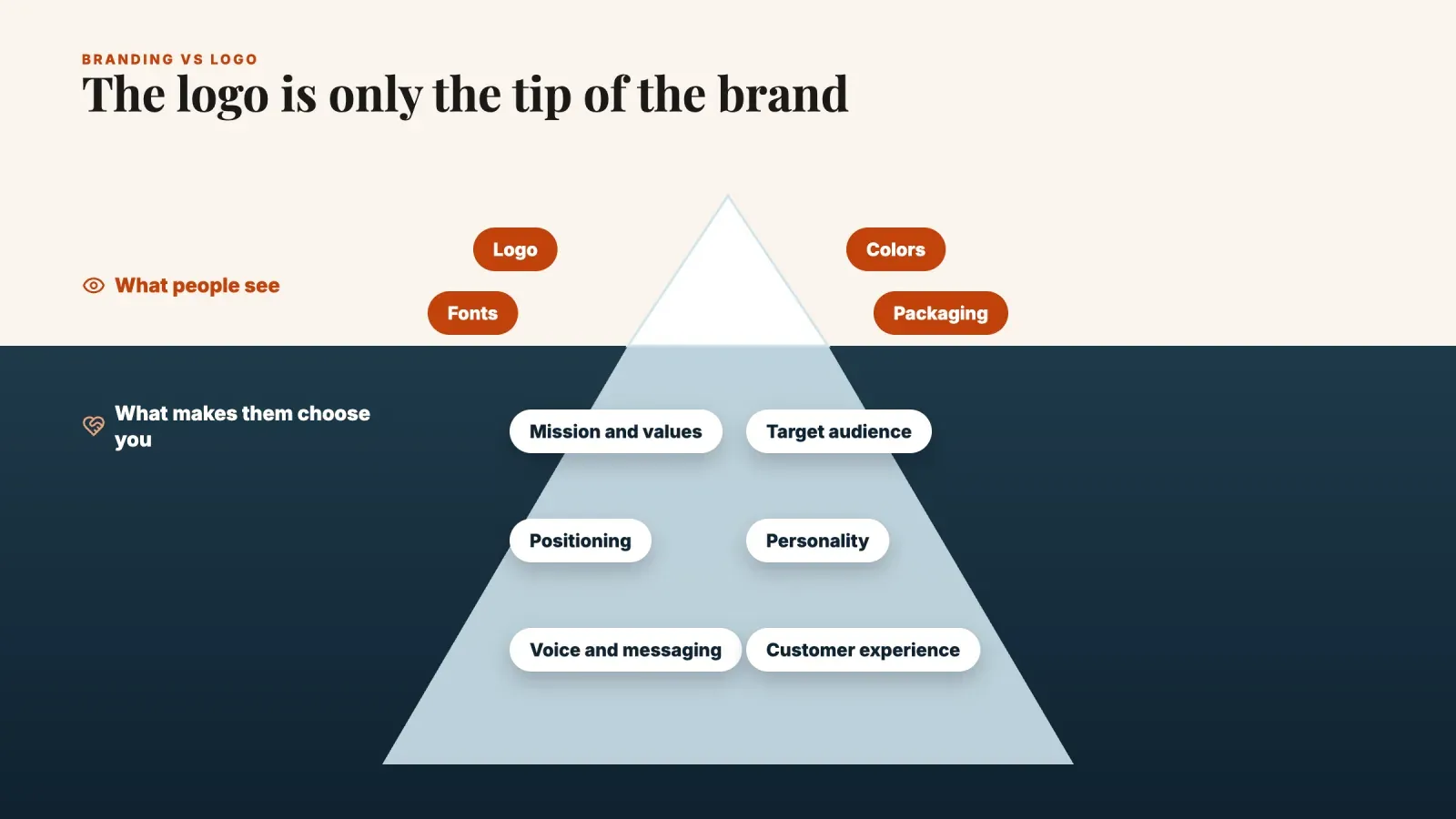
A logo is one small part of your brand identity. You can have a beautiful logo and a weak brand, and some strong brands started with very simple logos. Marketing, on the other hand, works much better when the branding is clear. When people already know what you stand for, every ad, post and email has less explaining to do.
Why branding matters for small businesses and creators
Big companies spend fortunes on branding, but small businesses often benefit even more from it, because it's what makes growth possible on a small budget.
- It makes you memorable. People see thousands of posts, ads and products every day. A clear brand is easier to remember and easier to recommend.
- It lets you charge more. When people trust a brand and feel connected to it, price becomes less important than fit.
- It builds trust before the first sale. A consistent look, voice and message signal that you're real, reliable and serious.
- It brings customers back. Loyal customers buy again and tell others. Their lifetime value is what makes many small businesses profitable.
- It makes decisions easier. When you know what your brand stands for, it's easier to say yes or no to a product idea, a collaboration or a new channel.
- It helps search engines and AI assistants understand you. A clear, consistent description of what you do, used across your website, profiles and listings, makes it easier for people and tools to put you in the right category.
The 7 elements of a strong brand
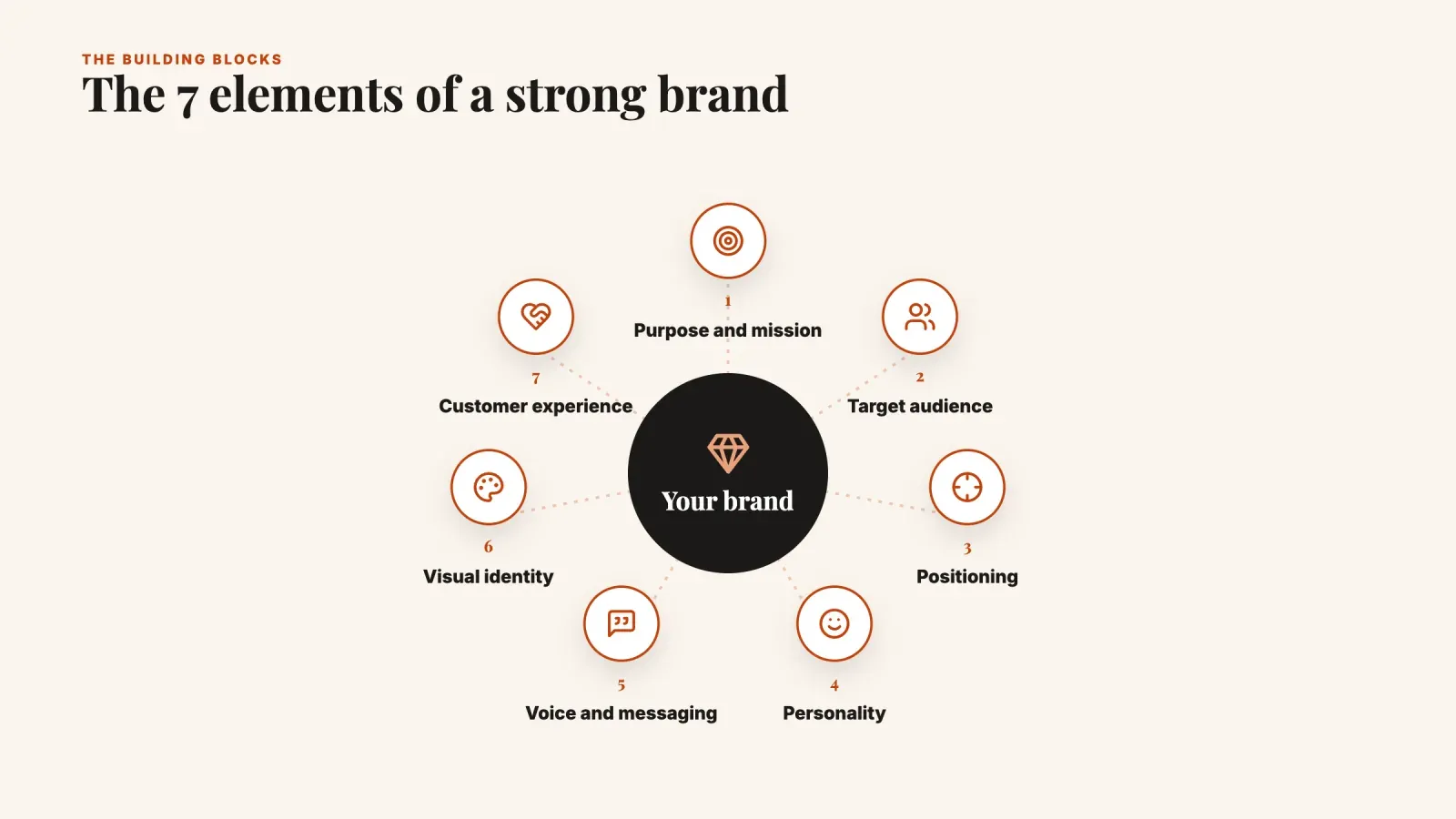
Every brand, from a solo creator to a global company, is built from the same seven elements.
1. Purpose and mission
Your purpose is why you exist beyond making money. Your mission says what you do, for whom and why, in one sentence. Patagonia's mission is a famous example, "We're in business to save our home planet." Nike's mission is to "bring inspiration and innovation to every athlete in the world," and it adds that if you have a body, you're an athlete.
A good mission is short and specific enough to guide real decisions. If it doesn't help you choose between two options, it's too vague.
2. Target audience
A brand that tries to speak to everyone ends up speaking to no one. Describe your audience as real people. What do they want? What frustrates them? How would they describe their problem to a friend? Specific beats broad, which is why many creators and small brands grow faster after they niche down.
3. Positioning
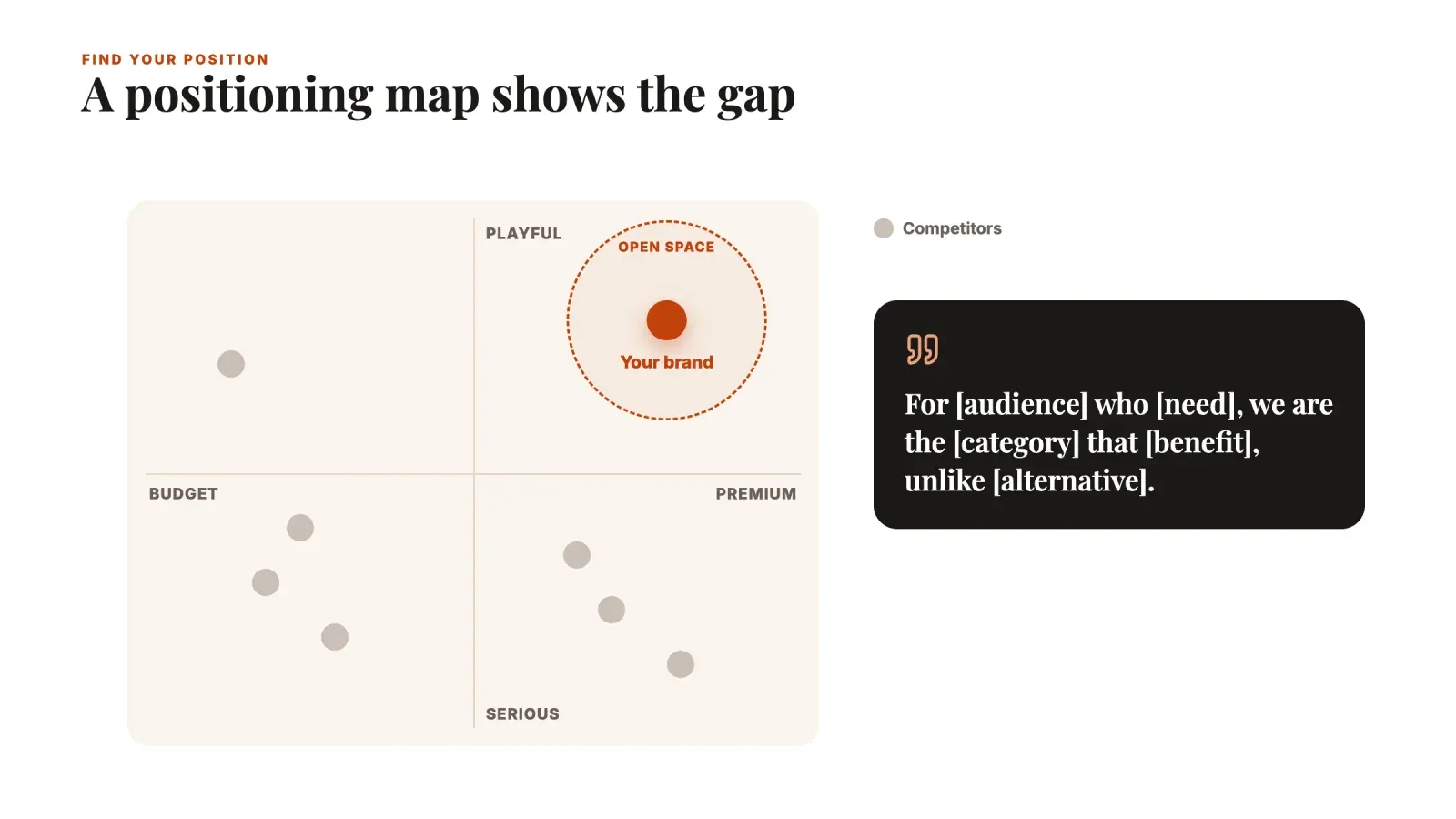
Positioning is the space you want to own in people's minds compared with the alternatives. A useful template is "For [audience] who [need], we are the [category] that [main benefit], unlike [alternative]." Liquid Death, for example, sells canned water with heavy metal style branding, which gives it a place on the shelf no other water brand occupies.
4. Brand personality
If your brand were a person, how would you describe them? Three to five adjectives are enough, such as playful, warm and bold, or calm, precise and expert. Personality guides everything from your photos to how you reply to comments.
5. Brand voice and messaging
Voice is how your personality sounds in words. It includes the words you use and avoid, how formal you are, whether you use humor and how you talk about competitors. Messaging is what you repeat, such as your tagline, your key benefits and the story of why you started.
6. Visual identity
This is the part people usually think of first. It includes your logo, color palette, typography, photography style, illustrations, packaging and templates. The goal is recognition. Tiffany & Co. made its shade of blue so recognizable that the color itself is protected as a trademark. Our guide to the Starbucks logo shows how a visual identity evolves over decades.
7. Customer experience
Your brand is also everything people experience when they deal with you, such as your website, checkout, delivery, packaging, emails, customer service and returns. A cheerful Instagram account followed by a cold, generic order confirmation feels like two different companies. The experience is where people decide whether your brand keeps its promises.
Types of branding
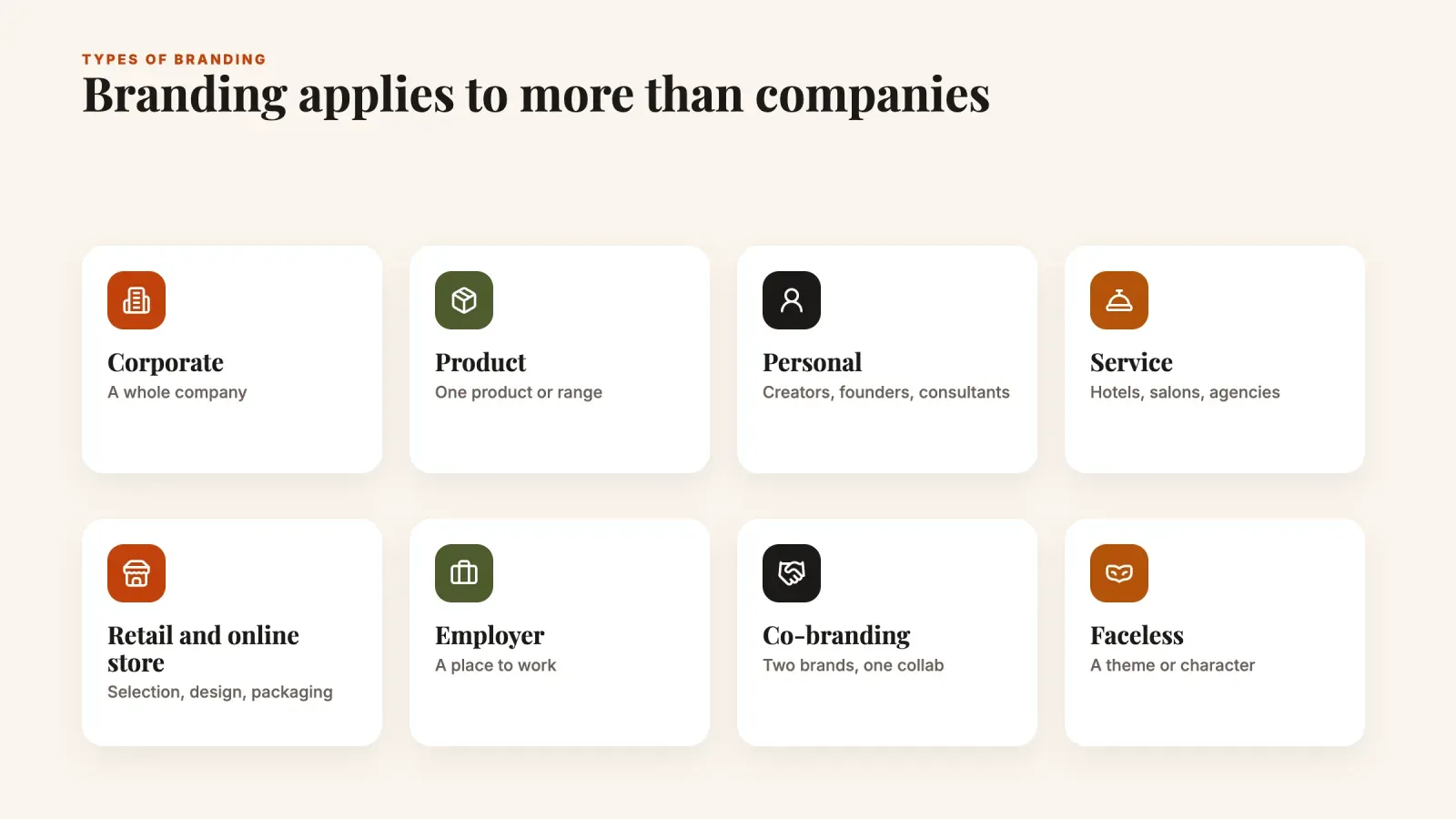
Branding applies to more than companies. Here are the main types you'll come across.
- Corporate branding. The brand of a whole company, such as Apple or Patagonia.
- Product branding. A brand for a specific product or range, sometimes with its own name and look, like a product line inside a larger company.
- Personal branding. The brand of an individual, such as a creator, consultant or founder. Our guide on the benefits of a personal brand covers this in depth, and our glossary explains what a personal brand is.
- Service branding. Brands built around an experience, such as a hotel, a salon or an agency, where the customer experience matters even more than visuals.
- Retail and online store branding. The brand of a shop, including its product selection, store design, packaging and website.
- Employer branding. How a company is seen as a place to work, which affects hiring.
- Co-branding. Two brands working together on a product or campaign, such as a collab collection.
Some creators build a faceless brand, where the brand is built around a theme, a style or a character instead of a person's face. The same seven elements still apply.
How to build a brand step by step
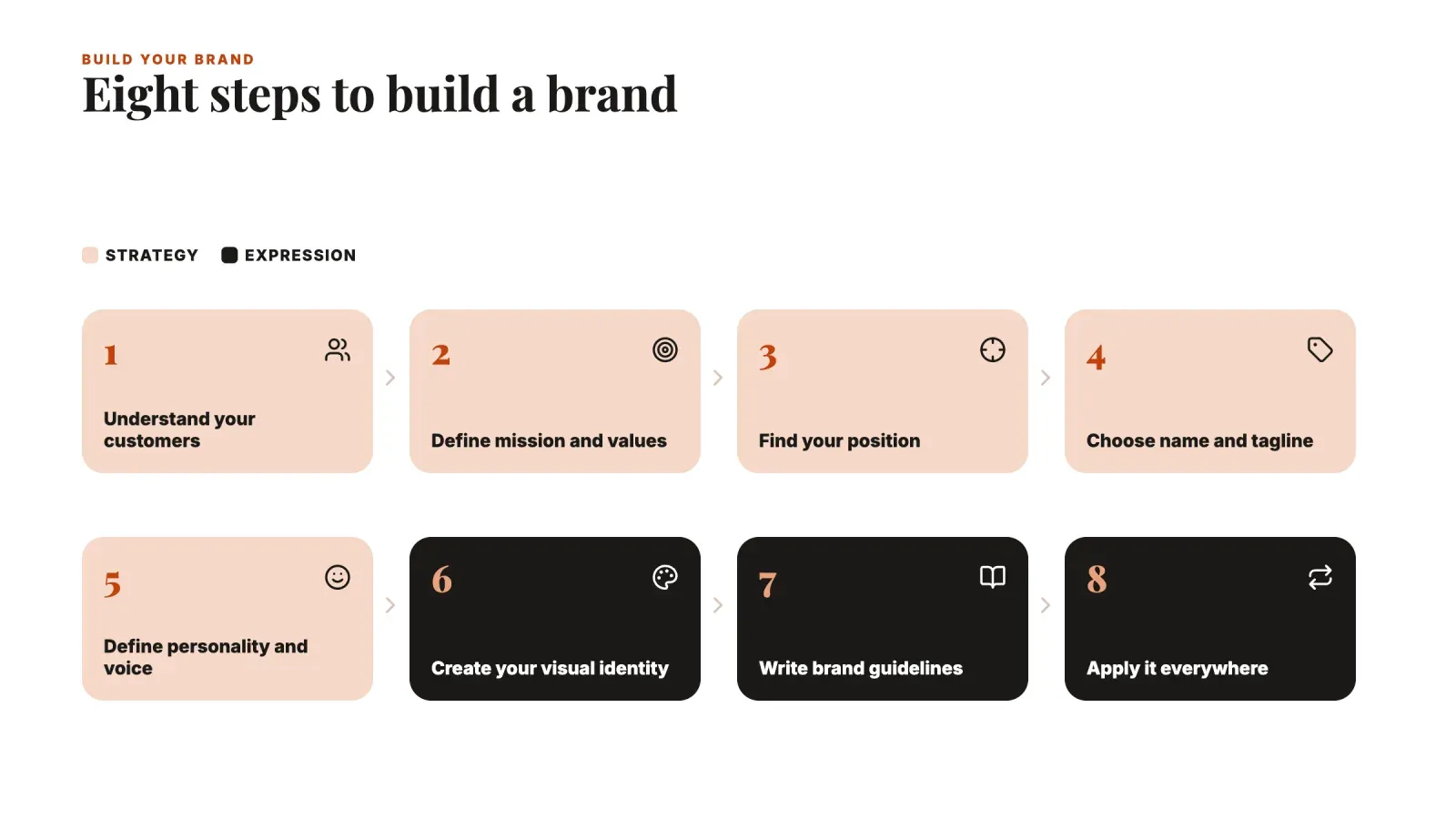
You don't need an agency to build a solid brand. Follow these steps in order, and write down your answers as you go. They'll become your brand guidelines.
Step 1, understand your customers
Start with real people. Talk to five to ten customers or followers, read reviews of competitors and look at the questions people ask in comments and forums. For each type of customer, note how they describe their problem before finding you, how they'd describe your product to a friend after buying it and what they read, watch or follow. Then write one sentence a real customer would read and think "that's me."
Step 2, define your purpose, mission and values
Write your mission in one sentence. Add three to five values that explain how you work, for example "We ship only what we'd use ourselves." Test your mission with a real decision, such as a partnership offer that doesn't quite fit. If the mission helps you answer, it's doing its job.
Step 3, study your competitors and find your position
List five competitors and note how they describe themselves, what they look like and what customers praise or complain about. Look for the gap. Maybe everyone sounds corporate and you can sound human, or everyone is cheap and you can be the premium, handmade option. Write your positioning statement using the template above.
Step 4, choose your name and tagline
If you're starting from scratch, choose a name that's easy to say, spell and remember, and check that the domain and social handles are available. A custom domain that matches your name makes you look established. A tagline sums up your promise in a few words. It's optional, but it helps people remember what you do.
Step 5, define your personality and voice
Pick three to five personality traits. For each one, write a short "we are this, we avoid that" line, for example "Friendly, never sloppy." Then rewrite three real pieces of content, such as your bio, a product description and an order confirmation, in that voice. Real examples are more useful than abstract rules.
Step 6, create your visual identity
Choose a logo, two or three main colors, one or two fonts and a photography or illustration style. Simple usually wins, especially online where your logo often appears as a tiny profile picture. Make sure your colors work on both light and dark backgrounds and that your text stays readable. Design trends come and go, so only follow one if it truly fits your personality.
Step 7, write your brand guidelines
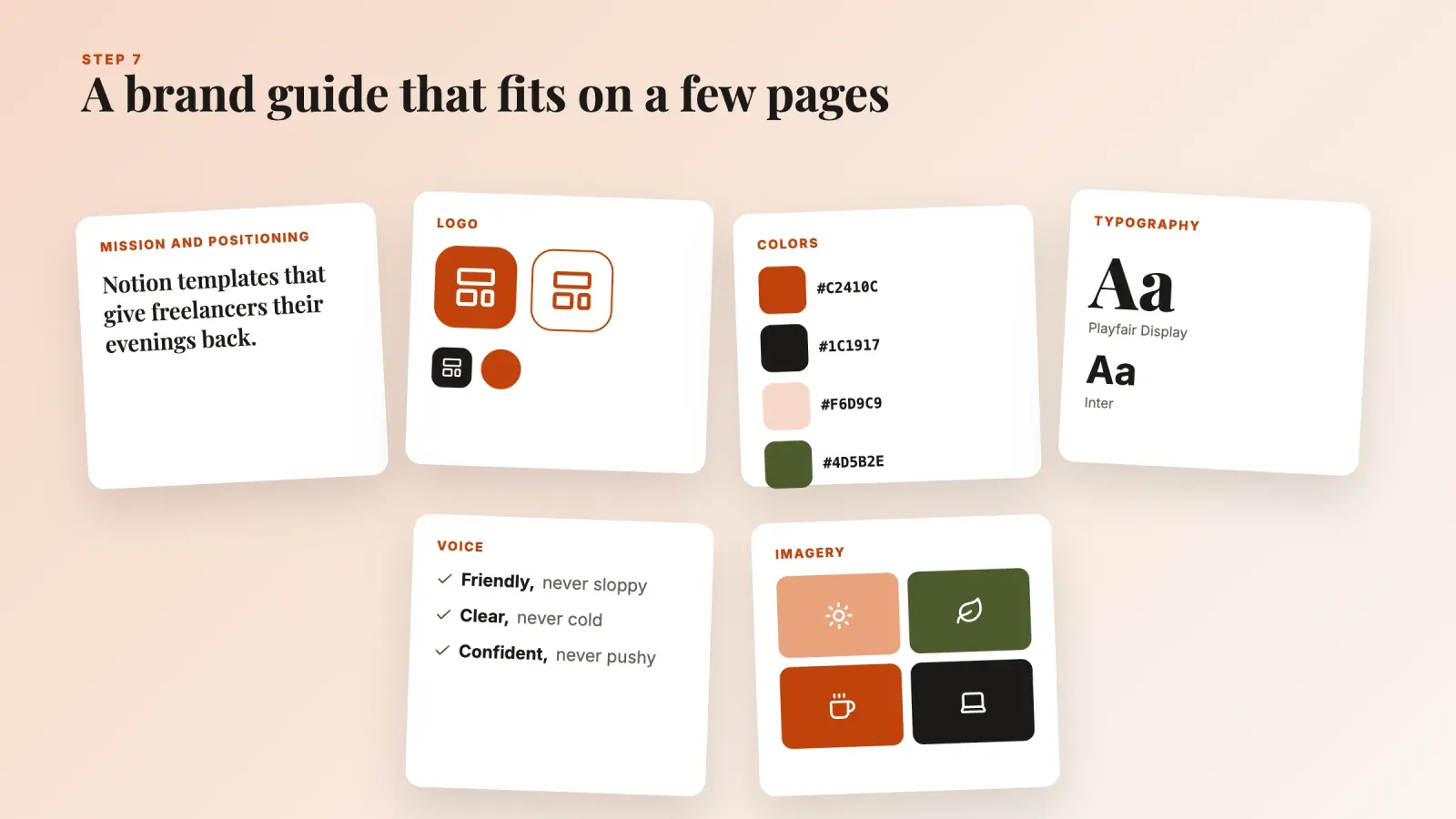
Put everything in one short document that anyone working with you can use. A useful brand guide fits on a few pages.
- Mission, values and positioning statement
- Target audience descriptions
- Personality traits and voice rules, with examples
- Logo versions and how to use them
- Color codes and fonts
- Photo and illustration style, with do and don't examples
- Templates for social posts, emails and documents
Step 8, apply it everywhere and stay consistent
Now update every place people meet your brand. Your website, social profiles, link-in-bio page, emails, packaging, invoices, business cards and Google listing should all look and sound like the same company. Consistency is what turns a set of nice assets into a brand people recognize.
Branding on Instagram and social media
For many small businesses and creators, social media is where most people meet the brand for the first time. A few habits make a big difference.
- Keep your profile consistent. Use the same profile picture, name, colors and description on every platform, so people recognize you when they move from TikTok to Instagram to your website.
- Create a visual signature. Repeat a few recognizable elements, such as a color, a type of cover image or a way of filming, so people know a post is yours before they see your name.
- Use your voice in captions and replies. Your brand voice shows most clearly in the small things, such as how you answer comments and DMs.
- Make your bio and link page match. The page people land on after tapping your link should look like the account they just left.
Our guide on how to increase Instagram engagement covers the content side, and our comparison of a link in bio vs a website helps you choose where your brand lives online.
Audit your brand touchpoints
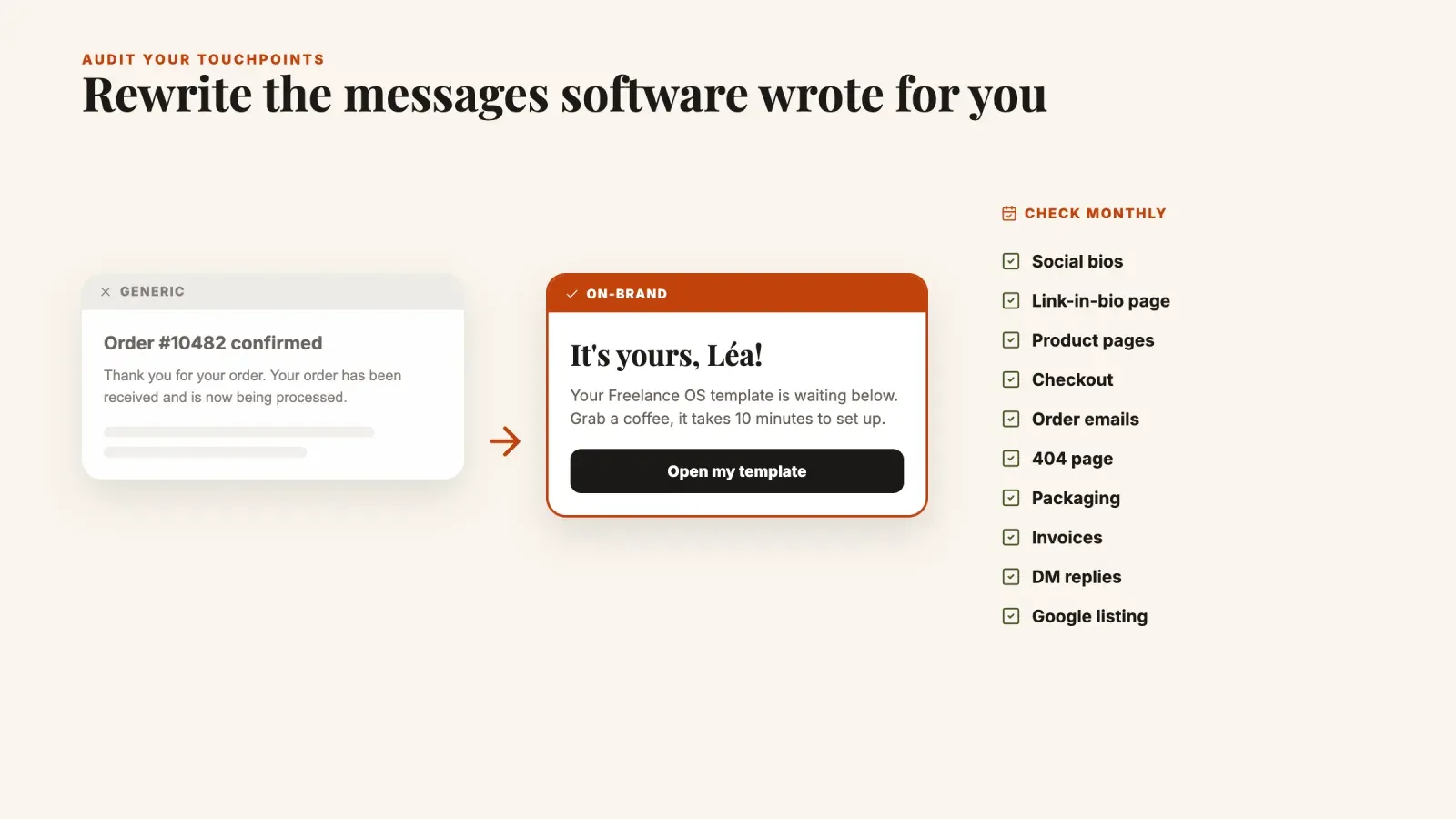
A touchpoint is any moment where someone meets your brand. Small businesses often polish the visible ones, such as Instagram and the homepage, and forget the rest. Once a month, check the list below and look for outdated messages, generic template text and a tone that doesn't match.
- Social media bios and profile pictures
- Link-in-bio page and website homepage
- Product pages and product photos
- Checkout page and payment confirmation
- Automated emails, such as welcome, order confirmation, shipping and password reset
- The 404 error page
- Packaging, inserts and thank-you cards
- Invoices and receipts
- Customer service replies and DM templates
- Your Google Business Profile and other listings
Many of these default to generic text written by a software company. Rewriting your order confirmation or 404 page in your brand voice takes a few minutes and makes a surprisingly big difference. Mapping your customer journey from first discovery to repeat purchase is a good way to find the touchpoints you've missed.
Branding examples to learn from
Big brands are useful examples because their choices are easy to see. Focus on the decision behind each one, since that part costs nothing to copy.
- Patagonia. Its environmental mission shows up in its products, its repair program and its campaigns, so customers who share those values feel at home.
- Liquid Death. It took one of the most boring products on earth, water, and gave it a loud, humorous, heavy metal personality that stands out on any shelf.
- Duolingo. Its green owl mascot and playful, slightly unhinged tone on social media made a language app feel like a character people follow for fun.
- Glossier. The beauty brand grew out of the Into the Gloss blog and built its brand around real customer voices, simple packaging and a signature pink.
- Apple. Its minimal design, clean product photography and focus on simplicity are consistent across products, stores, packaging and ads.
For a small business, the lesson is the same. Pick a clear position, commit to it and repeat it everywhere, from your Reels to your packing slips.
How to measure your brand
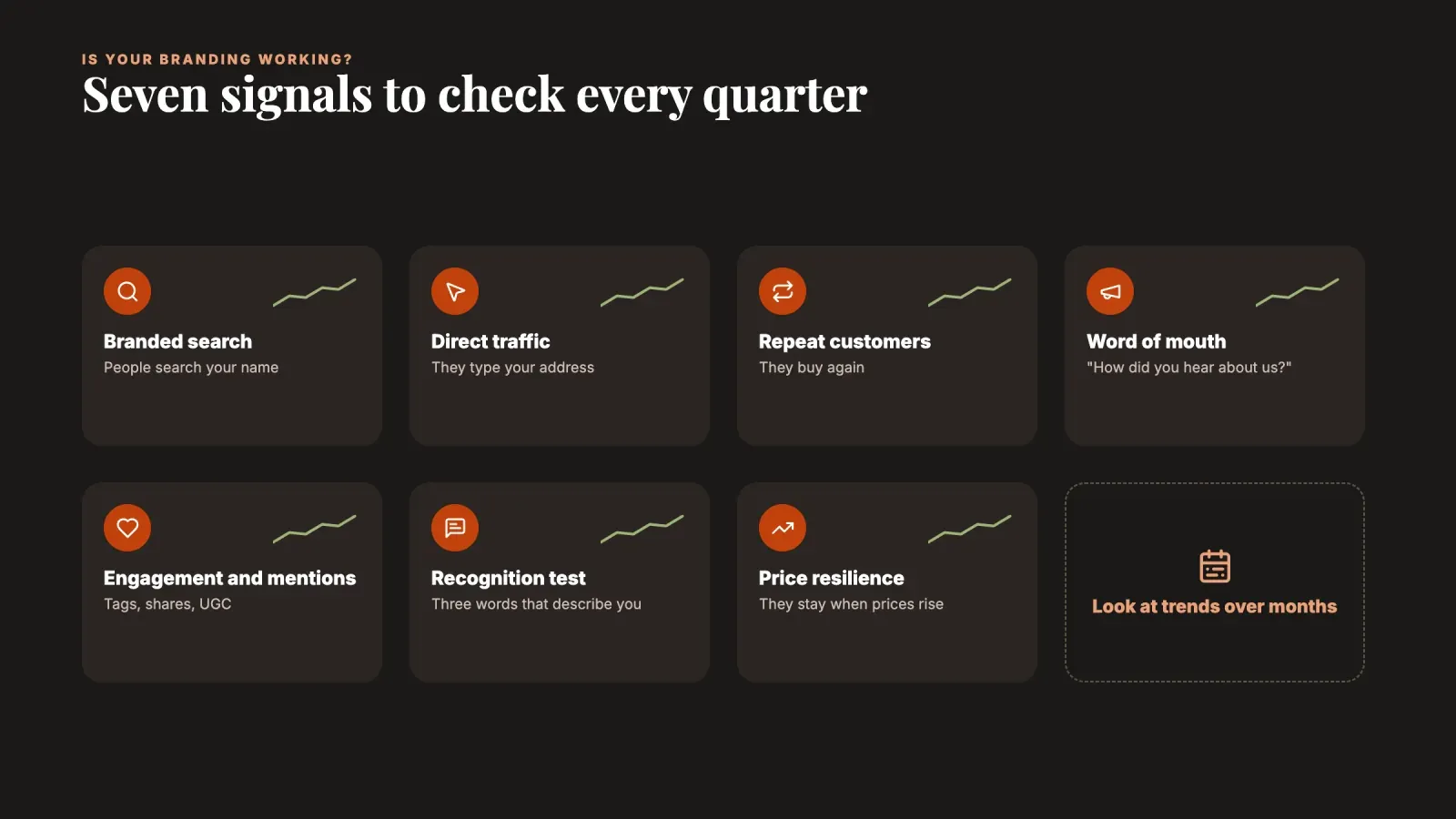
Branding can feel hard to measure, but a few signals show whether it's working.
- Branded search. How many people search for your name on Google or Instagram. Growth here means people remember you.
- Direct traffic. Visitors who type your website address or come back without clicking an ad.
- Repeat customers. The share of orders from people who bought before.
- Word of mouth. How new customers say they found you. Add a "How did you hear about us?" question after checkout.
- Engagement and mentions. Comments, shares, saves, tags and user-generated content.
- Recognition tests. Ask a few people to describe your brand in three words, then compare their answers with your intended personality.
- Price resilience. Whether customers keep buying when you raise prices a little.
Check these every quarter. Brand building is slow, so look for trends over months rather than day-to-day changes.
When to rebrand
A rebrand is a big change to your name, positioning or visual identity. It's worth considering when your business has changed a lot, when your audience has shifted, when your look feels dated compared with the quality of what you sell or when your name causes confusion or legal problems.
It isn't worth doing because you're bored with your logo. Your customers see your brand far less often than you do, so what feels old to you may still feel fresh to them. Often a refresh, such as cleaning up the logo, updating colors and rewriting your messaging, solves the problem without throwing away the recognition you've built.
How much does branding cost?
Branding can cost almost nothing or a lot, depending on how you do it.
- Do it yourself. Free to a few hundred dollars for fonts, a domain and design tools. Good for creators and new businesses that are still testing their offer.
- Freelance designer. A logo and basic visual identity often costs a few hundred to a few thousand dollars, depending on the designer and the scope.
- Branding agency. Full strategy, naming and identity projects usually start in the thousands and can go much higher.
Whatever you spend, the strategy work, meaning your audience, mission, positioning and voice, matters more than the logo. You can do that part yourself with the steps in this guide.
Branding mistakes to avoid
- Starting with the logo. Visuals should express a strategy. Without one, you'll redesign again and again.
- Copying a big brand. You'll always be the smaller version of someone else. Borrow the thinking behind a brand and create your own look.
- Trying to appeal to everyone. Broad brands are forgettable. Be specific about who you serve.
- Being inconsistent. Different colors, tones and messages on each platform confuse people and waste your marketing.
- Ignoring the experience. A great Instagram feed won't save a slow delivery or a rude reply.
- Changing too often. Recognition takes time. Give your brand at least a year before judging it.
- Making promises you can't keep. A brand is a promise. Break it and people remember that instead.
FAQ
What is branding in simple words?
Branding is everything you do to shape how people see and remember your business, from your name, logo and colors to your voice, values and customer experience. Your brand is the result, meaning what people think and feel when they hear your name.
What's the difference between branding and marketing?
Branding defines who you are and why people should choose you. Marketing is the set of actions that reach people and convince them to buy, such as ads, content and emails. Strong branding makes marketing easier and cheaper.
What are the main elements of branding?
The seven main elements are purpose and mission, target audience, positioning, personality, voice and messaging, visual identity and customer experience.
Is a logo the same as a brand?
No. A logo is one part of your visual identity, which is one part of your brand. Your brand also includes your values, voice, reputation and the experience people have with you.
How long does it take to build a brand?
You can define your brand strategy and identity in a few weeks, but recognition and trust take months or years of consistent work. Most small brands see a clear difference after six to twelve months of consistent messaging.
Do small businesses really need branding?
Yes. Small businesses can't outspend big competitors, so being clear, memorable and consistent is one of their best advantages. Even a one-page brand guide helps every post, product and email work toward the same goal.
Give your brand one consistent home
Branding comes down to a few clear decisions. Know who you serve, say what you stand for, choose a personality and a look that fit and repeat them everywhere people meet you. Do that consistently, and people will recognize you, trust you and come back.
Your link in bio is often the first page people see after your content. Create your free Roctify page with your colors, fonts, logo and custom domain, so your products, links and sign-up forms all look and sound like your brand.