A good promotion gives people a reason to buy today instead of "someday". A bad one trains them to wait for the next discount, eats your margin and brings in customers who never come back. The difference rarely comes from the size of the discount. It comes from choosing the right type of promotion for the goal you have right now.
This guide covers the 16 most useful types of sales promotions for online stores, creators and small brands. They're grouped by what each one does best, from price promotions that convert hesitant shoppers to loyalty and referral offers that bring people back. For each type, you'll find how it works, the real cost behind the headline, when to use it and the mistakes to avoid. After the list, you'll find a simple way to pick the right promotion, the margin math that tells you whether a discount is worth it, the legal rules to respect in the US and the EU, and how to run promotions on social media without hurting your brand.
What is a sales promotion?
A sales promotion is a short-term incentive that encourages people to buy, buy more or buy sooner. It can be a lower price, extra value at the same price, a reward for a specific action or a limited window to act. Promotions differ from your everyday pricing because they have a start, an end and a goal.
That goal matters more than anything else. Most promotions serve one of four purposes.
- Convert hesitant shoppers. People who visited, liked the product and left. A small push gets them over the line.
- Raise the average order. Customers who would buy anyway, but who could add a second item or move to a bigger pack.
- Bring customers back. People who bought once and drifted away, or loyal fans you want to keep.
- Reach new people. Promotions that spread through word of mouth, referrals and social sharing.
Each type below is strongest at one of these goals. Use the wrong one and you'll pay for a discount that doesn't move the number you care about.
Price promotions that convert hesitant shoppers
These are the classic discounts. They're easy to understand and quick to launch, but they cost you margin on every sale, including sales you would have made anyway. Use them with a clear end date and a reason.
1. Percentage or dollar off
The simplest promotion. "20% off everything" or "$10 off the winter collection". Shoppers instantly see what they save, which makes it the most effective format for a quick lift.
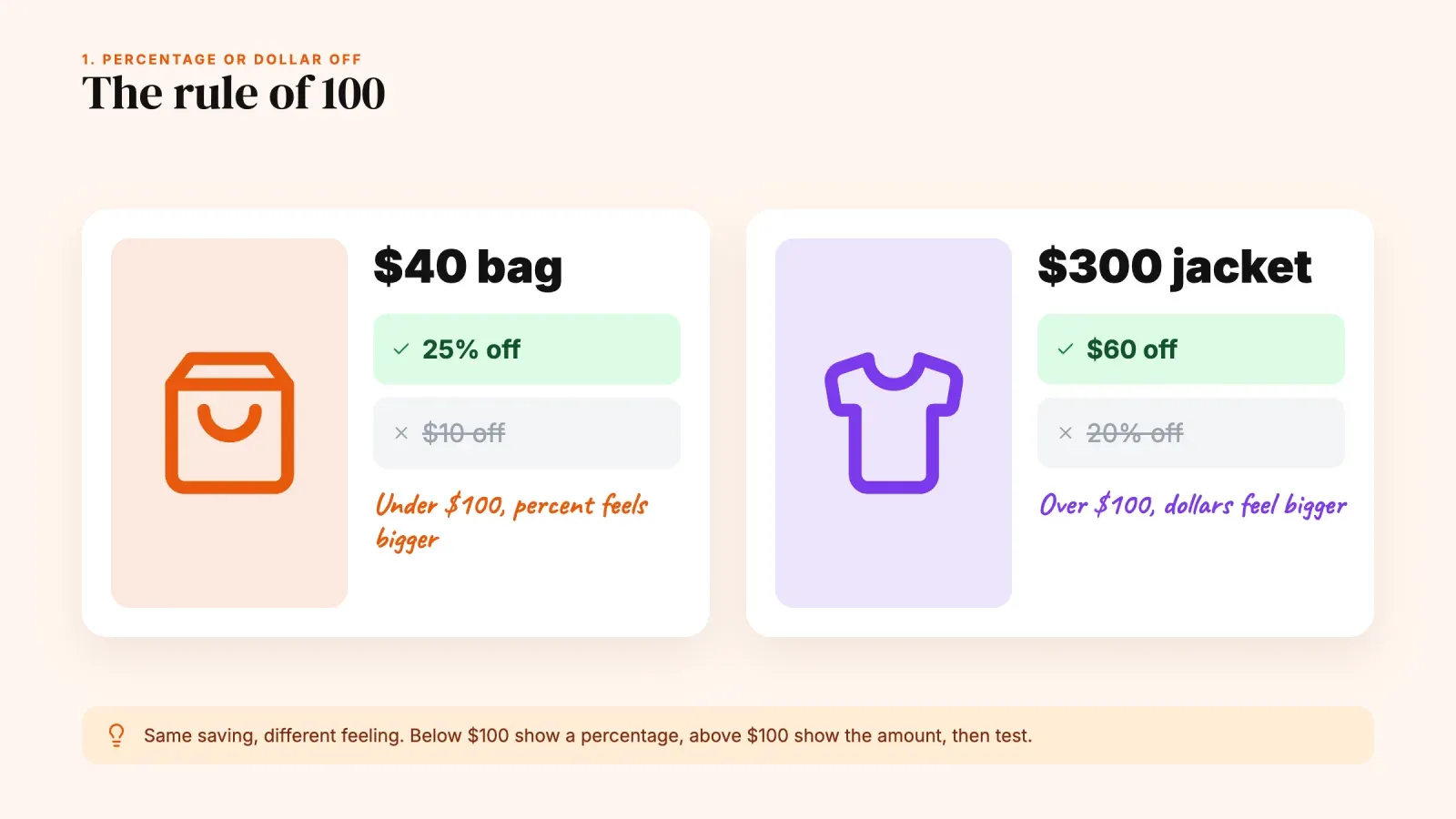
How to choose between percent and dollar. Behavioral research on pricing points to a simple rule of thumb, often called the rule of 100. Below $100, a percentage sounds bigger ("25% off a $40 bag" beats "$10 off"). Above $100, a dollar amount sounds bigger ("$60 off a $300 jacket" beats "20% off"). Test both, but start there.
When to use it. Clearing a specific product or category, celebrating an occasion, reacting to a slow week. Apply it to a defined scope rather than to the whole store when you can, so the discount works where you need it.
Watch out for. Store-wide discounts that run too often. If you run "20% off" every month, the discounted price becomes the real price in your customers' minds.
2. Buy one, get one (BOGO)
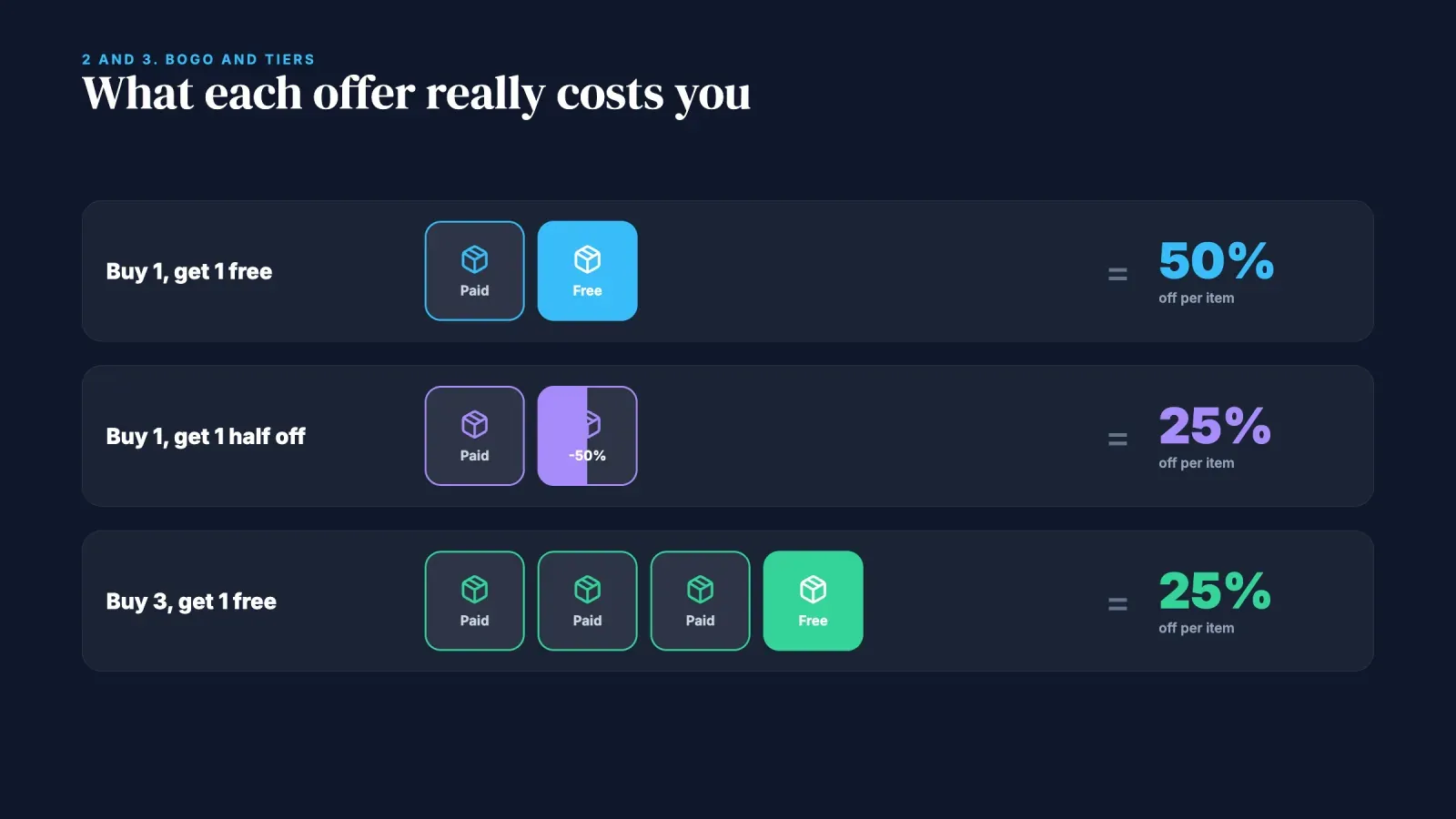
Buy one item, get a second one free or at a discount. "Buy one, get one free" works out to 50% off per item when someone buys two, which is expensive. Many stores use softer versions, like "buy one, get one 50% off", which is 25% off across both items.
When to use it. Consumable products people use up and rebuy, like coffee, skincare, socks or candles. Also useful to clear stock of a product you have too much of, or to get a new product into people's hands alongside one they already love.
Watch out for. BOGO on products people only need one of. Nobody wants two identical winter coats, and the promotion will feel irrelevant.
3. Tiered discounts (buy more, save more)
The more someone buys, the more they save. "Buy 2, save 10%. Buy 3, save 20%." Or "Spend $50, get $5 off. Spend $100, get $15 off." A variant is "Buy 3, get 1 free", which is a 25% discount if the customer takes all four.
When to use it. When your goal is a bigger basket rather than more customers. Tiered offers push people to add one more item to reach the next level. Set the first tier just above your current average order value, so many customers are close to it.
Watch out for. Tiers so high that nobody reaches them. If your average order is $35, a "spend $150" tier will be ignored.
4. Bundles
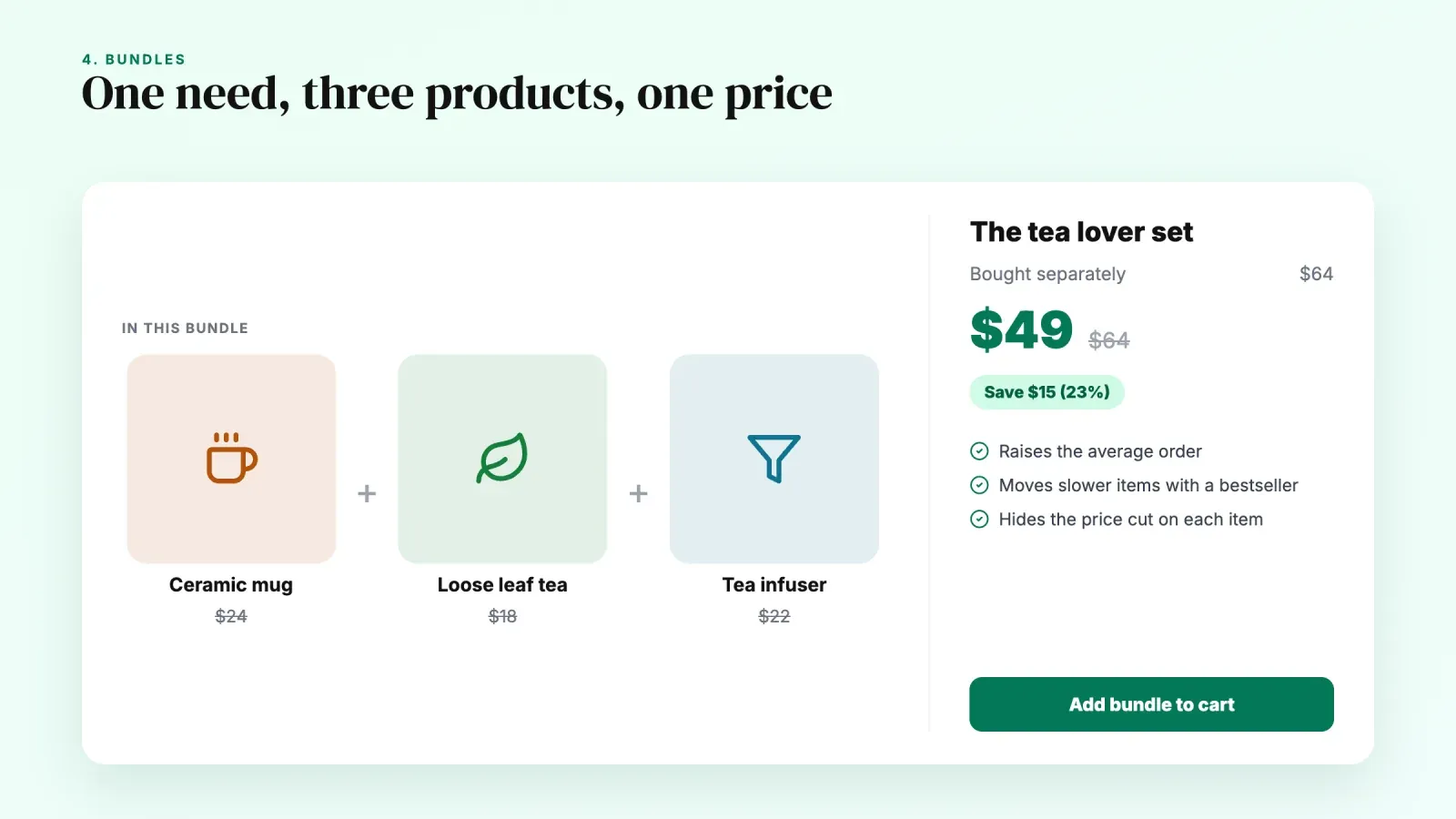
Group complementary products together at a lower price than buying them separately. A mug with a tea infuser, a camera strap with a lens cloth, a Notion template pack with a video tutorial. Our glossary entry on bundle pricing explains how to build them.
When to use it. Bundles raise average order value, help move slower products by pairing them with bestsellers and make great gifts. They also hide the individual price cut, which protects the perceived value of each item.
Watch out for. Bundles of products that don't belong together. A bundle should solve one need better than any single item.
5. Coupons and discount codes
A code people enter at checkout, like WELCOME10 or SUMMER20. Codes are the most flexible promotion, because you can give different codes to different audiences, track which channel brought each sale and limit use to one per customer. See our glossary entry on discount codes for the different types.
When to use it. Partnerships with creators and affiliates, ads, newsletters, packaging inserts and anywhere you want to measure what works. A code shared by a creator with their audience feels like an exclusive perk rather than a public discount.
Watch out for. Codes leaking to coupon websites. If anyone can find your code on Google, it stops being a targeted offer and becomes a store-wide discount. Use unique or limited codes for valuable offers.
6. Flash sales
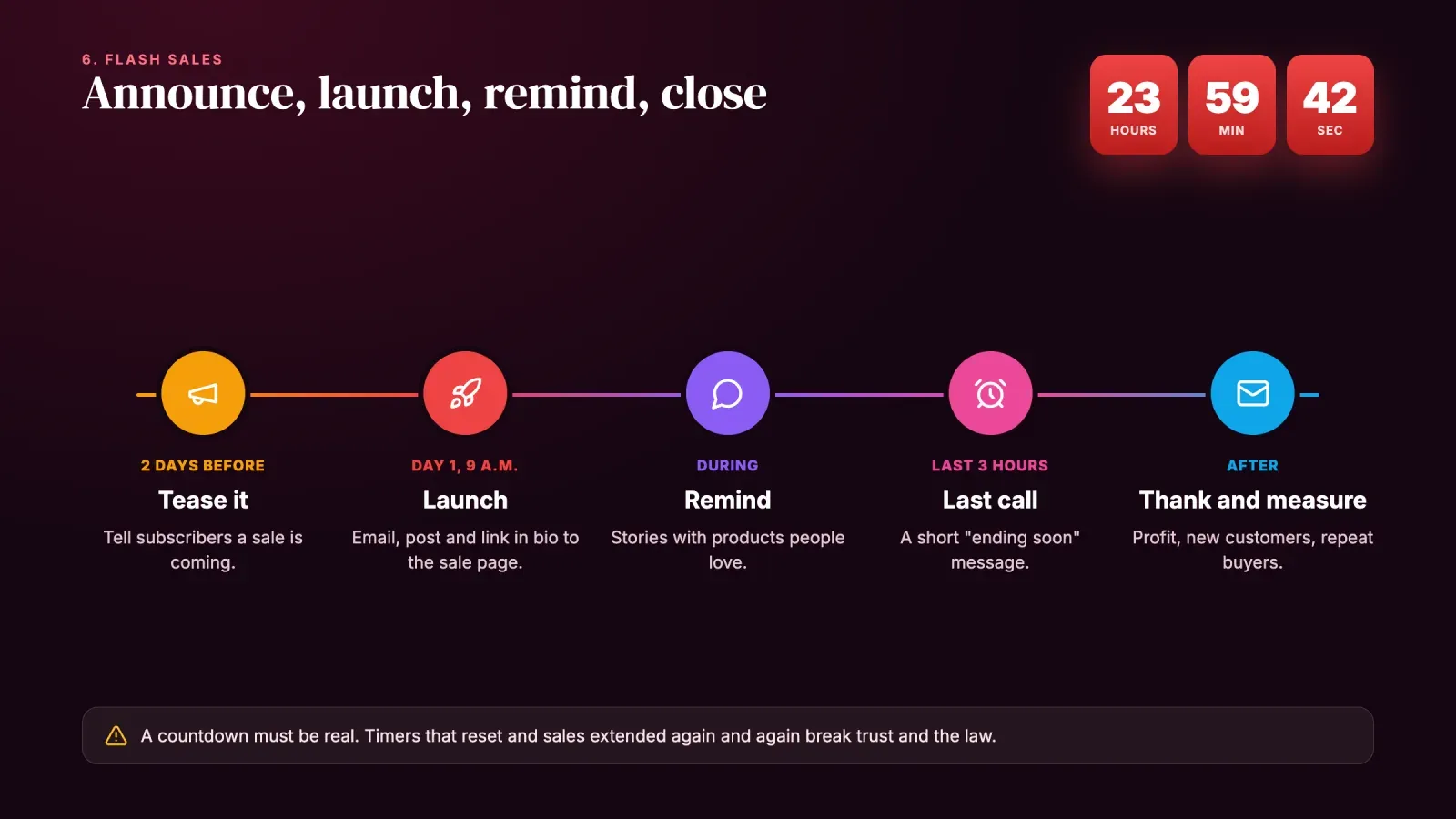
A big discount for a very short time, like 24 or 48 hours, or "this weekend only". The time pressure is what makes them work. People have less time to hesitate, compare or forget. Our glossary entry on flash sales covers the mechanics.
When to use it. Clearing seasonal stock, reactivating an email list, creating a moment around a launch or an anniversary. Announce it in advance to your subscribers, then send a reminder a few hours before the end.
Watch out for. Fake urgency. Countdown timers that reset when the page reloads, or "last day" sales that are extended three times, destroy trust and can break consumer protection rules.
Value-add promotions that protect your price
Value-add promotions give customers more without lowering your price. They're often cheaper than a discount for the same effect, because the perceived value of a gift is usually higher than what it costs you.
7. Free gift with purchase
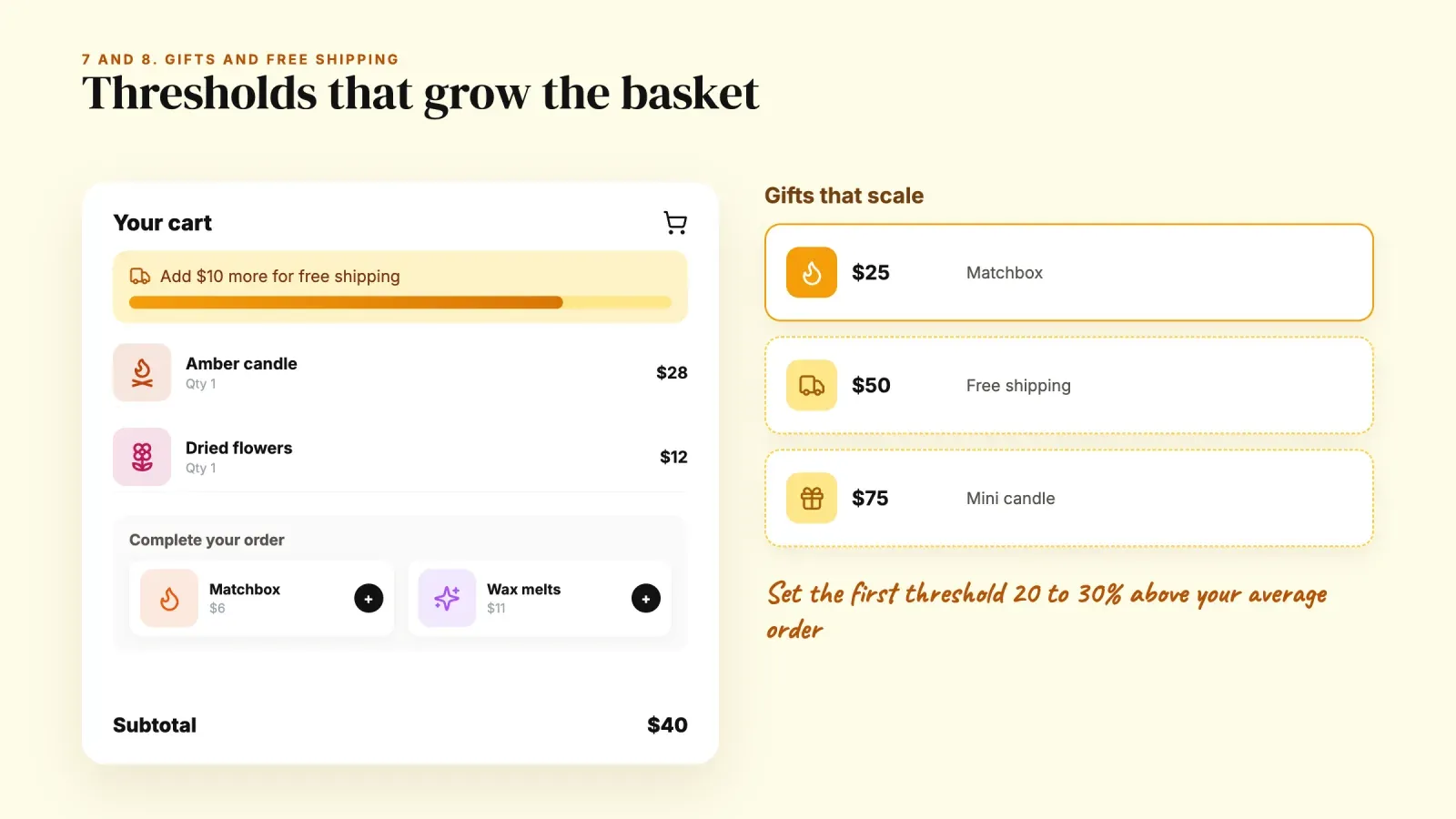
A free item added to the order, often above a spending threshold. "Free tote bag with any order over $60." Gifts can scale with spending, for example a bookmark at $25, a book light at $50 and a blanket at $75.
When to use it. Raising the average order with a threshold, introducing a new product as a sample, or using up stock of inexpensive items. Beauty brands use gifts with purchase constantly because a sample often leads to a full-size purchase later.
Watch out for. Gifts nobody wants. A useful gift related to your product line works. A random branded keyring doesn't.
8. Free shipping
Shipping costs are one of the most common reasons people abandon a cart. Removing them, even temporarily, can lift conversions more than a percentage discount of the same cost.
When to use it. Run free shipping as a limited-time promotion if you don't offer it all year, or use a threshold, "free shipping over $50", to raise the average order. Set the threshold about 20% to 30% above your current average order value so many customers add one more item to reach it.
Watch out for. Forgetting the real cost. Free shipping on heavy or bulky products can wipe out your margin. Run the numbers per order, not just per month.
9. Free samples and branded extras
Small free extras in every order. Samples of other products, a sticker sheet, a handwritten note, a mini version of a bestseller. They cost little and turn an ordinary delivery into a moment people share.
When to use it. Brands that rely on word of mouth and unboxing videos. A sample of a product the customer hasn't tried is also the cheapest way to sell it next time.
Watch out for. Inconsistency. If the extra appears in some orders and not others, customers who don't get it may feel cheated.
Loyalty and acquisition promotions that bring people back
These promotions are built for the long term. They cost less per sale than a store-wide discount because they target specific behaviors, like a second purchase or a recommendation.
10. Loyalty point boosts
If you run a loyalty program, you can promote it with temporary point boosts. "Double points on everything this week" or "500 bonus points on the new collection". Customers feel rewarded, and you don't lower your public prices.
When to use it. Slow periods, product launches you want to push to existing customers, or reactivating members who haven't bought in a while. Points also work well with a threshold, like 20% off once a member reaches 2,000 points.
Watch out for. Programs too complex to understand. If customers need a calculator to know what their points are worth, the boost won't motivate them.
11. Referral discounts
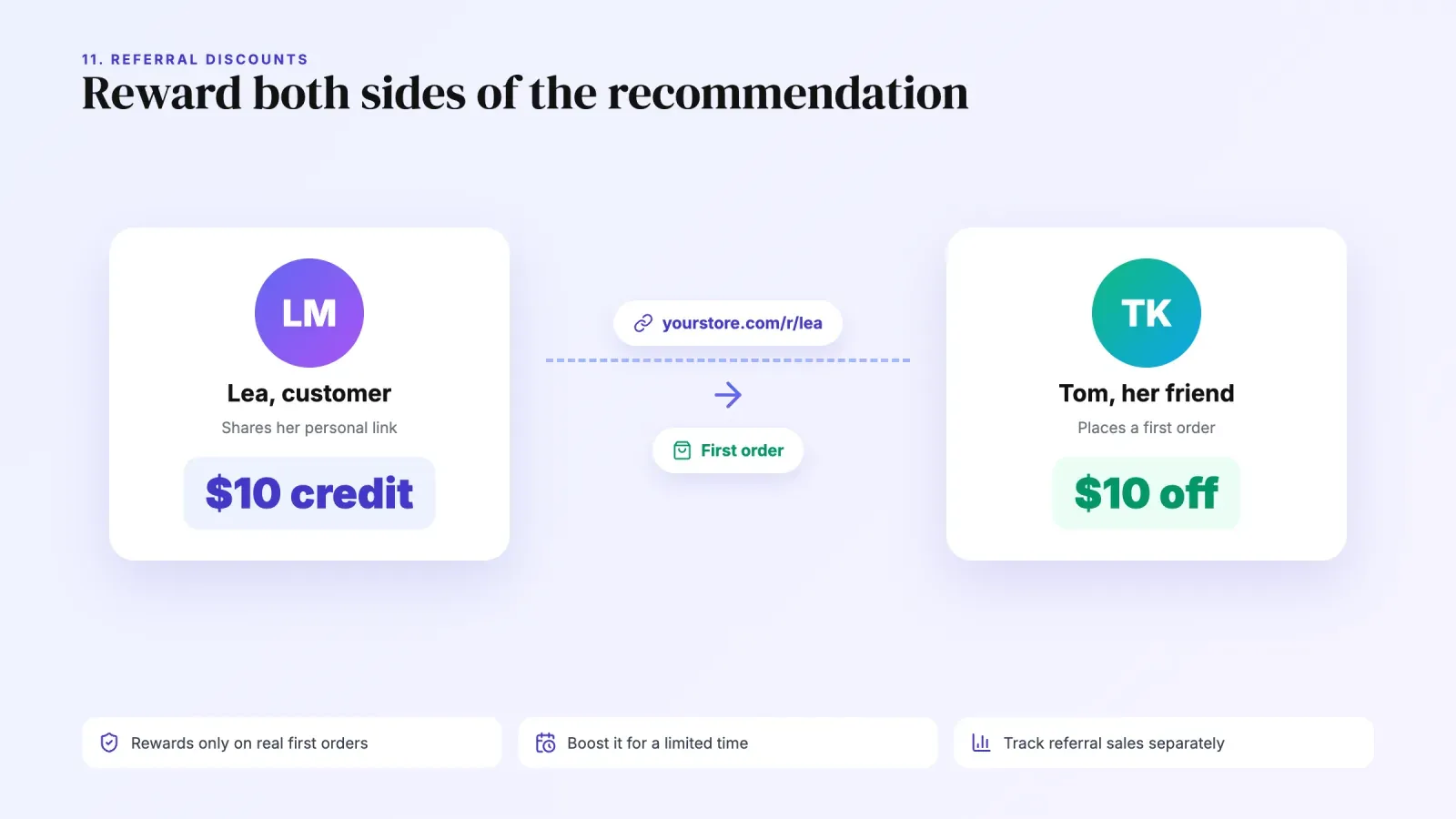
Reward customers who bring in new customers. The most effective programs are double-sided. The referrer gets a reward, like $10 credit, and the new customer gets one too, like $10 off their first order.
When to use it. When your customers already love your product and talk about it. Referral promotions turn that goodwill into measurable sales. A time-limited boost, "double referral rewards this month", gives your program a fresh push.
Watch out for. Rewards so small that nobody bothers, or so large that people create fake accounts to claim them. Limit rewards to real first orders.
12. Welcome offers for first-time buyers
A discount or gift for a first purchase, usually in exchange for an email address. "Join our list and get 10% off your first order." It's one of the most common promotions online because it does two jobs at once. It converts a hesitant visitor and it grows your email list.
When to use it. Always on, as a permanent part of your store. Deliver the code by email so people confirm their address, and follow up with a short welcome email sequence.
Watch out for. Offering the same discount to existing customers who simply sign up with another email. Limit the code to first orders.
13. Giveaways and contests
Give a prize to one or several winners. A giveaway is random among entrants. A contest asks people to do something, like post a photo with your product, and winners are chosen on merit or by vote.
When to use it. Growing a social following, collecting user-generated content, launching a product or celebrating a milestone. A prize related to your products attracts people who are likely to buy later. A generic prize like a phone attracts people who only want the phone.
Watch out for. Platform rules and the law. On Facebook, Meta doesn't allow you to require people to share on their timeline or tag friends to enter. In many countries, a giveaway can't require a purchase to enter, otherwise it becomes an illegal lottery. The section on legal rules below covers this in more detail.
Other promotions worth knowing
14. Rebates and cashback
The customer pays full price, then receives part of it back later, either automatically or after submitting a claim. Rebates are common in electronics, appliances and B2B sales, where volume rebates reward buyers who order a certain quantity over a year.
When to use it. High-ticket products, wholesale customers and situations where you want to protect the price shown at checkout. Cashback in store credit also brings customers back for a second purchase.
Watch out for. Complicated claim processes. They frustrate customers, and a rebate that feels like a trap damages your brand more than it helps.
15. Pre-order and early-bird pricing
A lower price for people who order before a product is available. "Pre-order now and save 20%, ships in March." It rewards your most enthusiastic customers, funds production and tells you how much stock to make. Our glossary entry on pre-orders covers the details.
When to use it. Product launches, new courses, limited editions, event tickets. Early-bird pricing with a firm deadline creates natural urgency without discounting forever.
Watch out for. Missed delivery dates. Communicate clearly and often, and offer a refund to anyone who doesn't want to wait.
16. Cause-related promotions
Donate a share of sales to a charity or cause. "10% of every order this week goes to the local food bank." The customer doesn't save money, but the cause gives them a reason to buy now.
When to use it. When the cause genuinely connects to your brand and your audience cares about it. Being specific helps, for example a named organization and a clear amount.
Watch out for. Vague promises. Say exactly how much goes where, and share the result afterwards. Customers and regulators both dislike cause marketing that can't be verified.
Types of sales promotions compared
Here is a quick comparison of the 16 promotion types by their main goal and the cost they put on your margin.
| Promotion | Best for | Margin impact |
| --- | --- | --- |
| Percentage or dollar off | Converting hesitant shoppers | High |
| BOGO | Consumables, clearing stock | High |
| Tiered discount | Bigger baskets | Medium |
| Bundle | Bigger baskets, gifts | Medium |
| Coupon code | Tracking channels and partners | Medium |
| Flash sale | Quick sales spike | High |
| Free gift with purchase | Bigger baskets, sampling | Low to medium |
| Free shipping | Fewer abandoned carts | Medium |
| Samples and extras | Word of mouth, next purchase | Low |
| Loyalty point boost | Repeat purchases | Low |
| Referral discount | New customers | Low to medium |
| Welcome offer | First purchase, email list | Medium |
| Giveaway or contest | Audience growth, content | Low |
| Rebate or cashback | High-ticket, B2B | Medium |
| Pre-order pricing | Launches, cash flow | Medium |
| Cause-related | Brand affinity | Low to medium |
How to choose the right type of promotion
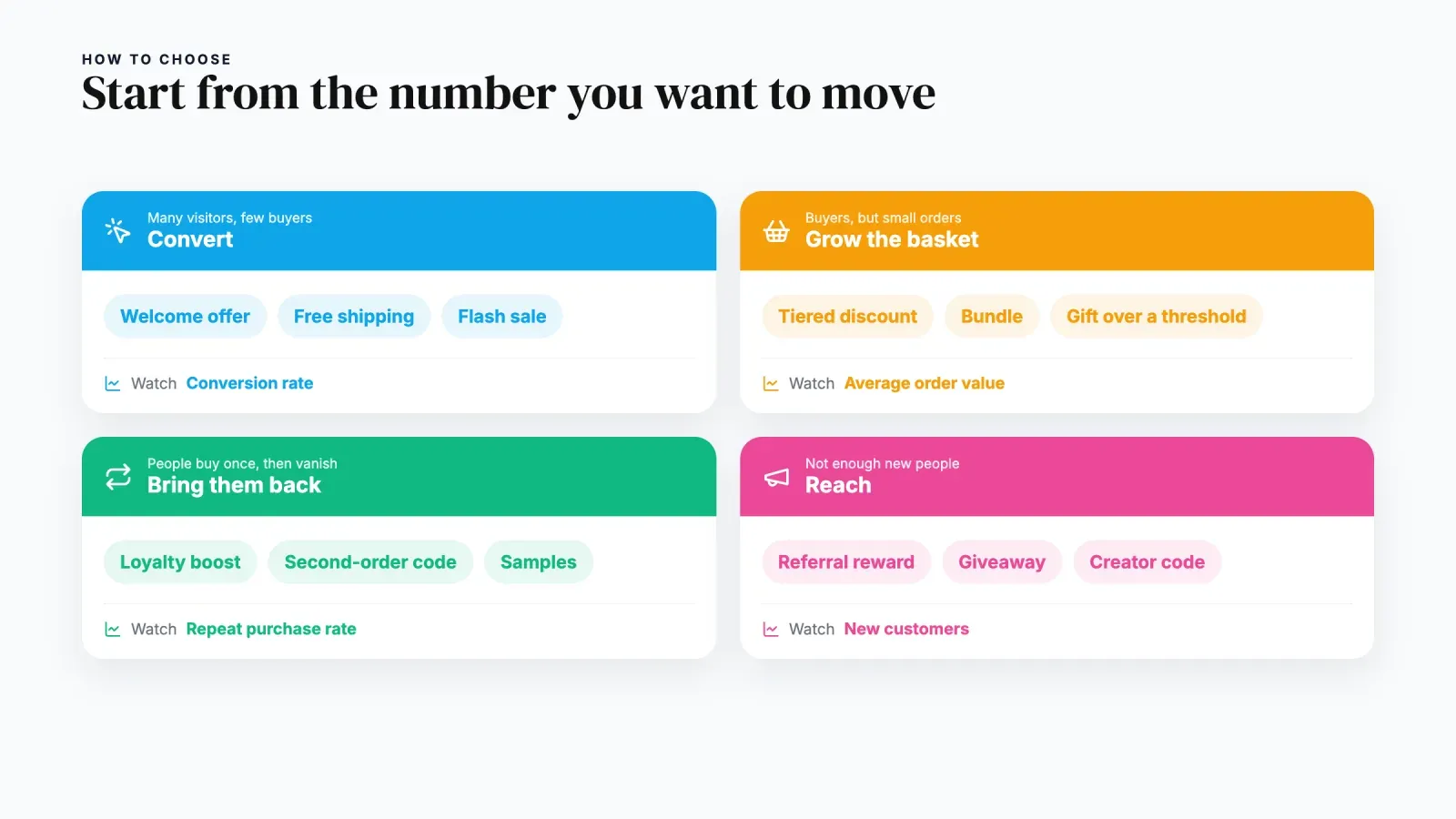
Start from the problem, not from the discount. Ask yourself which number you want to move, then pick the promotion built for it.
- Many visitors, few buyers? Try a welcome offer, free shipping or a short flash sale. Your problem is conversion.
- Plenty of buyers, small orders? Try a tiered discount, a bundle, a free gift above a threshold or a free shipping threshold. Your problem is basket size.
- Customers buy once and disappear? Try loyalty point boosts, a second-purchase coupon sent by email a few weeks after the first order, or samples of other products in each parcel. Your problem is retention.
- Not enough new people discovering you? Try referral rewards, a giveaway with a relevant prize or a creator partnership with a unique code. Your problem is reach.
- Too much stock of one product? Try BOGO, a bundle with a bestseller or a targeted dollar-off promotion on that item only.
- Launching something new? Try early-bird pricing, a free sample in existing orders or a gift with purchase.
Then decide on four details before launching. The scope, meaning which products are included. The duration, with a clear end date. The audience, everyone or a segment like your email subscribers. And the success metric, like conversion rate, average order value or new customers, so you can tell whether it worked.
The margin math behind every discount
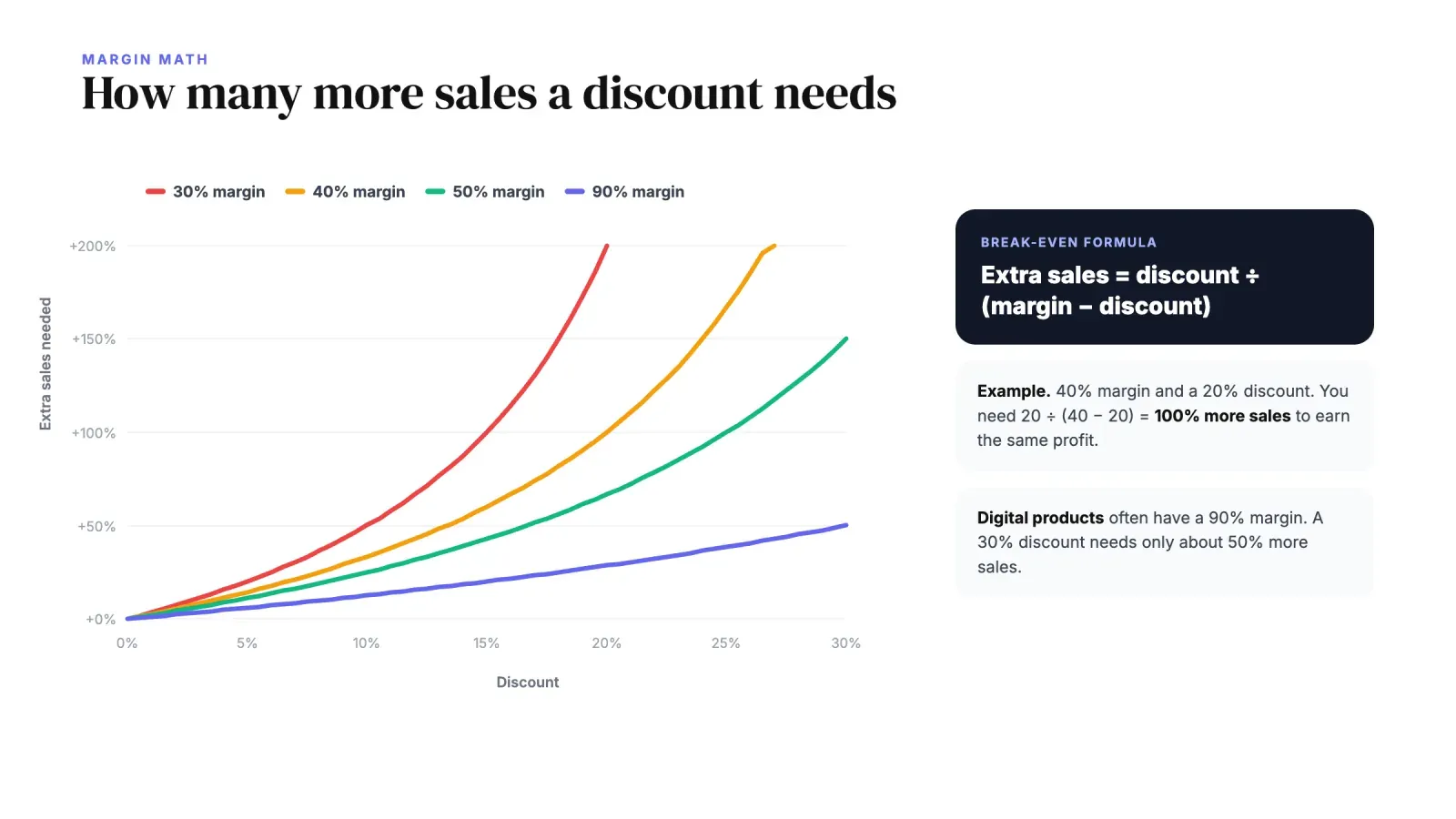
A discount always looks good on the revenue chart. The real question is whether it increases your profit. A simple formula tells you how many more units you need to sell to make the same profit after a discount.
Required sales increase = discount ÷ (gross margin − discount)
Here's an example. You sell a product at $50 with a 40% gross margin, so you make $20 per sale. You run a 20% discount. Your margin drops to 20%, or $10 per sale. To earn the same total profit, you now need to sell twice as many units. The formula gives 20 ÷ (40 − 20) = 100% more sales.
A few more cases show how quickly it adds up.
- 40% margin, 10% discount. You need 33% more sales.
- 50% margin, 20% discount. You need 67% more sales.
- 60% margin, 30% discount. You need 100% more sales.
- 30% margin, 20% discount. You need 200% more sales.
This is why value-add promotions are often smarter. A free gift that costs you $3 but feels worth $15 adds value without cutting your price. A threshold for free shipping raises the order size, which can pay for the shipping. And a promotion aimed at a specific segment, like lapsed customers, avoids giving discounts to people who would have bought anyway.
For digital products, the math is different. The cost of delivering one more copy is close to zero, so your margin is often above 90%. A 30% discount needs only about 50% more sales to break even. That's one reason flash sales and launch pricing work so well for templates, courses and ebooks.
Legal rules for sales promotions
Promotion rules vary by country. This section is general information, so check the rules where you sell or ask a professional.
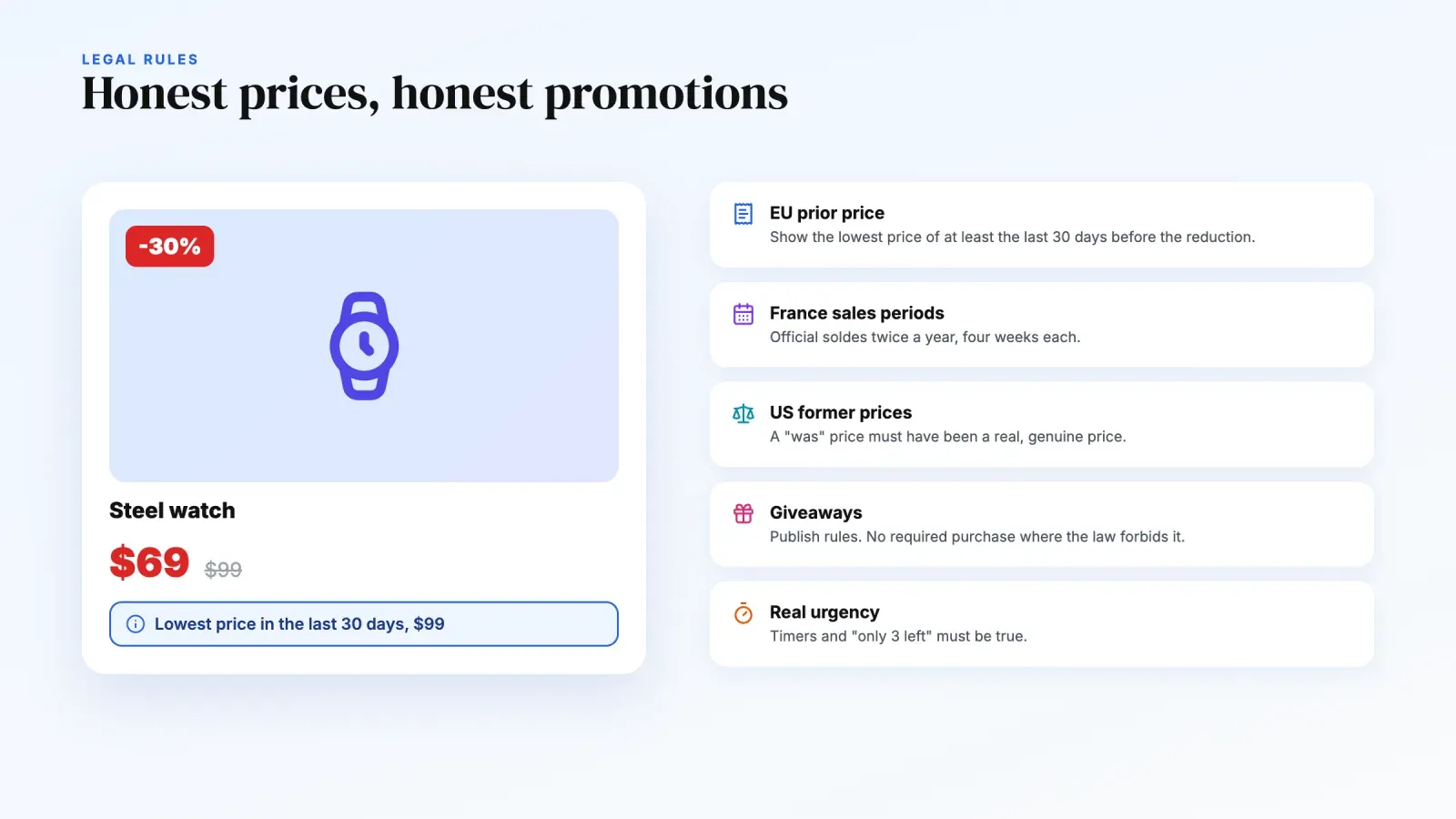
Reference prices in the European Union. Since May 2022, the Omnibus Directive requires stores that announce a price reduction to show the prior price, defined as the lowest price applied during at least the 30 days before the reduction. You can't raise a price the week before a sale to make the discount look bigger. France applies this rule in its consumer code.
Sales periods in France. The official "soldes" happen twice a year, in winter and summer, for four weeks each. During soldes, stores may sell at a loss on products they've had in stock for at least a month. Outside soldes, promotions are allowed, but reselling at a loss is generally prohibited.
Deceptive pricing in the United States. The Federal Trade Commission's guides on deceptive pricing say a "former price" used in a comparison must be a price at which the product was genuinely offered for a reasonable period. "Was $100, now $50" only works if $100 was a real price.
Giveaways and contests. In the US, a giveaway that requires a purchase and awards a prize by chance can be considered an illegal lottery, which is why sweepstakes say "no purchase necessary". Many EU countries have similar rules. Publish official rules with the dates, eligibility, prize and how winners are chosen.
Social media platform rules. Meta's rules for promotions on Facebook don't allow you to require people to share a post on their timeline or tag friends to enter. You must also state that the promotion isn't sponsored or endorsed by Meta. Instagram has similar guidelines. Asking people to like a post or comment is allowed.
Urgency claims. Countdown timers and "only 3 left" messages must be true. Fake urgency is treated as a misleading commercial practice in the EU and the US.
How to run promotions on social media
Most small brands and creators announce their promotions on Instagram, TikTok and Facebook. A few habits make the difference between a promotion that sells and one that only gets likes.
Send people to the right place. If your post says "20% off the summer collection", your link in bio should lead straight to that collection, with the discount already visible. Every extra tap loses buyers.
Use one code per channel. A code for Instagram, one for TikTok, one for your newsletter and one per creator partner. You'll know exactly where your sales come from.
Announce, remind, close. Tell your audience the promotion is coming, post on launch day, remind them in Stories during the promotion and post a "last hours" message before it ends.
Show the product, not just the percentage. A video of someone using the product with "20% off this week" in the caption sells better than a red graphic with a big number. The discount is the reason to buy now. The product is the reason to buy at all.
Collect emails while attention is high. People who visit during a promotion but don't buy are perfect subscribers. Offer them a reminder or an early access list for the next promotion.
Mistakes that make promotions backfire
Discounting too often. Frequent store-wide discounts teach customers that full price is for people who don't pay attention. They'll wait.
Discounting your best sellers. Products that sell well at full price rarely need a discount. Use promotions on products that need a push, or as a hook to sell them alongside bestsellers.
No end date. A promotion without a deadline is just a new price. Always set and respect an end date.
Ignoring the margin math. A 30% discount on a product with a 40% margin needs three times more sales to make the same profit. Run the formula before you launch.
Stacking too many offers. A discount code plus free shipping plus a gift plus loyalty points can make an order unprofitable. Decide which offers can combine.
Not measuring. Compare the promotion period with a normal period. Look at revenue, but also profit, new customers and repeat purchases in the following weeks.
FAQ about types of sales promotions
What are the main types of sales promotions?
The main types are price promotions like percentage off, BOGO, tiered discounts, bundles, coupons and flash sales. Value-add promotions include free gifts, free shipping and samples. Loyalty and acquisition promotions include point boosts, referral rewards, welcome offers and giveaways. Rebates, pre-order pricing and cause-related promotions complete the list.
Which sales promotion is the most effective?
It depends on your goal. For converting first-time visitors, a welcome offer or free shipping often works best. For increasing order value, tiered discounts and bundles are usually more effective. For repeat purchases, loyalty boosts and targeted coupons sent to past customers win. There's no single best promotion, only the best one for a specific problem.
How much discount should I offer?
Enough to change behavior, and no more than your margin allows. Many stores use 10% to 20% for welcome and code offers, and 25% to 40% for short flash sales or clearance. Use the break-even formula, discount ÷ (margin − discount), to check how many more sales you need.
What's the difference between a sales promotion and a discount?
A discount is one type of sales promotion, a lower price. Sales promotions also include offers that don't change the price, like free gifts, free shipping, loyalty points, giveaways and referral rewards.
How long should a sales promotion last?
Flash sales usually last 24 to 72 hours. Seasonal promotions often run one to two weeks. Welcome offers and loyalty programs can be permanent. Shorter promotions create more urgency, but they need enough time for your audience to see your announcement.
Are giveaways on Instagram and Facebook allowed?
Yes, as long as you follow the platform rules and local law. Publish official rules, don't require a purchase to enter where the law forbids it and, on Facebook, don't require people to share on their timeline or tag friends to enter.
Pick the promotion that fits the goal
The most popular types of sales promotions all work, but not for the same reason. Price promotions convert hesitant shoppers quickly but cost margin. Value-add promotions protect your price while raising order value. Loyalty, referral and welcome offers build the customer base that makes every future promotion more profitable. Choose based on the number you want to move, run the margin math, set an end date and measure the result.
Create your free Roctify page to sell your products from your link in bio, add discount codes and bundles, and send every promotion post to a page where people can buy in a few taps, with 0% transaction fees on every plan.