You have an audience that trusts your taste. People ask where your candles come from, which serum you use, what is in your gym bag. At some point, recommending other brands' products starts to feel like leaving money on the table. Private label is the most common way to fix that: a manufacturer makes the product, and you sell it under your own brand.
It is not a niche idea. In the United States, store brands reached a record $282.8 billion in sales in 2025, or 21.3% of every dollar spent in stores tracked by PLMA and Circana. In Europe, private label represents about 38% of grocery sales. The supermarkets proved the model decades ago. What changed is that creators, coaches and small online shops can now use it too, with first orders in the hundreds of units instead of the hundreds of thousands.
This guide explains what private label really is, how it compares with white label, dropshipping and print on demand, what it costs to launch with a full worked budget, and the nine steps from idea to reorder. You will also find the mistakes that sink most first launches, and how to sell your product directly to the people who already follow you.
What is private label?
A private label product is made by a third-party manufacturer and sold exclusively under the retailer's brand. The manufacturer produces it, often to your specifications. You own the name, the packaging, the price, the marketing and the customer relationship. The customer sees your brand and never the factory's.
Three things define real private label:
- Exclusivity. The product, or at least its formula, design or combination of features, is made for you only. Another seller cannot buy the same item from the same catalog.
- Customization. You decide the specifications, from the scent of a candle to the fabric weight of a hoodie, the size of a bottle or the color of a zipper.
- Ownership of the brand. The value you build over time belongs to you. If you change manufacturer, the brand, the reviews and the customers come with you.
You already know many private label products. Costco's Kirkland Signature, Amazon Basics and most supermarket own brands are made by external manufacturers. Many direct-to-consumer brands started the same way: the founders designed the product, found a factory that could make it, and focused their own energy on brand and distribution.
For a creator, private label usually looks like this. A home-decor creator develops a signature candle scent with a candle maker. A fitness coach launches a protein powder with a custom flavor and her own sourcing standards. A travel creator designs a packing cube set with the features her followers asked for in the comments. The factory does what it does best, manufacturing, while the creator does what she does best, knowing exactly what her audience wants.
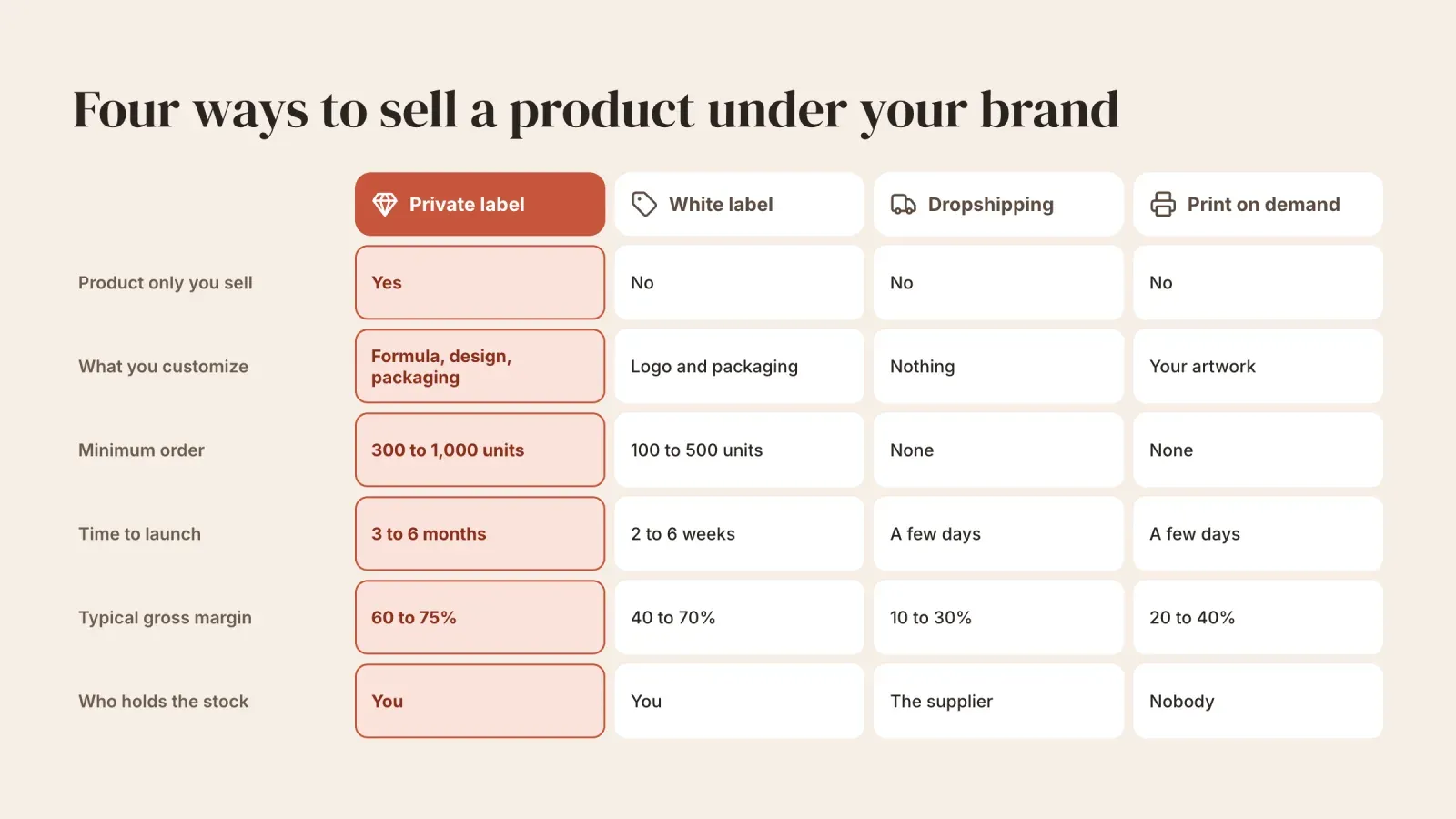
Private label vs white label, dropshipping and print on demand
These terms are often mixed up, but they describe very different levels of control, cost and risk.
White label is a ready-made generic product that the manufacturer sells to many brands. You add your logo and packaging, but the product itself is identical to what other sellers offer. It is fast and cheap to launch, and just as easy for a competitor to copy. Our white label glossary entry goes deeper into that model.
Private label is made for you, often to your specifications, and not sold to anyone else in that form. It takes longer and costs more to start, but it is the only one of these models that builds a product nobody can buy elsewhere.
Dropshipping describes logistics more than branding. You sell a supplier's product without holding stock, and the supplier ships each order. Products are usually generic, delivery is slower, and margins are thin because you compete on the same items as hundreds of other stores.
Print on demand is a form of dropshipping where a blank product, such as a t-shirt or a mug, is printed with your design after each order. There is no stock and no minimum order, but the product itself is not differentiated, and unit costs are high.
A simple way to choose: if you want to test whether your audience buys anything at all, start with print on demand or white label. If you already know they will buy and you want a product that is truly yours, with better margins, private label is the next step. Many brands move through all three, starting with merch, adding a white label product, and launching a private label line once they have proof of demand.
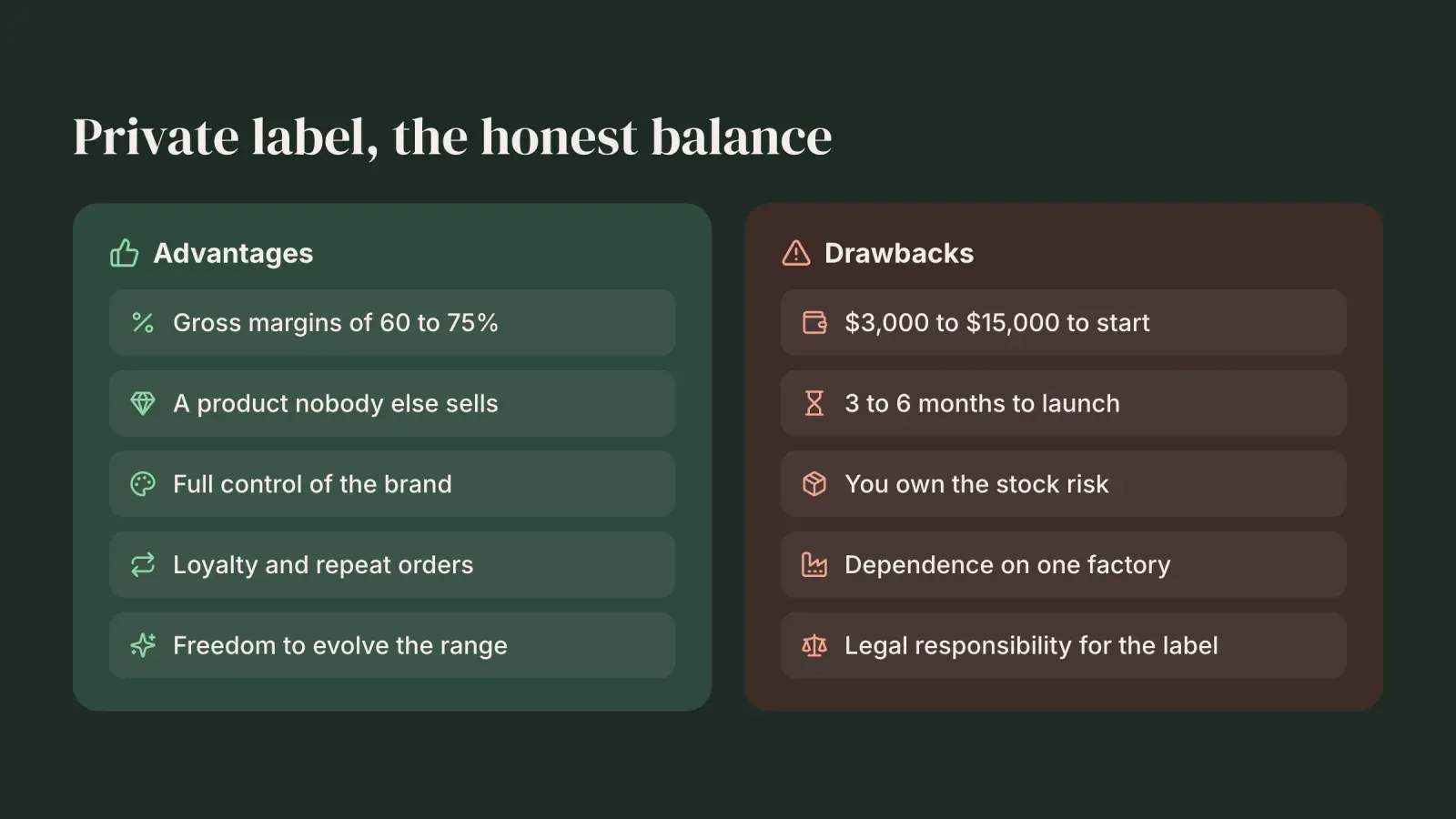
Pros and cons of private label
Private label is attractive, but it asks for cash, time and patience. Here is the honest balance.
The advantages
- Better margins. You buy directly from the manufacturer, without wholesalers or distributors in between. Gross margins of 60% to 75% on the product are common in categories like candles, cosmetics and accessories. That leaves room for shipping, ads and a real profit.
- A product nobody else sells. Your customers cannot find the same item cheaper on another store. Price comparison disappears, and you compete on brand and trust instead.
- Full control of the brand. You choose the name, the design, the packaging, the unboxing experience, the story and the price. Everything reinforces your personal brand instead of someone else's.
- Loyalty and repeat purchases. A consumable product people like, such as a serum, a coffee blend or a candle, gets reordered. Each repeat order costs far less to acquire than the first one.
- Freedom to evolve. You can adjust a formula, add a size, launch a seasonal edition or a bundle based on what your audience tells you.
The drawbacks
- Upfront cost. You pay for samples, design, compliance and a first production run before you sell a single unit. Budgets of $3,000 to $15,000 are typical for a first launch.
- Time to market. From the first sample request to delivery of a first order usually takes three to six months. Generic products can be online in a week.
- Inventory risk. You own the stock. If it does not sell, the cash stays on your shelves. If it sells too well, you can run out for weeks.
- Supplier dependence. One factory, one point of failure. Quality drift, delays or price increases hit you directly.
- Legal responsibility. Your name is on the label, so you are responsible for compliance, safety and claims, even if someone else made the product.
None of these drawbacks is a reason to avoid private label. They are reasons to validate demand first, start small and plan cash carefully, which is exactly what the steps below are built for.
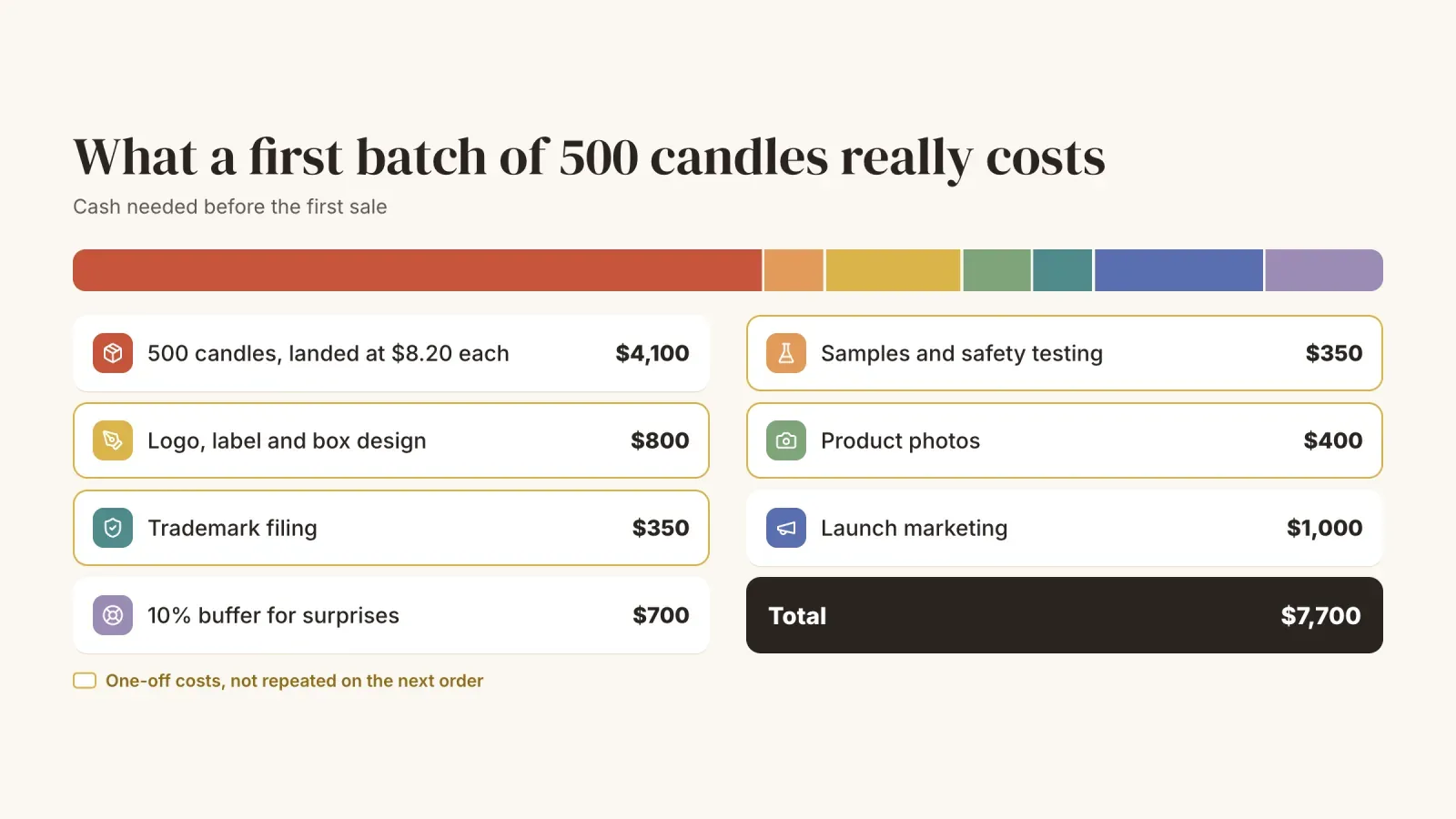
How much does it cost to launch a private label product?
Costs vary enormously by category, but the structure is always the same: one-off launch costs, the first production order, and the marketing to sell it. Here is a realistic example for a creator launching a scented soy candle with a custom fragrance and branded box.
First order of 500 candles
- Product and packaging. $6.20 per candle from the manufacturer, including the custom fragrance and label, plus $1.10 for a printed box. With $0.90 per unit for freight and duties, the landed cost is $8.20 per candle, or $4,100 for 500 units.
- Samples and testing. Three rounds of samples, plus safety testing of the fragrance, around $350.
- Brand design. Logo, label, box artwork and a short brand guide from a freelance designer, around $800.
- Product photos. A half-day shoot with lifestyle and white background shots, around $400.
- Trademark filing. About $350 for one class at the US Patent and Trademark Office.
- Launch marketing. Creator seeding, a few paid posts and a small ad budget, around $1,000.
- Buffer. Around 10%, or $700, for the surprises that always happen: a reprint, a delayed shipment, a broken pallet.
That is roughly $7,700 in cash before the first sale. Some categories are cheaper: jewelry or accessories can start at $2,000 to $3,000 with low minimums. Others are more expensive: supplements and cosmetics often need $10,000 to $20,000 because of higher minimum order quantities and mandatory testing.
The one-off costs, here about $1,900 for samples, design, photos and the trademark, do not come back with the second order. This is why the first batch is the hardest to make profitable and why the second one is where private label starts paying off. Step 5 shows the full unit economics for this candle.
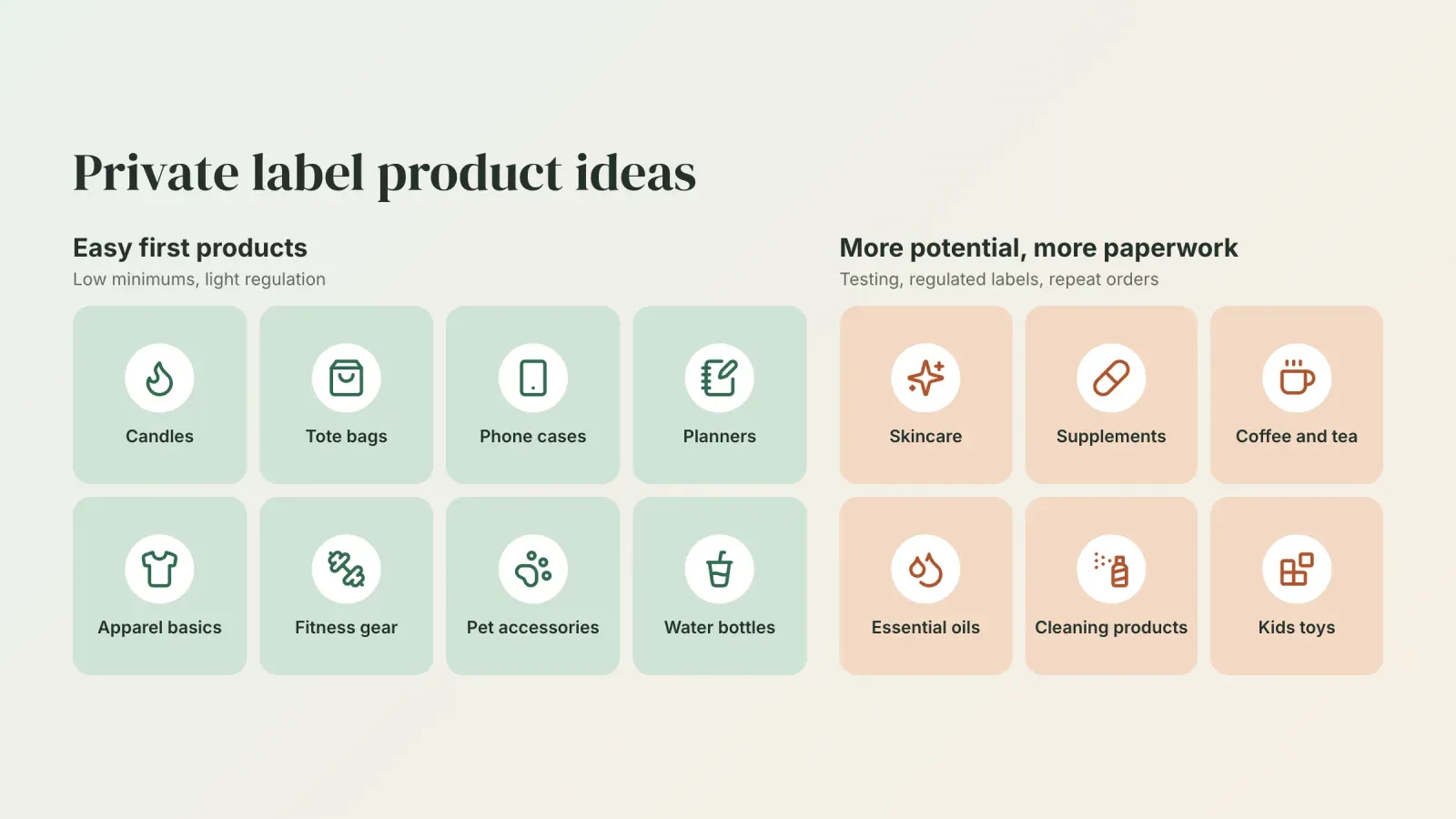
Private label product ideas that work for small brands
The best private label products share four traits: they are light and easy to ship, they are not fragile or heavily regulated, they can be differentiated with design or a small formula change, and ideally they are consumed and reordered.
Easy first products, low minimums and light regulation
- Scented candles and room sprays
- Tote bags, pouches and packing cubes
- Phone cases, cable organizers and desk accessories
- Notebooks, planners and stationery
- Hats, socks and simple apparel basics
- Yoga mats, resistance bands and fitness accessories
- Pet accessories such as leashes, bandanas and toys
- Reusable water bottles and coffee cups
Higher potential, more paperwork
- Skincare, haircare and body care
- Supplements, protein powders and teas
- Coffee, spices and packaged snacks
- Essential oils and diffuser blends
- Household cleaning products
- Children's toys, which have strict safety standards
The second list often has better margins and much stronger repeat purchases, but it requires testing, regulated labels and sometimes a responsible person registered in the market where you sell. If this is your first launch, start with the first list unless you have experience in the category.
The best product is not the one with the highest margin on paper. It is the one your audience already asks you about. If your comments are full of "what candle is that?" or "link to your bag?", that is your starting point.
1. Choose a niche you can actually reach
Most guides tell you to look for a high-demand, low-competition niche. That is half the answer. For a creator or a small brand, the better question is: which product can I sell to people who already follow me, and then to people like them?
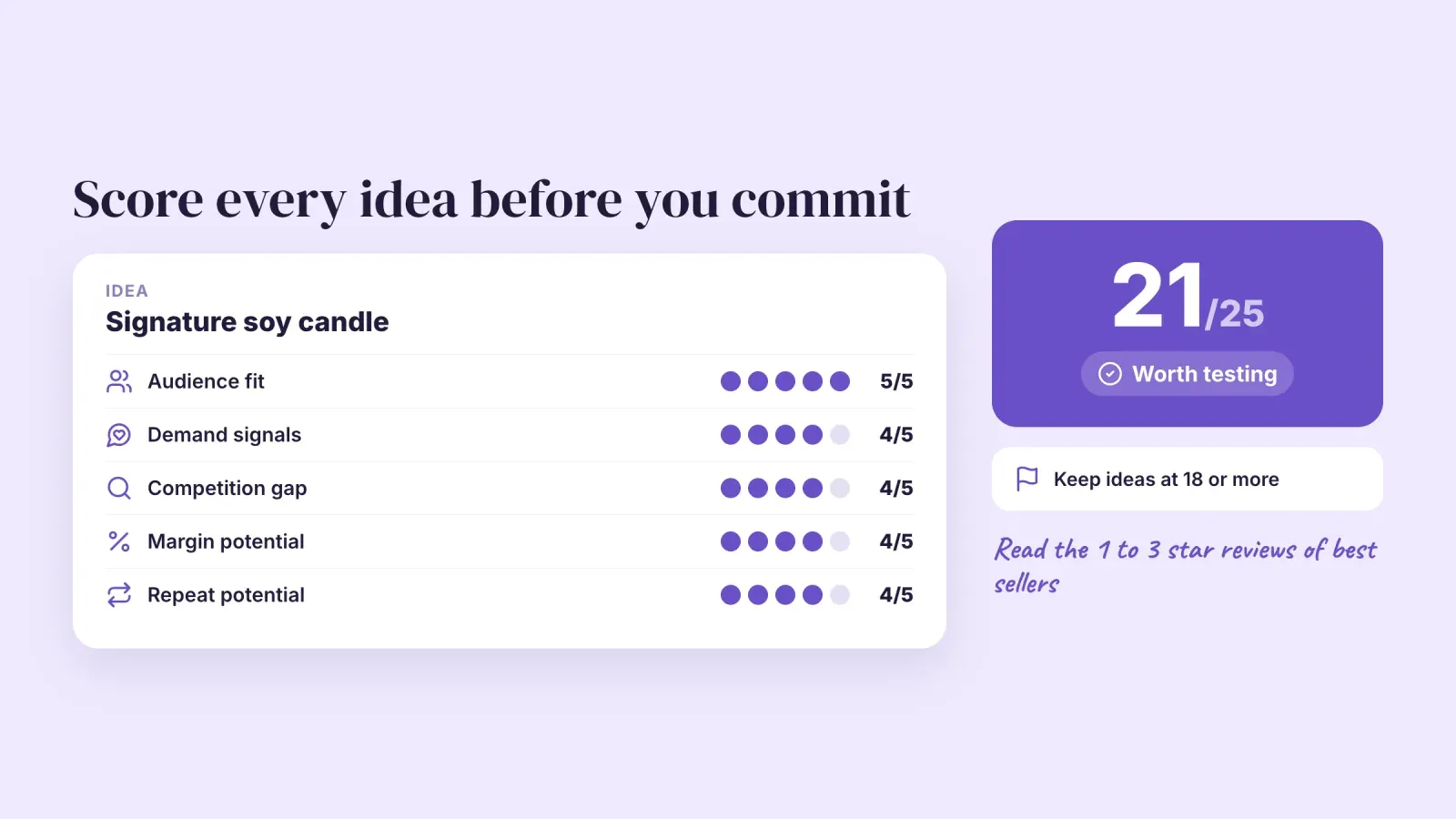
Score every idea against five criteria, from 1 to 5:
- Audience fit. Does it match what you already talk about? A coffee creator selling coffee scores 5. The same creator selling phone cases scores 1.
- Demand signals. Do people already ask about it in comments, DMs or polls? Are searches stable or growing in Google Trends over two to five years, not just a spike?
- Competition gap. Read the one, two and three star reviews of the best sellers on Amazon. Repeated complaints, such as "the scent fades after an hour" or "the zipper broke", are product specifications waiting to be written.
- Margin potential. Can you sell at three to four times the landed cost? If the market price is $15 and the landed cost is $9, there is no room for shipping and marketing.
- Repeat potential. Will a happy customer buy again within three months?
Keep ideas that score 18 or more out of 25. If several remain, choose the one with the strongest audience fit. A product you can talk about with genuine expertise will always sell more easily than a product that only looks good in a spreadsheet.
Being specific helps. "Skincare" is too wide. "A fragrance-free body oil for runners who shower twice a day" is narrow enough to be remembered and wide enough to sell thousands of units. The glossary entry on niching down explains why narrow beats broad for small brands.
2. Validate demand before you pay a factory
The most expensive mistake in private label is ordering 1,000 units of a product nobody asked for. Validation is cheap, and it should happen before you sign anything.
Here are five ways to validate, from fastest to strongest:
- Ask. Run a poll in Stories or a question box: "If I made a candle with this scent, would you buy it?" It measures interest, not intent, so treat the result as a first signal only.
- Show. Post a mockup or a first sample and watch saves, shares and replies, not just likes. Saves and DMs show stronger intent than a double tap.
- Collect emails. Create a waitlist page and send people to it from your link in bio. A waitlist of 300 to 500 people for a first order of 500 units is a healthy sign. Typically 10% to 30% of a warm waitlist buys at launch.
- Take deposits or pre-orders. The strongest signal is money. A pre-order campaign at a small launch discount proves demand and finances part of the first batch.
- Test a generic version. Sell a white label or print on demand version for a few weeks. If it sells, your private label version, which is better, will sell too.
Write down your success threshold before you start, for example "200 waitlist signups in 30 days" or "80 pre-orders in two weeks." Without a number decided in advance, every result looks encouraging.
3. Find and vet manufacturers
Once demand is validated, look for a manufacturer that can make your product at the quality, quantity and price you need.
Where to look
- Online sourcing platforms. Alibaba, Made-in-China and Global Sources for Asian factories. Filter for verified manufacturers, years in business and trade assurance.
- Domestic and European directories. Europages, Kompass, Thomasnet in the US and industry associations list manufacturers closer to home, with shorter lead times and simpler shipping.
- Trade shows. The PLMA trade shows in Chicago and Amsterdam are dedicated to private label. Category fairs, such as cosmetics or home decor shows, are also full of manufacturers looking for new brands.
- Specialized contract manufacturers. For cosmetics, supplements or food, look for contract labs that offer formulation, filling and regulatory support in one place.
- Packaging and brand clues. Some product labels mention the manufacturer. Industry forums and other founders are also an underrated source of introductions.
How to vet them
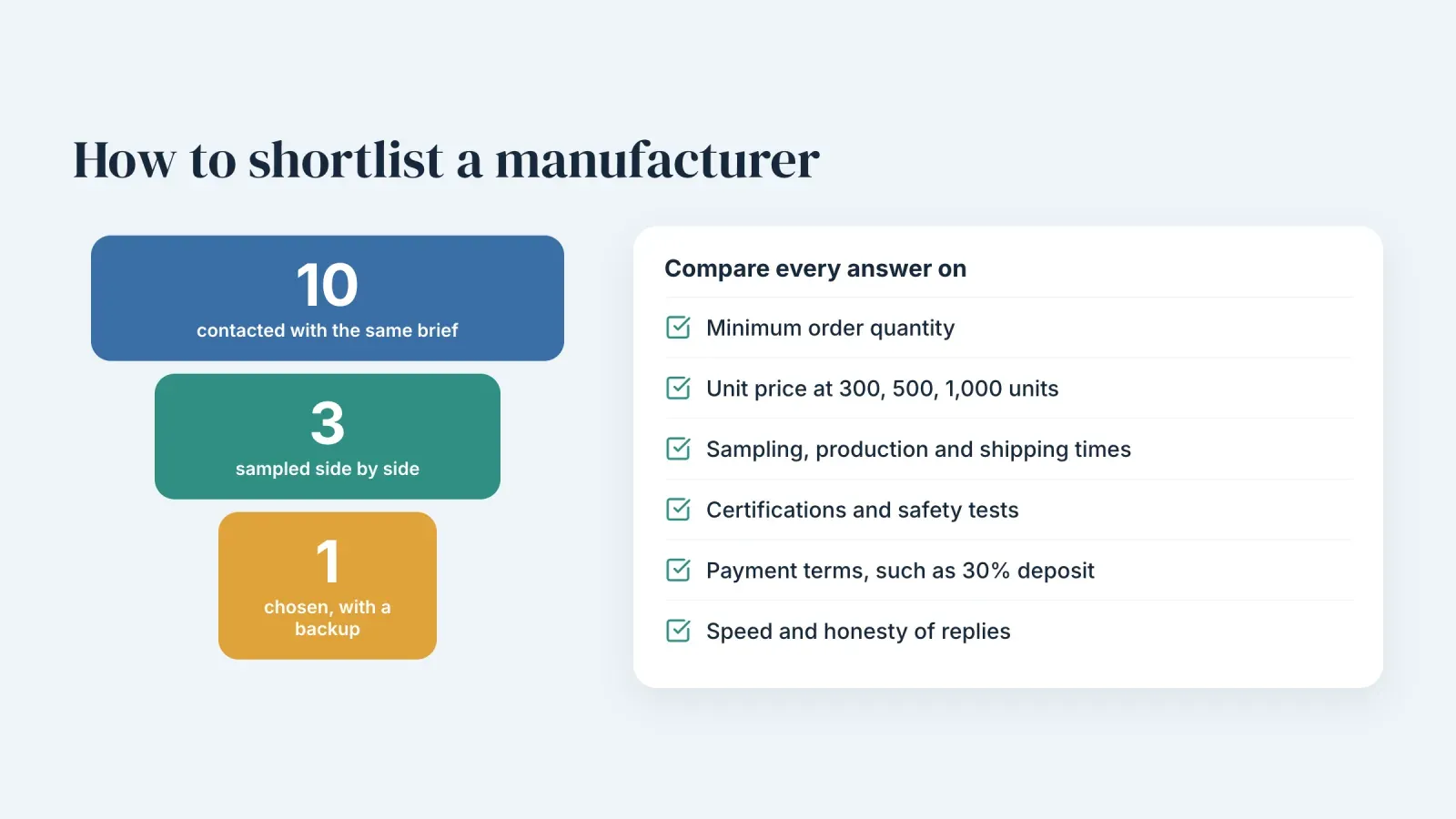
Contact at least five to ten manufacturers with the same short brief: product description, target quantity, target price, timeline and the markets where you will sell. Then compare their answers on:
- Minimum order quantity (MOQ). Ask whether a lower first order is possible at a higher unit price. Many factories accept it for a promising brand.
- Unit price at different quantities. Ask for 300, 500, 1,000 and 3,000 units to see how price falls with volume.
- Lead times. Sampling, production, and shipping, separately.
- Certifications and testing. ISO, GMP for cosmetics and supplements, and safety tests for the markets you target.
- Payment terms. A common structure is 30% deposit and 70% before shipping. Avoid paying 100% upfront to a new supplier.
- Communication. Speed, clarity and honesty in the first emails are the best predictors of how the relationship will go when something goes wrong.
Shortlist three, order samples from all of them, and never choose on price alone.
4. Order samples and lock the specifications
Samples are where your product becomes real. Plan two to three rounds, and treat each one seriously.
Test each sample the way your customers will use it. Burn the candle for its full duration. Wash the hoodie ten times. Use the serum for two weeks. Drop the bottle from your counter. Then give a few samples to trusted followers and ask specific questions: what would you change, what would you pay, would you buy it again?
When a sample is right, turn it into a specification sheet: materials, dimensions, weight, colors with Pantone references, formula or ingredient list, packaging, labeling, tolerances and quality checks. Ask the manufacturer to sign and keep a golden sample, an approved reference unit, on both sides. If a production batch differs from it, you have a clear basis to refuse it.
Do not skip this step to save three weeks. Most quality disputes in private label come from specifications that were never written down.
5. Price from your unit economics, not from competitors
Many first-time brands copy a competitor's price and discover later that they lose money on every order. Start from your own numbers.
Landed cost is what one unit costs you once it reaches your shelf: product, packaging, freight, duties and insurance. It is the private label equivalent of cost of goods sold.
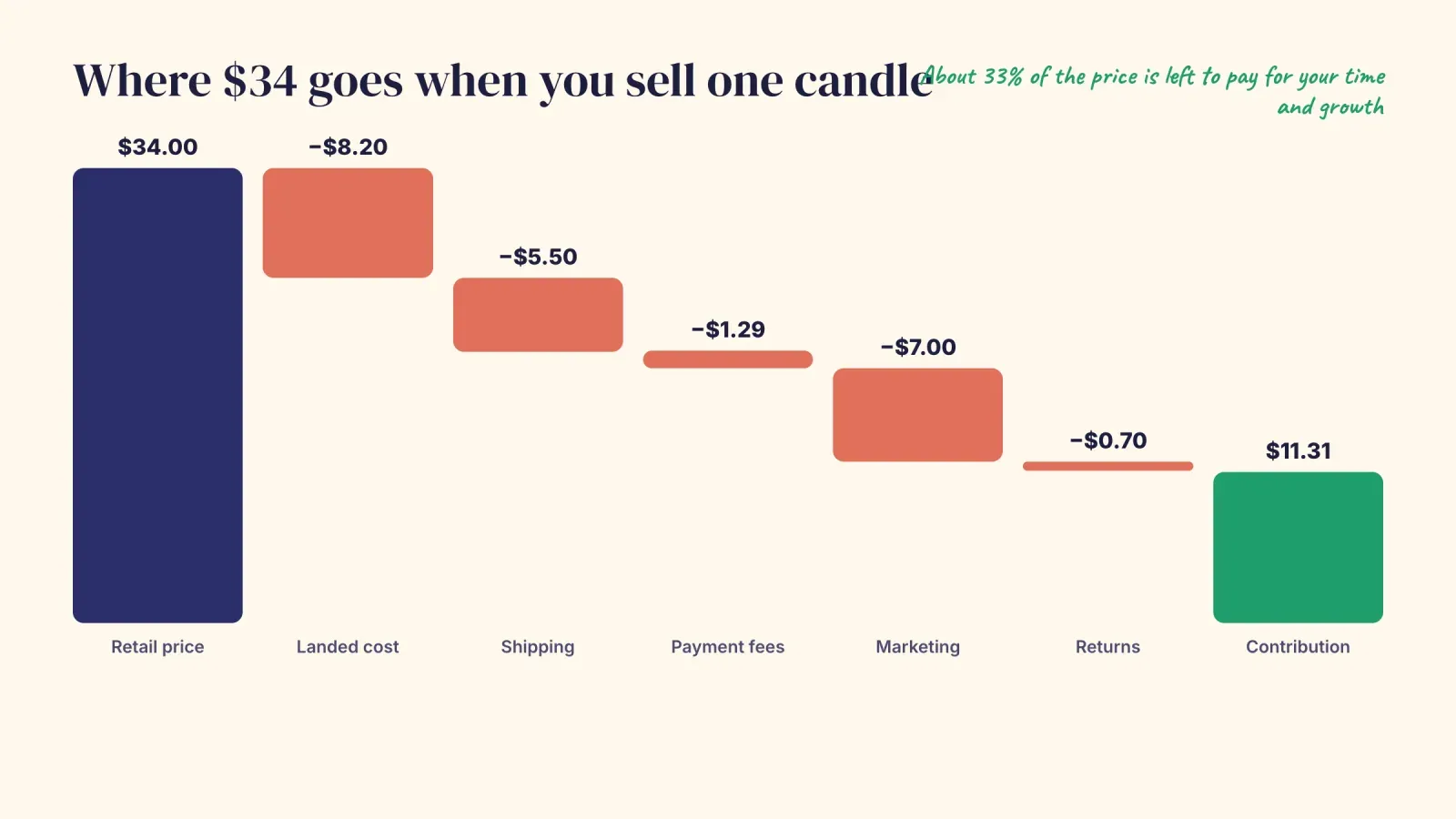
Then add every cost that comes with each order. For the candle from the budget above, sold at $34:
- Landed cost. $8.20
- Fulfillment and shipping, after what the customer pays for delivery. $5.50
- Payment fees, around 2.9% plus 30 cents. $1.29
- Marketing per order, a blended average of ads, creator seeding and discounts. $7.00
- Returns and breakage allowance. $0.70
That leaves $11.31 of contribution per candle, or about 33% of the price. The gross margin on the product alone is 76%, which looks impressive, but the contribution is the number that pays for your time and your growth.
If all 500 candles sell, the first batch generates about $5,655 of contribution. After the $1,900 of one-off launch costs, that is roughly $3,755 of profit, before the second order, which no longer carries those one-off costs.
Three rules help:
- Aim for a retail price of at least three to four times the landed cost for products sold online with paid acquisition.
- Know your break-even marketing cost: here, you can spend up to $18.31 per order on marketing before losing money.
- Plan bundles. Two candles at $60 raise the average order value and lower the shipping and marketing cost per unit.
6. Build the brand, packaging and compliance
Your manufacturer makes the product. Your brand makes people choose it.
The brand
Start from the audience, not the logo. Who is it for, what do they care about, and why does this product exist? Write a one-sentence promise, choose a name that is short and easy to spell, and check that the domain name and social handles are available.
Then file a trademark for the name in the countries where you will sell: the USPTO in the US, the EUIPO for the whole European Union, or national offices like the INPI in France. Do it before you print 500 boxes with a name you might have to abandon. Amazon Brand Registry also requires a registered or pending trademark.
The packaging
Packaging is your first product photo, your first unboxing video and your shelf presence in one. A good brief to a designer covers the brand promise, the target customer, three competitors to stand out from, the format and the mandatory information.
The label and compliance
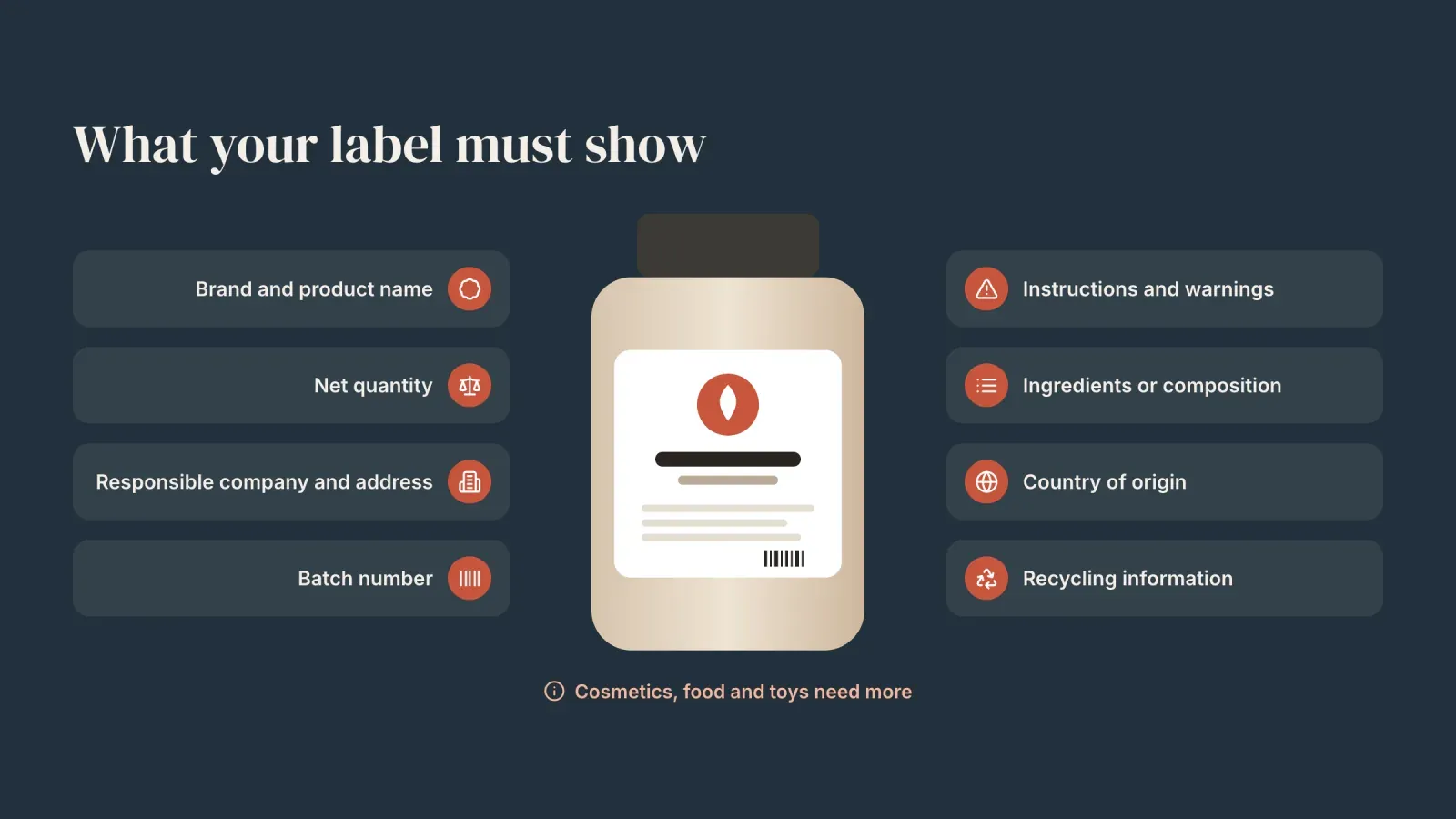
Because your name is on the product, you are legally responsible for it. Requirements depend on the category and the market, but most products need:
- The brand name and the product name
- The quantity or net content
- The name and address of the responsible company
- A batch number for traceability
- Instructions, warnings and safety information where relevant
- Ingredients, materials or composition
- The country of origin where required
- Recycling information where required
Some categories go further. In the European Union, cosmetics need a responsible person, a safety assessment, a product information file and a notification in the CPNP portal before they are sold. In the US, cosmetic brands must register facilities and list products with the FDA under MoCRA. Since December 2024, the EU General Product Safety Regulation also requires an economic operator established in the EU for most consumer products sold there. Food and supplements have their own rules on nutrition labels and claims.
If you are in a regulated category, budget for a specialist review. It costs far less than a product recall.
7. Choose where to sell
Where you sell shapes your margin, your data and your brand.
- Your own store. You keep the customer data, the email list and most of the margin, and you control the experience. It requires you to bring the traffic, which is exactly what an audience is for.
- Amazon. Huge demand and Fulfillment by Amazon logistics, but high fees, fierce price competition and very little customer data. It works best once the brand is established and reviews are coming in.
- Etsy. Etsy is built for items made or designed by the seller. A private label product you designed yourself, with a disclosed production partner, can fit. A generic sourced product does not.
- Social commerce. TikTok Shop and Instagram product tags let people buy without leaving the app. Great for discovery, though fees and rules change often.
- Wholesale and retail partners. Concept stores, gyms, salons and gift shops can carry your product once you have proof that it sells.
For a creator, the strongest setup is usually your own store at the center, fed by your social content, with marketplaces added later. Your link in bio is the bridge between the two. Instead of sending followers to a generic marketplace listing, send them to a page that shows your product, your story and your reviews, and lets them buy in a few taps. Our guide on turning followers into customers with your link in bio explains how to set it up.
8. Launch to your audience first
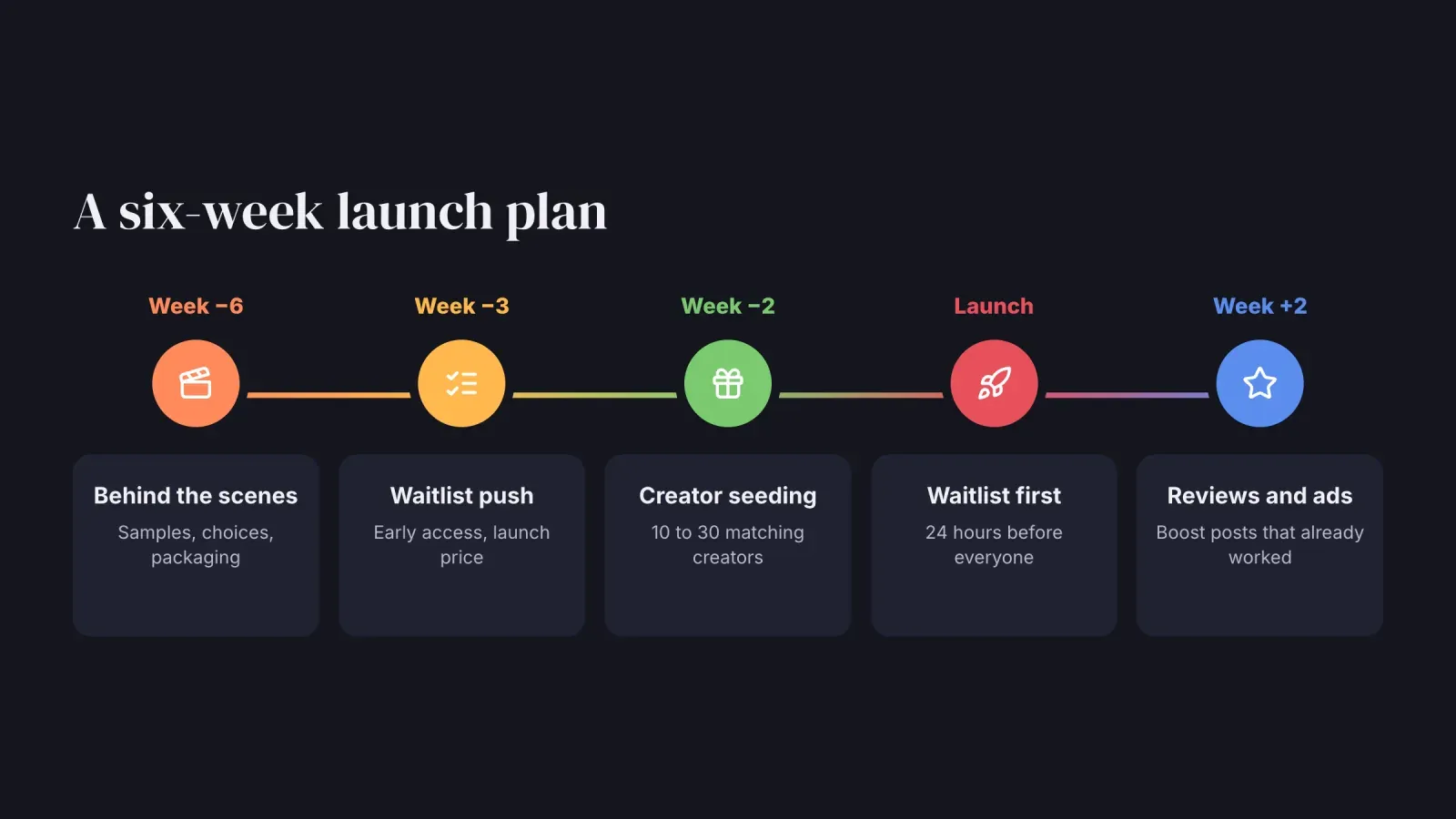
A private label launch is not a single post. It is a sequence that builds anticipation over four to six weeks.
- Behind the scenes, four to six weeks before launch. Share the samples, the failed attempts, the choice of scent or fabric, the packaging design. People who saw the product being made feel part of it.
- Waitlist push, three weeks before. Give your waitlist a reason to exist: early access, a launch price, a limited first edition, a free gift for the first 100 orders.
- Creator seeding, two weeks before. Send the product to 10 to 30 creators whose audience matches yours, without asking for a post. Those who love it will share it, and their content becomes your first user-generated content.
- Launch week. Open sales to the waitlist 24 hours before everyone else. Then post across every channel, go live, answer questions and share every unboxing.
- After launch. Collect reviews quickly and use them in your content and ads. Start paid ads only with the posts that already performed organically.
The 12 tips to sell more on social media and the 12 ad hooks that stop the scroll are a good next read to turn this launch into steady sales.
9. Reorder, improve and scale
The first batch tests the product. The second and third batches build the business.
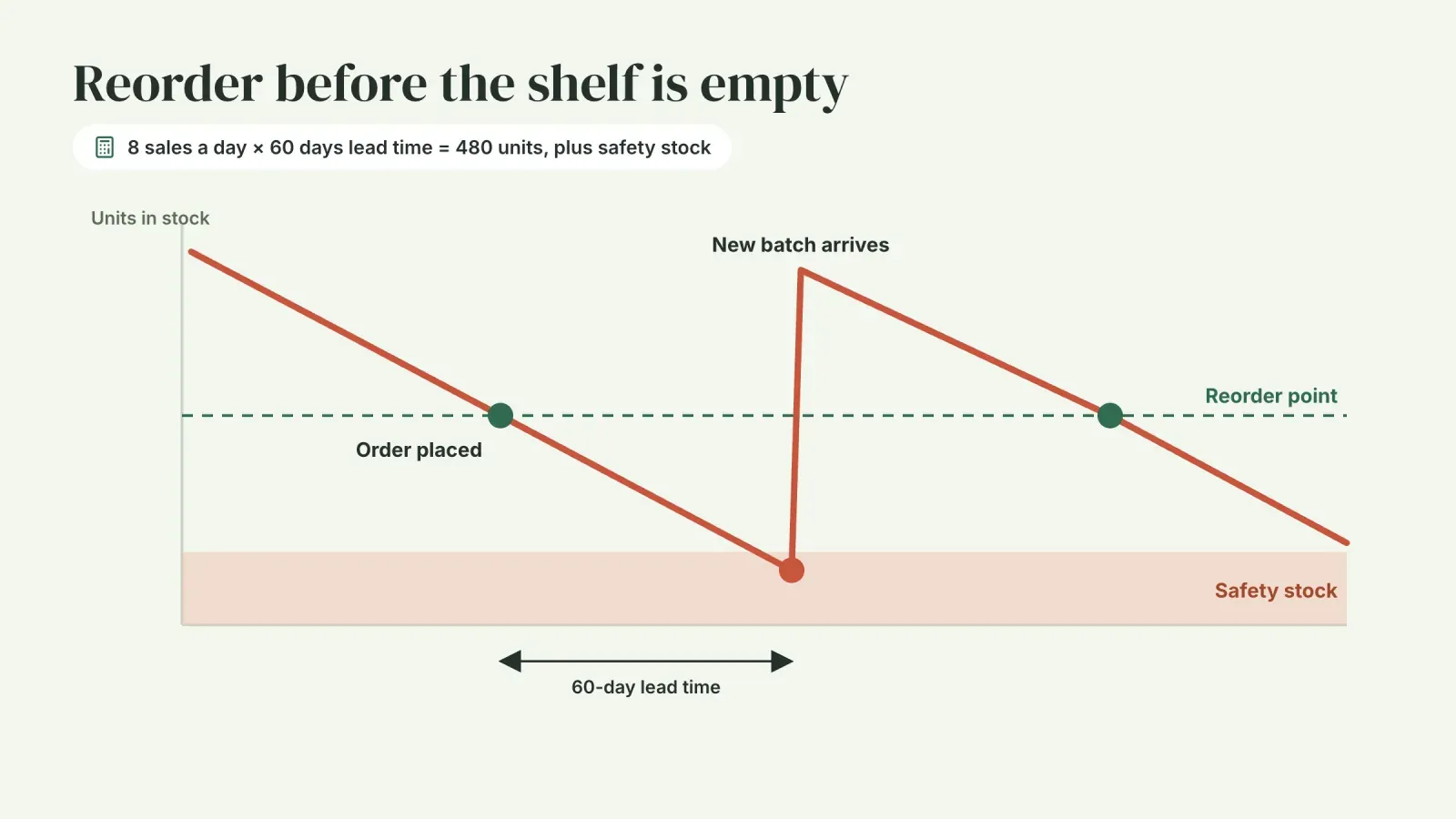
Reorder before you run out. Calculate a reorder point: daily sales multiplied by the full lead time, plus safety stock. If you sell 8 candles a day and the lead time is 60 days, reorder when you reach about 480 units plus your safety stock, not when the shelf is empty. A stockout right after a successful launch is one of the most frustrating ways to lose momentum.
Improve with feedback. Read every review and every DM. If several people say the scent is too light, fix it in the next batch. Each version gets closer to the product people cannot stop recommending.
Negotiate. With proof of sales, ask for better unit prices at higher volumes, longer payment terms or free packaging upgrades. Keep a second manufacturer qualified in case the first one fails.
Expand carefully. Add products that the same customer already wants: a refill, a larger size, a matching room spray, a gift set. Expanding into an unrelated category resets most of your learning.
Automate. As volume grows, consider a third-party logistics provider for storage and shipping, and email automations for reorders and reviews.
Common private label mistakes to avoid
- Ordering too much, too soon. Start close to the minimum order, even at a higher unit price. Running out is a better problem than a garage full of stock.
- Choosing the cheapest supplier. A lower unit price that brings a 10% defect rate is the most expensive option.
- Skipping the specification sheet. Without written specs and a golden sample, you cannot prove that a batch is defective.
- Forgetting compliance. Missing label information or an unregistered cosmetic can get a product removed from a marketplace or recalled.
- Pricing from competitors. Price from your landed cost and your marketing cost, then check the market.
- Launching to nobody. A great product with no audience and no launch plan rarely sells. Build the waitlist first.
- Ignoring cash flow. You pay the factory months before customers pay you. Plan the reorder budget before the first batch sells out.
FAQ about private label
What does private label mean? Private label means selling a product made by a third-party manufacturer under your own brand. The manufacturer produces it, often to your specifications, and you own the brand, the price and the customer relationship.
Is private label the same as white label? No. White label is a generic product sold to many brands with only the branding changed. Private label is made exclusively for one brand, usually to its specifications, so competitors cannot buy the same product.
Is private label legal? Yes, it is a standard business model used by supermarkets and many brands. You are responsible for the product you sell, though, so you need correct labeling, safety compliance and the rights to your brand name.
How much money do I need to start? Plan for $3,000 to $15,000 for a first product, depending on the category and the minimum order. Accessories and candles sit at the lower end, cosmetics and supplements at the higher end.
How long does it take to launch? Usually three to six months from the first supplier contact to the first sale, including sampling, production, shipping and launch preparation.
Can I do private label without stock? Not really. Some manufacturers offer low minimums or will store your stock, but private label means you own the product. If you want zero stock, start with print on demand and move to private label once demand is proven.
Can I sell private label products on Instagram and TikTok? Yes. Social platforms are often the best channel for a creator-led brand. Use content to create demand, then send people to a page where they can buy, such as your store or your link in bio.
Start with the people who already trust you
Private label works best when it starts from an audience, not from a catalog. Validate demand with your followers, work with a manufacturer you have tested, price from real unit economics, and launch to the people who watched the product being made.
When your product is ready, give it a home your followers can reach in one tap. Create your free Roctify page to turn your link in bio into a storefront for your own brand, with your products, your waitlist and your reviews in one place, and 0% transaction fees on every plan.