The United States is the largest e-commerce market in the Western world and the one that sets the trends everyone else follows a few years later. Retail media, same-day delivery, buy now pay later, live shopping, AI shopping assistants: most of them were tested at scale on American shoppers first.
It is also a market that has changed a lot in the last 18 months. Online sales growth accelerated again in 2026, Walmart became a real challenger to Amazon, TikTok Shop turned into a serious sales channel, and the end of duty-free imports for small parcels reshuffled the cards for Temu, Shein and every foreign seller shipping directly to American homes.
This guide gathers the numbers that matter for 2027, using official and first-party sources only: the US Census Bureau, company annual reports, Adobe's checkout data and Similarweb's traffic estimates. You will find the size of the market, what to expect in 2027, the top 10 online stores in the US with their latest KPIs, the challengers to watch and what all of this means if you sell online, whether you are based in the US or abroad.
US e-commerce in numbers
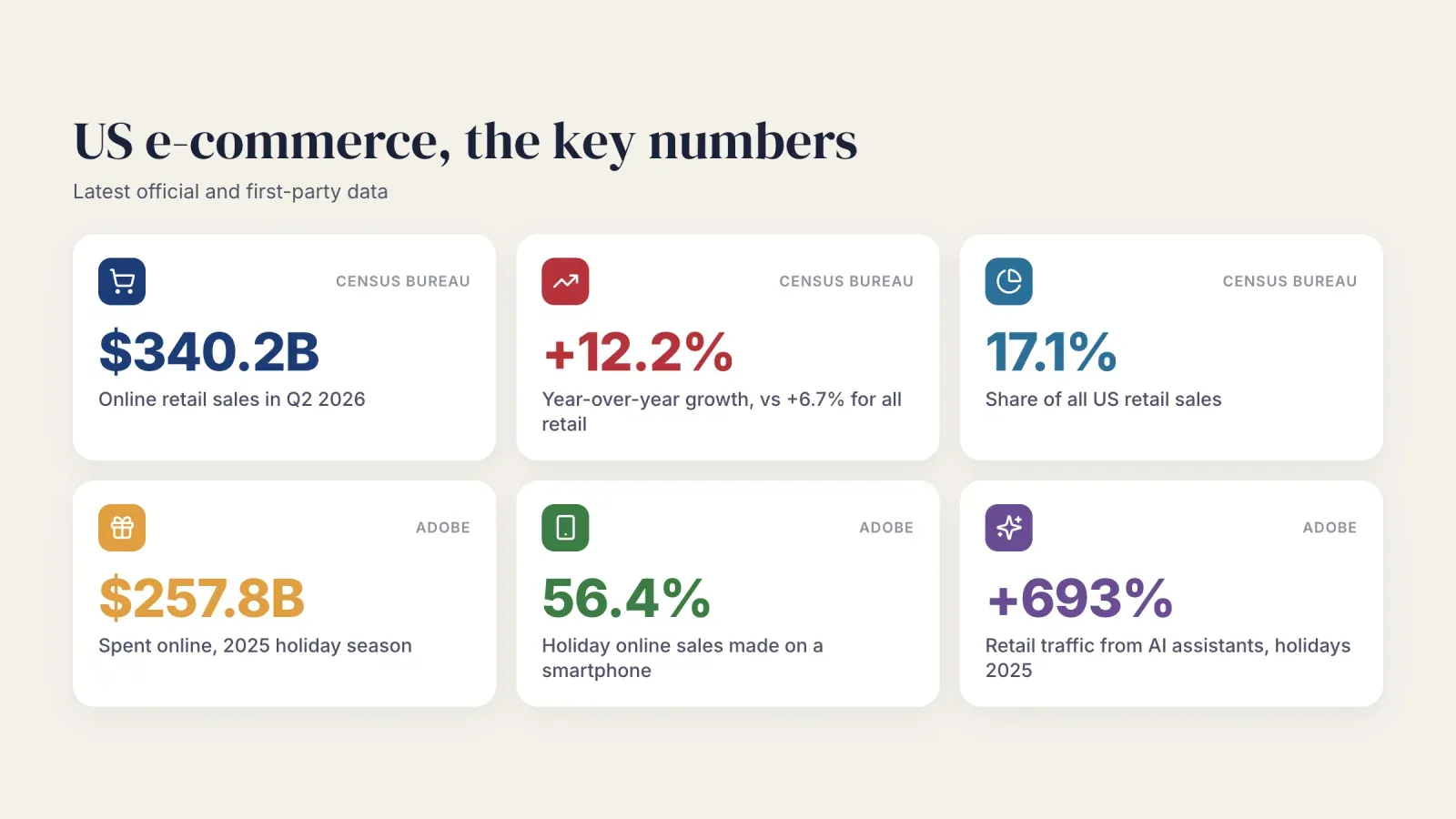
Here are the key indicators to keep in mind, with their source and period.
- $340.2 billion of online retail sales in Q2 2026. That is the latest quarterly estimate from the US Census Bureau, published in August 2026, seasonally adjusted.
- +12.2% year over year. Online sales grew 12.2% compared with the second quarter of 2025, while total retail grew 6.7%. E-commerce is growing almost twice as fast as retail overall.
- 17.1% of all retail sales. Roughly one dollar in six spent in American retail now goes through an online order. In 2025, the Census Bureau put this share at about 16.4%, for around $1.23 trillion of e-commerce sales over the year.
- $257.8 billion spent online during the 2025 holiday season. Adobe measured this record between November 1 and December 31, 2025, up 6.8% from 2024.
- $14.25 billion on Cyber Monday 2025. The biggest online shopping day in US history, up 7.1% year over year, with more than $1 billion paid with buy now pay later.
- 56.4% of holiday online sales on a smartphone. Mobile passed the halfway mark for good, and reached 66.5% on Christmas Day.
- +693% traffic from generative AI tools. Adobe recorded that traffic to US retail sites coming from AI assistants and AI browsers grew almost eightfold during the 2025 holiday season, from a small base.
Two things stand out. First, e-commerce is not slowing down. After a few years of normalization following the pandemic boom, double-digit growth is back. Second, the market is concentrated. Amazon alone represents about four in ten dollars spent online in the US, and eMarketer estimates that Amazon and Walmart together now capture around half of all US retail e-commerce sales.
What to expect in 2027
Nobody can predict exact figures, but the trend is clear enough to make an informed estimate.
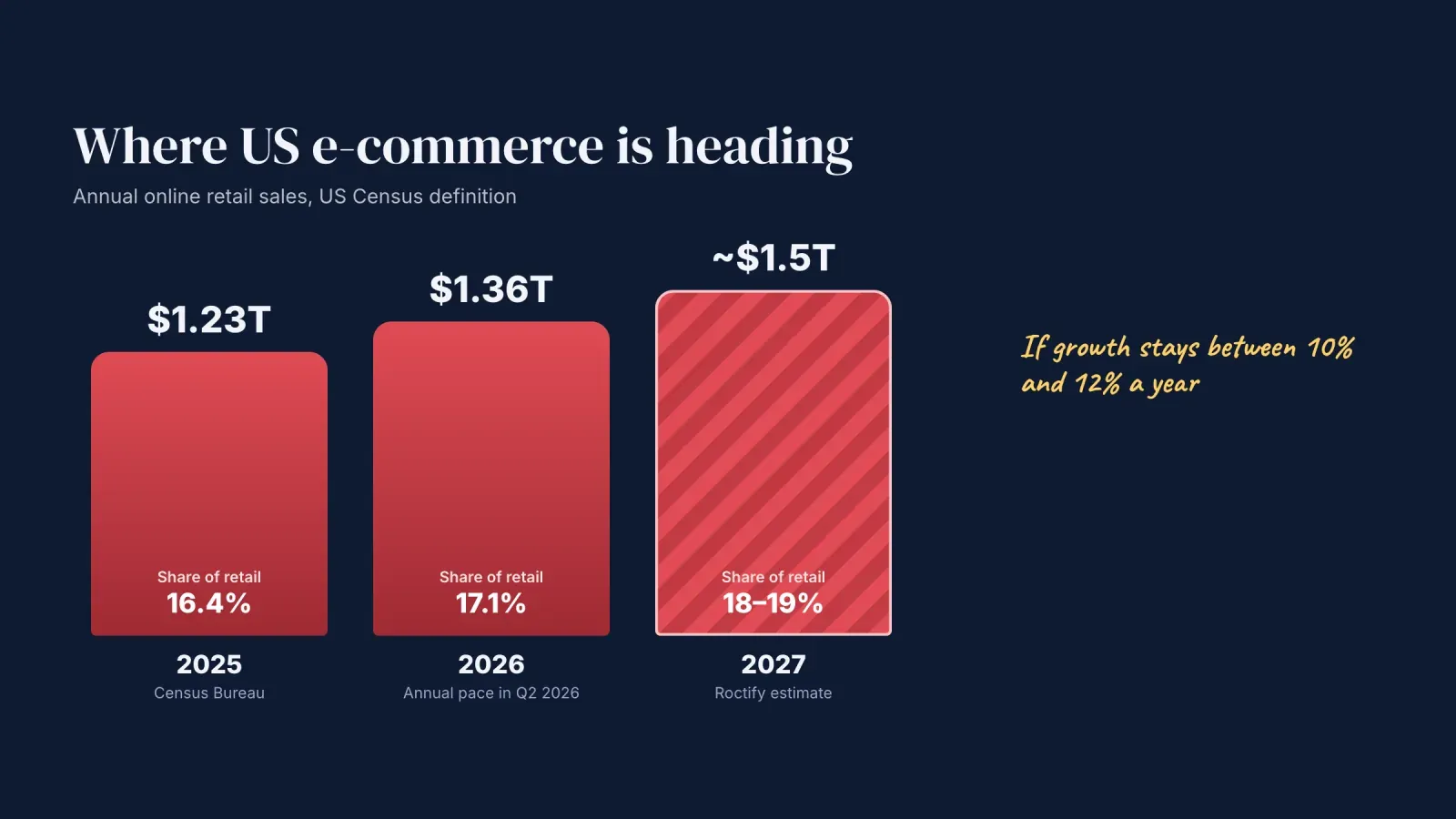
The market should pass $1.5 trillion. At $340.2 billion per quarter, US e-commerce is already running at an annual pace of about $1.36 trillion. If growth stays between 10% and 12%, which is where it has been since the end of 2025, online retail sales would reach roughly $1.5 trillion in 2027. That is our estimate based on the Census trend, not an official forecast.
Online should approach one fifth of all retail. With e-commerce growing almost twice as fast as total retail, its share should keep rising by close to one point per year, toward 18% to 19% of US retail sales in 2027 by the Census definition. Research firms that use broader definitions, such as eMarketer, already put the share above 20%.
Six trends will shape the year:
- Retail media becomes a profit engine. Amazon earned $68.6 billion from advertising in 2025 and Walmart's global advertising revenue grew 46% in its last fiscal year. Selling on a big marketplace increasingly means paying for visibility on it.
- Marketplaces keep spreading. Walmart, Target, Lowe's, Best Buy and many others now host third-party sellers next to their own products. Target's third-party marketplace, Target Plus, grew more than 30% in 2025.
- Social commerce goes mainstream. TikTok Shop generated $15.1 billion of gross merchandise value in the US in 2025, up 68%. Buying directly from a video or a creator's page is no longer a niche behavior.
- AI shopping assistants become a traffic source. People ask AI chat tools to compare products and find deals, then click through to buy. It is still small, but it is the fastest-growing source of retail traffic.
- Speed is the baseline. Same-day and next-day delivery are now expected by a large share of shoppers, pushed by Amazon and Walmart. More than half of Home Depot's online orders are already fulfilled through its stores.
- Cross-border gets more expensive. Since August 29, 2025, low-value parcels entering the US no longer benefit from the duty-free de minimis exemption, whatever their country of origin. Foreign sellers now pay duties on small orders, which changes their pricing and logistics.
How we ranked the top 10 online stores in the US
There is no single official ranking of US online stores. Sales figures are not always published, and companies define e-commerce differently. Some count only orders placed online, others include orders picked up in store or delivered from stores.
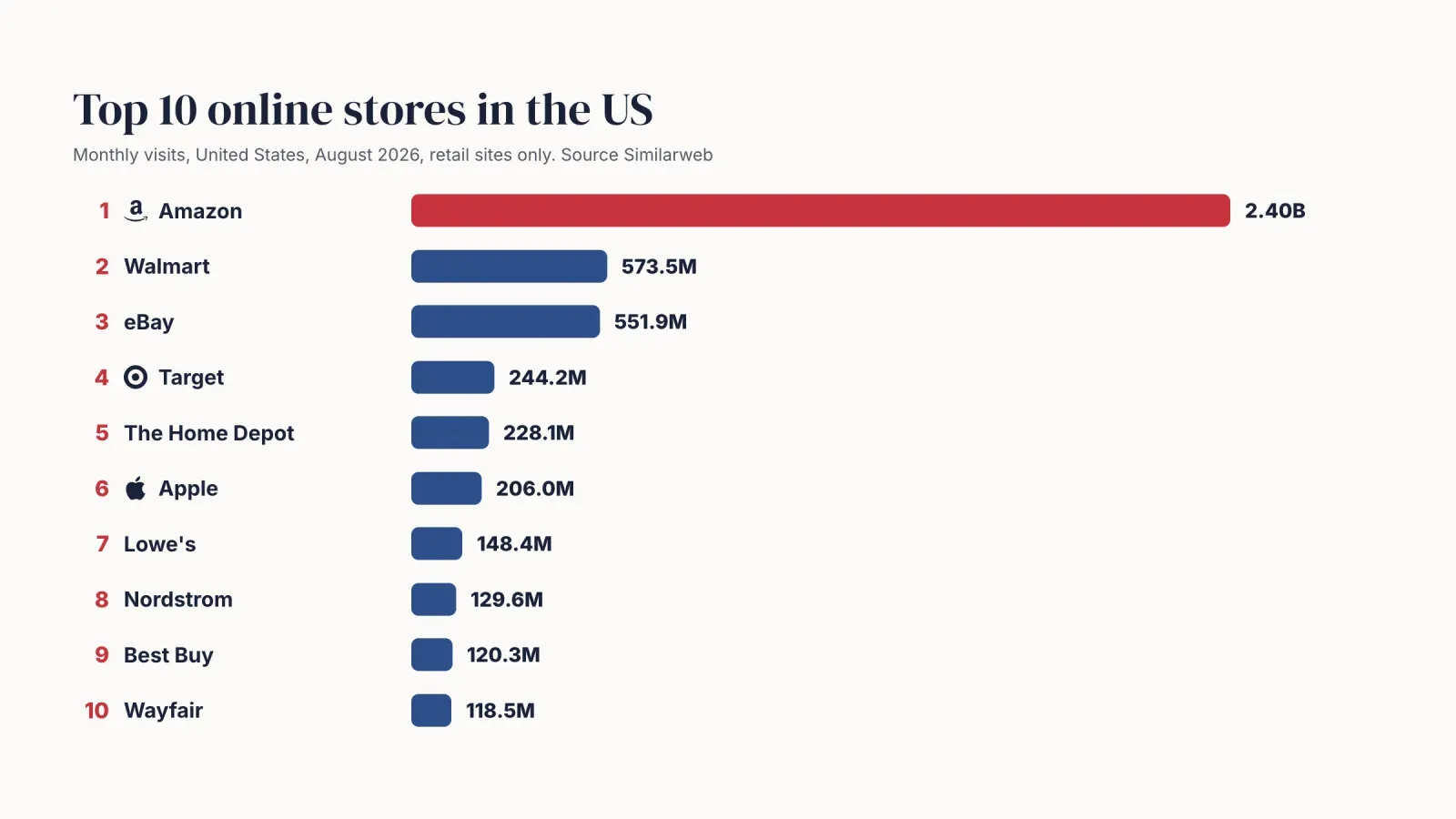
To keep the ranking simple and comparable, we used monthly website visits in the United States measured by Similarweb for August 2026, and kept only retailers that sell physical products. Telecom operators and travel sites, which also appear in Similarweb's list, are excluded. For each retailer, we then added the most recent sales KPIs it published itself, usually for its 2025 fiscal year.
Traffic is not revenue, so a site with fewer visits can sell more. Apple and Costco are good examples: their visitors come with a high intent and a high basket. But traffic shows where American shoppers spend their attention, which is what matters if you want to be found.
1. Amazon
Monthly visits: 2.40 billion (US, August 2026)
Amazon is in a league of its own. Its US site receives more than four times the visits of the second-ranked retailer, and about 45% of all visits generated by the 15 largest US e-commerce sites. Digital Commerce 360 estimates that Amazon's online sales in 2025 were larger than those of the next 52 largest US online retailers combined.
Key figures for 2025, from Amazon's annual report:
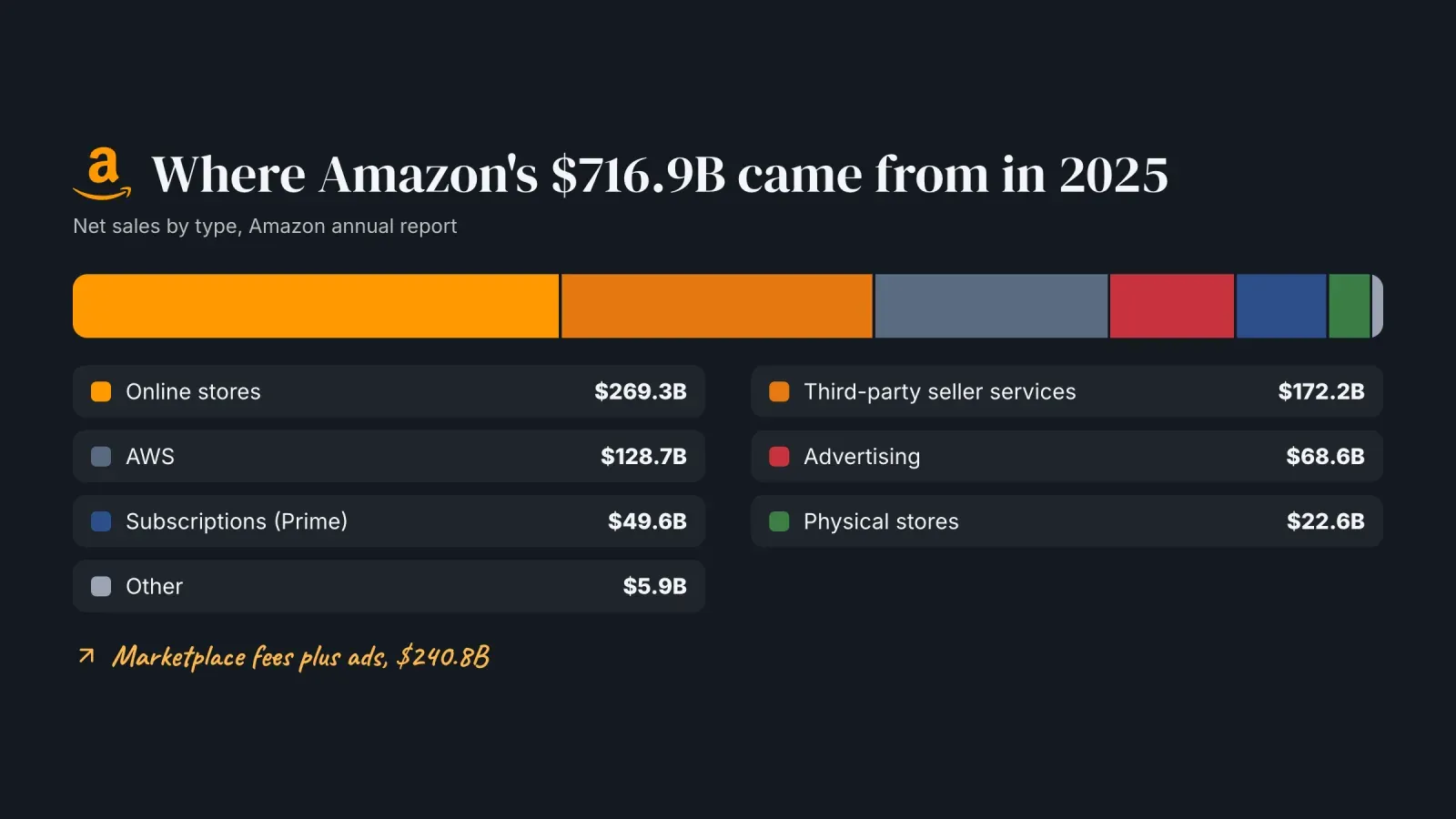
- Total net sales of $716.9 billion, up 12%
- North America segment sales of $426.3 billion
- Online stores revenue, Amazon's own retail sales, of $269.3 billion
- Third-party seller services, the fees paid by marketplace sellers, of $172.2 billion
- Advertising services of $68.6 billion
- Subscription services, mainly Prime, of $49.6 billion
The most important number for sellers is the second-to-last one. More than half of the units sold on Amazon come from independent sellers, and Amazon makes more money from their fees and ads than many retailers make in total sales. Selling on Amazon gives access to the largest audience in the country, at the cost of referral fees, fulfillment fees, advertising and very little customer data.
2. Walmart
Monthly visits: 573.5 million
Walmart overtook eBay in 2026 to become the second most visited online store in the US, and it is the only retailer whose e-commerce business grows faster than Amazon's.
Key figures for fiscal 2026, ended January 31, 2026:
- Total revenue of $713.2 billion, up 4.7%
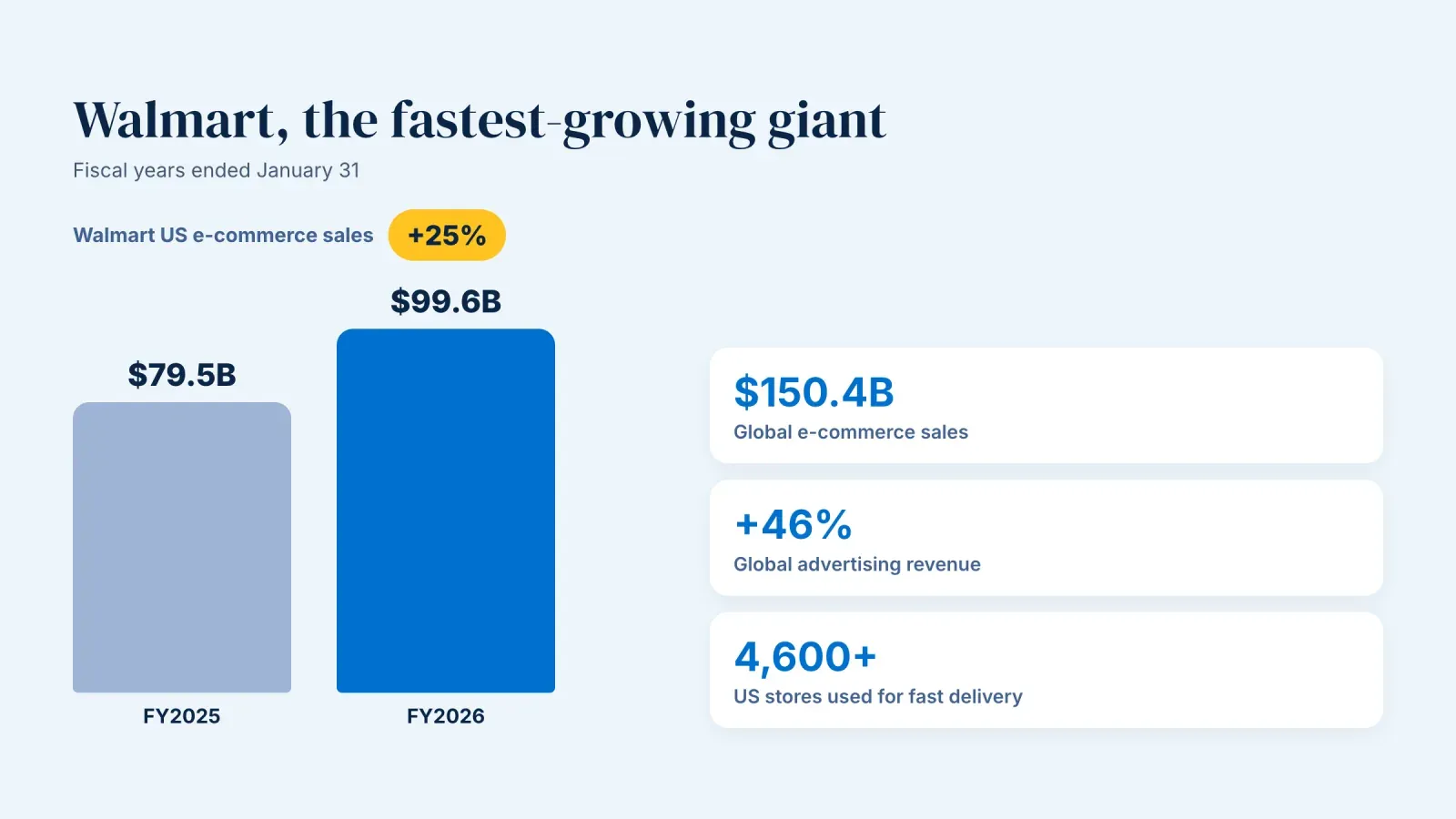
- Walmart US e-commerce sales of $99.6 billion, up about 25% from roughly $79.5 billion a year earlier
- Global e-commerce sales of $150.4 billion
- Global advertising revenue up 46%
Walmart's strength is its network of more than 4,600 US stores, which act as local warehouses for fast delivery and pickup. Its marketplace, open to third-party sellers, keeps growing, and its Walmart+ membership competes directly with Amazon Prime. For a seller, Walmart Marketplace is often the second channel to open after Amazon, with less competition per product.
3. eBay
Monthly visits: 551.9 million
eBay is the original American marketplace and remains a giant, even if it now ranks just behind Walmart for traffic. It has refocused on categories where it has an edge: collectibles, trading cards, auto parts, refurbished electronics, luxury and pre-owned fashion.
Key figures for 2025:
- Gross merchandise volume of $79.6 billion, up 7%
- 135 million active buyers worldwide
- 2.5 billion live listings
- Revenue of $11.1 billion, up 8%
- About 49% of GMV generated in the US
eBay is a strong channel for resale, collectibles and niche products with passionate buyers. It is also one of the most accessible marketplaces for sellers based outside the US.
4. Target
Monthly visits: 244.2 million
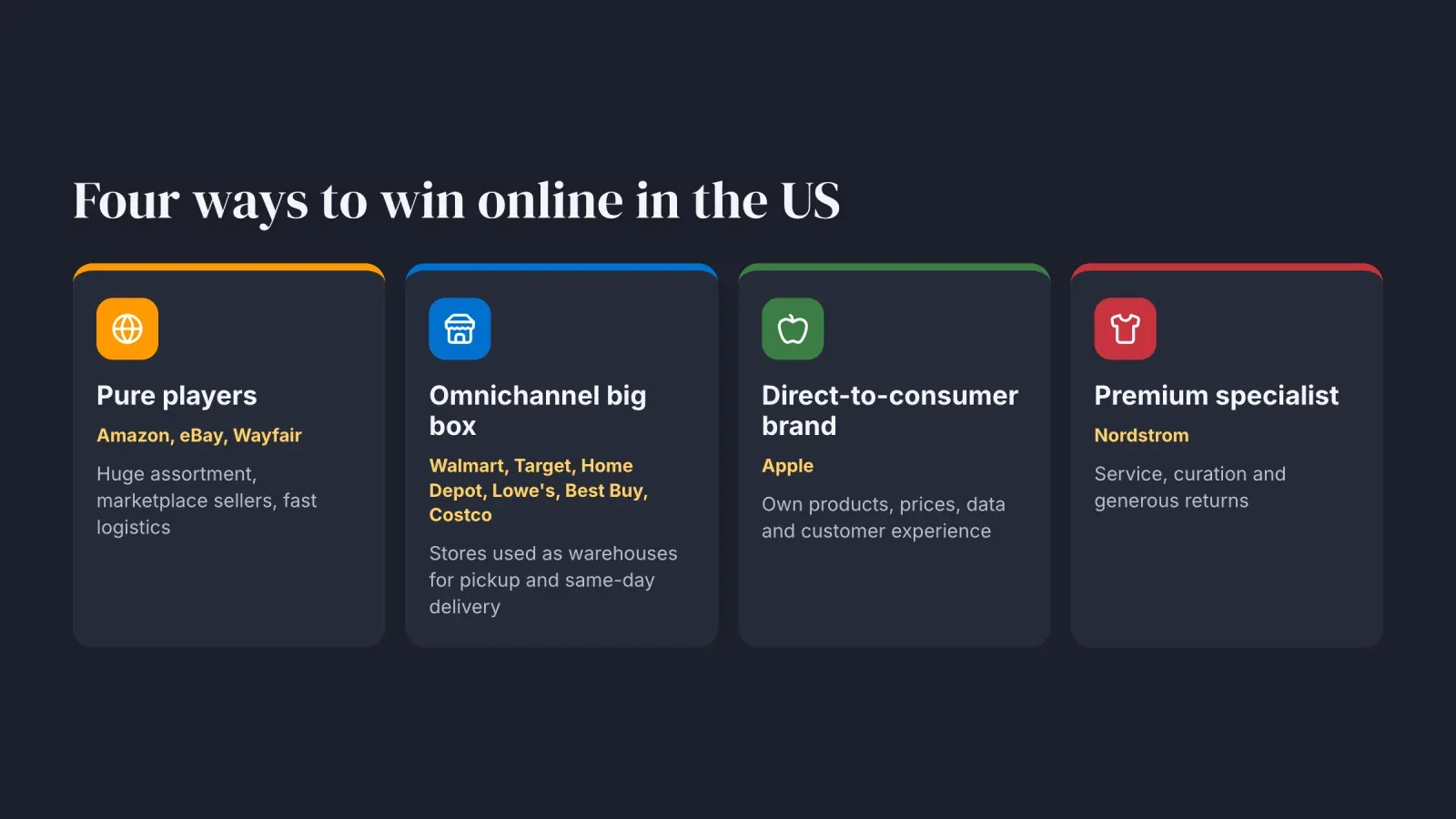
Target is one of the great omnichannel success stories. Most of its online orders are fulfilled by its stores, through same-day delivery, order pickup and Drive Up, where employees bring the order to the customer's car.
Key figures for fiscal 2025:
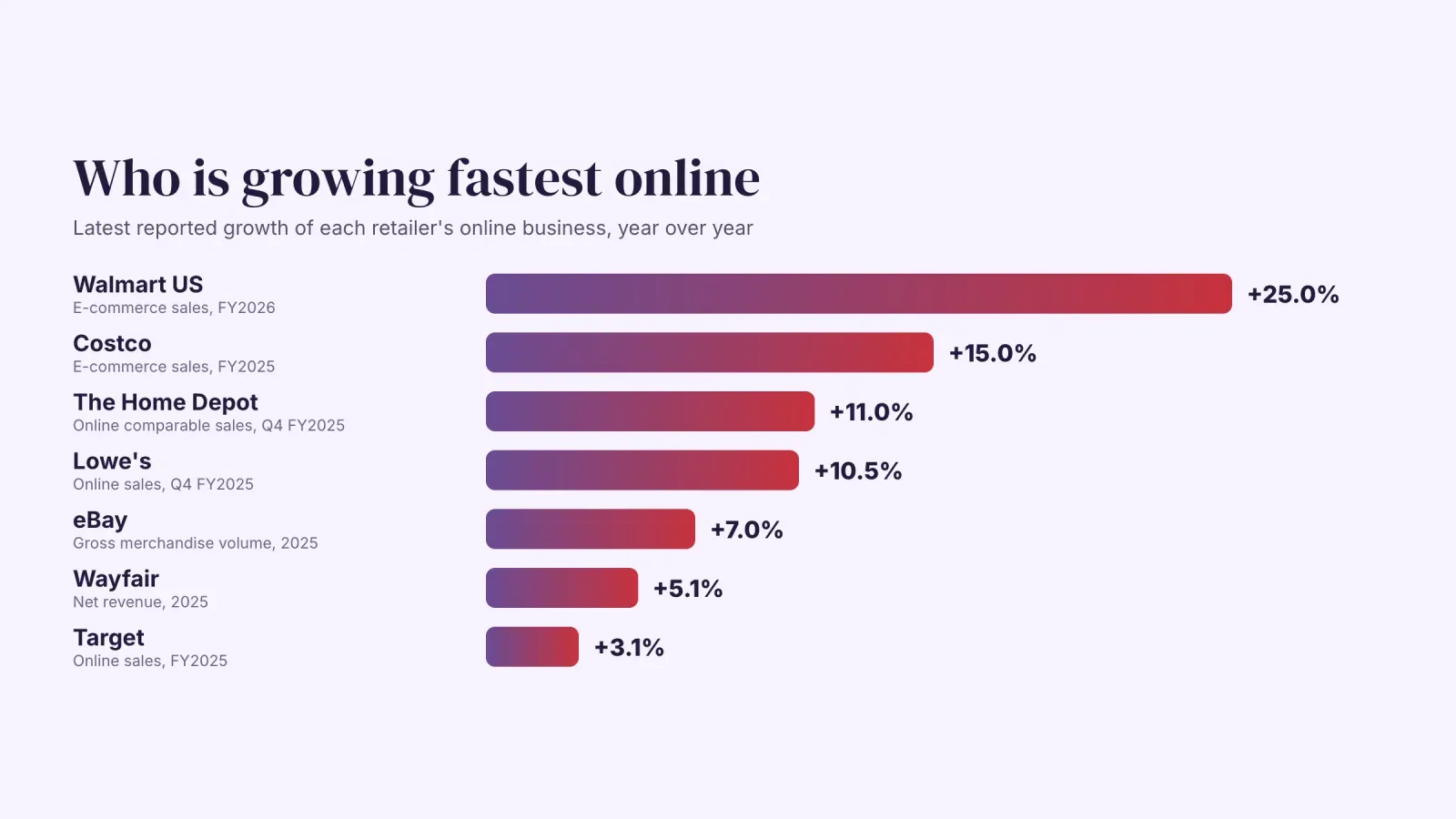
- Online sales up 3.1%
- E-commerce at 20.6% of total sales, up from 19.6% the year before
- Target Plus, its invitation-only third-party marketplace, up more than 30%
Target's overall sales have been under pressure, but its digital share keeps rising, and its retail media network, Roundel, is one of the most advanced in the country. Target Plus is selective: brands are invited, which makes it a strong signal of credibility for those who get in.
5. The Home Depot
Monthly visits: 228.1 million
The leader in home improvement shows that e-commerce is not only for small, light products. Lumber, appliances, tools and building materials are ordered online every day, by homeowners and by professional contractors.
Key figures for fiscal 2025:
- Online comparable sales up about 11% in both the third and fourth quarters, while total comparable sales were nearly flat
- More than 50% of online orders fulfilled through its stores
Home Depot's model is what the industry calls interconnected retail: people research and buy online, then pick up in store or get a delivery from the nearest store. Its online growth is one of the clearest signs that professional buyers are moving their purchasing online too.
6. Apple
Monthly visits: 206.0 million
Apple's online store is a special case. It sells only Apple products, and the company does not publish its online sales separately. Yet it consistently ranks among the top US e-commerce companies by sales in estimates from eMarketer and Digital Commerce 360, because its average order value is so high. One iPhone or MacBook order is worth dozens of orders on most other sites.
Apple is the ultimate example of a direct-to-consumer brand. It controls its products, its prices, its customer experience and its data, and uses its online store as a showroom, a configurator and a checkout at the same time. For any brand, it is a reminder that a strong owned channel can compete with the largest marketplaces.
7. Lowe's
Monthly visits: 148.4 million
Lowe's, the second home improvement chain, has made its website and app a priority to catch up with Home Depot.
Key figures for fiscal 2025:
- Total sales of $86.3 billion
- Online sales up 11.4% in the third quarter and 10.5% in the fourth quarter, while total comparable sales grew 0.2%
Like most big retailers, Lowe's has also opened its website to third-party sellers through an online marketplace, built with the marketplace software company Mirakl. Home and garden brands now have one more large US channel to consider.
8. Nordstrom
Monthly visits: 129.6 million
Nordstrom is the first fashion and department store retailer in the ranking. It is a reference for premium fashion, beauty and accessories, and for its customer service, including free shipping and easy returns.
Nordstrom was taken private in May 2025 by the Nordstrom family and the Mexican retailer El Puerto de Liverpool, in a deal worth about $6.25 billion. Since then, it no longer publishes detailed results. Its last public figures showed digital sales at about a third of total sales, down from a pandemic peak of 55% in 2020.
For fashion and beauty brands, Nordstrom shows what American shoppers expect in these categories: a premium experience, generous returns and a mix of online and in-store services.
9. Best Buy
Monthly visits: 120.3 million
Best Buy is the largest specialized electronics retailer in the US, with a strong online business and stores that double as pickup points and service centers.
Key figures for fiscal 2026, ended January 31, 2026:
- Domestic online revenue of $4.91 billion in the holiday quarter alone
- Online sales at 39.0% of domestic revenue in that quarter
Electronics is one of the categories where e-commerce penetration is highest in the US, and one where Amazon, Walmart and Apple compete hard. Best Buy defends its position with expert advice, installation services and fast pickup, which shows how specialists can compete with generalists.
10. Wayfair
Monthly visits: 118.5 million
Wayfair is the only pure player in this top 10 besides Amazon and eBay. It sells furniture, decor and home goods, mostly shipped directly by thousands of suppliers.
Key figures for 2025:
- Net revenue of $12.5 billion, up 5.1%
- 21.3 million active customers
- $586 of revenue per active customer over the last 12 months, up 5.6%
Wayfair proves that bulky products can sell online at scale, with the right logistics. It has also started opening physical stores, a sign that even online leaders now see value in an omnichannel presence.
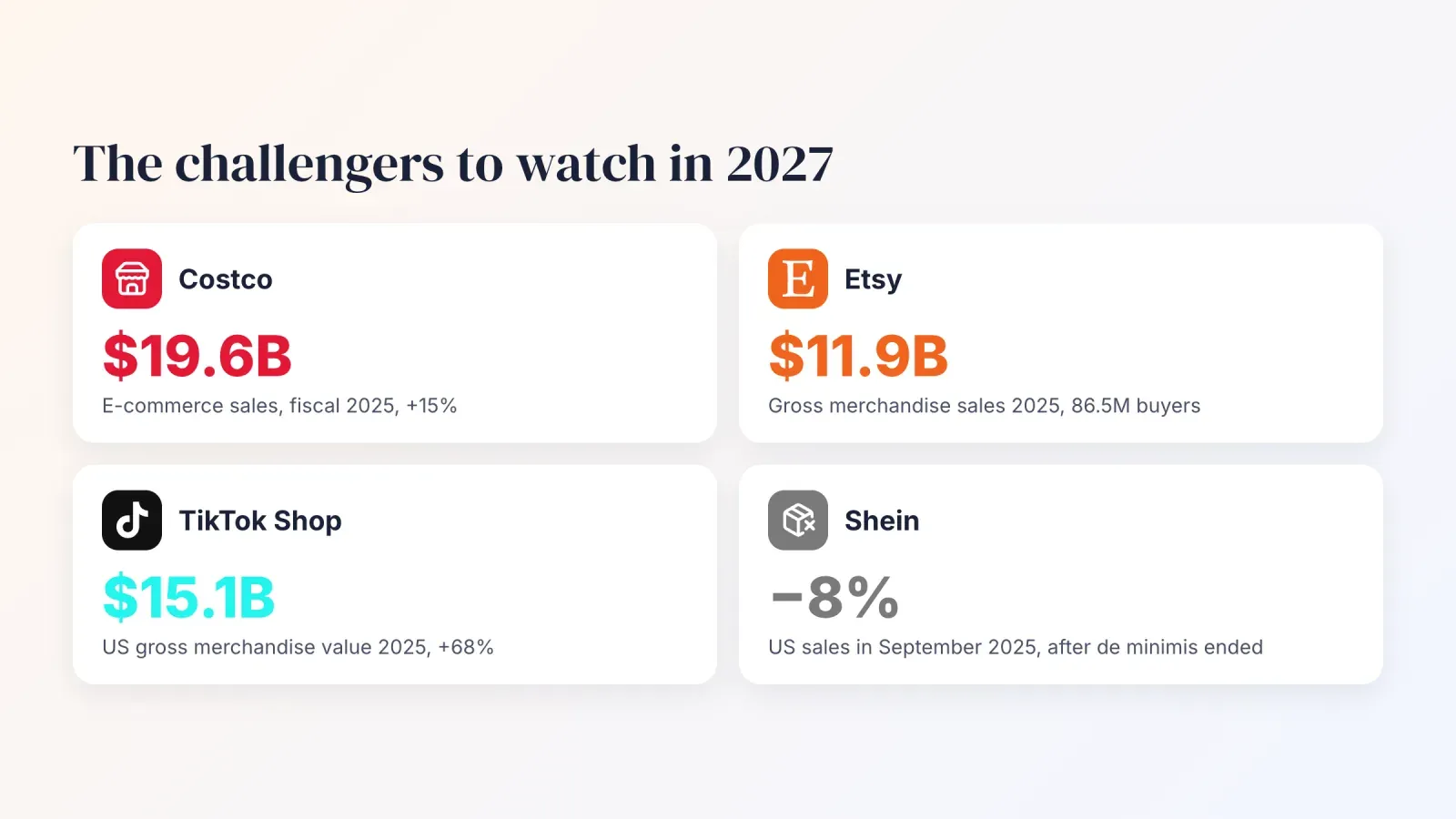
The challengers to watch in 2027
Some of the most important players in US e-commerce do not appear in the top 10 by traffic, either because their visitors are fewer but spend more, or because their sales happen inside apps.
Costco. With 110.9 million monthly visits, Costco is just outside the top 10, but its online business is growing fast. In its fiscal 2025, e-commerce sales passed $19.6 billion, up 15%, and digitally enabled sales, including orders placed online and fulfilled from warehouses, passed $27 billion. Its members buy in bulk, so each visit is worth a lot.
Etsy. The marketplace for handmade, vintage and creative products had consolidated gross merchandise sales of $11.9 billion in 2025 and 86.5 million active buyers. Growth has been difficult since the pandemic, but Etsy remains the reference for creators, artisans and small brands with a distinctive product.
TikTok Shop. In-app shopping on TikTok generated $15.1 billion of gross merchandise value in the US in 2025, up 68% from about $9 billion in 2024. Beauty, fashion and wellness lead, driven by creators and affiliate videos.
Temu and Shein. The two Chinese-founded platforms grew explosively by shipping low-cost items directly from China. The end of the de minimis exemption on August 29, 2025 hit that model: Bloomberg Second Measure data showed Shein's US sales down about 8% year over year in September 2025. Both are adapting by shipping more stock from US warehouses and recruiting local sellers.
What this means for online sellers
The top 10 tells a clear story. American shoppers buy where they find speed, trust and convenience, and the biggest players have built all three at enormous scale. Here is how independent brands and creators can compete.
Go where the demand already is, but own a channel. Marketplaces like Amazon, Walmart, eBay and Etsy give access to buyers who are ready to purchase. They also take 8% to 15% or more in fees, push you to buy ads, and keep the customer relationship. Use them for reach, and build at least one channel you control, such as your own store or a link in bio storefront, where you keep the data and the margin.
Design for mobile commerce first. With 56.4% of holiday online sales made on a smartphone, a product page that loads slowly or a checkout that requires ten fields loses most of its buyers. Apple Pay, Google Pay and PayPal are expected, and buy now pay later options such as Klarna, Affirm or Afterpay are now mainstream.
Treat social as a sales channel. TikTok Shop's growth and the 2025 holiday numbers confirm that Americans buy from creators and videos. Short videos that show the product in use, creator partnerships and affiliate programs often outperform traditional ads. The 12 tips to sell more on social media explain how to turn that attention into orders.
Make delivery and returns a selling point. American shoppers are used to free shipping thresholds, two-day delivery and free returns. You do not have to match Amazon, but you need to be clear: delivery time on the product page, a simple return policy and tracking for every order.
Stand out with a product that is yours. Competing on price against Amazon, Walmart and Temu is a losing game. Brands that win have a product, a story or a community others cannot copy. Our guide to launching a private label product explains how to create one.
Get ready for AI-driven discovery. As more shoppers ask AI assistants for recommendations, clear product information, honest reviews, detailed FAQs and structured data on your pages make it easier for these tools to understand and recommend what you sell.
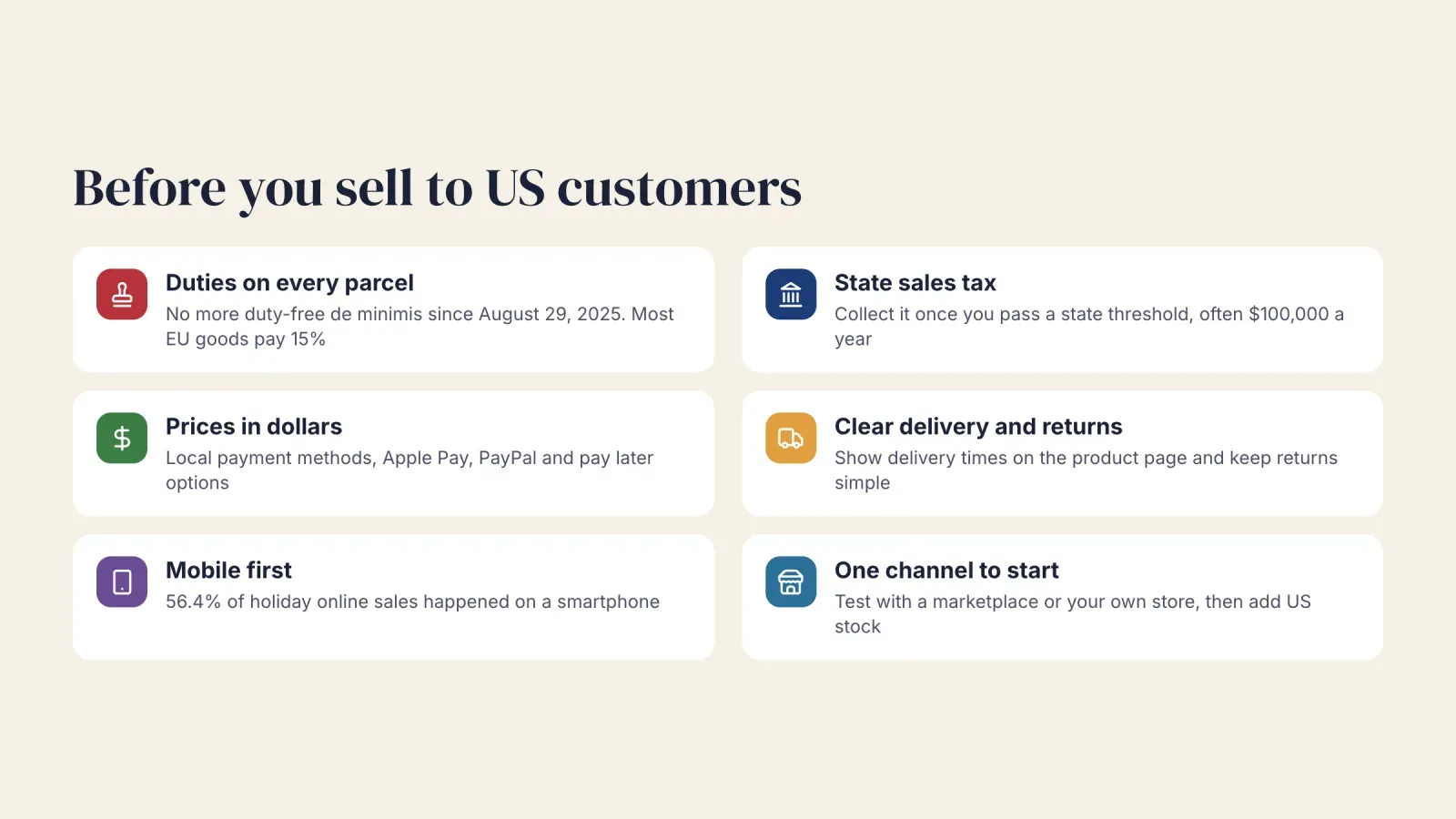
Selling to US customers from abroad
The US is the first export market for many European and international brands. A few rules have changed recently.
- Duties now apply to small parcels. Since the end of the de minimis exemption in August 2025, every commercial shipment to the US is subject to duties, even under $800. For goods made in the European Union, most products face a tariff of 15% under the trade framework agreed in 2025. Decide early whether you charge duties at checkout or let the customer pay at delivery, which often leads to refused parcels.
- Sales tax is your responsibility above certain thresholds. Since the Supreme Court's Wayfair decision in 2018, each state can require remote sellers to collect sales tax once they pass an economic threshold, often $100,000 of sales in that state per year. Marketplaces collect it for you on their platforms, but your own store must handle it.
- Prices in dollars, with clear delivery times. Showing prices in euros or with uncertain delivery times kills conversion. Use a US currency display, local payment methods and, when volume allows, stock in a US warehouse or with a fulfillment partner.
- Start with one channel, then expand. Many brands test the US through Amazon or Etsy, or through their own store promoted to an existing American audience on social media, before investing in local stock and paid ads.
FAQ about US e-commerce
How big is US e-commerce? According to the US Census Bureau, online retail sales reached $340.2 billion in the second quarter of 2026, or about 17.1% of all retail sales. Over 2025, e-commerce sales totaled around $1.23 trillion.
What is the largest online store in the US? Amazon, by far. Its US site receives about 2.4 billion visits per month, more than four times Walmart.com, and it represents roughly 40% of US e-commerce sales according to industry estimates.
What are the top 10 e-commerce sites in the US? By monthly visits in August 2026, the top 10 retail sites are Amazon, Walmart, eBay, Target, The Home Depot, Apple, Lowe's, Nordstrom, Best Buy and Wayfair. Costco ranks just after them.
How fast is US e-commerce growing? Online sales grew 12.2% between the second quarter of 2025 and the second quarter of 2026, about twice as fast as total retail sales.
What share of US online purchases is made on mobile? During the 2025 holiday season, 56.4% of online sales were made on a smartphone according to Adobe, a record.
What will US e-commerce look like in 2027? If current growth continues, online sales should pass $1.5 trillion and approach one fifth of all retail sales, with growing roles for marketplaces, retail media, social commerce and AI shopping assistants.
Can a foreign brand sell online in the US? Yes, through marketplaces like Amazon, eBay and Etsy or through its own store. Since August 2025, duties apply to all commercial parcels, so pricing, logistics and tax collection need to be planned before launch.
Turn American attention into sales
The US market rewards brands that are easy to find, easy to trust and easy to buy from. The giants have the scale, but independent sellers have something they do not: a direct relationship with an audience that follows them.
If your audience is on Instagram, TikTok or YouTube, give it a place to buy in one tap. Create your free Roctify page to turn your link in bio into a mobile storefront for your products, with 0% transaction fees on every plan.