"How much does YouTube pay per view?" is one of the most searched questions about the platform, and one of the most misunderstood. YouTube doesn't pay a fixed rate per view. Two channels with exactly the same number of views can earn ten times more or less than each other, depending on their topic, their audience's country, the length of their videos and even the month of the year.
What we do know is that the money is real. YouTube says it paid more than $70 billion to creators, artists and media companies in the three years before 2024. In 2027, the question is not whether YouTube pays, but how much it pays you, and how to earn more from the same views.
This guide explains how YouTube calculates your pay, the difference between RPM and CPM, realistic earnings per 1,000 and per million views, how much Shorts pay, what the 2027 rule changes mean for your income, how and when you get paid, and the levers that raise your earnings. Every figure in this article is an estimate or a range, because YouTube's real numbers depend on your channel. You'll find them in your own YouTube Studio once you're monetized.
How much YouTube pays, the short answer
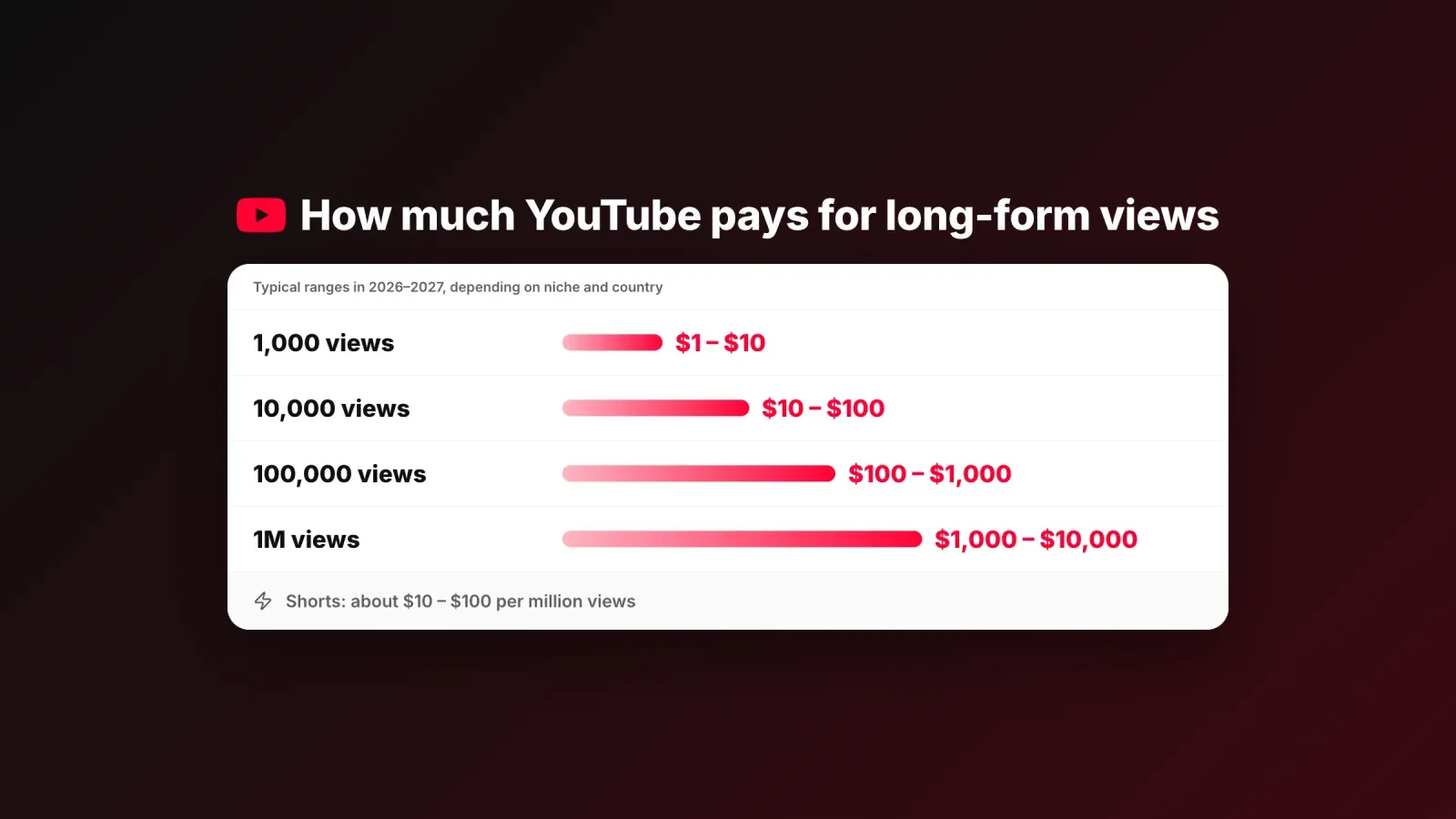
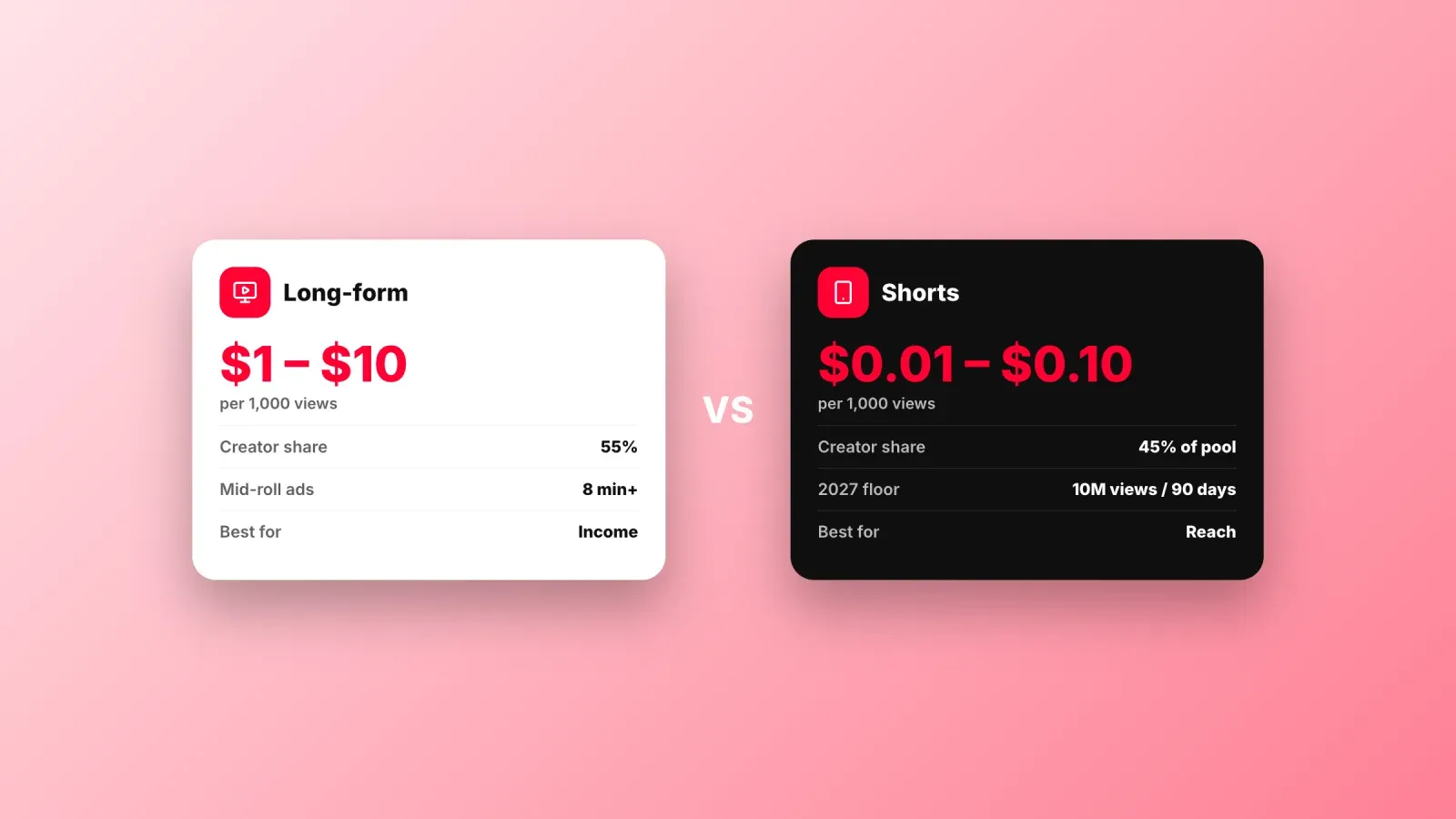
For long-form videos, most monetized channels earn somewhere between $1 and $10 per 1,000 views, and some finance or business channels earn much more. Shorts pay far less per view.
Here's what that means in practice for long-form videos:
- 1,000 views: about $1 to $10
- 10,000 views: about $10 to $100
- 100,000 views: about $100 to $1,000
- 1 million views: about $1,000 to $10,000, and up to $20,000 or more in the best-paying niches
For Shorts, creators commonly report roughly $0.01 to $0.10 per 1,000 views, which means about $10 to $100 per million views, with higher figures in a few niches and countries.
These ranges are wide on purpose. The rest of this guide explains where your channel is likely to land, and why.
How YouTube pays creators
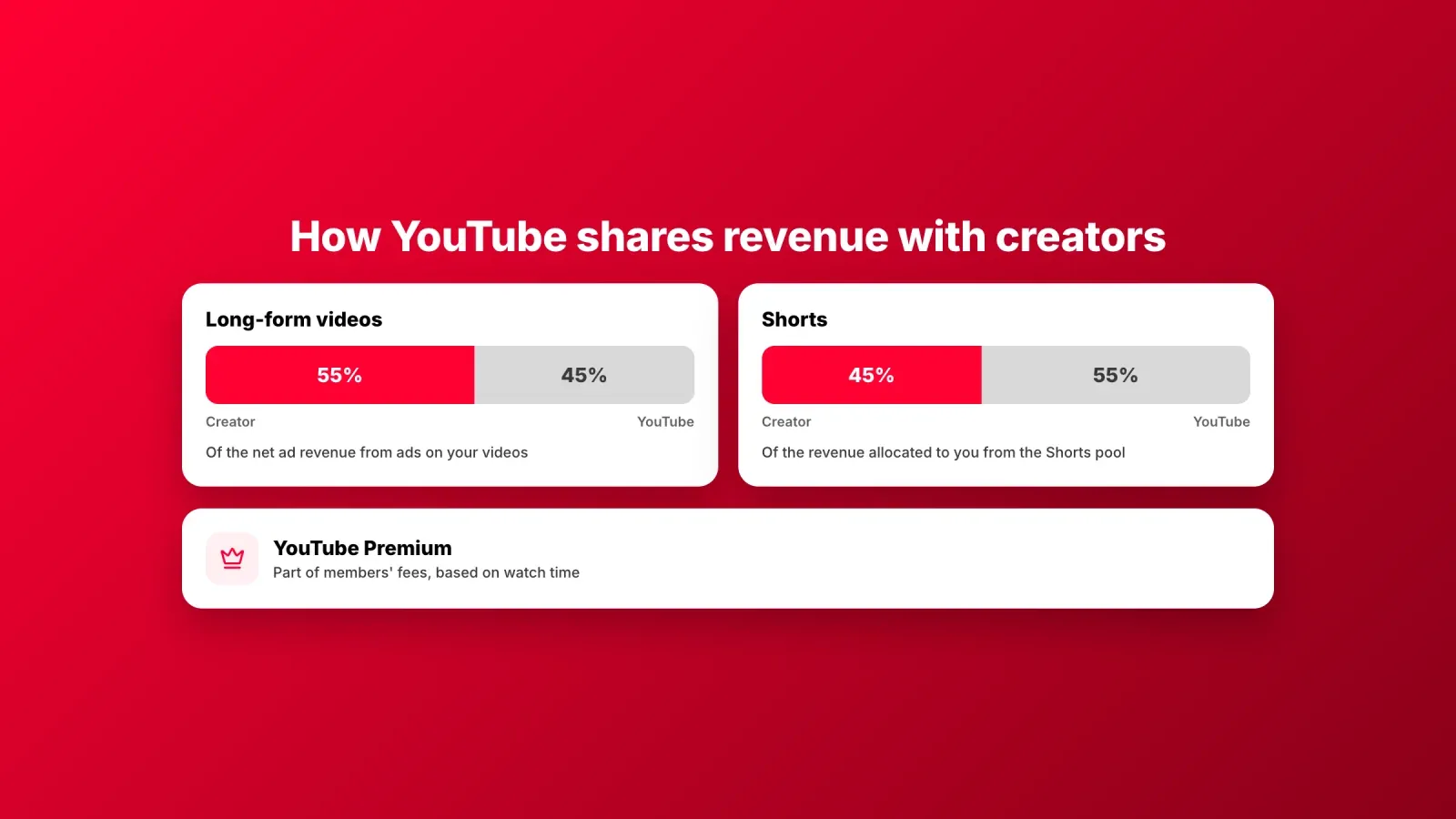
YouTube doesn't pay you for views. It shares the money advertisers and YouTube Premium subscribers pay to watch content.
- Long-form videos: creators in the YouTube Partner Program receive 55% of the net ad revenue from ads shown on their videos. YouTube keeps 45%.
- Shorts: ads run between Shorts in the feed. YouTube pools that revenue, allocates part of it to creators based on their share of Shorts views, and creators keep 45% of their allocation.
- YouTube Premium: Premium members don't see ads. Instead, part of their subscription fee is shared with creators based on how much of their content members watch.
Not every view earns money. A view counts toward ad revenue only if an ad is actually shown and, depending on the ad format, watched or clicked. Viewers using ad blockers, videos that aren't suitable for most advertisers, and views from countries with few advertisers all lower the share of views that earn.
RPM vs CPM, the two numbers that matter
YouTube Studio shows two metrics that people constantly confuse.
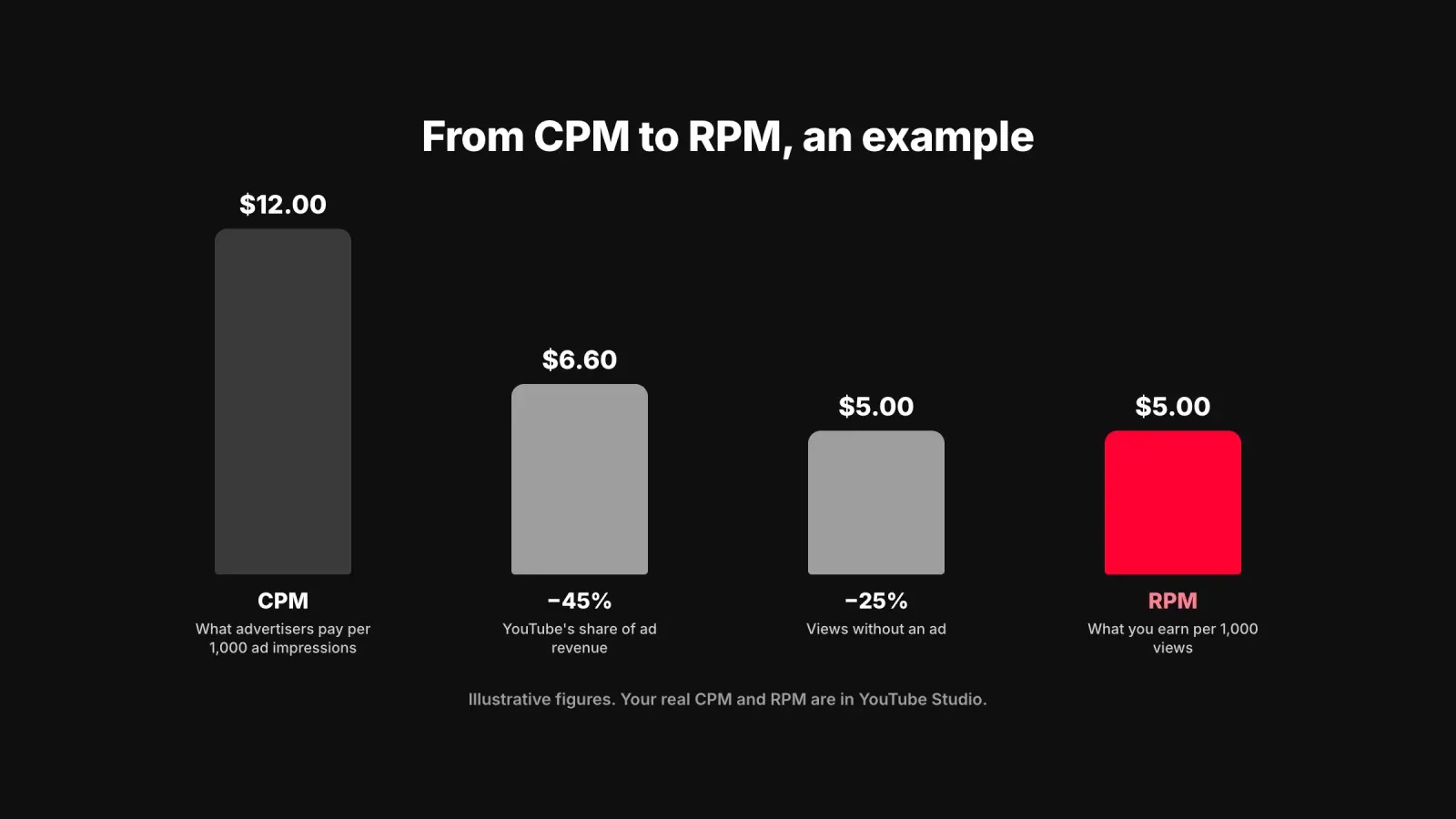
CPM, cost per mille, is what advertisers pay for 1,000 ad impressions on your videos, before YouTube's share. It only counts views where an ad was shown.
RPM, revenue per mille, is what you actually earn per 1,000 views, after YouTube's share, counting all views, including those without ads, and all revenue sources, including Premium, memberships and Super Chat.
RPM is always lower than CPM. If your CPM is $12, your RPM might be around $5, because YouTube keeps 45% and not every view shows an ad. RPM is the number to use to estimate your income. CPM is useful to understand what advertisers think your audience is worth.
How to calculate your YouTube earnings
The formula is simple:
Earnings = (views ÷ 1,000) × RPM
Example: a cooking channel gets 250,000 long-form views in a month with an RPM of $4. It earns (250,000 ÷ 1,000) × $4 = $1,000 from YouTube that month.
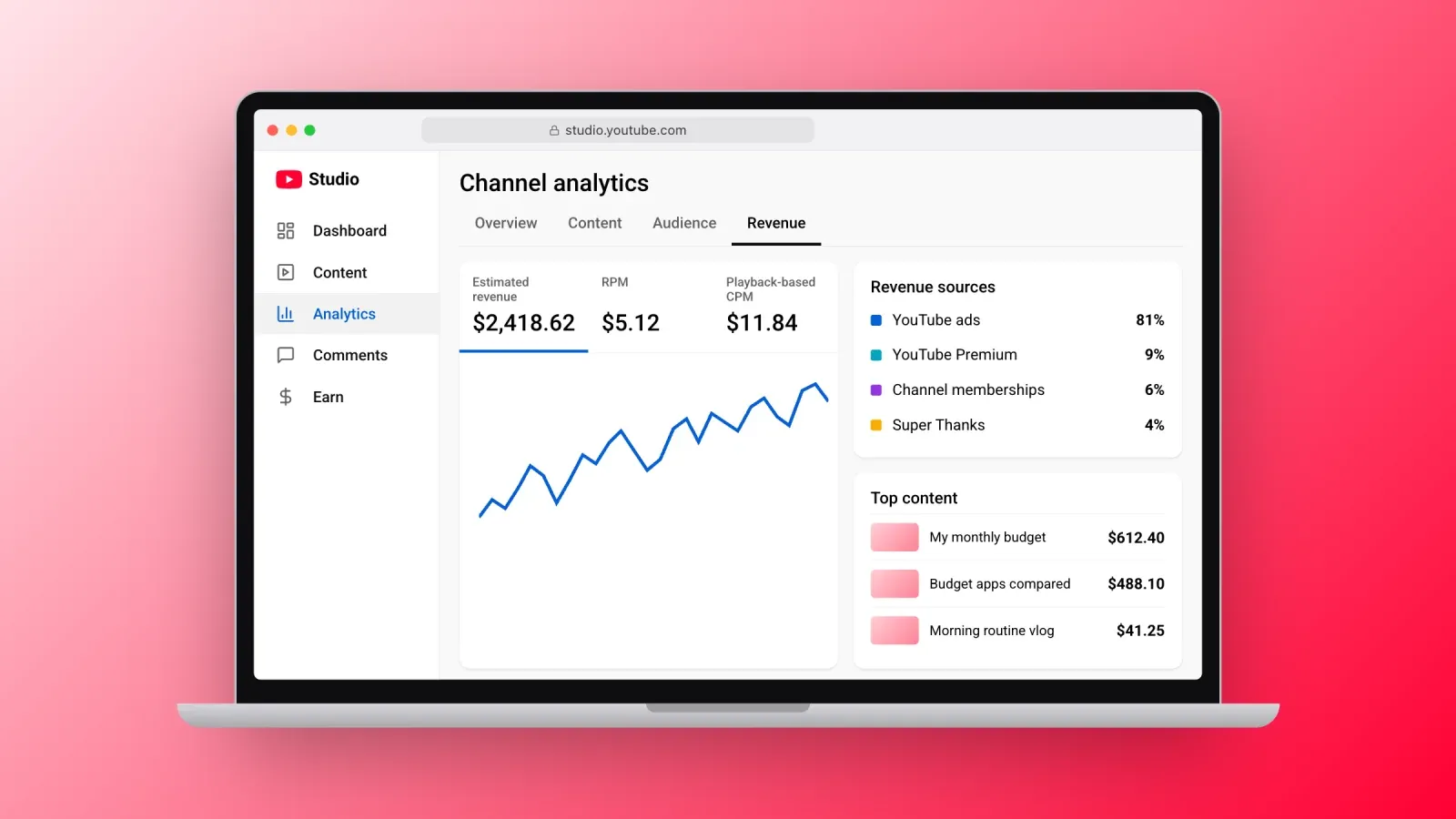
Once you're monetized, your exact RPM appears in YouTube Studio, under Analytics, in the Revenue tab. Before that, use a conservative range for your niche and your audience's main country, and treat any online calculator as a rough estimate.
What changes how much YouTube pays you
Seven factors explain most of the difference between a channel earning $1 per 1,000 views and another earning $15.
1. Your niche
Advertisers pay more to reach viewers who are about to spend money. A video about choosing a credit card or business software attracts advertisers with high customer value, which raises CPM. A gaming clip or a prank video attracts a younger audience and cheaper ads.
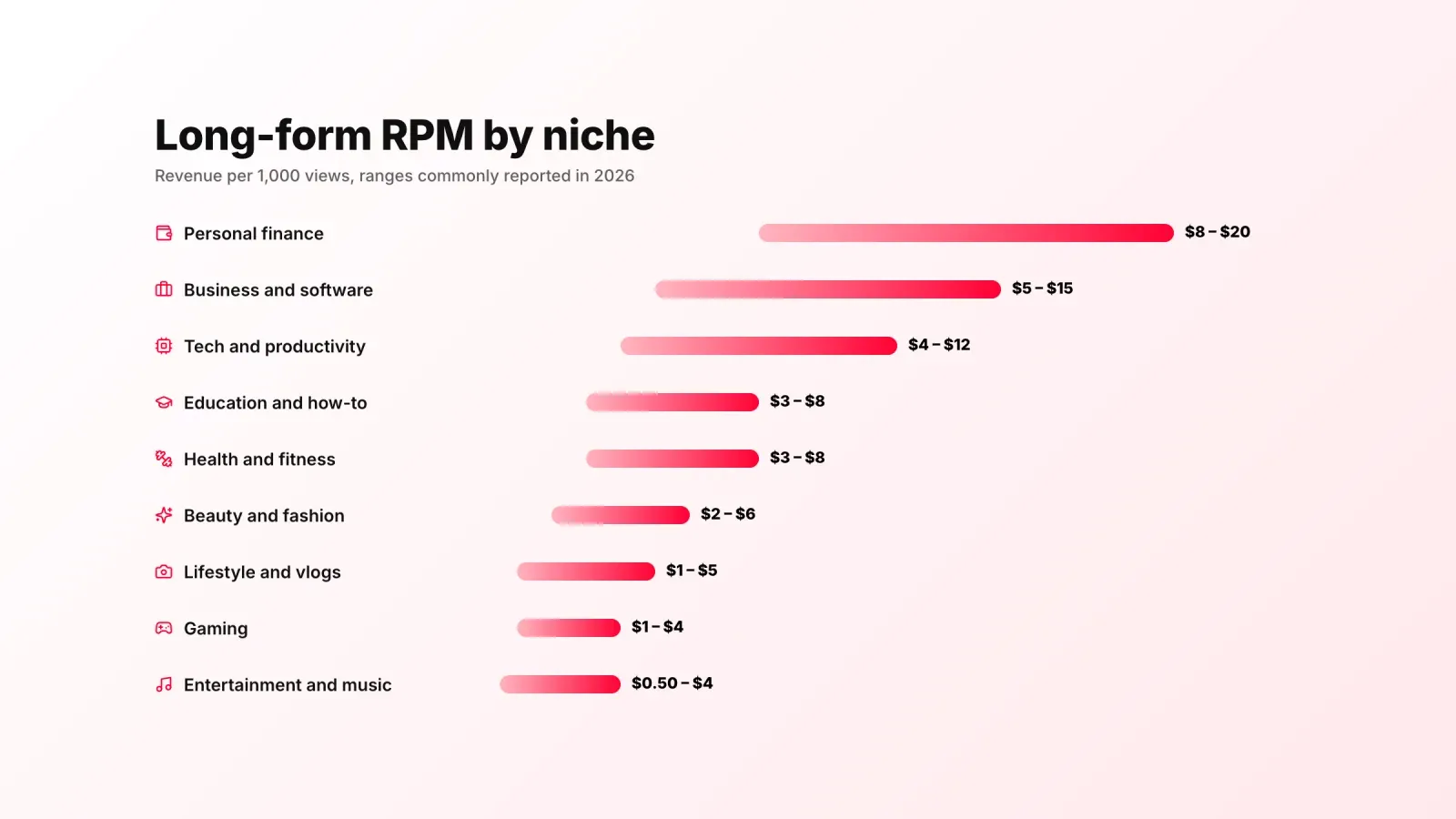
Typical long-form RPM ranges reported by creators and industry trackers in 2026:
- Personal finance and investing: about $8 to $20, sometimes more
- Business, marketing and software: about $5 to $15
- Technology and productivity: about $4 to $12
- Education and how-to: about $3 to $8
- Health and fitness: about $3 to $8
- Beauty and fashion: about $2 to $6
- Lifestyle, travel and vlogs: about $1 to $5
- Entertainment, comedy and music: about $0.50 to $4
- Gaming: about $1 to $4
These ranges overlap a lot, and a well-targeted channel in a "low" niche can out-earn a poorly targeted channel in a "high" one.
2. Your audience's country
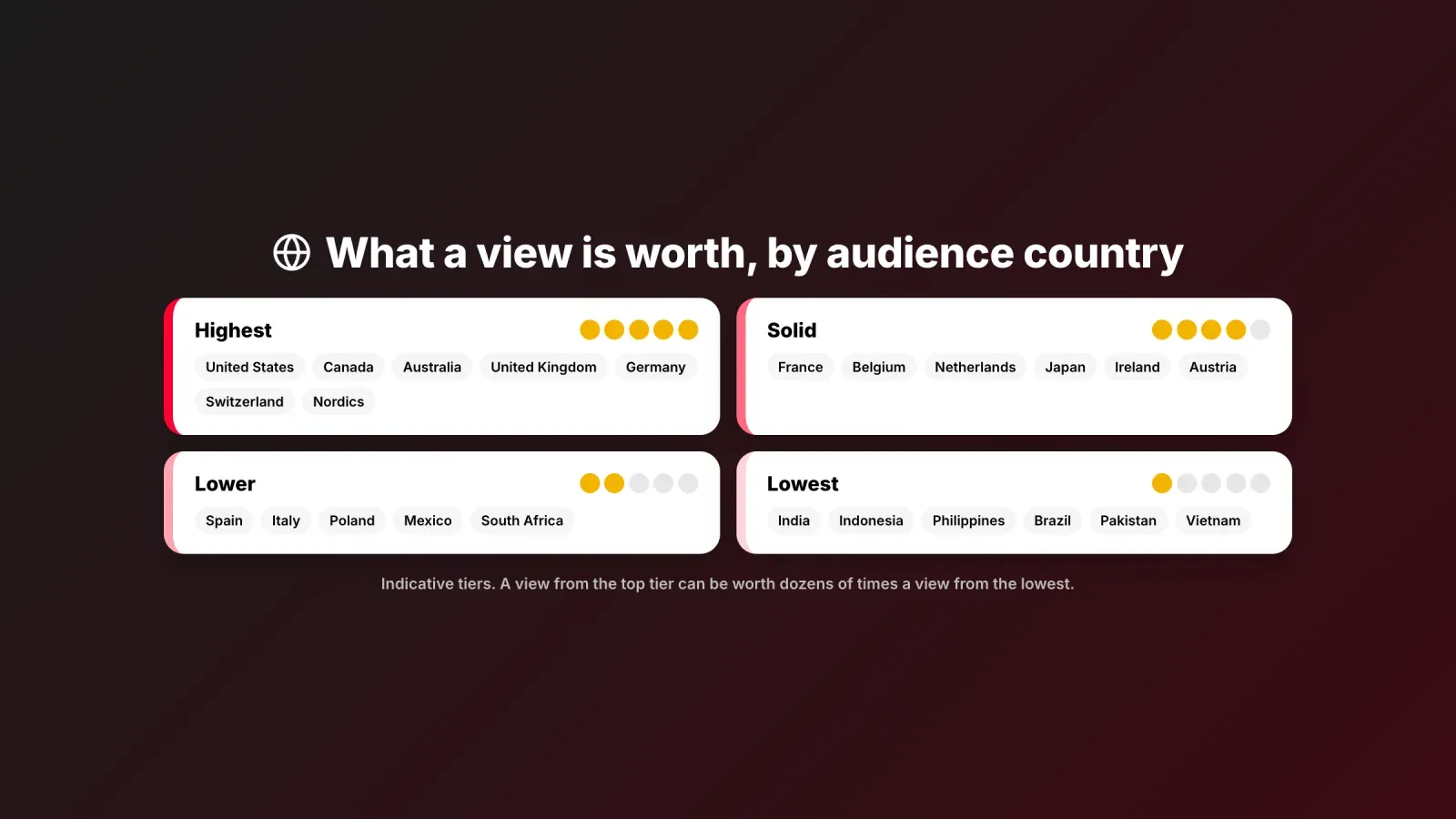
Advertisers pay much more to reach viewers in countries with high consumer spending. Views from the United States, Canada, Australia, the United Kingdom, Germany, Switzerland and the Nordic countries usually earn the most. Views from France, Belgium and other Western European countries are typically solid, often a little below the United States. Views from India, Indonesia, the Philippines, Brazil and many other large markets usually earn several times less, sometimes ten times less, for the same content.
Industry benchmarks regularly show views from the best-paying countries being worth dozens of times more than views from the lowest-paying ones. That's why two channels with the same views can earn very different amounts. You can see your audience's countries in YouTube Studio, under Analytics, in the Audience tab.
3. Video length and mid-roll ads
Videos of 8 minutes or more can include ads in the middle, called mid-rolls, in addition to ads before and after. More ad slots usually mean more revenue per view, as long as viewers keep watching. A 12-minute video that people watch to the end often earns more than three 4-minute videos with the same total views. But padding a video to cross 8 minutes backfires: lower retention means fewer ads seen and fewer recommendations.
4. The time of year
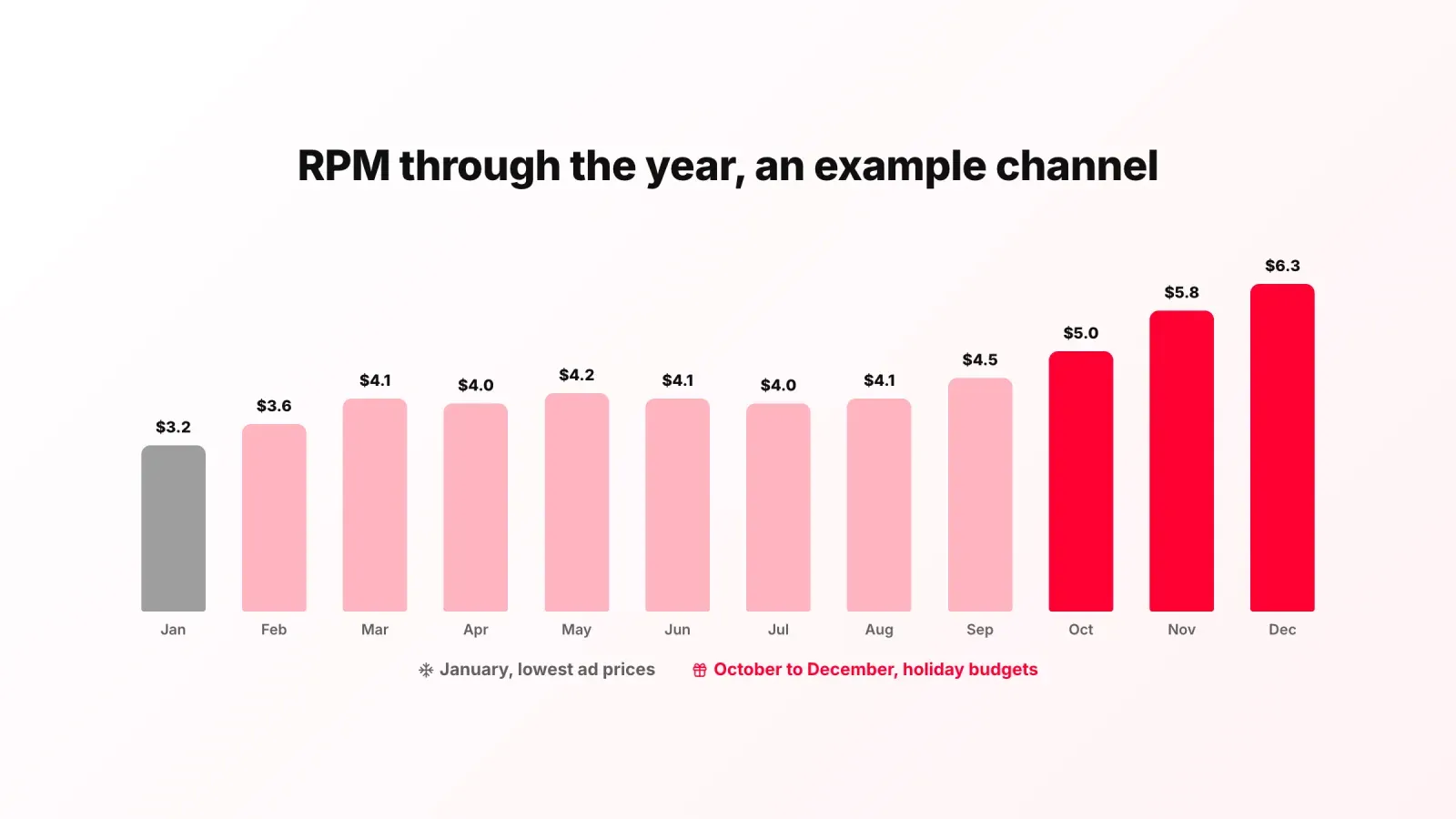
Ad prices follow advertisers' budgets. CPMs are usually lowest in January, after the holiday season, and highest from October to December, when brands spend heavily for Black Friday and the holidays. Many creators see their RPM rise by 30% to 50% or more in the fourth quarter compared with the first. Plan important uploads, and your financial expectations, around that cycle.
5. Long-form vs Shorts
Shorts reach huge audiences, but they earn far less per view, because ads are shown between Shorts rather than inside them and the revenue is shared across all Shorts creators. A channel with a million Shorts views might earn what a long-form channel earns from 10,000 to 20,000 views. Shorts are best used to grow your audience and send viewers to long-form videos and other offers.
6. Watch time and advertiser-friendliness
Videos that keep viewers watching show more ads and get recommended more, which increases both views and revenue. Videos with strong language, violence or sensitive topics can receive limited ads, shown with a yellow icon in YouTube Studio, which reduces earnings sharply. Following YouTube's advertiser-friendly content guidelines keeps your full revenue on the table.
7. YouTube Premium and other in-platform revenue
Premium revenue, channel memberships, Super Chat, Super Stickers, Super Thanks and YouTube Shopping all add to your RPM. A channel with a loyal community can raise its effective earnings per 1,000 views well above its ad-only CPM.
How much YouTube Shorts pay in 2027
Shorts revenue depends on the pool of ad and Premium money generated in the Shorts feed, your share of eligible Shorts views and the music used in your Shorts. Shorts that use licensed music share part of their revenue with rights holders.
In practice, creators commonly report Shorts RPMs between about $0.01 and $0.10, with finance, business and education at the top and gaming and entertainment at the bottom. That's roughly $10 to $100 per million views, and sometimes a bit more in strong niches and high-paying countries.
The 2027 change. From February 1, 2027, channels in the Partner Program need at least 10 million valid Shorts views in the last 90 days to share in Shorts ad and subscription revenue. Channels below that level stay in the program and keep earning from long-form videos, and Shorts revenue sharing resumes when they reach the threshold again. For most small and mid-size channels, this makes Shorts primarily a growth tool rather than an income source.
What the 2027 rules change for your pay
YouTube's 2027 update raises the bar to start earning from ads. From February 1, 2027, new applicants who want ad revenue need 1,000 subscribers plus either 8,000 valid public watch hours in the last 12 months or 20 million valid public Shorts views in the last 90 days, double the previous thresholds. Channels already in the Partner Program keep their place, as long as they accept the updated terms.
A lower tier, with 500 subscribers, 3 public uploads in the last 90 days and 3,000 watch hours or 3 million Shorts views, still unlocks memberships, Super Chat, Super Thanks and shopping features. That means you can earn from your community before you earn from ads.
Our guide on how to monetize a YouTube channel in 2027 explains every requirement and the application step by step.
How and when YouTube pays you
YouTube pays Partner Program earnings through AdSense for YouTube.
- Monthly cycle. Your estimated earnings for a month are finalized early in the following month and added to your AdSense balance.
- Payment threshold. You get paid once your balance reaches the threshold for your currency, for example $100 in the United States. Below that, the balance rolls over to the next month.
- Payment date. Once the threshold is reached, payments are usually issued during the second half of the following month.
- Taxes. You must submit tax information in AdSense. Depending on your country and where your viewers are, taxes can be withheld from some earnings, especially US earnings for creators outside the United States.
- Payment method. Bank transfer is the most common method, and options depend on your country.
Income from sponsorships, affiliate programs and your own products doesn't go through AdSense. It comes directly from brands, affiliate networks or your payment provider.
How to read your earnings in YouTube Studio
Once you're in the Partner Program, the Revenue tab in YouTube Studio Analytics shows everything you need.
- Estimated revenue: what you earned over the selected period, from all sources.
- RPM: your revenue per 1,000 views, all views counted. Watch the trend month over month.
- Playback-based CPM: what advertisers paid per 1,000 views where an ad was shown.
- Revenue sources: the split between ads, YouTube Premium, memberships, Super Chat, Super Thanks and shopping.
- Top-earning content: the videos that earn the most. They often aren't your most viewed videos, which tells you which topics advertisers value.
Compare RPM by video, not only by month. If a tutorial earns $9 per 1,000 views and a vlog earns $2, you know which format to make more often.
How much YouTubers make by channel size
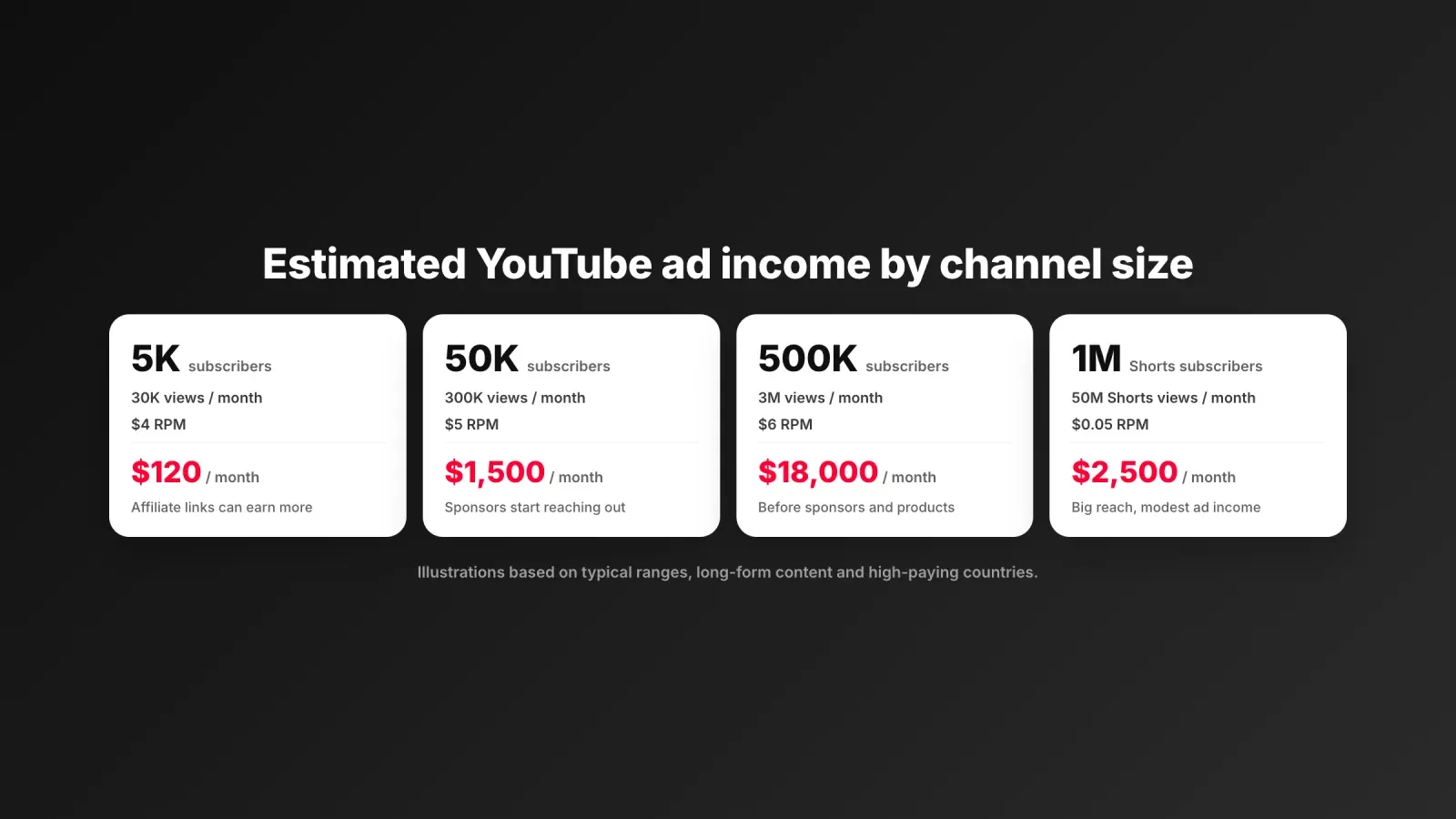
These examples are illustrations based on typical ranges, not promises. They assume long-form content and a mostly English-speaking audience from high-paying countries.
A small channel, 5,000 subscribers. 30,000 monthly views at a $4 RPM earn about $120 per month from YouTube. One affiliate link and a small digital product can easily earn more than the ads.
A growing channel, 50,000 subscribers. 300,000 monthly views at a $5 RPM earn about $1,500 per month. At this size, brands start offering sponsorships, often worth more than a month of ad revenue for a single integration.
An established channel, 500,000 subscribers. 3 million monthly views at a $6 RPM earn about $18,000 per month from YouTube, before sponsorships, memberships and products.
A Shorts-first channel, 1 million subscribers. 50 million monthly Shorts views at $0.05 RPM earn about $2,500 per month from Shorts. Huge reach, modest ad income. Channels like this usually earn most of their money from brand deals and products.
Subscribers don't directly pay you. Views, watch time and audience quality do. A focused channel with 20,000 engaged subscribers can earn more than a broad channel with 200,000 passive ones.
Why ad revenue is only part of the picture
For most full-time creators, YouTube ad revenue is one income stream among several, and often not the biggest.
- Sponsorships. Brands pay you to present their product in a video. Rates vary widely, but many creators and agencies use a starting point of about $20 to $50 per 1,000 expected views for an integration, adjusted for niche and engagement.
- Affiliate marketing. Commissions when viewers buy through your links, often more valuable than ads in tech, beauty, finance and education.
- Memberships and fan funding. Monthly memberships, Super Chat and Super Thanks from your most loyal viewers.
- Your own products. Courses, templates, presets, ebooks, coaching or merch. A $29 product bought by 1% of 100,000 viewers brings $2,900, more than many channels earn from ads on the same views. Our guide to digital products that sell lists ideas and prices.
- Services and bookings. Consulting, coaching calls or freelance work for viewers who want your help directly.
The common tool behind most of these streams is a link in the video description and in your channel's links. A single page that gathers your products, affiliate links, bookings and newsletter makes every view more valuable. Our guide on YouTube links explains where to place them.
How to increase how much YouTube pays you
- Target topics with buying intent. Reviews, comparisons, tutorials for paid tools and "how to choose" videos attract higher-paying advertisers than general entertainment.
- Make longer videos people actually finish. Aim for 8 minutes or more when the topic deserves it, and work on retention: strong hooks, clear structure, no filler.
- Place mid-rolls at natural breaks. Let YouTube place them automatically or choose transitions yourself, so ads don't cut a sentence in half.
- Speak to high-value audiences. Content in English, German or French, or about topics relevant to these markets, generally earns more per view.
- Publish your best work in the fourth quarter. Higher CPMs mean the same views earn more from October to December.
- Stay advertiser-friendly. Avoid unnecessary strong language in the first seconds and in titles and thumbnails, and appeal limited-ads decisions when you think they're wrong.
- Turn on every revenue feature. Memberships, Super Thanks, Super Chat in lives and shopping features add up.
- Use Shorts as a funnel. Link each Short to a related long-form video and grow subscribers who watch your monetized content.
- Send viewers to an offer you own. Ads pay cents per view. Your own product or service can pay dollars per buyer.
Mistakes to avoid
- Comparing your earnings with another channel's views. RPM varies too much by niche and country to compare raw view counts.
- Confusing CPM with income. CPM is before YouTube's share and only counts monetized views. Plan with RPM.
- Chasing Shorts views for income. Shorts are great for discovery but rarely pay the bills on their own, especially with the 2027 floor.
- Padding videos to reach 8 minutes. Lower retention cancels the benefit of extra ads.
- Buying views or subscribers. Fake engagement can get your channel removed from the Partner Program and doesn't earn money anyway.
- Relying only on ads. One policy change or a slow month can cut your income. Diversify early.
FAQ about how much YouTube pays
How much does YouTube pay per view? On long-form videos, most monetized channels earn about $0.001 to $0.01 per view, which means $1 to $10 per 1,000 views. Some finance and business channels earn $15 to $20 or more per 1,000 views. Shorts usually pay well under $0.0001 per view.
How much does YouTube pay for 1 million views? Roughly $1,000 to $10,000 for long-form videos, and more in the best-paying niches and countries. For Shorts, roughly $10 to $100 per million views.
How much does YouTube pay per 1,000 subscribers? Nothing directly. YouTube pays for monetized views and engagement, not subscribers. Subscribers matter because they bring regular views and unlock the Partner Program.
What is a good RPM on YouTube? It depends on your niche and audience. Around $3 to $6 is common for many long-form channels, above $10 is excellent, and finance channels can go higher. Compare yourself with channels in your niche and country, not with the whole platform.
What percentage does YouTube take? YouTube keeps 45% of ad revenue on long-form videos, so creators receive 55%. On Shorts, creators keep 45% of the revenue allocated to them from the Shorts pool.
When does YouTube pay you? Monthly, through AdSense, once your balance reaches the payment threshold, for example $100 in the United States. Payments are usually issued in the second half of the following month.
Do Shorts pay in 2027? Yes, for channels in the Partner Program with at least 10 million valid Shorts views in the last 90 days from February 1, 2027. Shorts RPMs are much lower than long-form RPMs.
How many views do you need to make $1,000 on YouTube? With a $4 RPM, about 250,000 long-form views. With a $10 RPM, about 100,000. With Shorts at $0.05 RPM, about 20 million views.
Earn more from every view
YouTube pays for attention, but not equally. Your niche, your audience's country, your video length and the season can multiply or divide your income from the same views. Use RPM to plan, build long-form videos people finish, and treat ad revenue as a foundation, not the whole house.
The fastest way to earn more per view is to give viewers something to buy or join. Create your free Roctify page to put one link in your descriptions and channel links that leads to your products, affiliate picks, bookings and newsletter, with 0% transaction fees on every plan.