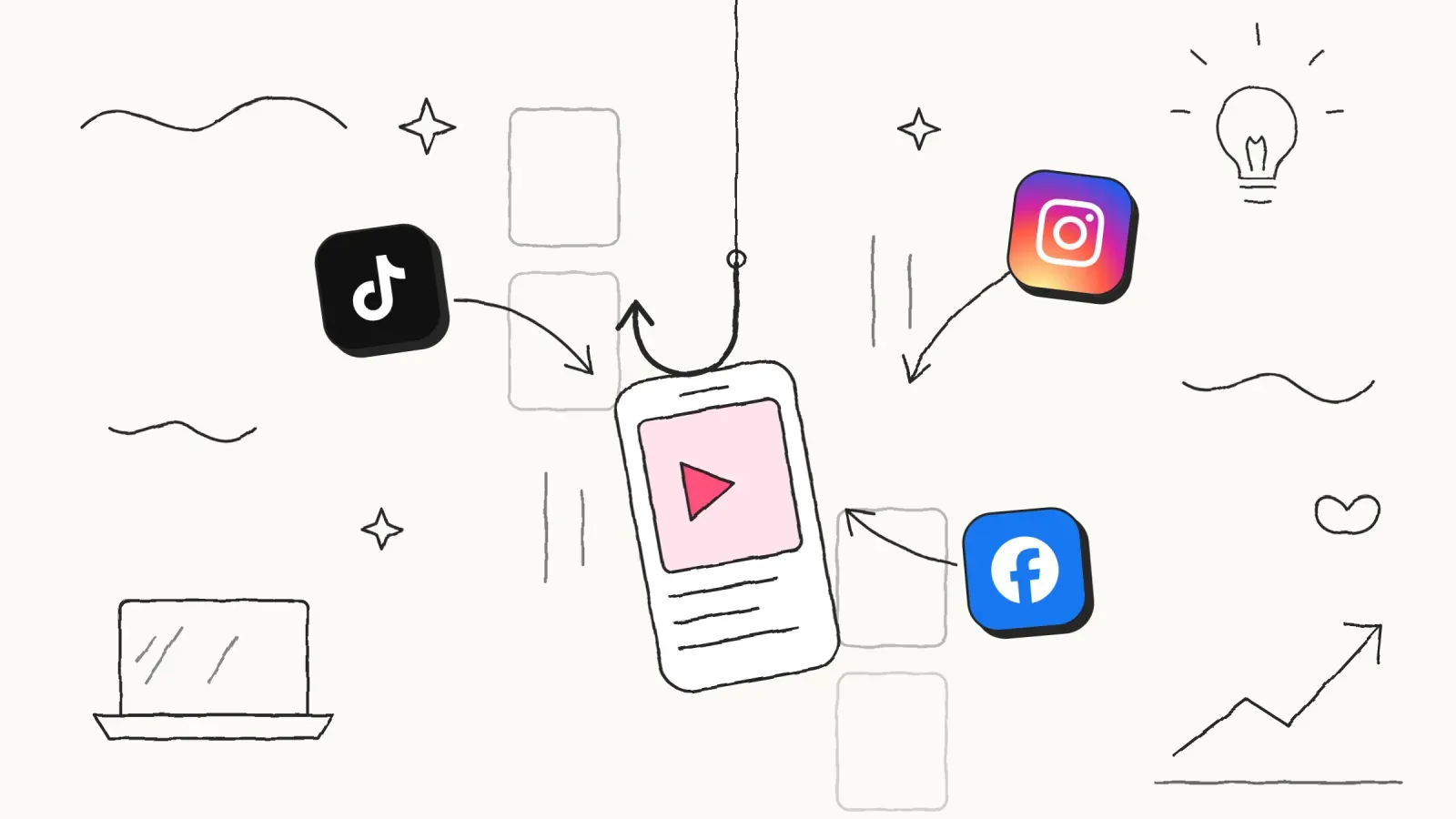
People decide whether to watch your ad before they know what it is about. On TikTok, Reels and the Facebook feed, a thumb moves fast, and the first one to three seconds of a video, or the first glance at an image, decide whether the rest of your message ever gets seen. That opening moment is the hook. A great product with a weak hook rarely gets the chance to sell, while an average product with a strong hook at least earns a fair hearing.
The good news is that strong hooks are not a mystery or a talent you either have or do not have. They follow a small number of psychological patterns that keep working across products, platforms and budgets. Once you know them, you can write ten hook variations for the same ad in half an hour, test them, and keep the ones your audience actually responds to.
This guide covers 12 types of ad hooks that consistently stop the scroll. For each one you will find why it works, ready-to-use formulas, example lines for different kinds of businesses, when to use it and what to watch out for. After that, you will learn how to build a hook in layers, adapt it to each platform, measure it with the right metrics, avoid the mistakes that waste ad spend, and make sure the page people land on keeps the promise your hook made.
What an ad hook is and why the first three seconds matter
An ad hook is the opening element of an ad whose only job is to earn the next few seconds of attention. In a video, it is the first frame, the first words spoken, the first line of on-screen text and the first sound. In a static image, it is the visual that the eye lands on first plus the headline. In a carousel, it is the first card.
The hook does not need to sell. It needs to make the right person think "this is for me" or "wait, what?" quickly enough that they stop moving their thumb. Selling comes later, in the body of the ad, the proof, the offer and the landing page.
Why so much focus on the first seconds? Because social feeds are built for speed. People scroll through dozens of posts in a minute, and many watch with the sound off. Most viewers who leave your video do so at the very beginning, so a small improvement in the opening has a large effect on everything that follows. An ad that holds twice as many people past the first three seconds gives the rest of your message twice the audience, with the same budget.
A useful way to think about it is that every ad has two jobs, and the hook carries the first one.
- Stop the right people. Earn attention from the audience who can actually buy.
- Move them forward. Explain, prove and invite them to the next step.
Notice the word "right". A hook that stops everyone, including people who will never buy, can look great in your dashboard and still lose money. The best hooks are both attention-grabbing and filtering: they pull in the buyers and politely let everyone else keep scrolling.
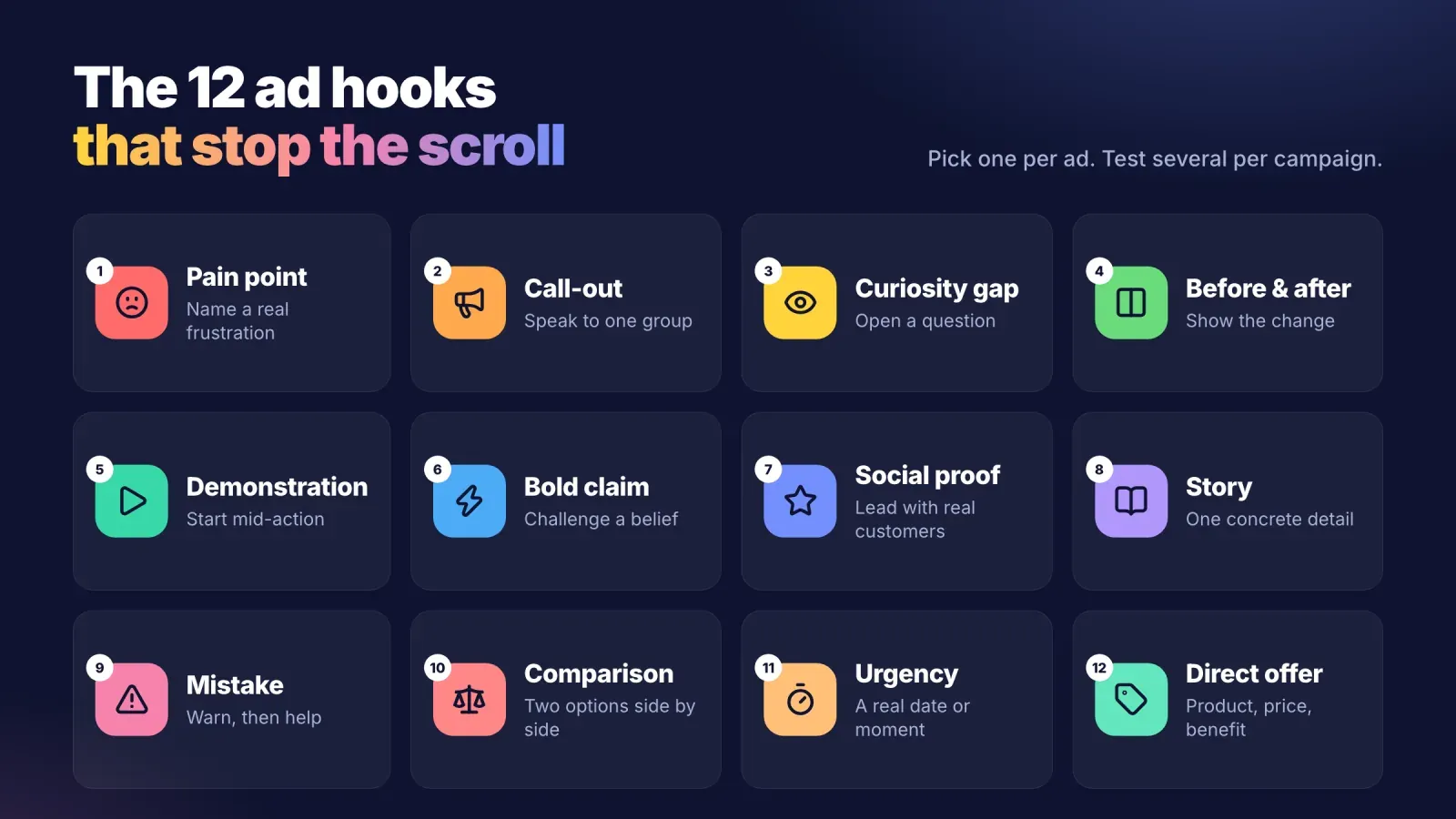
1. The pain point hook
Why it works. People pay attention to their own problems before anything else. When an ad names a frustration someone feels right now, it feels personal, and it instantly filters out people who do not have that problem.
Formulas you can adapt:
- "Tired of [specific frustration]?"
- "If [problem] keeps happening to you, watch this."
- "The reason your [thing] keeps [failing] is not what you think."
Examples:
- A skincare brand: "If your makeup looks patchy by lunchtime, it is probably your moisturizer."
- A bookkeeping service: "Still spending your Sunday evenings sorting receipts?"
- A pet store: "Your dog pulls on the lead because of how the harness sits."
Best for. Products that solve a clear, recognizable problem, and audiences who are already aware of that problem but have not found a solution yet.
Watch out. Be specific. "Struggling with your skin?" is too vague to feel personal. "Dry patches around your nose every winter?" is a problem someone recognizes immediately. Also avoid shaming people or exaggerating their pain, which damages trust and can break advertising policies on personal attributes, especially for health, weight or finance.
2. The call-out hook
Why it works. Hearing your own situation named feels like someone tapping you on the shoulder. A call-out hook addresses a precise group of people, so the right viewers lean in and everyone else moves on quickly, which keeps your budget focused.
Formulas you can adapt:
- "If you are a [role or situation], this is for you."
- "[Specific group], stop scrolling for ten seconds."
- "For anyone who [specific behavior]."
Examples:
- A course creator: "Freelance designers who hate writing proposals, this one is for you."
- A coffee roaster: "For people who own a good espresso machine but still buy supermarket beans."
- A booking tool: "Hairdressers who lose clients to no-shows, listen up."
Best for. Niche products, services for professionals, and any business that knows its ideal customer well.
Watch out. Call out situations and interests rather than sensitive personal characteristics. "New runners training for their first 10k" is fine. Hooks that imply you know someone's health condition, financial difficulties or other personal attributes ("Are you in debt?") are restricted on Meta and can get the ad rejected.
3. The curiosity gap hook
Why it works. When we notice a gap between what we know and what we want to know, we feel a small itch to close it. A curiosity hook opens that gap and promises to close it if the viewer keeps watching.
Formulas you can adapt:
- "I did not expect [surprising result] from [ordinary action]."
- "Nobody talks about this part of [topic]."
- "Here is what happened after [number] days of [action]."
Examples:
- A meal kit: "I cooked every dinner from this box for 30 days. Here is what changed."
- A language app: "The weird trick that finally made me remember vocabulary."
- A candle maker: "Why this candle burns twice as long as the one I used to make."
Best for. Products with a genuine surprise, a non-obvious benefit or an interesting story behind them. It also works well for audiences who do not yet know they have a problem.
Watch out. You must close the gap, and quickly. A curiosity hook that leads nowhere feels like clickbait, and people remember it. If the payoff only arrives after 40 seconds, most viewers will leave before it.
4. The before-and-after hook
Why it works. The brain processes contrast faster than explanation. A visual transformation shows the value of a product in one second, without a single word, which makes it perfect for sound-off viewing.
Formulas you can adapt:
- Open on the "before" for one second, then cut hard to the "after".
- Split screen: the problem on top, the result below.
- "Same [room, face, garden, page], [time] apart."
Examples:
- A cleaning product: a stained oven door, then the same door clean, in one swipe.
- A website builder: a cluttered old page, then the new storefront on the same phone.
- A home organizer: a chaotic closet on top, the organized version below.
Best for. Any product whose result is visible: cleaning, home, beauty, fitness, design, renovation, gardening, food.
Watch out. Be honest. Same lighting, same angle, same person, no filters on one side only. Misleading before-and-after images break consumer protection rules in many countries and are restricted in advertising policies for health, weight loss and cosmetics. They also lead to refunds and angry comments.
5. The demonstration hook
Why it works. Showing a product working is more convincing than any claim. When the first frame is the product doing something useful, the viewer immediately understands what it is and why it matters.
Formulas you can adapt:
- Start in the middle of the action, with no intro.
- "Watch what happens when I [use product on problem]."
- A close-up of the satisfying moment: the click, the pour, the reveal.
Examples:
- A kitchen tool: the first frame is an avocado being pitted and sliced in one move.
- A phone case: the phone is dropped on concrete in the first second.
- A planner app: a messy week becomes a tidy schedule on screen in three taps.
Best for. Physical products with a satisfying use, and software or apps with a clear before and after in the interface.
Watch out. Cut the setup. Many demonstration ads waste the first three seconds unboxing, introducing the brand or showing a logo. Start at the most interesting moment and explain afterwards.
6. The bold claim or contrarian hook
Why it works. A statement that contradicts what people believe creates a small shock. Viewers stop to find out whether you are wrong, right or crazy. It also positions your brand as one with a point of view.
Formulas you can adapt:
- "Stop [common advice]. Do this instead."
- "[Popular belief] is wrong, and here is why."
- "You do not need [expensive thing] to [result]."
Examples:
- A fitness coach: "You do not need a gym membership to get strong."
- A link-in-bio storefront: "Your website is probably losing you sales from Instagram."
- A financial educator: "Saving 10% of your income is not the goal."
Best for. Brands with real expertise and a defensible opinion, and markets full of repeated, generic advice.
Watch out. Only make claims you can back up in the next few seconds of the ad and on the landing page. Health, financial and performance claims are heavily regulated. A contrarian hook without substance turns into an argument in the comments instead of a sale.
7. The social proof hook
Why it works. When we are unsure, we look at what other people do. Opening with proof that many people, or the right people, already trust a product lowers doubt before the viewer has even heard the pitch.
Formulas you can adapt:
- "[Number] people bought this last month. Here is why."
- Open on a real customer review read aloud or shown on screen.
- "The [product] my customers keep reordering."
Examples:
- A bakery: "We sold 2,000 of these cinnamon rolls in December, and this is the recipe change that did it."
- A course creator: open on a real student message saying they landed their first client.
- A fashion brand: a quick montage of real customers wearing the same jacket.
Best for. Businesses with genuine customer volume, strong reviews, user-generated content or recognizable clients.
Watch out. Every number and every testimonial must be real and verifiable. Fake reviews and invented figures are illegal in the European Union and many other markets, and they destroy trust when someone checks. If you are just starting out, use quality of proof (one detailed, authentic story) instead of quantity.
8. The story hook
Why it works. Stories are how humans make sense of things. A story hook signals that a journey is about to unfold, with a character, a problem and a turning point, and people want to know how it ends.
Formulas you can adapt:
- "Two years ago I was [struggle]. Today I [result]."
- "This started in my kitchen with [small detail]."
- "The day a customer told me [surprising thing], I changed everything."
Examples:
- A jewelry maker: "I made my first ring with a tool I bought for 12 euros."
- A coaching business: "I was fired on a Tuesday. By Friday I had my first client."
- A family farm: "My grandmother refused to sell this honey. Here is why we finally do."
Best for. Founder-led brands, handmade products, coaches, creators and any business with an authentic origin.
Watch out. A story hook needs a concrete detail in the first line. "Let me tell you my story" is not a hook. "I made my first ring with a 12-euro tool" is. Keep the story short and connect it to the product within the first ten seconds.
9. The mistake or warning hook
Why it works. People are more motivated to avoid a loss than to gain an equivalent benefit. Warning viewers that they might be making a mistake triggers that instinct, and nobody wants to be the one doing it wrong.
Formulas you can adapt:
- "[Number] mistakes that are costing you [result]."
- "Do not buy [category] before you watch this."
- "If you are still [doing X], you are losing [Y]."
Examples:
- A mattress brand: "Do not buy a mattress until you check this one thing."
- A photographer offering courses: "Three settings that make your product photos look cheap."
- A digital product seller: "The pricing mistake that keeps your ebook from selling."
Best for. Educational brands, products in categories where buyers are confused, and audiences comparing options.
Watch out. Use fear lightly. A helpful warning feels like advice from a friend. A threatening one feels manipulative. Always follow the warning with a genuinely useful tip, even before you mention the product, so the viewer feels they gained something either way.
10. The comparison hook
Why it works. Choosing is hard, and comparisons make it easier. A hook that puts two options side by side gives viewers a mental shortcut and invites them to judge for themselves.
Formulas you can adapt:
- "[Cheap option] vs [your option]. Is the difference worth it?"
- "I tried [number] [products]. Only one is still in my bag."
- "What [price A] gets you vs what [price B] gets you."
Examples:
- A water bottle brand: holding a dented plastic bottle next to a sleek insulated one.
- A link-in-bio tool: "A list of links vs a real storefront. Same followers, different sales."
- A tea shop: "Tea bags vs loose leaf, tasted blind."
Best for. Products with a clear advantage, buyers who are actively comparing, and categories with a well-known alternative.
Watch out. Comparative advertising is allowed in Europe but strictly framed. Compare like with like, use verifiable facts, and do not denigrate or name competitors in a misleading way. Comparing your product with a generic alternative ("a standard plastic bottle") is usually safer than naming a brand.
11. The urgency or timely hook
Why it works. A reason to act now beats a reason to act someday. Timely hooks connect the ad to a moment the viewer is already living: a season, an event, a deadline or a trend.
Formulas you can adapt:
- "If you want [result] before [date or event], start this week."
- "[Season or event] is in [time]. Here is how to be ready."
- "Last chance: [real deadline]."
Examples:
- A garden center: "Plant these bulbs this weekend if you want flowers in March."
- A gift shop: "Order by Thursday for delivery before Mother's Day."
- A tax advisor: "Your declaration is due in three weeks. Do not wait for the last day."
Best for. Seasonal products, launches, events, limited stock and services tied to deadlines.
Watch out. The urgency must be real. Fake countdowns, endless "last chance" sales and invented stock limits are misleading commercial practices under EU consumer law, and they train your audience to ignore you. Use real dates and real limits.
12. The direct offer hook
Why it works. Sometimes the clearest hook is the offer itself. People who already know your brand, or who are actively looking for a product like yours, do not need a story. They need to know what it is, what it costs and why now.
Formulas you can adapt:
- "[Product] for [price]. [One key benefit]."
- "Your first [product] free when you [simple action]."
- "New: [product], [one benefit], available today."
Examples:
- A pizzeria: "Two large pizzas for 20 euros, delivered in 30 minutes."
- A course creator: "My full photography course, 49 euros, lifetime access."
- A subscription box: "Your first box free when you subscribe this month."
Best for. Retargeting people who visited your page, warm audiences, promotions and simple products.
Watch out. Direct offers work poorly on cold audiences who have never heard of you, because they have no reason to care yet. Keep them for warm traffic, and make sure the price and conditions on the ad match exactly what people see after the click.
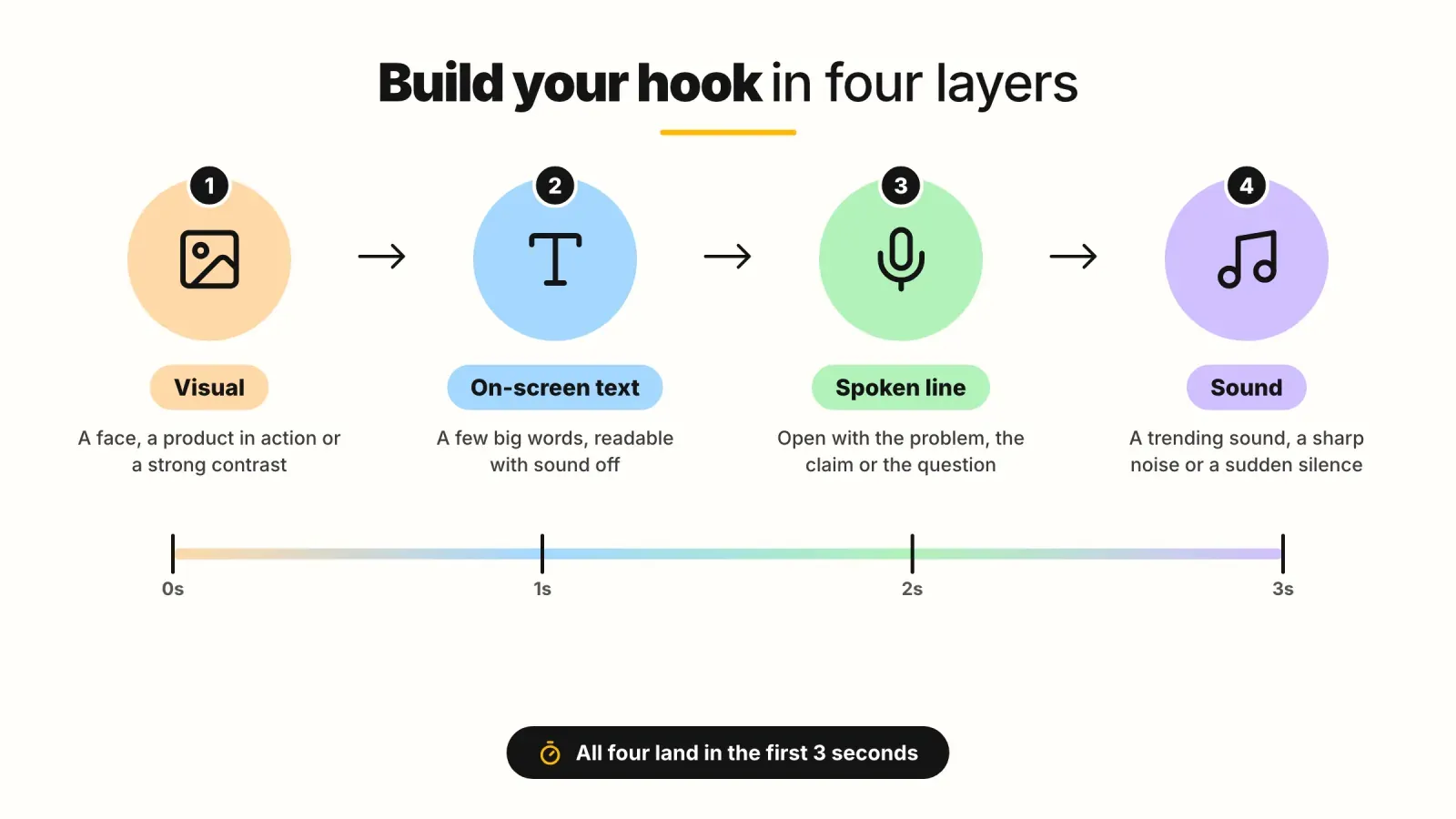
Build your hook in four layers
A strong video hook is rarely just a sentence. It combines four layers that work together in the first seconds. Treat each layer as something to design and test.
The visual. What the eye sees in the first frame: a face showing emotion, a product in action, a strong contrast, an unexpected object, movement. Faces and hands tend to stop people well. A static logo or a slow fade almost never does.
The on-screen text. Many people watch with the sound off, so the key line should also appear on screen, large, high contrast and placed away from the parts of the screen covered by the app's buttons and captions. Keep it to a few words.
The spoken line. If someone talks, the first sentence should be the hook itself. Skip greetings like "Hi guys" or "So today I want to talk about". Start with the problem, the claim or the question.
The sound. A trending sound, a sharp noise, a voice with energy or a sudden silence can all stop the scroll. On TikTok and Reels especially, sound is part of the hook.
The layers do not need to say the same thing. A powerful pattern is a visual that shows the result while the text names the problem: a spotless oven on screen with the text "This took 4 minutes." Each layer adds information instead of repeating it.
For static ads, the same logic applies in compressed form. The image is the visual layer, the headline on or near the image is the text layer, and the first line of the primary text replaces the spoken line. Write that first line as if the rest of the caption will be hidden, because on most placements it will be.
Adapt your hooks to each platform
The same hook type can work everywhere, but its execution needs to fit how people use each platform.
TikTok. People expect native, creator-style content. Hooks that look like ads get skipped. Talk to the camera, use the platform's text styles and sounds, and get to the point within the first two seconds. Pattern interrupts (an unexpected movement, a sudden cut, an object thrown into frame) work well here.
Instagram Reels and Stories. Similar to TikTok, with a slightly more polished, aesthetic expectation. Vertical 9:16 video, strong first frame, text placed in the safe zone away from the username and buttons. In Stories, the first frame has to work almost like a static ad, because people tap through very quickly.
Facebook feed. The audience is often broader and a bit older, and the feed shows more text. Square or 4:5 formats take more screen space. The first line of the primary text matters a lot here, so write it as a second hook.
YouTube. In skippable ads, viewers can skip after five seconds, so you have five seconds to earn the rest. Name the viewer or the problem immediately, and show the brand or product early, because many people will only see those first seconds.
Static and carousel ads. The first card or the image does all the work. Use one clear focal point, high contrast and a short headline. For carousels, the first card should make people want to swipe, for example by starting a list or a story.
Whatever the platform, make one version per format instead of cropping a single video everywhere. A horizontal video squeezed into a vertical frame looks like an ad from another platform, which is the fastest way to get skipped.
How to test ad hooks and read the results
You will not know which hook works best by guessing. The reliable approach is to write several, test them under the same conditions and let the numbers decide.
Change only the hook. Keep the same body, the same offer, the same audience and the same landing page, and create three to five versions that differ only in the first three seconds. This is the cheapest creative test you can run, because you reuse 90% of the video.
Use different hook types, not small word changes. Testing "Tired of dry skin?" against "Sick of dry skin?" teaches you very little. Testing a pain point hook against a before-and-after hook against a social proof hook tells you what kind of message your audience responds to.
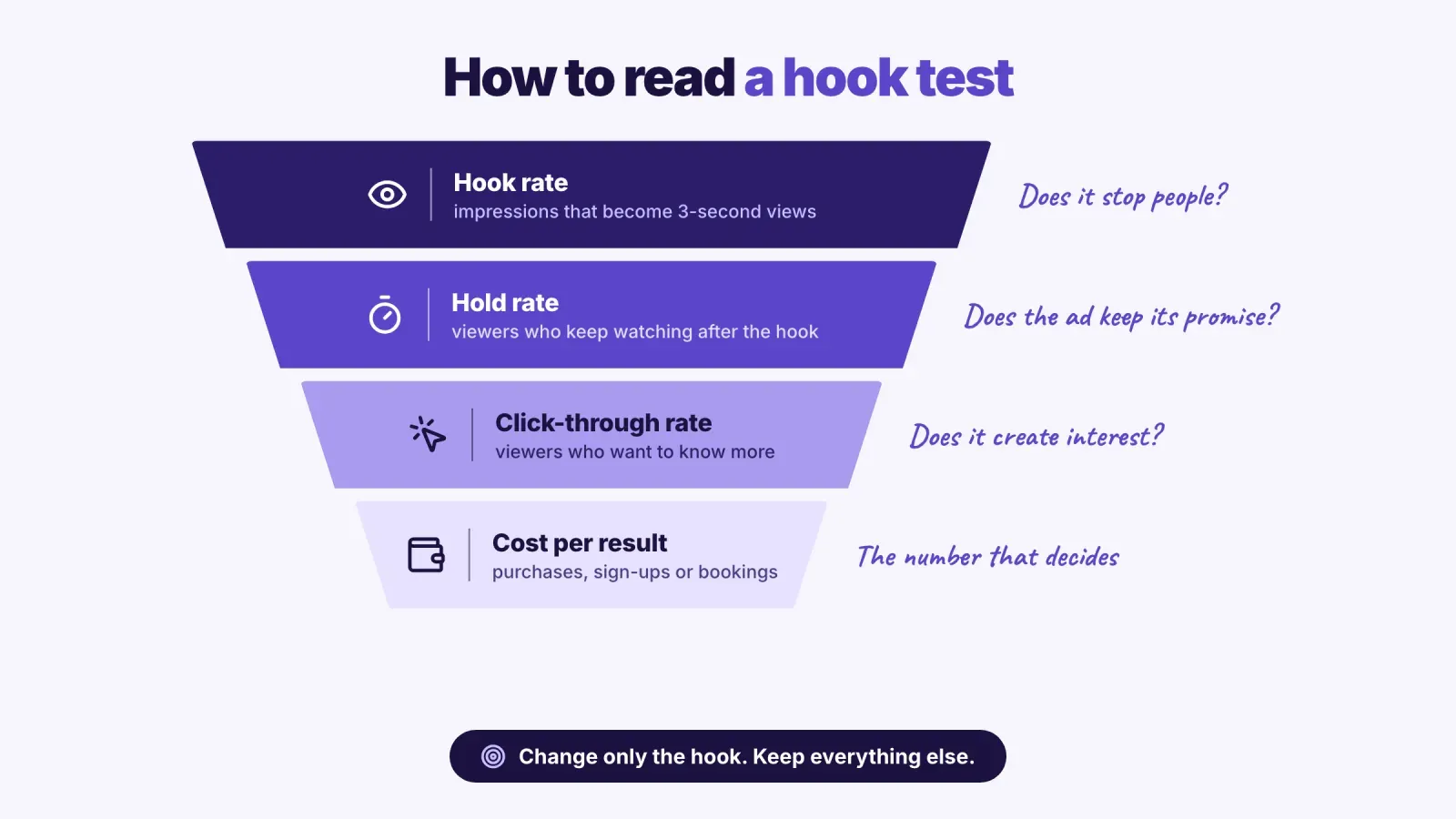
Watch the right metrics.
- Hook rate (or thumb-stop rate). The share of impressions that turn into a three-second video view. It tells you whether the opening stops people. Many advertisers aim for roughly a quarter to a third of impressions, but benchmarks vary a lot by platform, placement and industry, so compare your hooks against each other rather than against a universal number.
- Hold rate. The share of people who watch a larger part of the video, for example 15 seconds or until the end, among those who passed the first three seconds. A great hook with a terrible hold rate means the opening promised something the rest of the ad did not deliver.
- Click-through rate. Whether the ad makes people want to know more.
- Cost per result. Purchases, sign-ups or bookings. This is the number that really matters. A hook with a slightly lower hook rate but a lower cost per purchase wins.
Give each test enough data. Do not decide after 200 impressions. Let each version gather a meaningful number of impressions and results before judging, and keep the test running for several days to smooth out daily swings.
Keep a hook log. Record every hook you test, its type, the metrics and what you learned. After a few months, you will know which hook types your audience prefers, which saves you from starting from zero with every new campaign. If you research competitors' ads for inspiration, our guide on how to research Meta ads without copying your competitors shows how to turn public examples into original hypotheses.
Make the landing page keep the hook's promise
A hook earns the click. The page earns the sale. If your ad says "Two large pizzas for 20 euros" and the link opens your home page, where the visitor has to search for the offer, you lose people at the exact moment they were most interested.
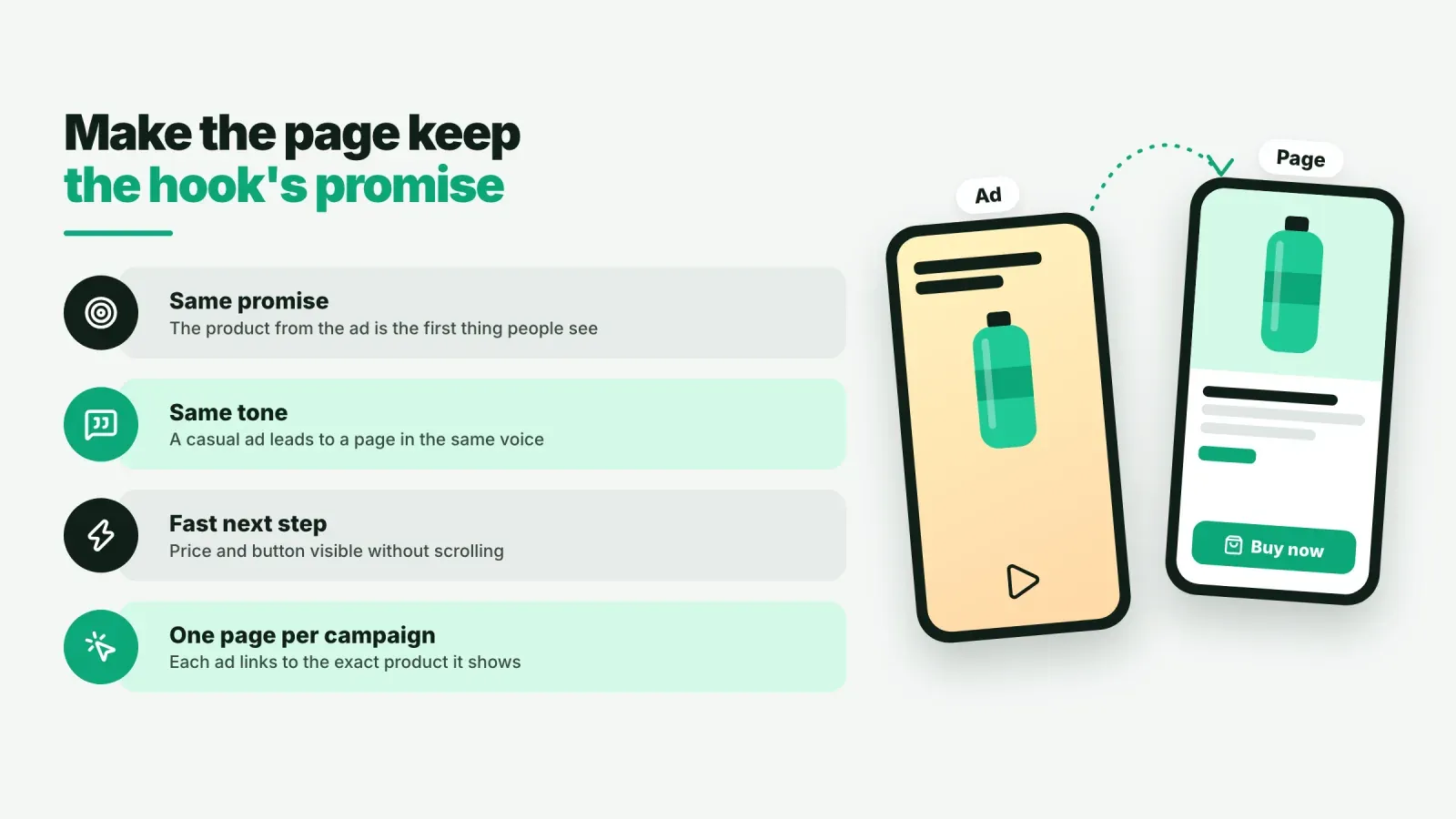
Check three things for every hook you launch.
The same promise. The product, offer or result in the hook should be the first thing visible on the landing page, with the same words and, ideally, the same image.
The same tone. A casual creator-style video followed by a stiff corporate page feels like two different businesses. Keep the voice consistent.
A fast, clear next step. Most social ad traffic arrives on a phone. The page should load quickly, show the price and the main button without scrolling, and make checkout or booking simple.
This is also why it helps to create one focused destination per campaign instead of sending everything to the same page. With Roctify, you can add products, digital downloads, bookings and offers to your storefront and link in bio page, then point each ad to the exact product or collection it talks about. When the hook and the page tell the same story, more of the attention you paid for turns into customers.
Common mistakes that kill hook performance
Starting with the logo. A logo animation or a brand intro in the first seconds tells viewers "this is an ad" before giving them a reason to care. Put the brand later, or integrate it naturally in the product shot.
Warming up before the hook. "Hi everyone, welcome back" wastes the most valuable seconds of your ad. Cut everything before the first interesting sentence.
Being too clever. A wordplay that needs a second reading, or an abstract visual that needs explaining, loses people. Clear beats clever on a fast-moving feed.
Promising what the ad does not deliver. A hook that baits attention and then changes subject earns views, angry comments and very few sales. The hold rate and the cost per purchase will expose it.
Ignoring the sound-off viewer. If your hook only works with sound, you lose a large part of your audience. Always add on-screen text.
Testing one hook and stopping. Even great hooks wear out as the same audience sees them repeatedly. Plan to refresh hooks regularly, keeping the body of the ad that works.
Using the same hook type everywhere. If every ad you run is a pain point hook, you never learn whether a story or a demonstration would perform better. Rotate hook types in your tests.
30 hook lines you can adapt today
Use these as starting points, then replace the brackets with your own product, audience and proof.
- "If you [situation], you need to see this."
- "This is why your [thing] keeps [problem]."
- "I wish someone had told me this before I [action]."
- "Stop [common habit]. Try this instead."
- "[Number] seconds. That is all it takes to [result]."
- "Nobody believes me when I say [surprising fact]."
- "The [product] that replaced [three other things] in my [place]."
- "Here is what [price] gets you."
- "My customers keep asking me about this, so here it is."
- "Do not buy [category] until you check this."
- "POV: you finally found [solution]."
- "This is the [product] I give to every friend who [situation]."
- "Three mistakes I made when I started [activity]."
- "[Before] to [after] in [time]."
- "If you only change one thing in your [routine], change this."
- "I tested [number] [products] so you do not have to."
- "The reason [group] love this [product]."
- "You are probably doing [task] the hard way."
- "This sold out twice. It is back."
- "Order before [real date] for [benefit]."
- "What I would do if I had to [goal] from zero."
- "[Group], this one is for you."
- "The cheapest way to [result] that actually works."
- "Watch this before your next [purchase or event]."
- "One question I ask every new client."
- "This is what [time] of [activity] taught me."
- "Same [thing], two different results. Here is why."
- "Most people throw this away. Do not."
- "I almost did not post this."
- "If you have [object] at home, try this."
Frequently asked questions
How long should an ad hook be? Aim for the first one to three seconds of a video, or a single short line of text. On YouTube skippable ads, think in terms of the first five seconds. If the hook needs more than one sentence to make sense, it is probably trying to do too much.
Which hook type performs best? There is no universal winner. Pain point, demonstration and before-and-after hooks often perform well for cold audiences because they are clear and visual, while direct offer hooks tend to work best for warm audiences. Your audience, product and platform decide, which is why testing several types matters.
How many hooks should I test per ad? Three to five versions per ad is a practical number for most small businesses. That is enough to see real differences without splitting a small budget into too many pieces.
Should my hook mention the brand? It can, but it rarely needs to in the very first second. People decide based on relevance to them. Showing the product clearly in use is usually enough, and the brand can appear a few seconds later.
Do hooks matter for static image ads? Yes. The main visual and the headline play the role of the hook. The same patterns apply: name the problem, show the result, use proof or make an offer, all in a single glance.
How often should I refresh my hooks? When performance starts to drop on an ad that used to work, especially if frequency rises and the hook rate falls, test new hooks on the same body first. It is the fastest and cheapest way to give a winning ad a second life.
Can I use AI to write hooks? AI is helpful to generate many variations quickly from your own notes about your product, customers and proof. Edit the results so they sound like you, check every claim, and let your test data choose the winners.
Turn the attention you earn into sales
A hook is a promise made in under three seconds. Choose the type that fits your product and audience, build it with a strong visual, clear on-screen text, a direct first sentence and the right sound, then test several types against each other and keep what your numbers support.
The final step happens after the click. Send every ad to a page that repeats its promise and makes buying easy. Create your free Roctify page to turn your link in bio into a storefront for products, bookings and digital downloads, with 0% transaction fees on every plan, so the people your best hooks stop actually become customers.