Almost every creator asks the same question at some point. How many followers do you need to make money on Instagram? The honest answer is that there is no single number. Some creators make their first sale with 300 followers, and some accounts with 50,000 followers earn nothing because nobody trusts them enough to act on what they say.
There are real numbers, though, and they're worth knowing. Instagram sets official follower minimums for its own money tools, brands use follower tiers to decide what they pay, and simple funnel math tells you what a small audience can earn from your own products. This guide puts all of it in one place for 2027. You'll see the exact thresholds Instagram publishes, what creators charge per post at each size, how to price your first deal, what to do at every follower level and a 90-day plan to earn your first income.
The short answer
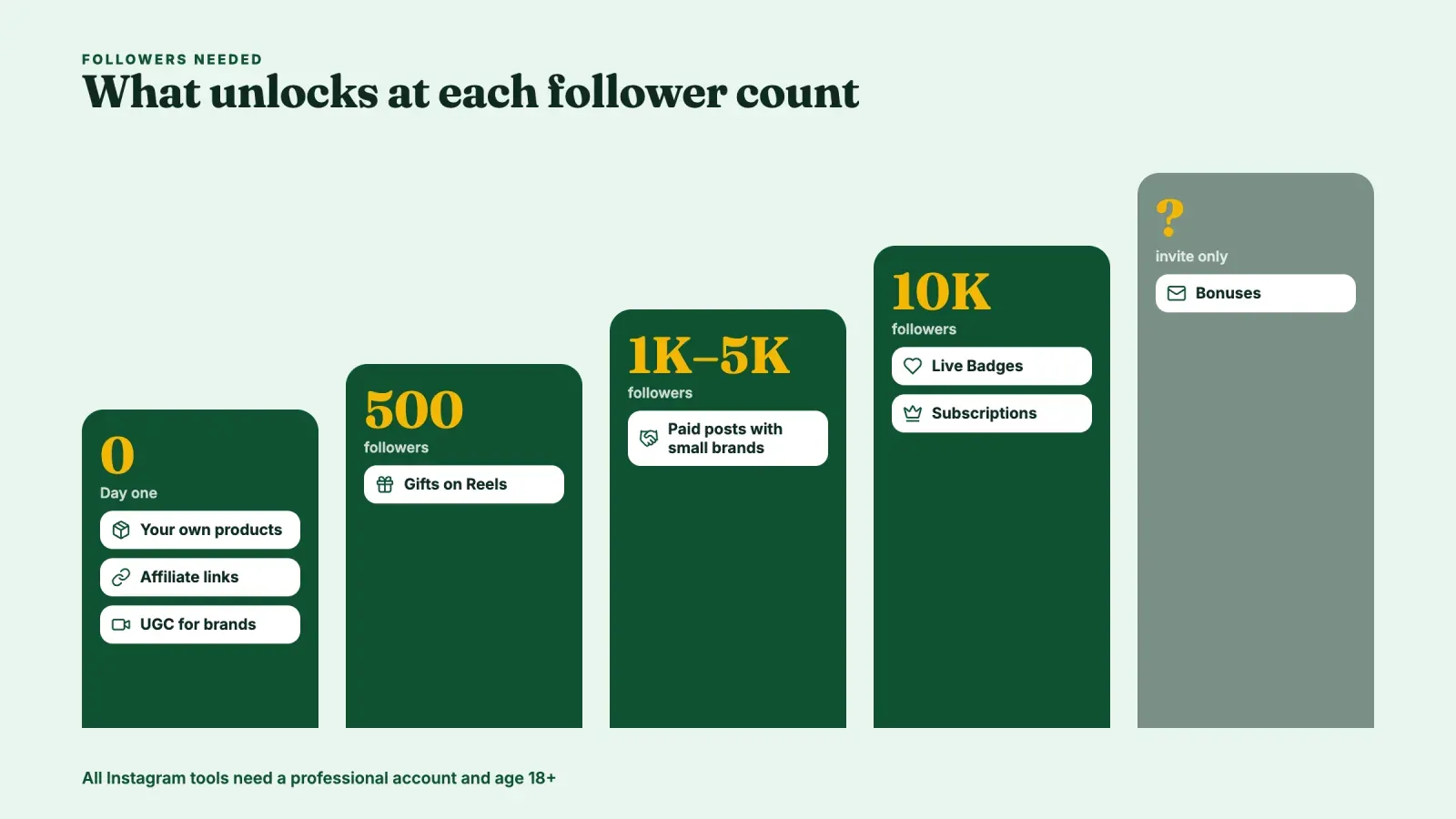
You can start making money on Instagram with a few hundred followers if you sell something yourself or work with small brands, while Instagram's own payout tools start at 500 followers and its bigger features need 10,000.
Here is how the main ways to earn compare.
| Way to earn | Followers needed | What else you need |
|---|---|---|
| Selling your own products or services | None | A link in bio and something people want |
| Affiliate links | None | A program that accepts you and honest recommendations |
| UGC for brands | None | A portfolio of sample videos |
| Gifts on Reels | 500 | Professional account, 18+, payout account, eligible country |
| Paid posts with small brands | About 1,000 to 5,000 | A clear niche and good engagement |
| Live Badges | 10,000 | Professional account, 18+, eligible country |
| Subscriptions | 10,000 | Professional account, 18+, eligible country |
| Bonuses | Invite only | An invitation from Instagram |
The table hides one important detail. Follower count is only a gate. What you actually earn depends on how many people see your posts, how many of them act and what you offer them. A creator with 4,000 engaged followers in a narrow niche often earns more than one with 40,000 passive followers from a giveaway.
Instagram's official follower requirements
Instagram publishes eligibility rules for each of its monetization tools in its Help Center. Every tool requires a professional account (creator or business), being at least 18 years old and following Instagram's Partner Monetization Policies and Content Monetization Policies. On top of that, each tool has its own follower minimum and country list.
Gifts on Reels, 500 followers
Gifts let viewers, including people who don't follow you, send you virtual gifts on your Reels. They buy Stars inside the app and spend them on gifts. Instagram then pays you a monthly revenue share equal to 0.01 USD for every Star you receive.
To earn from Gifts, you need at least 500 followers, a professional account, to be 18 or older, an eligible country and a payout account. If someone sends you a gift before your payout account is set up, you'll see who sent it but you won't receive the money. Collab posts and accounts that mainly post content focused on children can't earn from Gifts.
Do the math before you get excited. 1,000 Stars equals 10 USD. Gifts are a nice tip jar and a signal that people value your work, but very few creators live on them.
Live Badges, 10,000 followers
Badges let viewers buy hearts next to their name during your live videos. Their comments stand out, and you get paid. The requirements are 10,000 followers, a professional account, being 18 or older and living in a country where Badges are offered.
Badges work best for creators who go live on a schedule, such as teachers, coaches, gamers, musicians and anyone running live Q&As. If you never go live, this tool won't matter to you.
Subscriptions, 10,000 followers
Subscriptions let your followers pay a monthly fee for exclusive Reels, Stories, lives, broadcast channels and a purple badge next to their name. Instagram's Help Center lists 10,000 followers as the minimum, along with a professional account, being 18 or older and agreeing to the Subscriptions Terms of Use. Accounts that mainly post content focused on children aren't eligible, and the feature is only available in a list of countries that has grown over time.
Subscriptions are the closest thing Instagram offers to recurring income. They only work if you can publish exclusive content every week without burning out, so plan your subscriber content before you switch the feature on.
Bonuses, invite only
Instagram has run several bonus programs over the years, paying creators for Reels performance, for joining from other apps or for bringing in new users. They change often, they're invite only and they're usually limited to a few countries. You can't apply for them, and there's no public follower minimum. If you see a bonus offer in your Professional dashboard, read the terms carefully, then treat it as extra income you can't count on.
Creator marketplace and paid partnerships, no fixed number
Instagram's creator marketplace connects brands with creators who have professional accounts. Meta doesn't publish a single follower threshold for it, and access depends on your country, your account standing and the rollout. The paid partnership label, which you use to disclose sponsored posts, doesn't have a follower minimum either. Any professional account can tag a brand partner, provided the content follows Instagram's branded content rules.
What content can't be monetized
Hitting a follower number isn't enough. Instagram's Content Monetization Policies exclude some formats from its money tools, even if they are allowed on the platform. That includes a single static image with little or no motion, slideshows of still images, looping clips, videos that are mostly text over images and posts that only ask people to like or comment. Engagement bait, misleading health claims and content rated false by fact-checkers can't earn either. If you plan to rely on Gifts or Subscriptions, make original video your default format.
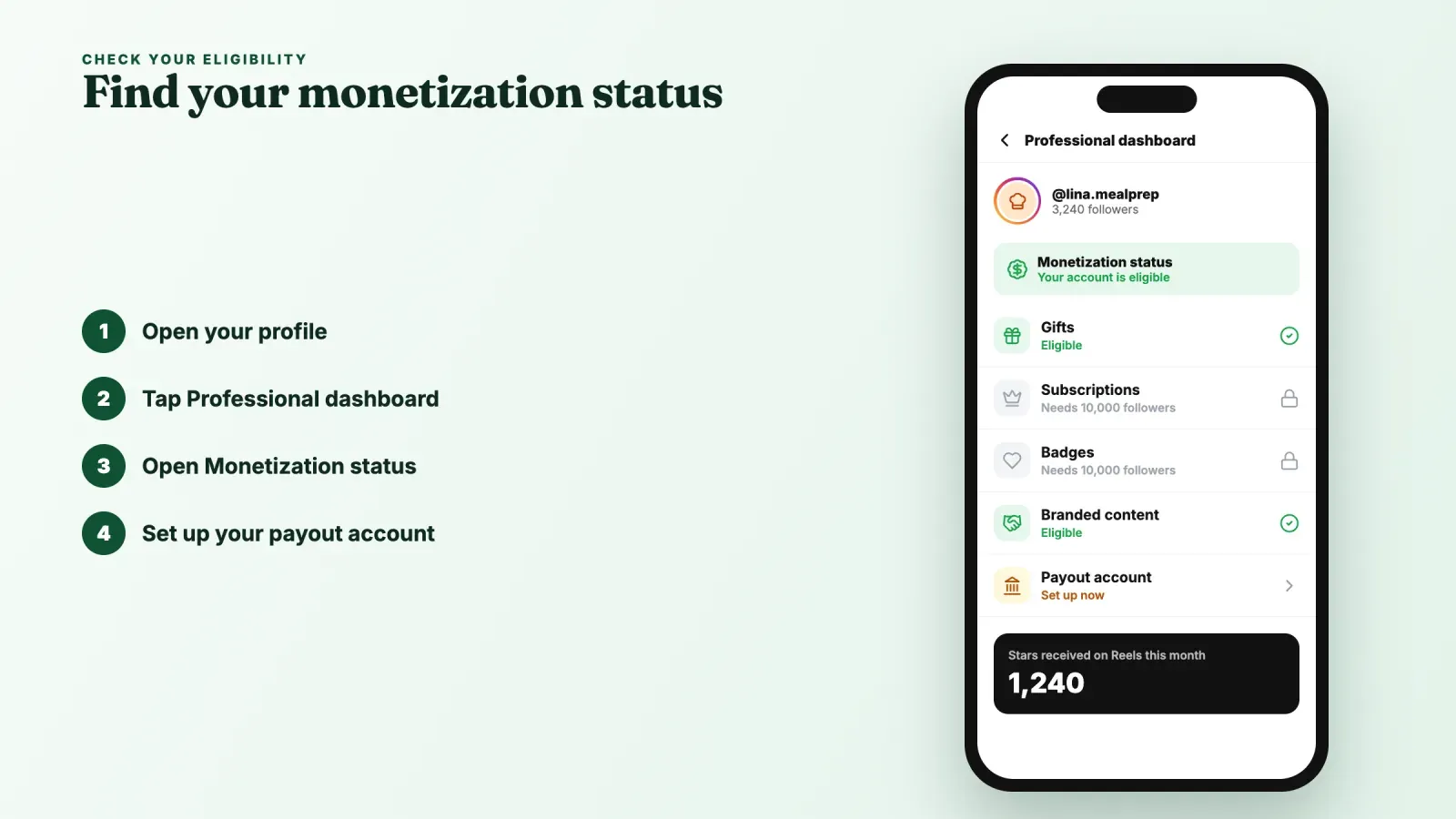
How to check if you're eligible
You don't have to guess. Instagram shows your status in the app.
- Open the Instagram app and go to your profile.
- Tap Professional dashboard under your bio.
- Look for Monetization status or the list of tools such as Gifts, Subscriptions and Badges.
- Tap a tool to see whether you're eligible, what's missing and how to set it up.
- If you're eligible, add your payout details so the money can reach you.
If a tool doesn't appear at all, it's usually because it isn't available in your country yet or because your account has a policy issue. Check Account status in your settings, since recent violations can block monetization even when you meet the follower minimum.
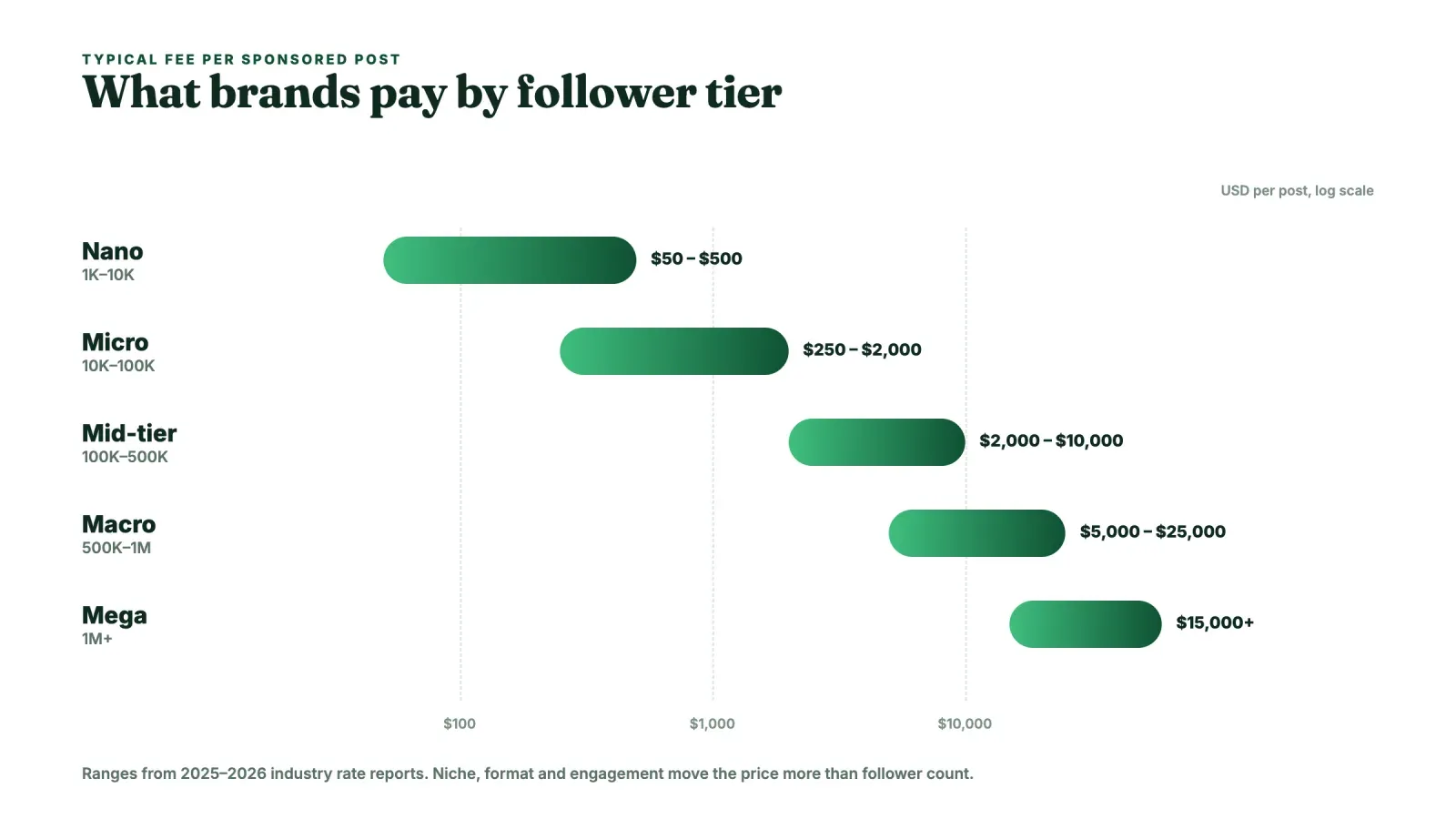
What creators earn per post by follower count
Most money on Instagram doesn't come from Instagram. It comes from brands paying creators to feature their products. Industry reports and creator marketplaces publish rate ranges every year, and while the exact numbers vary a lot, the pattern is consistent.
| Tier | Followers | Typical fee per sponsored post |
|---|---|---|
| Nano | 1,000 to 10,000 | 50 to 500 USD, often paid in free products at first |
| Micro | 10,000 to 100,000 | 250 to 2,000 USD, more for Reels |
| Mid-tier | 100,000 to 500,000 | 2,000 to 10,000 USD |
| Macro | 500,000 to 1 million | 5,000 to 25,000 USD |
| Mega | Over 1 million | 15,000 USD and up, negotiated case by case |
Treat these ranges as a starting point. A few things move the price more than follower count.
- Format. A Reel usually costs more than a single photo, and a package with Stories and a link costs more again.
- Niche. Finance, software, beauty and parenting audiences buy more, so brands pay more to reach them. Meme and general entertainment accounts usually get less per follower.
- Engagement. Small accounts often have much higher engagement rates than big ones, which is one reason brands keep shifting budget to nano and micro creators.
- Audience location. Followers in the US, the UK, France or Canada are worth more to most brands than the same number of followers in markets where those brands don't sell.
- Usage rights. If a brand wants to run your video as an ad, that's an extra fee on top of the post.
Surveys of creators also show how uneven earnings are. In Influencer Marketing Hub's creator earnings research, more than half of creators earned less than 15,000 USD a year, and only a small share passed 100,000 USD. The creators who earn the most almost always combine several income streams instead of relying on brand deals alone.
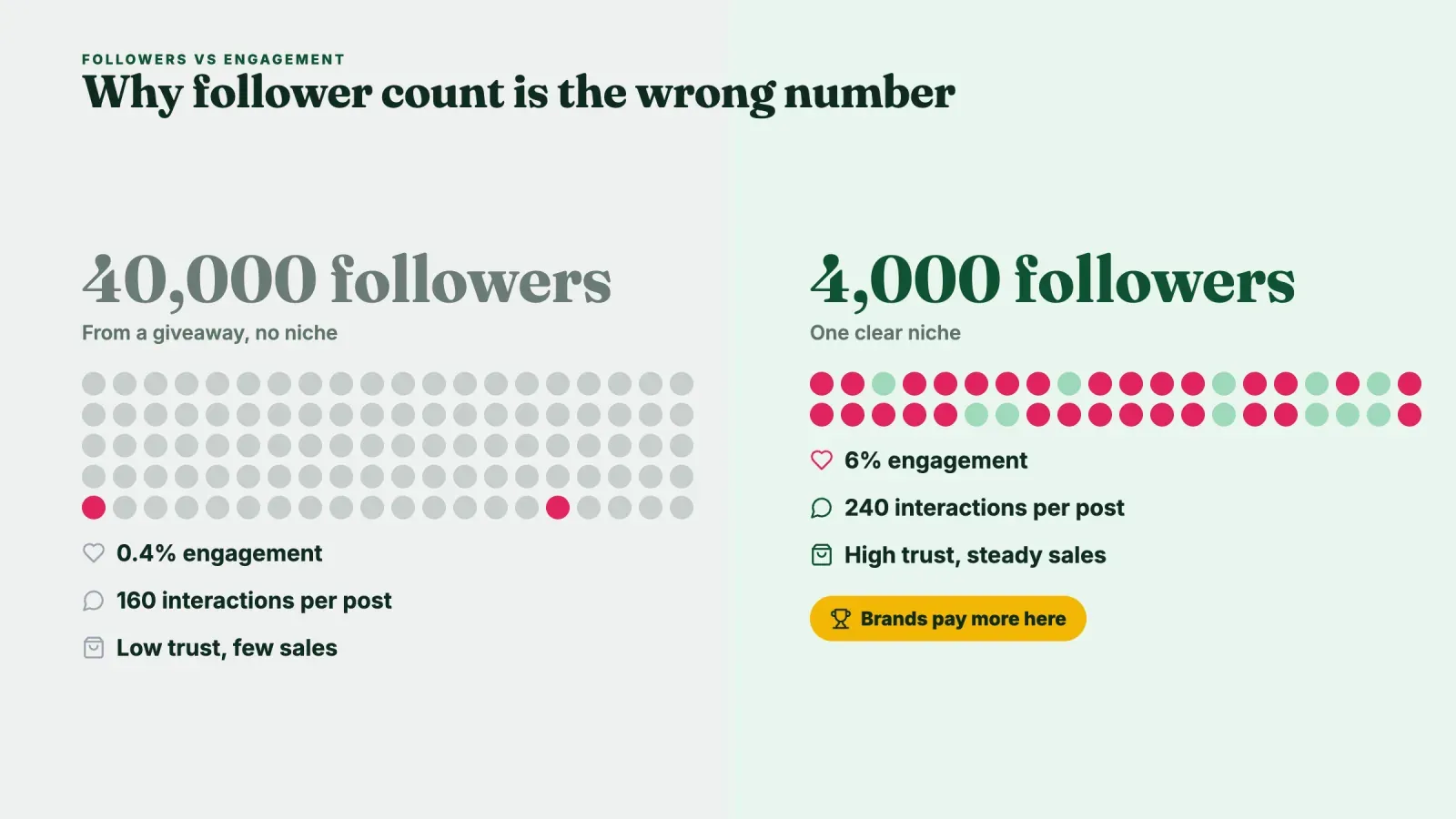
Why follower count is the wrong number to chase
Followers are easy to see, so everyone focuses on them. Brands and buyers look at other numbers.
Reach per post. Instagram now shows a large part of your content to people who don't follow you yet, and many followers never see your posts. The number of accounts each post actually reaches is a better measure of your value than the total on your profile. See our guide to reach for how it's counted.
Engagement rate. Likes, comments, saves and sends divided by reach tells a brand whether people care. Our guide on how to increase Instagram engagement explains the formula and the benchmarks for each account size.
Audience fit. A skincare brand would rather reach 3,000 people who ask about routines in your comments than 30,000 people who followed you for a viral joke. A narrow topic, what marketers call niching down, makes you easier to sponsor and easier to buy from.
Trust. The real asset is how many people act when you recommend something. That's what makes someone an influencer, and it can't be bought. Fake followers lower your engagement rate, make brands suspicious and can get your account flagged, so never buy them.
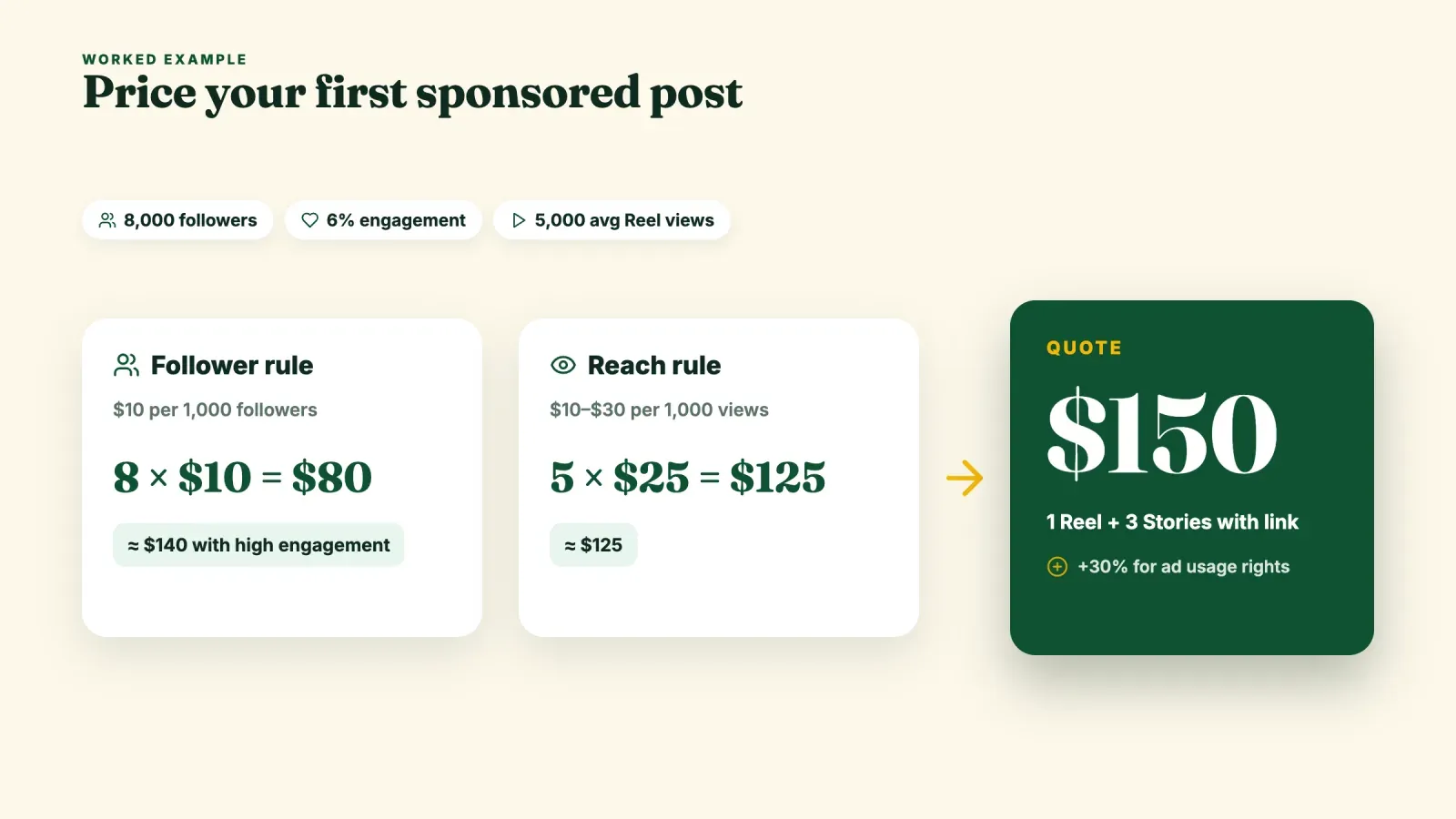
How to price your first sponsored post
Your first brand email will probably ask for your rates. Here are two simple ways to set a fair starting price.
Method 1, the follower rule. A common starting point is about 10 USD per 1,000 followers for one feed post or Reel. Then adjust it for engagement. If your engagement rate is well above average for your size, raise it by 50 to 100 percent. If it's below, lower it.
Method 2, the reach rule. Take the average number of views on your last 10 Reels and charge a cost per thousand views, usually somewhere between 10 and 30 USD depending on your niche. This method is fairer for small accounts whose Reels travel far beyond their follower base.
Here's a worked example. Sam has 8,000 followers, an engagement rate of 6 percent and Reels that average 5,000 views.
- Follower rule gives 8 x 10 = 80 USD, and the high engagement pushes it to about 140 USD.
- Reach rule gives 5 x 25 = 125 USD.
- Sam quotes 150 USD for one Reel plus three Stories with a link, and adds 30 percent if the brand wants to use the video in ads.
Write your prices down in a simple rate card, together with your audience stats from Insights, so you can answer quickly and look professional. When you negotiate, ask about deliverables, deadlines, usage rights, exclusivity and payment terms before you agree on the number.
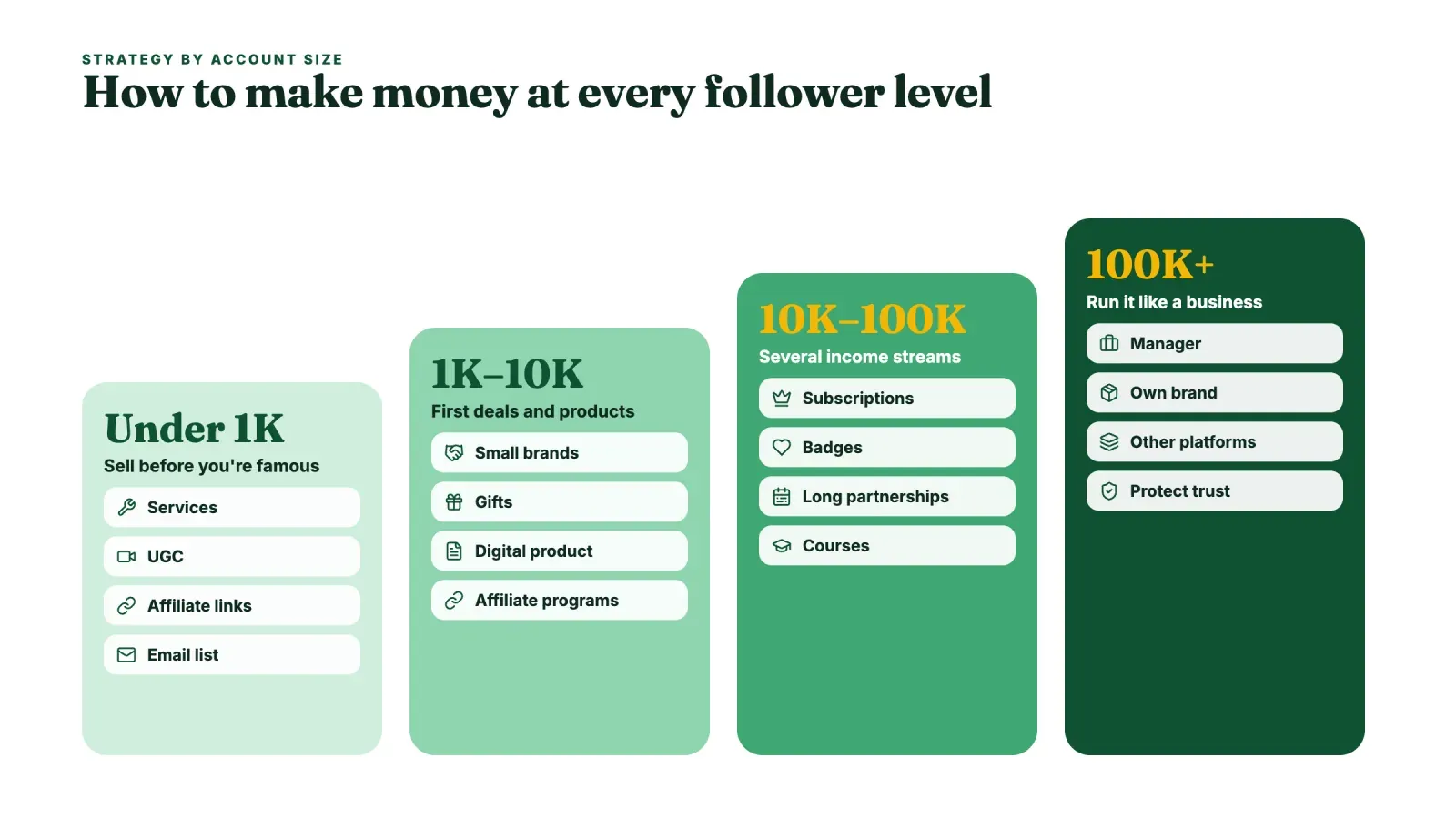
How to make money at every follower level
The best strategy changes as you grow. Here is what to focus on at each stage.
Under 1,000 followers, sell before you're famous
At this stage, nobody will pay you for exposure, but you can still earn.
- Sell a service. If you design, edit, coach, cook, teach or fix things, Instagram is your portfolio. Five clients from your posts are worth more than a thousand new followers.
- Create UGC. Brands pay UGC creators to film product videos for their own accounts and ads. Your follower count doesn't matter because the video is posted by the brand.
- Use affiliate links. Recommend tools and products you already use with affiliate links, and put them on one page linked from your bio.
- Start an email list. Offer a free checklist or guide in exchange for an email. That list will be your most valuable asset later.
1,000 to 10,000 followers, your first brand deals and products
This is where most creators make their first real money.
- Pitch small brands. Local businesses and young brands in your niche are happy to work with nano creators. Send a short pitch with your stats, one idea and your rate instead of waiting to be found.
- Unlock Gifts. Once you pass 500 followers, set up Gifts and a payout account. Mention Gifts naturally on your best Reels.
- Launch a small digital product. A template, a guide, a preset pack or a mini course priced between 9 and 49 USD. Our list of digital products that sell has ideas for every niche.
- Join affiliate programs. Many brand programs accept small accounts if the audience fits.
10,000 to 100,000 followers, build several income streams
At this size, brands start contacting you, and Instagram opens its bigger tools.
- Turn on Subscriptions and Badges if you have content worth paying for, such as weekly lives, behind-the-scenes or deeper tutorials.
- Sign longer partnerships. Ask for three-month or six-month deals instead of single posts. They pay better per post and look more authentic to your audience.
- Sell higher-priced offers. Courses, coaching packages, memberships and workshops become realistic.
- Raise your rates. Update your rate card every quarter. Most creators charge too little for too long.
Over 100,000 followers, run it like a business
With a large audience, the creator becomes a company.
- Work with a manager or agency to handle brand outreach and contracts, but keep a direct line with your audience.
- Launch your own brand or product line. Many large creators earn more from their own products than from sponsors.
- Diversify platforms. Repurpose your best content to YouTube, TikTok, a newsletter or a podcast so one algorithm change can't cut your income in half. Our guide on how to monetize a YouTube channel covers the next step for video creators.
- Protect your trust. Turn down deals that don't fit. At this size, one bad sponsor costs more than it pays.
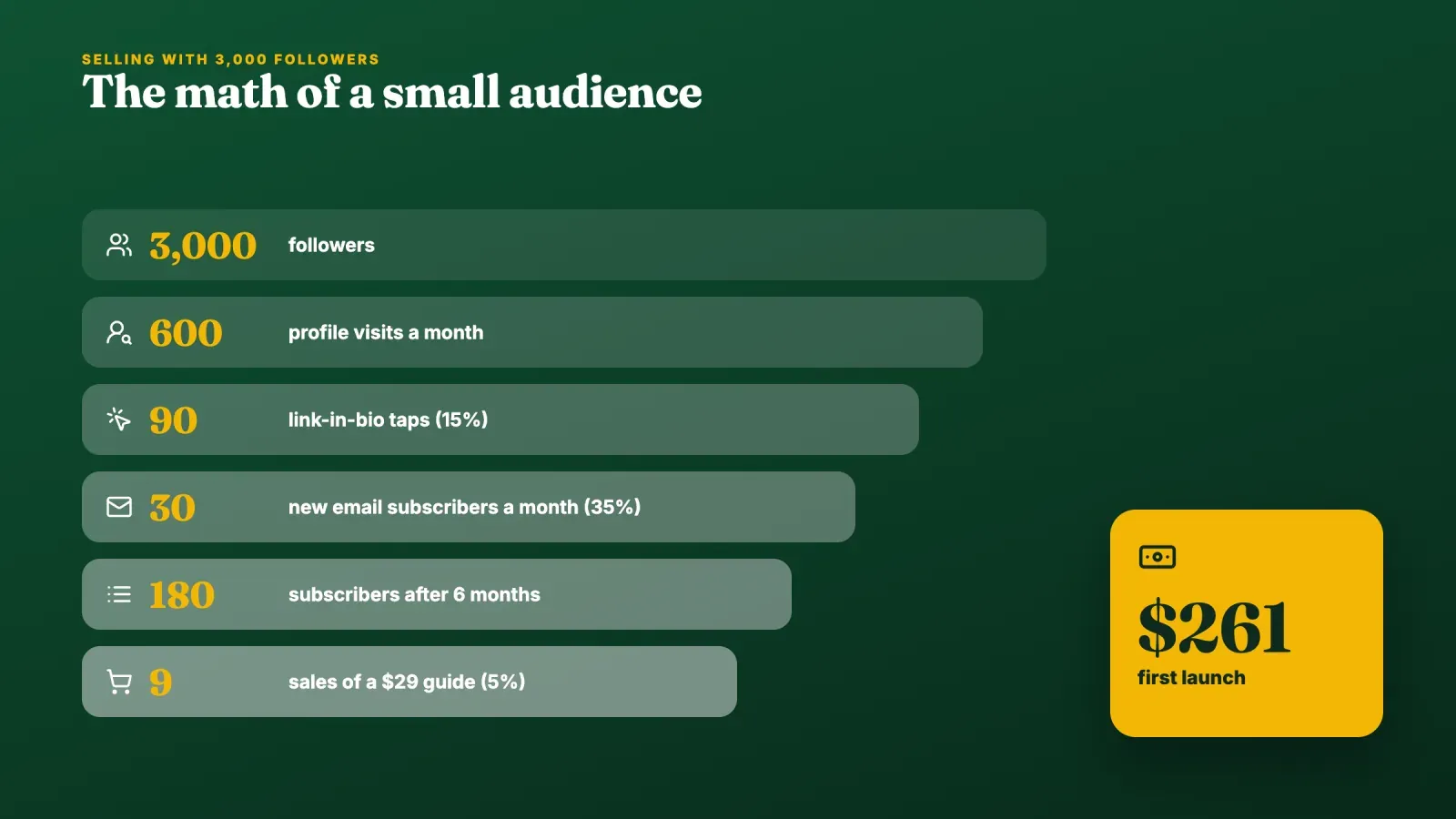
The math of selling your own product with a small audience
Small accounts underestimate how much they can earn from their own offers. Here's a realistic example with honest numbers.
Lina has 3,000 followers in a meal-prep niche. Over a month, her Reels bring about 600 visits to her profile. Around 15 percent of those visitors tap the link in her bio, so 90 people land on her page. She offers a free weekly meal plan, and about 35 percent of visitors sign up. That's about 30 new email subscribers a month, or 180 after six months.
When she launches a 29 USD recipe guide, 5 percent of her list buys it in the first week, which means 9 sales and 261 USD. Add a few direct sales from her bio page and a couple of affiliate commissions on kitchen tools, and she earns a few hundred dollars a month from 3,000 followers. That won't replace a salary yet, but it grows every month and it doesn't depend on any brand or algorithm.
Three numbers make the biggest difference.
- Profile visits. Better hooks and more Reels bring more visitors.
- Click-through from your bio. A clear call to action and a simple page that answers the question every visitor has, which is "what's in it for me?"
- Conversion rate. A focused offer for one specific problem converts far better than a general one.
Our guide on turning followers into customers with your link in bio shows how to set up that page step by step.
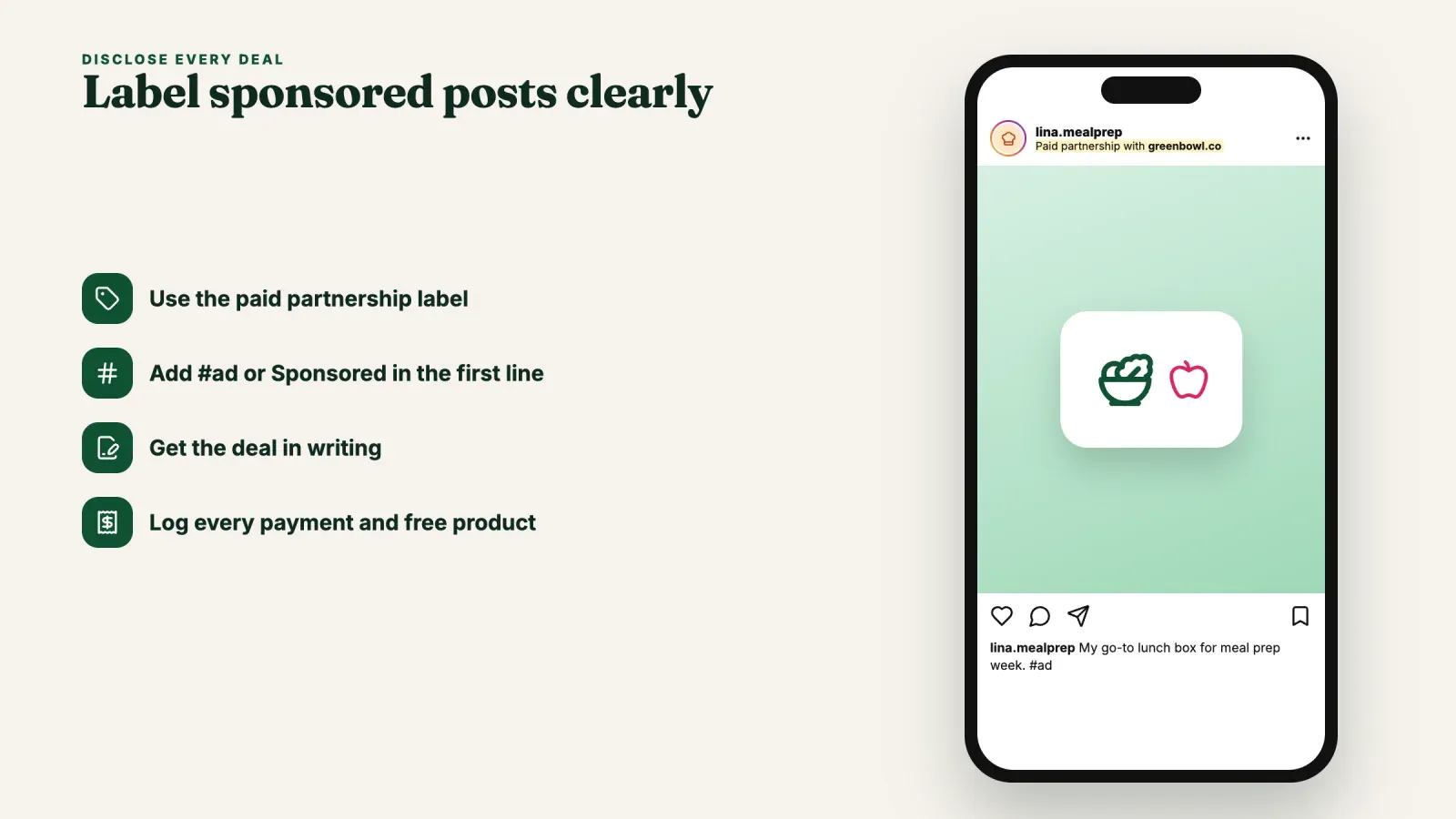
Disclose sponsored content and declare your income
Making money brings rules with it. Ignoring them can cost you more than you earn.
Use the paid partnership label. Whenever a brand pays you or sends you free products in exchange for a post, Instagram requires you to tag the brand with the paid partnership label. In the US, the FTC also expects a clear disclosure such as #ad or "Sponsored" that people can see without tapping "more."
Know your local law. France passed a specific law for influencers in June 2023. It requires the words "publicité" or "collaboration commerciale" on sponsored content, bans the promotion of some products and services, and requires written contracts in many cases. Other countries in Europe have similar rules, so check what applies where you live.
Declare your income. Brand fees, Gifts, Subscriptions, affiliate commissions and even free products can count as taxable income. Keep a simple spreadsheet of every payment and gift from the start, and talk to an accountant once your income becomes regular.
Mistakes that keep creators from earning
- Waiting for a magic number. Creators who wait for 10,000 followers before they sell anything lose years of practice and income.
- Buying followers or joining engagement pods. Both destroy the numbers brands actually check.
- Posting without a niche. If people can't explain what your account is about in one sentence, brands can't either.
- Saying yes to every deal. Promoting products you don't use is the fastest way to lose trust.
- Working without a contract. Always agree in writing on deliverables, dates, usage rights and payment.
- Sending everyone to a single link. A bio link that only points to one post wastes most of your traffic. A page with all your offers works much better.
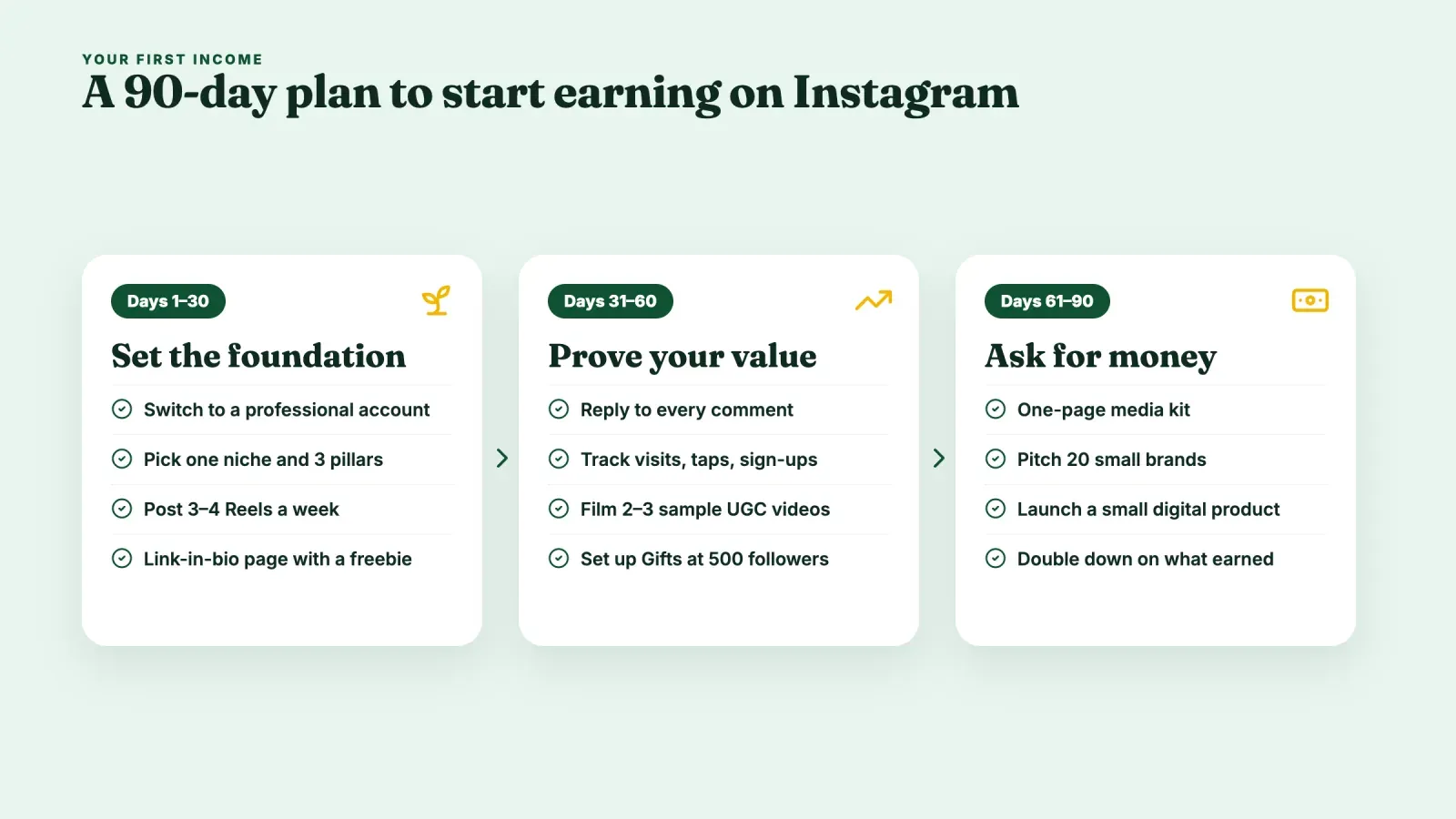
A 90-day plan to earn your first income on Instagram
Days 1 to 30, set the foundation. Switch to a professional account. Pick one niche and three content pillars. Post three or four Reels a week and study which hooks keep people watching. Create a link-in-bio page with a free lead magnet and one paid offer or affiliate link.
Days 31 to 60, prove your value. Post consistently and reply to every comment. Track profile visits, link taps and email sign-ups every week. Film two or three sample UGC videos and send them to brands you like. When you pass 500 followers, set up Gifts.
Days 61 to 90, ask for money. Build a one-page media kit with your stats. Pitch 20 small brands with a specific idea. Launch your first small digital product to your email list. At the end of the 90 days, look at what earned the most and do more of it.
Most creators who follow a plan like this earn their first income long before they reach 10,000 followers. The key is to start selling early and treat every follower as a person you can help.
FAQ
How many followers do you need to get paid on Instagram?
Instagram's own tools start paying at 500 followers for Gifts on Reels and 10,000 followers for Live Badges and Subscriptions. You can earn from brands, affiliate links, UGC and your own products with any follower count.
Does Instagram pay you for views?
Not directly for most creators. Instagram has paid for Reels performance through invite-only bonus programs, but there's no permanent pay-per-view program like YouTube's Partner Program. Your views turn into money through brand deals, Gifts and what you sell.
How much does Instagram pay for 1,000 followers?
Instagram doesn't pay per follower. With around 1,000 engaged followers in a clear niche, many creators earn their first 50 to 150 USD per sponsored post, or more by selling their own products.
How much can you earn with 10,000 followers on Instagram?
A creator with 10,000 followers and good engagement can typically charge 100 to 500 USD per sponsored post, plus income from Subscriptions, Badges, affiliate links and products. Monthly income ranges from almost nothing to several thousand dollars, depending on niche and how many streams you run.
Can you make money on Instagram without showing your face?
Yes. Faceless accounts can earn through affiliate links, digital products, UGC filmed with only your hands and brand deals, as long as the content is original and useful. Monetization tools only require a professional account and the follower minimums.
Is it easier to make money with a creator account or a business account?
Both are professional accounts and both can use monetization tools where they're available. Creator accounts are usually the better choice for individuals because they're designed for audience growth and brand partnerships.
Start earning before you hit the big numbers
The follower count you need depends on how you want to earn. Instagram's Gifts open at 500 followers, Badges and Subscriptions at 10,000, and everything else, from your own products to affiliate links and UGC, is open from day one. What matters most is a clear niche, engaged followers and a place where they can buy from you.
Make that place easy to find. Create your free Roctify page to put your products, affiliate links, booking form and email sign-up behind one link in your bio, so every new follower has a way to become a customer.