Every November, the same thing happens in every feed. Thousands of brands publish almost identical Black Friday adverts at the same moment: a black background, a red percentage, "up to 50% off", "shop now". Ad prices climb, attention gets scarcer, and most of those ads blur into one long scroll of discounts nobody remembers.
A few campaigns escape that blur. Some of them did it with a bigger, clearer offer. Others did it by refusing to discount at all, closing their stores, raising their prices or telling people not to buy. Both routes can work, and both teach you something you can use on a much smaller budget.
This guide breaks down 12 Black Friday adverts that stood out, from famous brand stunts to everyday direct-response ads found in public ad libraries. For each one you will see what the brand did, why it worked and how to adapt the idea to your own shop. After the examples, you will find the patterns they share, a week-by-week campaign calendar, ready-to-use copy lines, the legal rules that now apply to discounts and countdown timers, and a simple way to check that your Black Friday ads make money and not only sales.
Why Black Friday adverts play by different rules
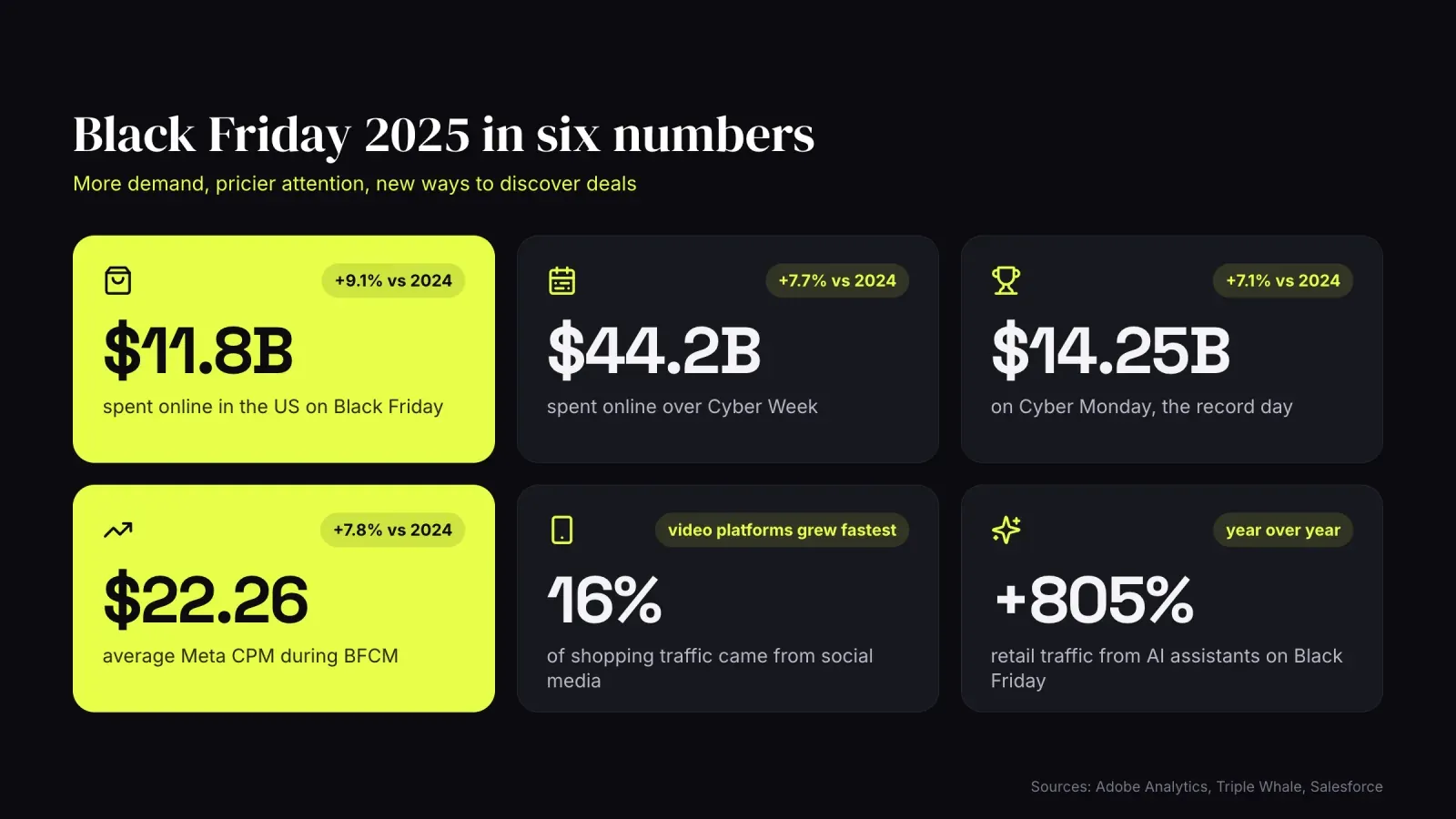
Black Friday is the busiest advertising window of the year, and the numbers explain why so many ads fail. According to Adobe Analytics, US shoppers spent a record $11.8 billion online on Black Friday 2025, up 9.1% on the year before. The full Cyber Week, from Thanksgiving to Cyber Monday, reached $44.2 billion, and Cyber Monday alone hit $14.25 billion, still the biggest online shopping day ever recorded.
Demand is enormous, but so is competition for attention. Triple Whale's benchmarks for Black Friday and Cyber Monday 2025 put the average Meta CPM, the cost of reaching a thousand people, at about $22.26, roughly 8% higher than in 2024. Agency trackers saw Meta CPMs jump around 11% in the second half of November alone, with some industries paying far more. You pay more for every impression at the exact moment when every competitor is shouting a discount.
Two other shifts matter for your creative. Salesforce reported that social media referrals made up about 16% of online shopping traffic during the 2025 season, with video platforms such as TikTok and YouTube growing fastest. And Adobe measured an 805% jump in traffic to retail sites coming from AI assistants on Black Friday. People increasingly discover deals in short videos, compare them with an assistant, and buy wherever the offer looks clearest.
Three practical consequences follow.
- Your ad must be understood in under two seconds. If the offer needs reading, it loses to the ad next to it.
- Your ad must stand out from a sea of identical ads. "Up to 50% off" on a black background is now the default, so it no longer signals anything.
- Your ad must earn its higher cost. With CPMs up and margins squeezed by discounts, an ad that sells a lot at a loss is worse than no ad at all.
The examples below solve those three problems in very different ways. Some of them are big-brand stunts you will not copy literally, but the mechanism behind each one scales down to a small shop, a creator or a service business.
1. Patagonia, "Don't Buy This Jacket"
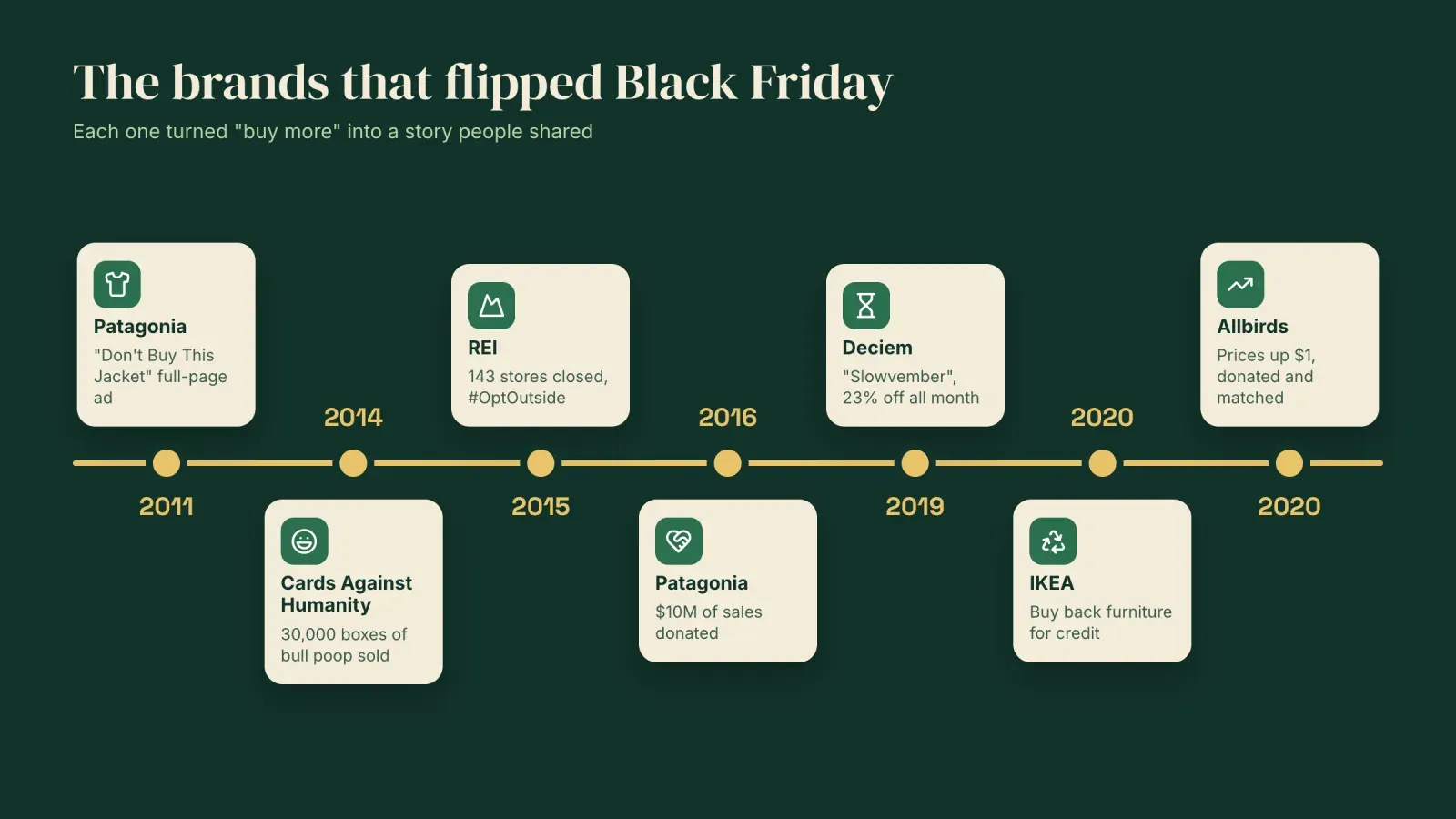
What they did. On Black Friday 2011, Patagonia ran a full-page advert in The New York Times showing one of its best-selling fleece jackets under the headline "Don't Buy This Jacket". The body copy listed the environmental cost of making the jacket and asked readers to think twice and buy only what they needed. Five years later, in 2016, the brand pledged to give 100% of its global Black Friday sales to grassroots environmental groups. It had forecast around $2 million in sales that day and took more than $10 million, all of which it donated.
Why it worked. The ad broke the pattern of the day completely. Every other brand said "buy more", and Patagonia said "buy less", which made it impossible to scroll past. Crucially, it was consistent with what the brand already stood for, including its repair program and long product guarantees. The message felt believable because the company acted on it.
How to adapt it. You do not need a newspaper page. A small brand can publish a simple post or ad that says "Before you buy anything this Black Friday, read this", followed by honest buying advice, a repair or care guide, or a promise to donate part of the day's sales. It only works if your brand has a real reason to say it. Borrowed values without matching actions read as cynical, and people notice.
2. REI, #OptOutside
What they did. In October 2015, the outdoor retailer REI announced that its 143 stores would close on Black Friday and that its 12,000 employees would be paid to spend the day outside. Instead of a sale ad, it ran a campaign inviting everyone to "opt outside" and share their day with the hashtag #OptOutside. The campaign generated more than 1.4 million social mentions in its first year, more than 175 organizations joined in, and REI repeated it for years afterwards.
Why it worked. The announcement came weeks before Black Friday, so it owned the conversation before competitors had even published their deals. It turned customers into participants, since every hiking photo with the hashtag became free advertising. And it matched the co-op's purpose perfectly: an outdoor store asking people to go outdoors.
How to adapt it. Think of a participatory alternative that fits your niche. A bookshop can run a "read instead of shop" challenge, a fitness coach a free Black Friday workout, a crafts brand a "make it yourself" live session. Announce it early, give it a hashtag or a simple action, and collect the content people share. You keep the attention without giving away your margin.
3. IKEA, Buy Back Friday
What they did. For Black Friday 2020, IKEA ran a "Buy Back Friday" campaign in several countries. Instead of only promoting new furniture, it offered to buy back customers' used IKEA furniture in exchange for store credit worth up to 50% of the original price. The returned pieces were resold in its as-is areas, and items it could not resell were recycled or donated.
Why it worked. It gave customers a reason to visit with something in their hands, and a voucher that could only be spent at IKEA. The sustainability angle earned press coverage that a standard discount never would. And the offer was simple to explain: bring back your old furniture, get credit for the new.
How to adapt it. Trade-in offers work far beyond furniture. A clothing shop can offer credit for a returned item it resells or recycles, an electronics seller can take old devices, and a software or course business can offer an upgrade price for existing customers. A trade-in turns a discount into a reason to return, and the credit keeps the money in your shop.
4. Allbirds, raising prices for Black Friday
What they did. On Black Friday 2020, Allbirds raised the price of every product by $1 and matched each extra dollar with its own, donating the total to the youth climate movement Fridays for Future. Its Wool Runners went from $95 to $96 for the day. The brand framed it with a simple line explaining that Black Friday deals may satisfy a momentary desire, but their impact on the planet lasts a lot longer.
Why it worked. A price increase on the most discounted day of the year is a headline in itself. The amount was tiny, so it did not stop anyone who wanted to buy, while the donation gave customers a good feeling about buying anyway. The campaign reinforced the sustainability position Allbirds had built since its launch.
How to adapt it. You can keep your normal prices and add a visible contribution instead, such as "$1 from every order today goes to the local animal shelter" for a pet brand. Make the amount concrete, name the beneficiary, and publish the total afterwards. Avoid vague promises like "a portion of proceeds", which sound like marketing and can raise legal questions in some markets.
5. Deciem and The Ordinary, closing on Black Friday
What they did. The skincare group Deciem, owner of The Ordinary, went dark on Black Friday for several years. It closed its stores and website for the day and offered a 23% discount across the whole of November instead. From 2019 it named the approach "Slowvember", encouraging customers to take their time, buy only what they needed and avoid the one-day rush.
Why it worked. Closing the website on the busiest day is a bold signal, and it generated far more press than any discount could. At the same time, the brand did not give up sales. It simply spread them across a month, which reduced the pressure on stock and delivery and gave customers more time to decide. The odd 23% figure stood out against the round 20% and 30% everyone else used.
How to adapt it. A month-long, moderate offer can beat a deep one-day sale for a small business, because it smooths your workload and avoids burning out your fulfilment. Give it a name, explain why you do it, and use an unusual number that feels deliberate. If you sell services or bookings, a month-long window also avoids an impossible calendar on a single weekend.
6. Cards Against Humanity, the anti-sale stunts
What they did. The party game company has turned Black Friday into an annual joke. In 2014 it sold 30,000 boxes of actual bull poop for $6 each and donated the proceeds to charity. In 2015 it sold "nothing" for $5, and people paid $71,145 for literally nothing. In 2016 it asked people to pay to dig a giant hole in the ground for no reason, and they contributed $100,573 while watching a livestream of the hole.
Why it worked. The stunts matched the brand's irreverent tone exactly, and they mocked the consumer frenzy of the day in a way its audience loved. They were designed to be shared, written about and talked over at dinner. Even when the stunt itself made little money, the attention reminded millions of people that the game existed right before the holiday gifting season.
How to adapt it. Humor only works if it is already your voice. If it is, a playful Black Friday "anti-deal" can earn more attention than a discount. Keep it cheap to run, make sure people understand the joke instantly, and include a clear path to your real products. Do not make fun of your customers or use humor that could look like you are deceiving them about prices.
7. Apple, gift cards instead of discounts
What they did. Apple almost never cuts its prices. For Black Friday, it runs a four-day "shopping event" in which customers get an Apple gift card with eligible purchases instead of a lower price. In 2025 the event ran from November 28 to December 1, and some of the newest products, such as the latest iPhones, were excluded entirely.
Why it worked. The offer protects the price perception of the products, since a MacBook never appears "cheaper". The gift card brings customers back for a second purchase, and some of them will spend more than the card's value. The approach is not universally loved, and tech sites regularly point out that third-party retailers offer bigger straight discounts on Apple products. That trade-off is the point: Apple accepts losing price-hunters to protect its brand and margin.
How to adapt it. "Spend $100, get a $20 credit for January" is a powerful alternative to "20% off" for any business with repeat customers. It protects your prices, brings people back after the holidays when traffic is quiet, and costs you less than a discount because not every credit gets used. Be transparent about the conditions and the expiry date.
8. ghd, the premium discount done cleanly
What they did. The hair tool brand ghd ran Black Friday adverts on Meta built around a simple message, "up to 30% off" and "five-star deals", on a rich deep red background with the product as the hero. The call to action sent people straight to the website with no extra steps.
Why it worked. It is a direct-response ad, but it still looks premium. The color and lighting keep the luxury feel, the "five-star" phrase links the discount to customer proof, and the copy has nothing to decode. Premium brands often fear that discounting cheapens them. Good art direction lets you announce a deal without looking like a clearance bin.
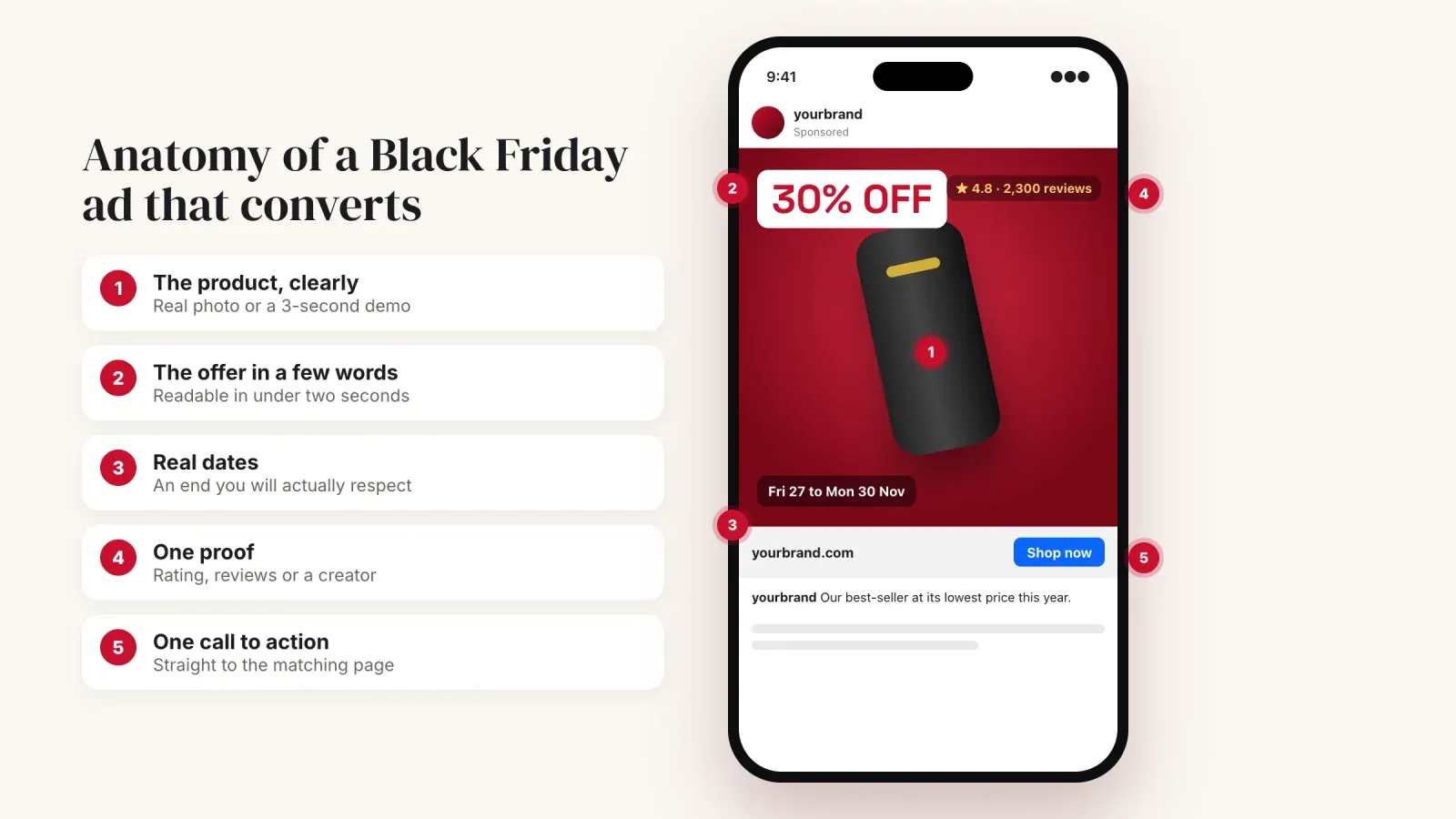
How to adapt it. If you discount, keep your brand codes: your colors, your fonts, your photography style. Put the offer in one short line, add one proof element such as a rating or a review count, and use a single call to action. Testing your normal product photo with a clean offer overlay against a busy "SALE" template is a quick experiment worth running.
9. Nordic Nest, the teaser that captures leads
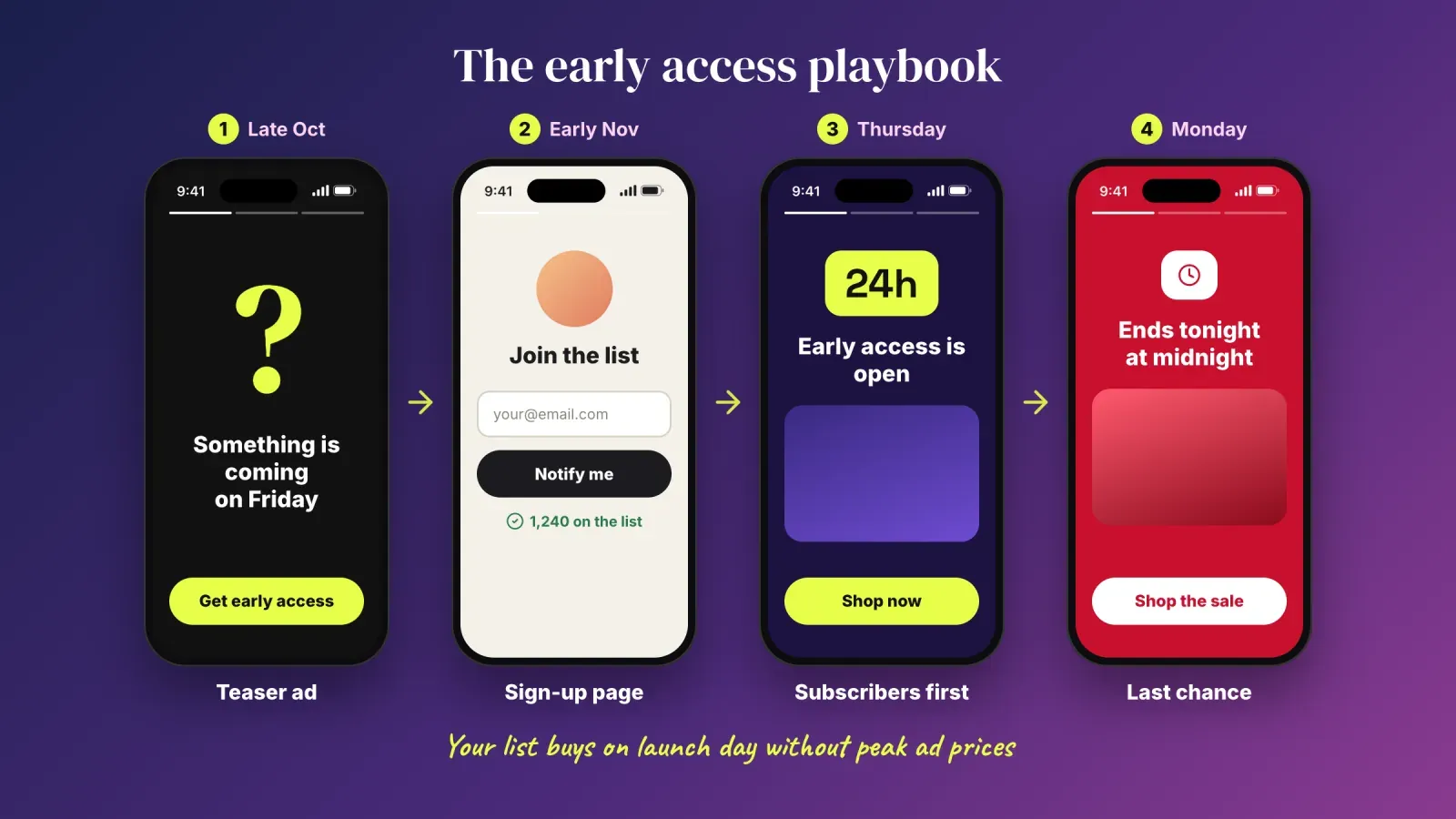
What they did. The Scandinavian design retailer Nordic Nest ran pre-Black Friday adverts that did not announce a discount at all. Using sleek black visuals and very little text, the ads invited people to sign up to get early access before the sale opened.
Why it worked. The teaser runs in late October and early November, when ad costs are still lower. It builds an email or SMS list of people who have raised their hand, and on launch day the brand can reach them directly without paying peak CPMs. Early access also gives subscribers a real advantage, which makes the sign-up worth it.
How to adapt it. This is one of the most useful tactics for small businesses. Run a "get early access" ad two to three weeks before Black Friday, send people to a simple sign-up page, and open your offer to that list 24 hours before everyone else. Your link in bio can host the sign-up form so your organic followers join too. On Black Friday itself, a large part of your sales then comes from email and messages that cost almost nothing to send.
10. Beautiful Earth Boutique, the bundle with a native hook
What they did. The small fashion brand Beautiful Earth Boutique ran a Black Friday ad that opened with a social-first line, roughly "this wasn't supposed to go live yet", followed by a bundle of five items at a reduced combined price.
Why it worked. The hook feels like a creator's post rather than a polished ad, which suits the feed it appears in. The leaked-deal angle creates curiosity and a feeling of insider access. And the bundle raises the average order value, so the brand sells more items per order instead of simply cutting the price of one.
How to adapt it. Bundles are one of the healthiest Black Friday offers because they protect your average order value. Group products people already buy together, show the saving clearly, and give the bundle a name. For the hook, write the first line the way a person would talk. Only claim a leak or a surprise if it is genuinely true, since invented urgency can break consumer law, as you will see below.
11. Meta Quest with a creator, entertainment over price
What they did. Meta promoted its Quest headsets around Black Friday with creator-led content, including a partnership with a music creator who filmed a casual, user-generated style clip showing the headset in use and having fun with it.
Why it worked. For an expensive product people do not fully understand, seeing a real person enjoy it does more than any price cut. The clip blends into the feed, holds attention and answers the silent question "what would I actually do with this?". The discount becomes the final nudge rather than the whole message.
How to adapt it. If your product needs explaining, invest your Black Friday creative budget in demonstrations. Ask a creator or a happy customer to film themselves using the product, unboxing it or giving it as a gift, then add the offer in the last seconds and in the caption. Run it as a partnership ad when the platform allows it, so it appears from the creator's account. Our guide to ad hooks that stop the scroll covers how to open these videos.
12. SHEIN, the localized lifestyle ad
What they did. SHEIN runs thousands of Black Friday ad variations across Europe. In its French campaign, the ads showed relatable models in everyday settings with minimal copy, and they were adapted to the local market rather than simply translated.
Why it worked. At SHEIN's scale, small gains in relevance multiply across millions of impressions. Local faces, settings and wording make the ad feel made for the viewer, while minimal text lets the outfit and the price do the work for impulse buyers.
How to adapt it. Even with a small budget, localize the essentials if you sell in more than one country: the currency, the delivery promise, the date format, the words people use and, if you can, the faces in your photos. A French shopper reads "-30 %" and "livraison offerte" faster than a translated English slogan. If you research what competitors run in each country, our method to research Meta ads without copying keeps you on the right side of inspiration.
What the best Black Friday adverts have in common
Put the 12 examples side by side and four patterns appear. Each winning ad used at least one of them, and most used two.
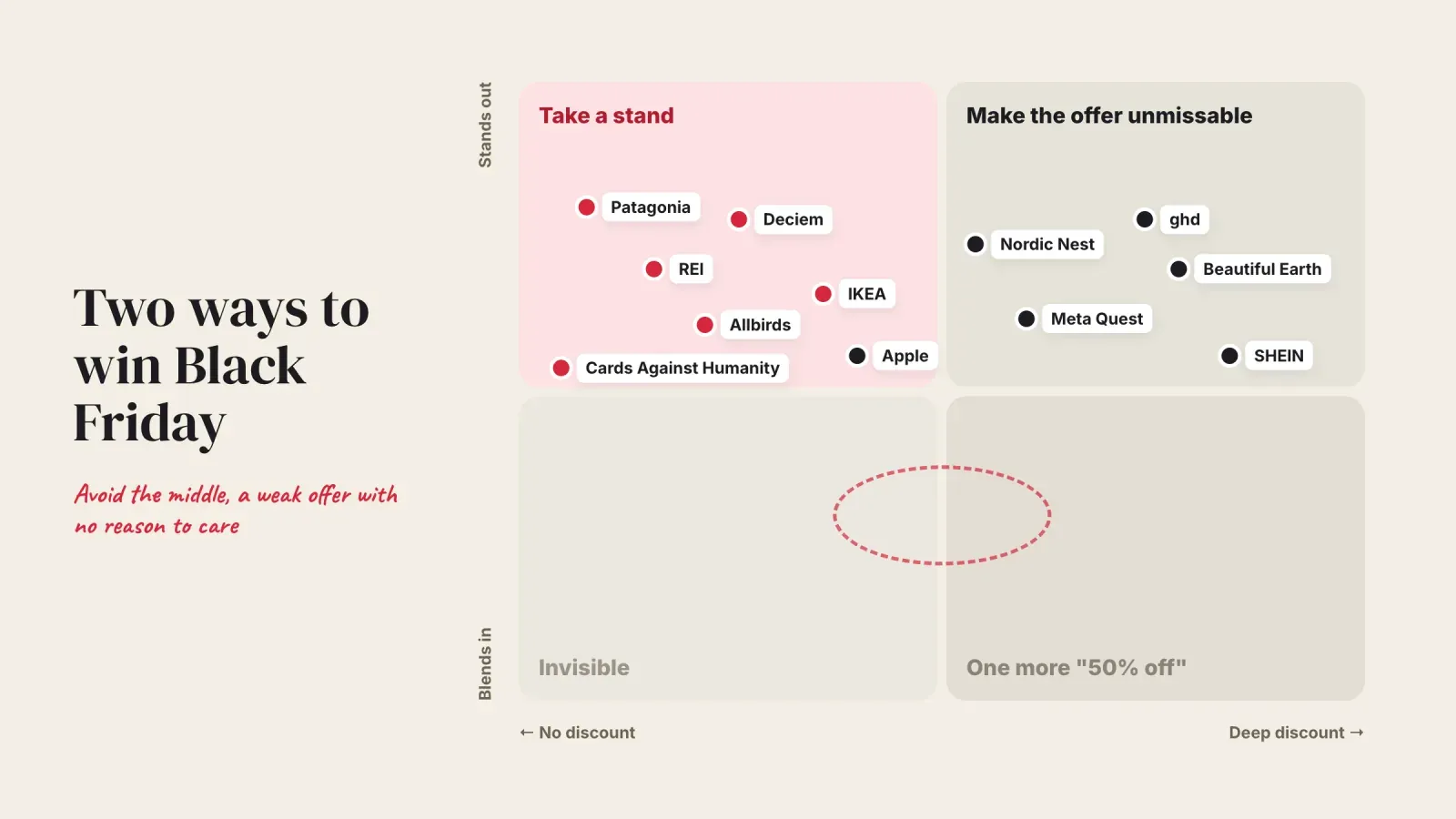
A stance or a clear offer, never a vague one. The brands that refused Black Friday took a strong position that matched their identity. The brands that discounted made the offer impossible to misunderstand. The ads that fail sit in between, with a weak discount and no reason to care.
Real urgency with a real reason. A sale that ends on a stated date, a limited number of bundles or early access for subscribers creates honest urgency. A timer that restarts every time you refresh the page creates distrust, and in Europe and the UK it can now create legal trouble too.
Proof close to the offer. Ratings, review counts, best-seller badges, creator content and customer photos reassure people who are about to buy from you for the first time. On Black Friday, many buyers are new to your brand, so proof matters more than usual.
One message per ad. The strongest examples say one thing. "Up to 30% off, five-star deals" or "we are closed today" are easy to remember. An ad that lists five offers, three dates and two codes asks people to think when they only want to scroll.
The anatomy of a solid discount ad follows from these patterns. A clear product image or short demonstration comes first, then the offer in a few words, the dates or the deadline, one proof element and one call to action. Everything else is optional.
Plan your Black Friday ad calendar week by week
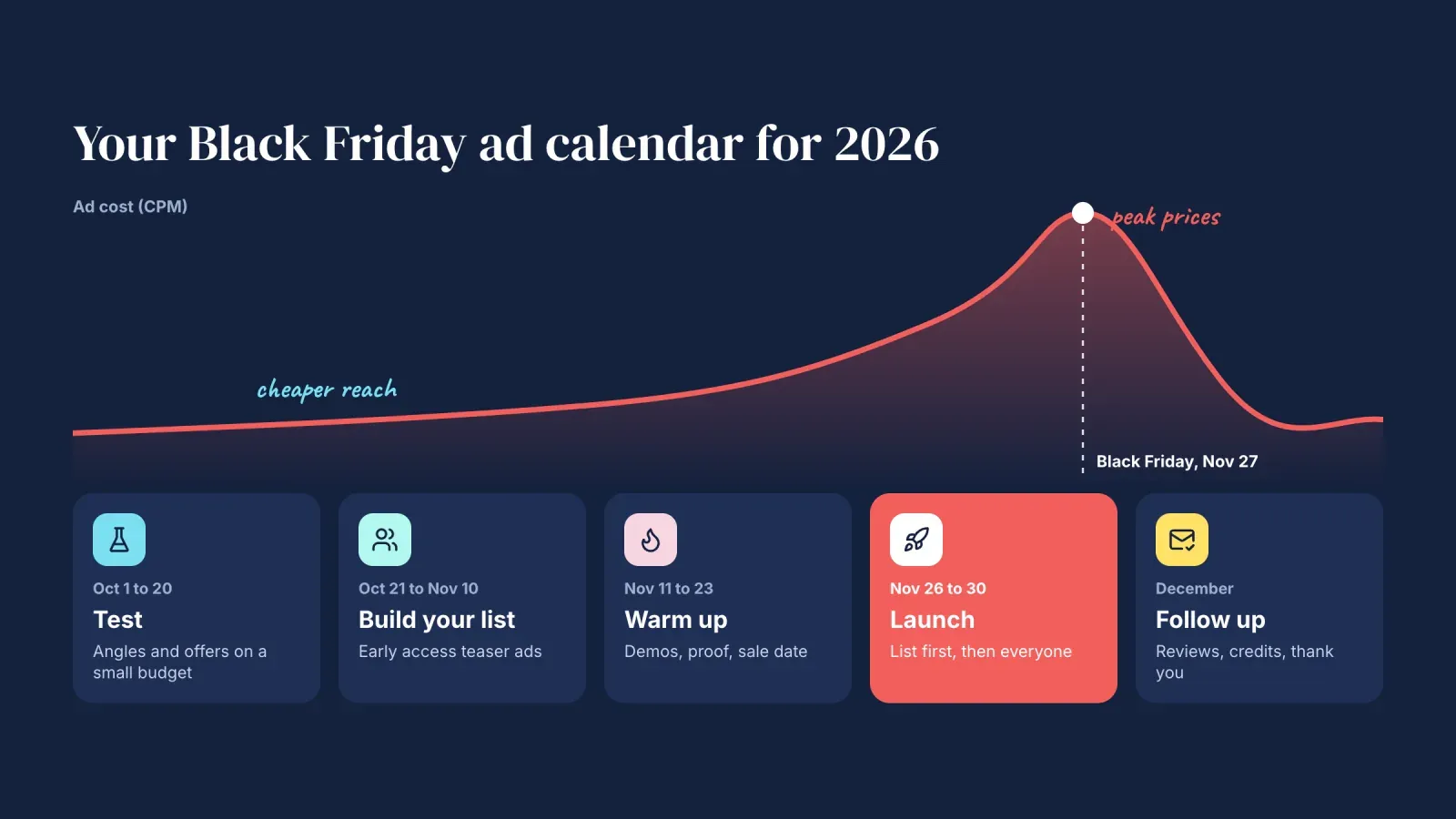
The best Black Friday adverts are planned well before the day. Here is a practical calendar for a small business, counting back from Black Friday, which falls on November 27 in 2026.
Early to mid October, test. Ad costs are still reasonable. Test two or three creative angles and two or three offers on a small budget. Find out whether your audience responds better to a percentage, a bundle, a gift with purchase or a credit. Prepare your product photos, videos and landing pages now.
Late October to early November, build your list. Launch a teaser like Nordic Nest's, inviting people to sign up for early access. Retarget your recent visitors and followers. Every subscriber you collect now is someone you can reach on launch day without paying peak prices.
Mid November, warm up. Publish content that explains your products, answers common questions and shows customer proof. Announce the date of your sale. People who saw your products before Black Friday are more likely to buy during it.
Black Friday week, launch. Open early access to your list first, then go public. Increase your budget on the creatives and offers that won your October tests rather than launching untested ideas. Monitor your results daily and move money toward what works.
Cyber Monday, extend or close. Either close the sale cleanly with a genuine last-chance message, or run a separate Cyber Monday offer, for example on digital products or a different bundle. Do not pretend to end a sale and then extend it, which damages trust and can be misleading.
December, follow up. Thank your buyers, ask for reviews and invite them back with a post-holiday offer or the credit they earned. Black Friday customers are a list you can sell to all year.
Black Friday ad copy you can adapt
Here are lines you can adapt to your own products. Keep the ones that suit your tone and test them against each other.
Clear offer lines
- "30% off everything until Monday night."
- "Our best-selling [product] at its lowest price of the year."
- "Buy two, get the third free, this weekend only."
- "Spend $80, get a $20 credit for January."
- "Free shipping on every order until [date]."
Early access and teaser lines
- "Our Black Friday sale opens tomorrow. Subscribers shop 24 hours early."
- "Join the list and get first pick before stock runs out."
- "Something is coming on Friday. Want to see it first?"
Proof lines
- "Rated 4.8 by 2,300 customers, now 25% off."
- "The gift our customers bought most last December."
- "Why 10,000 people switched to [product] this year."
Stance and alternative lines
- "No Black Friday sale here. Just fair prices all year, and $1 from every order to [cause]."
- "Before you buy anything this Friday, read this."
- "We are closing on Friday. Here is why."
Last chance lines
- "Ends tonight at midnight. No extensions."
- "Last 40 bundles left at this price."
Each line works only if it is true. If you say "last 40 bundles", you need 40 bundles. If you say "lowest price of the year", check it against your own price history.
Adapt the format to each platform
The same offer needs a different shape on each channel.
Meta, Facebook and Instagram. Use vertical video and static images for Reels and Stories, square or vertical images for the feed, and carousels for showing several products in a bundle. Put the offer in the first frame and the first line of the caption. Advantage+ shopping campaigns can help larger catalogs, but feed them good creative.
TikTok. Native-looking videos win. Use creators, real hands and real voices, and avoid polished TV-style edits. The TikTok ads library is useful to see the formats other brands in your category use.
Instagram and TikTok bio. Update your link in bio to point to your Black Friday offer the day it starts, and remove it as soon as the sale ends. A "Black Friday sale" button in January makes your page look abandoned.
Google Shopping and search. Shoppers often compare prices before buying. Make sure your product feed shows the correct sale price, and that your landing page matches it exactly.
Email and SMS. These are your cheapest Black Friday channels. Use them for early access, launch, reminder and last-chance messages, and keep the subject line as clear as your ads.
Make the landing page keep the ad's promise
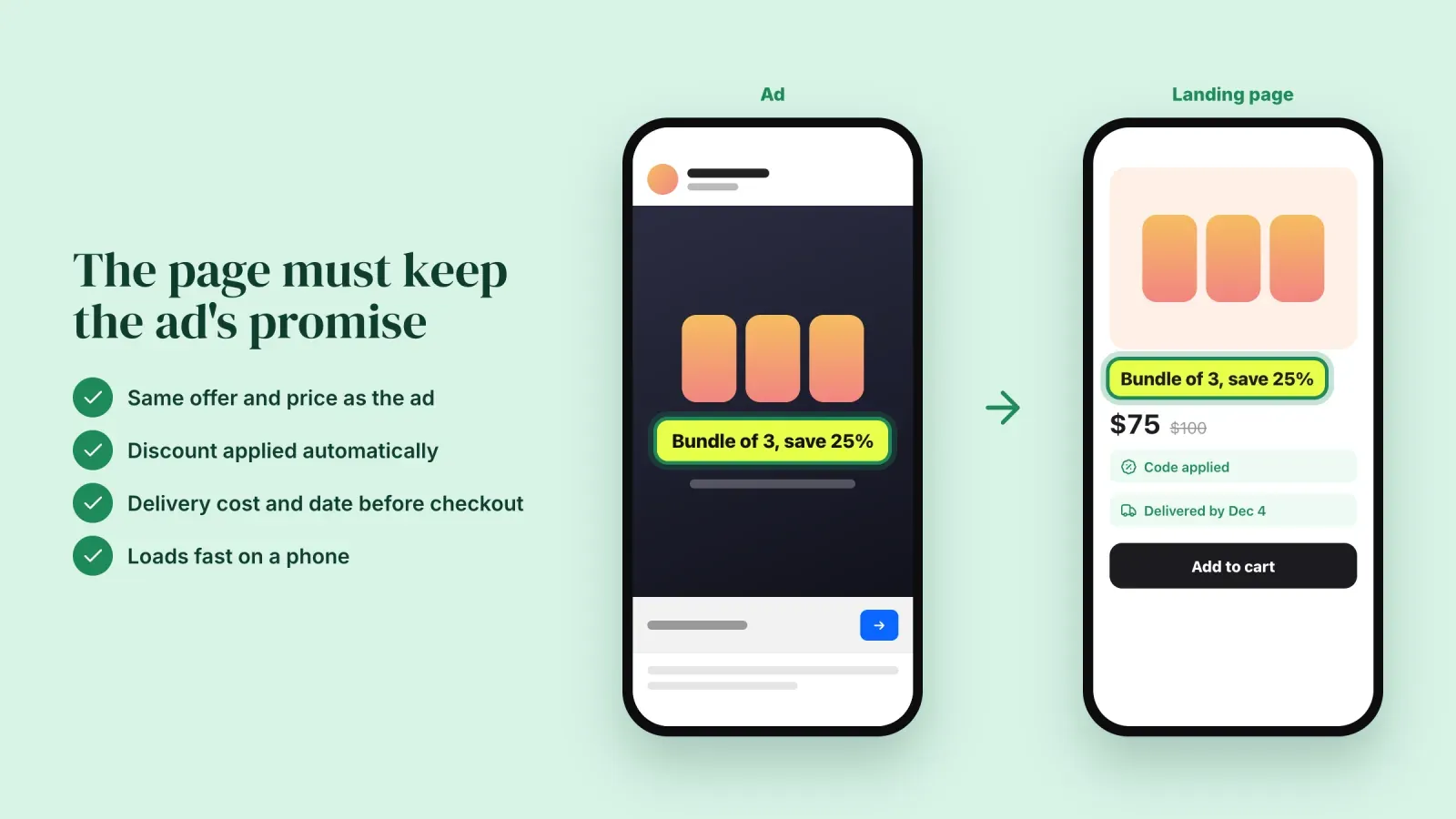
An ad that says "30% off the [product]" should land on that product, with the 30% visible straight away. Sending people to your home page, where they must search for the deal, wastes the click you paid a premium for.
Check four things before you launch. The offer and price shown on the page match the ad exactly. The discount code, if you use one, is applied automatically or displayed clearly, which avoids people leaving to search for a discount code elsewhere. Delivery dates and costs are visible before checkout, because surprise fees are one of the main causes of cart abandonment. The page loads fast on mobile, since most Black Friday traffic from social media arrives on a phone.
For creators and small brands that sell from social media, a focused storefront often converts better than a full website during a sale. With Roctify, you can put your Black Friday products, bundles, digital downloads or bookings on your link in bio page and point each ad to the exact item it promotes. Our guide on how to sell more on social media shows how to tie that page into your daily content.
Stay legal, discounts, timers and reviews
Regulators now watch Black Friday closely, and the rules have teeth.
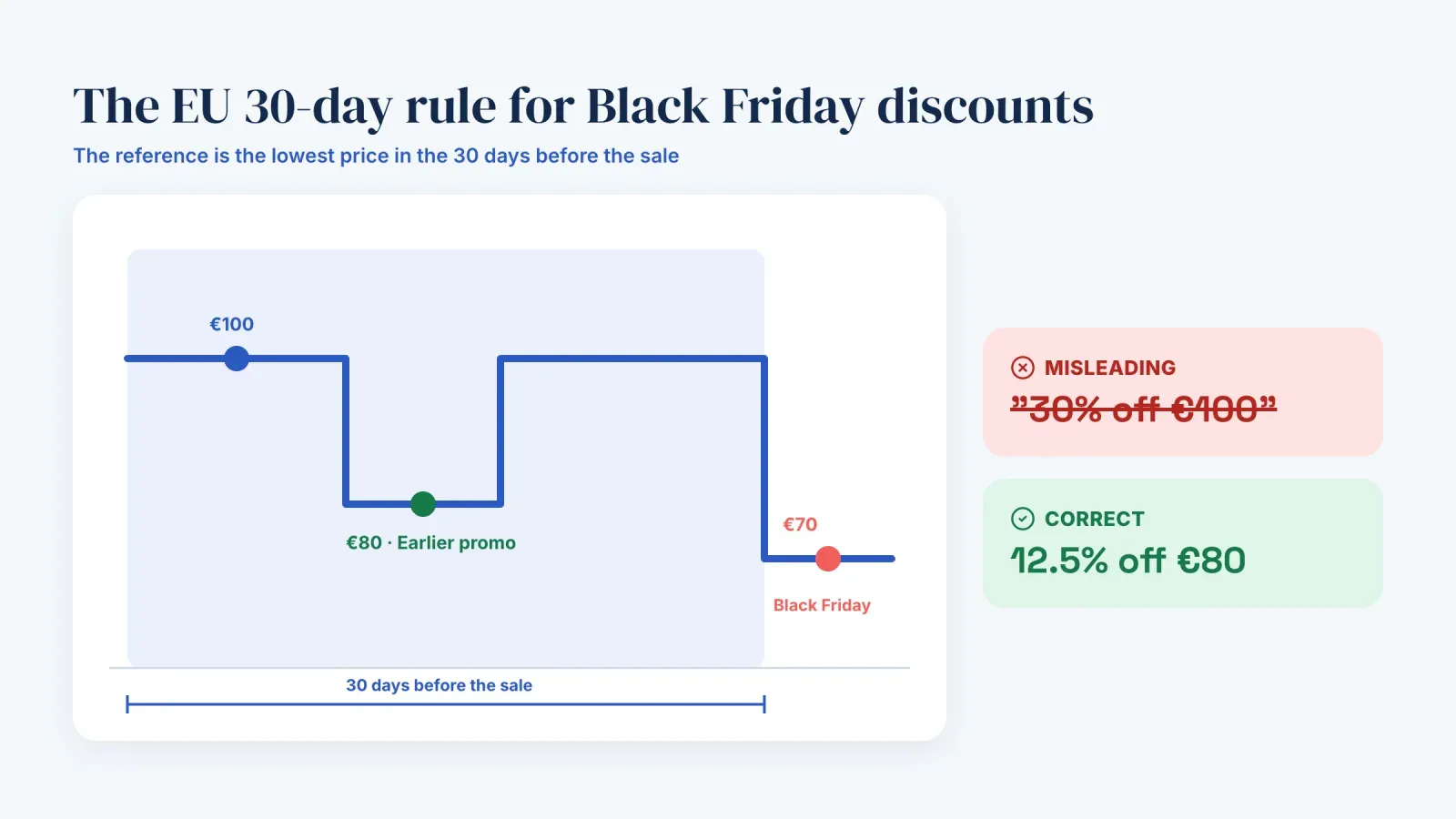
In the European Union, the Omnibus rules require that any announced price reduction be calculated from the lowest price you charged in the 30 days before the reduction. If a product was €80 during a promotion three weeks ago and is €70 on Black Friday, you cannot advertise "30% off €100". The discount must be calculated from €80, which makes it 12.5% off. A coordinated EU sweep of 314 online shops during Black Friday and Cyber Monday found that 30% displayed discounts incorrectly, and that 18% used pressure techniques such as countdown timers or stock claims, more than half of which were misleading or fake.
In the United Kingdom, the Digital Markets, Competition and Consumers Act has allowed the Competition and Markets Authority to fine businesses up to 10% of their global turnover since April 2025, without going to court first. The CMA has already acted against countdown timers that restart when the page is refreshed and against misleading "high demand" messages, and the advertising regulator increasingly asks retailers for months of sales data to check reference prices.
In the United States, the Federal Trade Commission's rule on fake reviews, in force since October 2024, bans fake or bought reviews and testimonials, and false "was" prices remain deceptive under long-standing guidance.
The practical rules are the same everywhere. Calculate discounts from a price you actually charged. Use timers only when the offer truly ends at that moment. Claim low stock only when stock is low. Show all fees before checkout. Use real reviews from real customers. This is not legal advice, so check the rules in each country where you sell, but these habits keep you safe in most markets and make your ads more credible too.
Check that your Black Friday ads make money
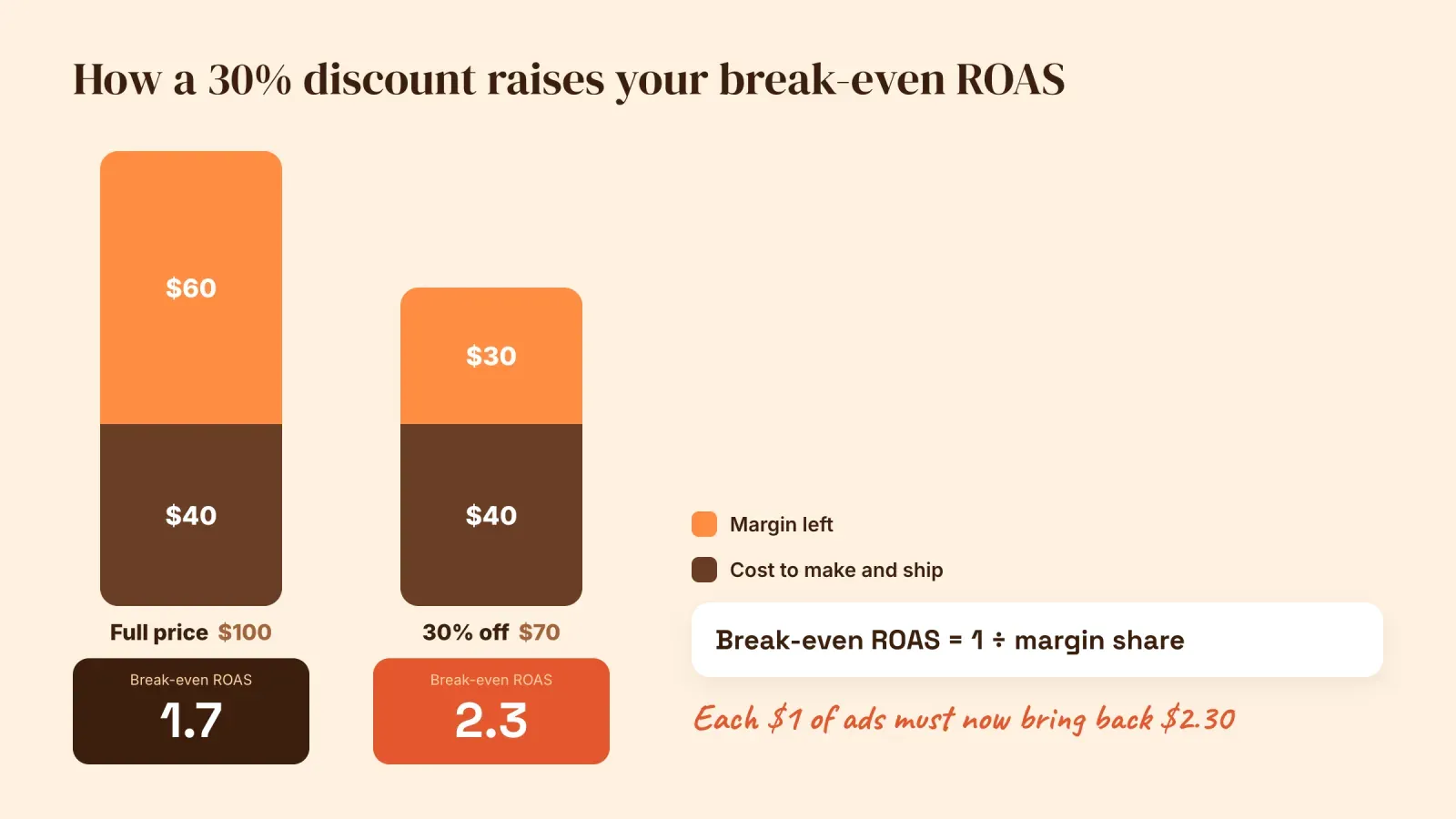
A sale can break records and still lose money. Before you launch, calculate your break-even ROAS, the minimum revenue each dollar of advertising must bring back for you not to lose money.
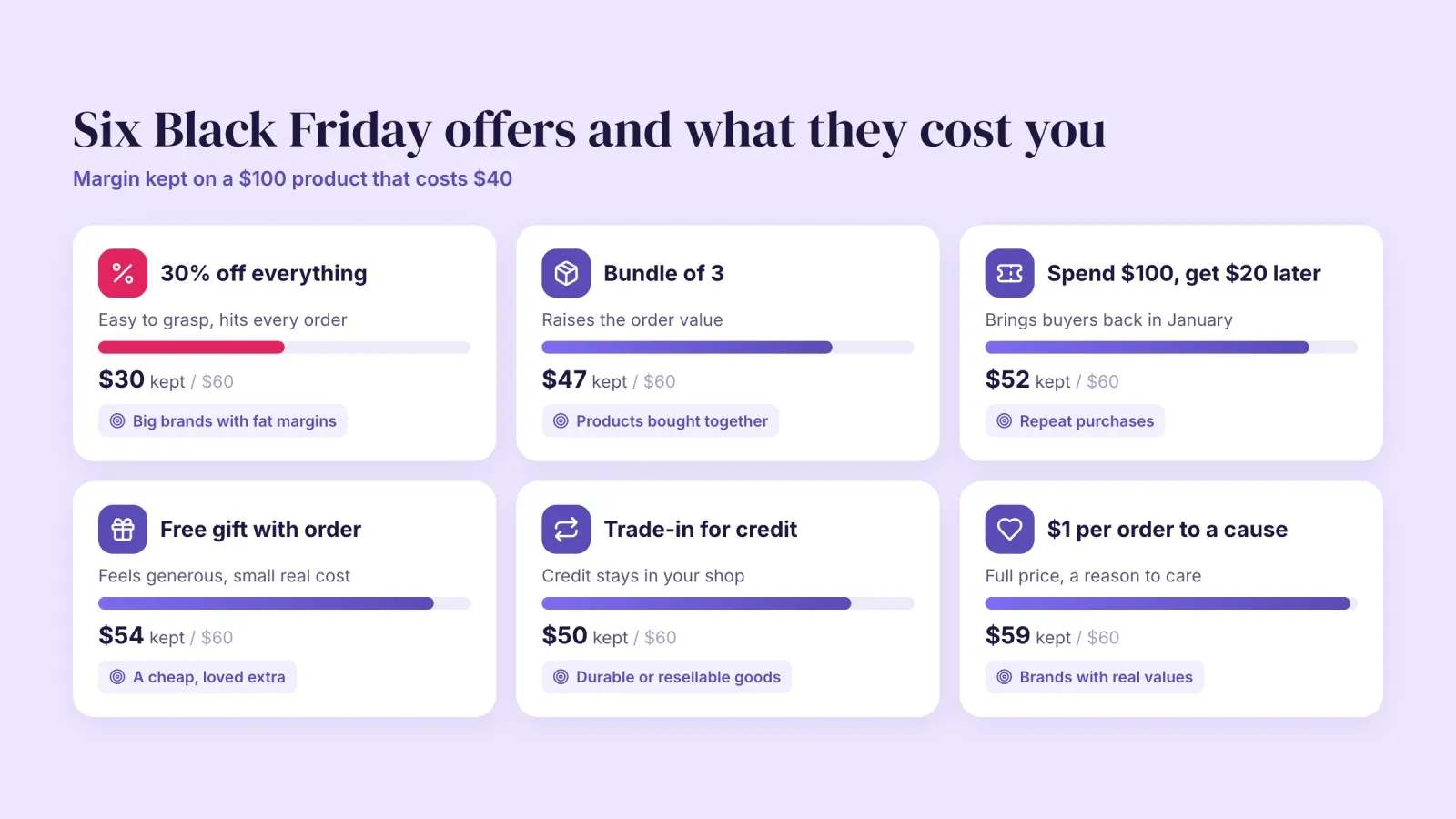
The formula is simple. Take your gross margin after the discount, as a share of the sale price, and divide 1 by it. Suppose a product sells for $100 and costs you $40 to make and ship. Your normal margin is 60%, so your break-even ROAS is 1 divided by 0.6, about 1.7. With a 30% discount, the price falls to $70 and your margin to $30, or about 43% of the new price. Your break-even ROAS rises to 1 divided by 0.43, about 2.3.
In other words, the same ad must now bring back $2.30 for every dollar spent just to break even, at a time when each impression costs more. That is why bundles, gifts with purchase and future credits are often healthier than deep percentages. They protect the margin while still giving people a reason to buy now.
Track these numbers every day of your campaign.
- ROAS against your break-even. Any campaign below break-even is losing money on each sale.
- New versus returning customers. A campaign that only discounts for people who would have bought anyway is expensive.
- Average order value. Bundles and spending thresholds should push it up.
- The conversion rate of the landing page. If clicks are high and sales low, look at the page first.
- Refunds and returns. Impulse purchases come back more often, so check your real revenue a few weeks later.
Common mistakes that waste Black Friday budget
Launching untested creative on the most expensive days. Test in October, scale what works in November.
Copying the default black and red template. If your ad looks like everyone else's, it gets ignored like everyone else's. Keep your own brand codes.
Hiding the offer. "Big savings inside" makes people work. "25% off all candles" does not.
Running the same ad from October to December. Teaser, launch, reminder and last chance need different messages.
Forgetting existing customers. Your past buyers and subscribers are your cheapest and most loyal Black Friday audience.
Fake urgency. Timers that restart, fake stock counters and invented "previous prices" can now cost you far more than the sale earns.
Leaving Black Friday links live in December. Update your ads, bio links and banners as soon as the sale ends.
Frequently asked questions
When should I start running Black Friday adverts? Start testing creative and offers in early or mid October, run teaser and sign-up ads from late October, and launch the sale itself during Black Friday week. Starting early lets you find winners while ad costs are lower.
Are Black Friday ads more expensive? Yes. Ad costs rise through November as more advertisers compete for the same people. Benchmarks for 2025 showed Meta CPMs around 8% higher during Black Friday and Cyber Monday than the year before, with bigger jumps in some industries. Building an email or SMS list beforehand reduces how much you depend on paid reach.
What discount works best for Black Friday adverts? There is no universal number. A clear offer people understand instantly matters more than its size. Many small brands do well with bundles, gifts with purchase or credits for a future order, because they protect the margin. Test two or three offers in October before choosing.
Do I have to offer a discount on Black Friday? No. REI, Patagonia, Deciem and Allbirds all built memorable campaigns without a classic discount. A stance only works if it matches what your brand really stands for and what you do the rest of the year.
Can I use a countdown timer in my Black Friday ads? Yes, if it is honest. The timer must reflect a real end to the offer, and the offer must actually end then. Timers that restart on refresh or offers that are extended right after the "deadline" are treated as misleading in the EU and the UK.
How do I calculate a Black Friday discount legally in Europe? Base the reduction on the lowest price you charged for the product in the 30 days before the promotion. If you ran another promotion during that period, its price becomes your reference.
What is the difference between Black Friday and Cyber Monday ads? Black Friday ads usually carry the main event and the biggest offers. Cyber Monday is a good moment for a separate, clearly defined online offer, such as a different bundle or digital products, or a genuine last chance, rather than a disguised extension.
Turn your Black Friday attention into sales
The best Black Friday adverts either make an offer impossible to misunderstand or take a stand that people remember. Pick your route, test early, keep your claims honest and make sure every ad lands on a page that delivers what it promised. Create your free Roctify page to turn your link in bio into a storefront for your Black Friday products, bundles, bookings and digital downloads, with 0% transaction fees on every plan, so the clicks you pay a premium for become customers who come back after the sale.