Every ad you see in your feed is a small public experiment. Somebody chose a product, an angle, a hook, a price and a landing page, then paid to show it to strangers. When an ad keeps running for weeks, it is usually because it pays for itself. An adspy tool lets you look at thousands of those experiments at once, so you can learn from what the market already tested before you spend your own budget.
The choice has become confusing. Some tools only cover Facebook and Instagram, others specialize in TikTok, native or push traffic, and a few have turned into AI creative platforms. Prices range from free to several hundred dollars a month, and many reviews still quote plans that no longer exist.
This guide compares 15 adspy tools as they stand in October 2026, starting with the free official ad libraries that most people underuse, then the paid tools worth considering. Every screenshot in this article was taken from the tool's own website or public library, and every price was checked on the vendor's pricing page. After the reviews you will find a comparison table, recommendations by use case, a research workflow that keeps you away from copying, and a simple way to decide whether a paid plan will pay for itself.
What an adspy tool does, and what it cannot tell you
An adspy tool, also called an ad intelligence or spy tool, collects ads that are publicly visible on platforms such as Facebook, Instagram, TikTok, YouTube or Google, stores them in a searchable database and adds filters. Depending on the tool, you can search by keyword, advertiser, landing page domain, country, language, format, start date, number of days running or engagement. The better tools also save the landing pages and keep the history of an ad after it stops, which the official libraries often do not.
Here is what a good tool helps you see.
- Which products, offers and angles competitors keep paying to promote. An ad still live after 30 or 60 days is a strong signal that it works for that advertiser.
- How a market talks. Repeated pain points, promises, proof types and formats tell you what customers in a category respond to.
- The full funnel. The ad, the landing page, the price, the bundles and sometimes the upsells.
- Timing and saturation. When many advertisers start pushing the same product, the window for a newcomer narrows.
And here is what no tool can tell you with certainty: a competitor's real ad spend, return on ad spend, margins or sales. Spend and revenue figures shown by spy tools are estimates built from engagement, traffic panels and assumed conversion rates. Treat them as rough directions, never as facts.
How we picked and judged these tools
We looked at seven criteria, the same ones you should use when you run your own free trials.
- Platform coverage. Does it cover the channels where your customers actually are?
- Database freshness. How fast new ads appear, and whether stopped ads stay searchable.
- Filters. Days running, country, language, format, engagement, landing page technology and date range matter far more than database size.
- Funnel data. Access to landing pages, product pages and store information.
- Price and trial. What you pay, whether a free plan or trial exists, and whether the entry plan is actually usable.
- Workflow. Saving, tagging, sharing with a team, exporting and briefing.
- Honesty of the data. Clear labels on estimates and vendor claims you can check.
Prices below are the public list prices in US dollars at the time of writing. Vendors change their plans often, so check the pricing page before you subscribe. Database sizes are the vendors' own claims, which we could not audit.
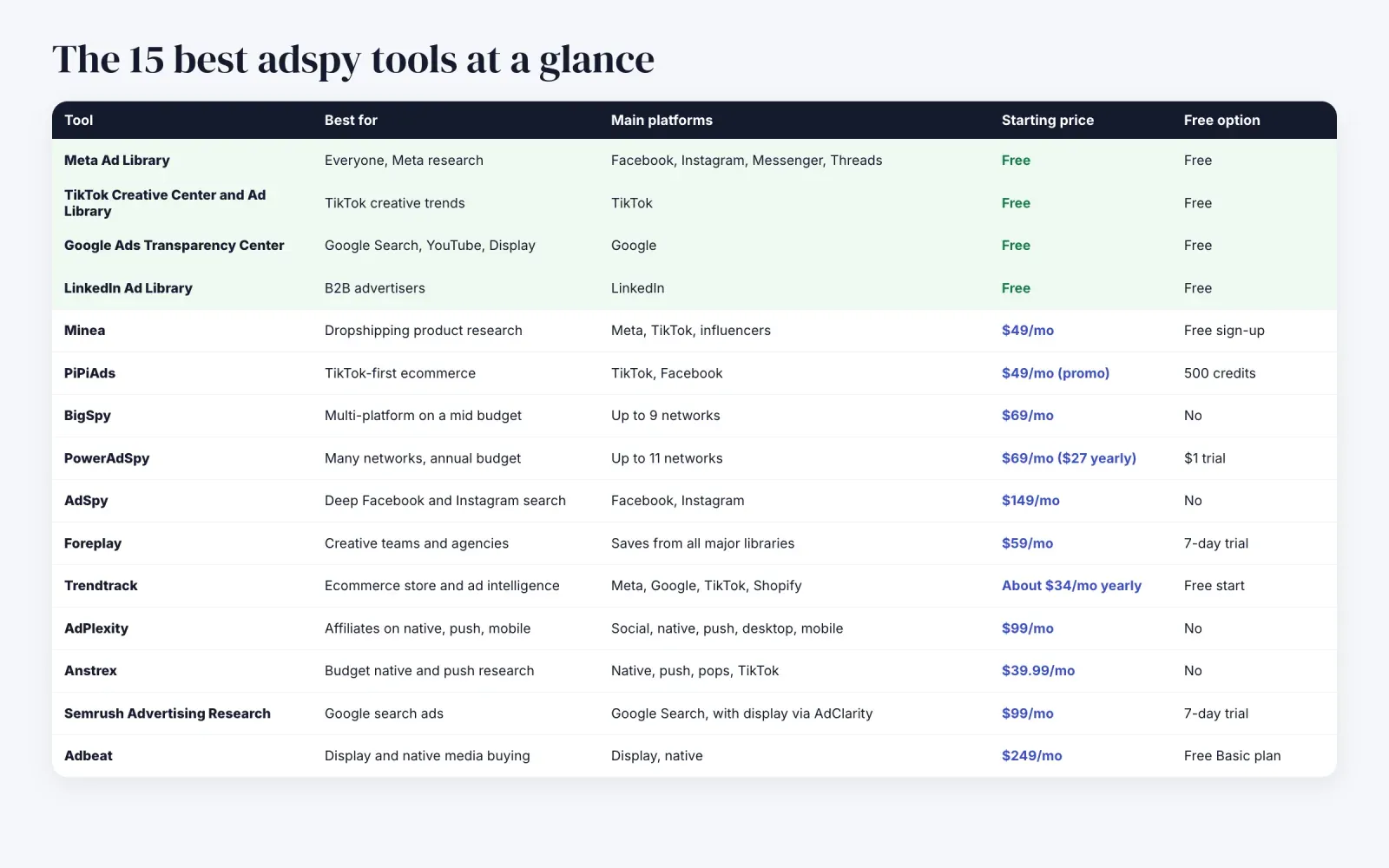
Quick comparison of the 15 best adspy tools
- Meta Ad Library, free. The starting point for everyone researching Facebook, Instagram, Messenger and Threads ads.
- TikTok Creative Center and Ad Library, free. Best for spotting TikTok creative trends and top-performing ads.
- Google Ads Transparency Center, free. Shows competitors' Google Search, YouTube and Display ads.
- LinkedIn Ad Library, free. The go-to library for B2B advertisers.
- Minea, from $49 a month, free sign-up. Product research for dropshipping across Meta, TikTok and influencers.
- PiPiAds, from $49 a month on promotion, 500 free credits. TikTok-first ecommerce research, with Facebook too.
- BigSpy, from $69 a month, no free plan. Multi-platform research on a mid budget, up to 9 networks.
- PowerAdSpy, from $69 a month or $27 a month yearly, $1 trial. Up to 11 networks for agencies on an annual plan.
- AdSpy, $149 a month, no trial. Deep Facebook and Instagram search, including comments.
- Foreplay, from $59 a month, 7-day trial. Swipe files and briefs for creative teams, saving from every major library.
- Trendtrack, about $34 a month billed yearly, free start. Store and ad intelligence for ecommerce on Meta, Google, TikTok and Shopify.
- AdPlexity, from $99 a month, no trial. Social, native, push, desktop and mobile data for affiliates.
- Anstrex, from $39.99 a month, no trial. Budget native, push, pops and TikTok research.
- Semrush Advertising Research, from $99 a month, 7-day trial. Google search ads, with display through AdClarity.
- Adbeat, from $249 a month, free Basic plan. Display and native media buying intelligence.
Start with the free official ad libraries
Before you pay for anything, use the libraries that the platforms publish themselves. They are free, they are the original source of most of the data paid tools resell, and since the European Digital Services Act they show more detail for ads delivered in the EU than they used to. Their limits are filtering and history, which is where paid tools earn their price.
1. Meta Ad Library
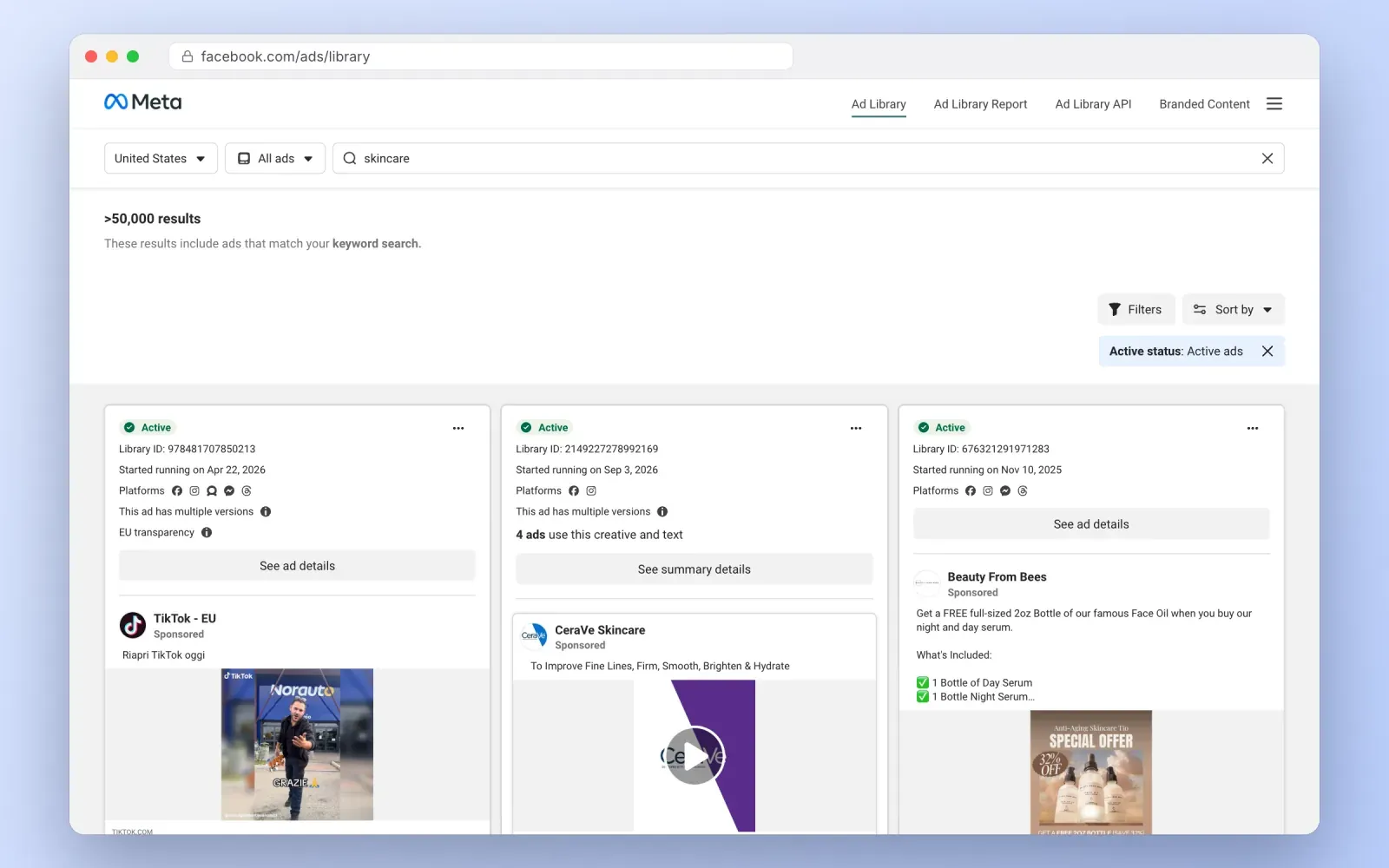
What it is. Meta's public database of every ad currently running on Facebook, Instagram, Messenger, the Audience Network and Threads. You can search by keyword or advertiser, choose a country and filter by platform, media type and active status. Ads appear within about 24 hours of their first impression.
Price. Free, no account required.
What stands out. For ads delivered in the EU, and in the UK since July 2025, the library keeps ads for a year and shows reach and targeting details such as age, gender and location. Political and social issue ads are kept for seven years with spend ranges. The "started running on" date and the number of versions using the same creative are simple but powerful signals.
Limits. Outside political ads, there are no spend or performance figures. Ads that stopped running disappear for most countries outside the EU. Filtering by days running or engagement is not possible, so finding the winners means scrolling.
Best for. Everyone, as the first stop for Meta research. Our step-by-step guide on how to research Meta ads without copying shows how to turn it into a structured research log.
2. TikTok Creative Center and Commercial Content Library
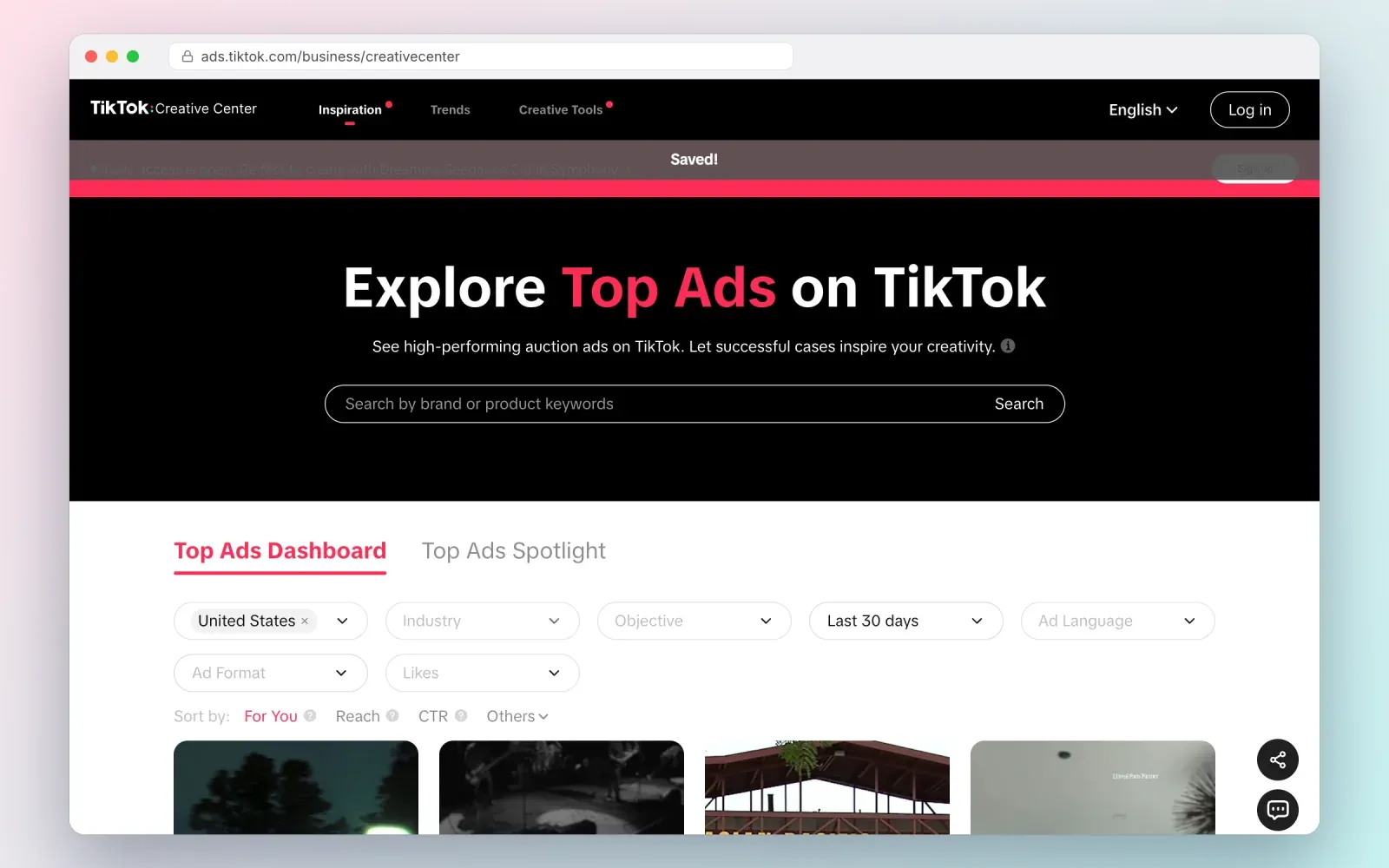
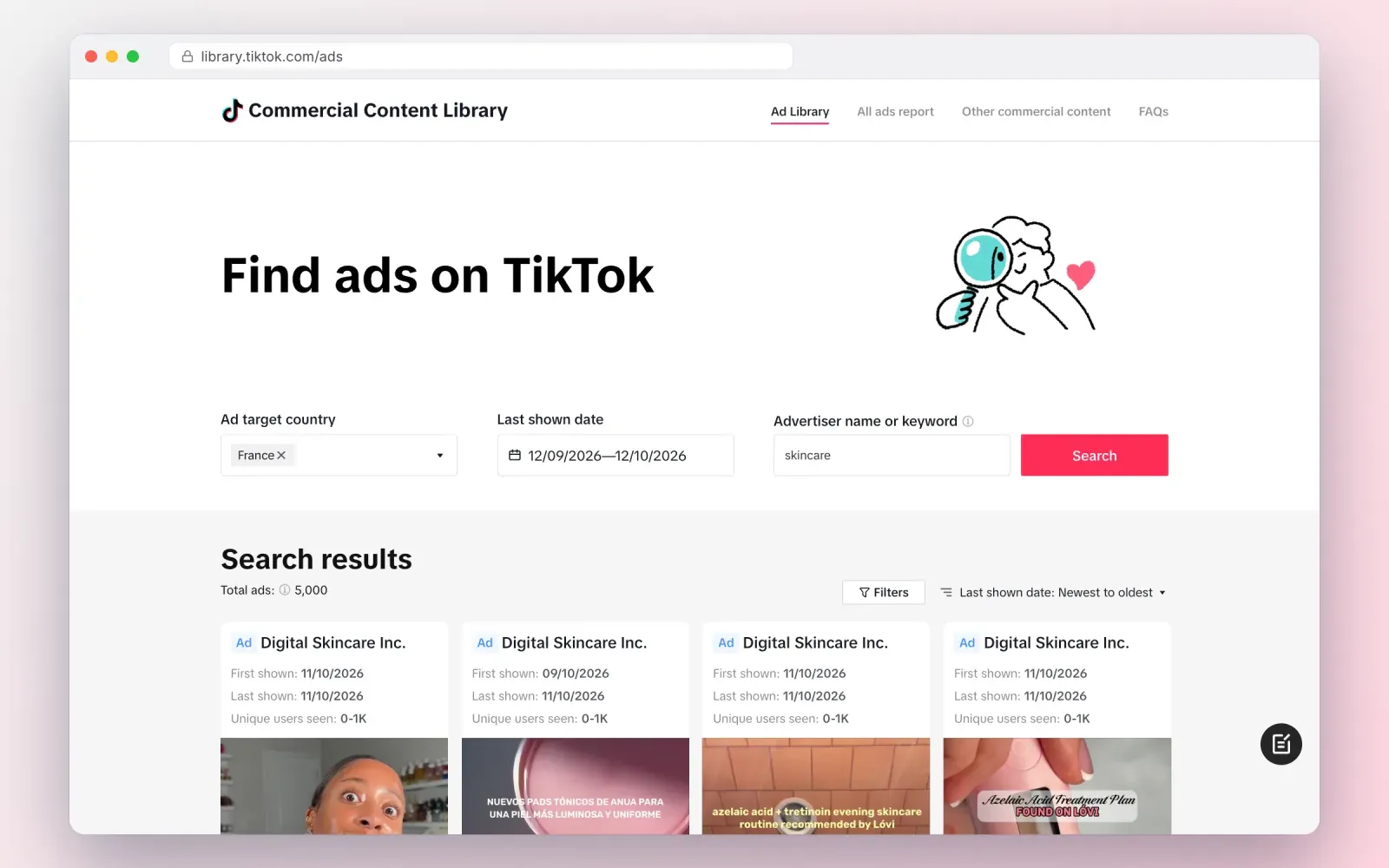
What it is. TikTok offers two free tools. The Creative Center's Top Ads dashboard shows high-performing auction ads filtered by region, industry, objective, format, language and period, sortable by reach, likes or click-through rate. The Commercial Content Library is the transparency database, searchable by country, date range and advertiser name or keyword.
Price. Free.
What stands out. Top Ads is one of the only free places where a platform tells you which ads performed well, with CTR and reach indicators. The Commercial Content Library shows first and last shown dates, reach ranges and targeting for ads in the European Economic Area, the UK and Switzerland, and it also lists paid partnership content from creators.
Limits. The Commercial Content Library only covers Europe, so you will not find US-only campaigns there. Top Ads shows a curated selection rather than every ad, and neither tool shows spend.
Best for. Studying TikTok hooks, formats and trends before you film. See our glossary entry on the TikTok ads library for a method to turn top ads into briefs.
3. Google Ads Transparency Center
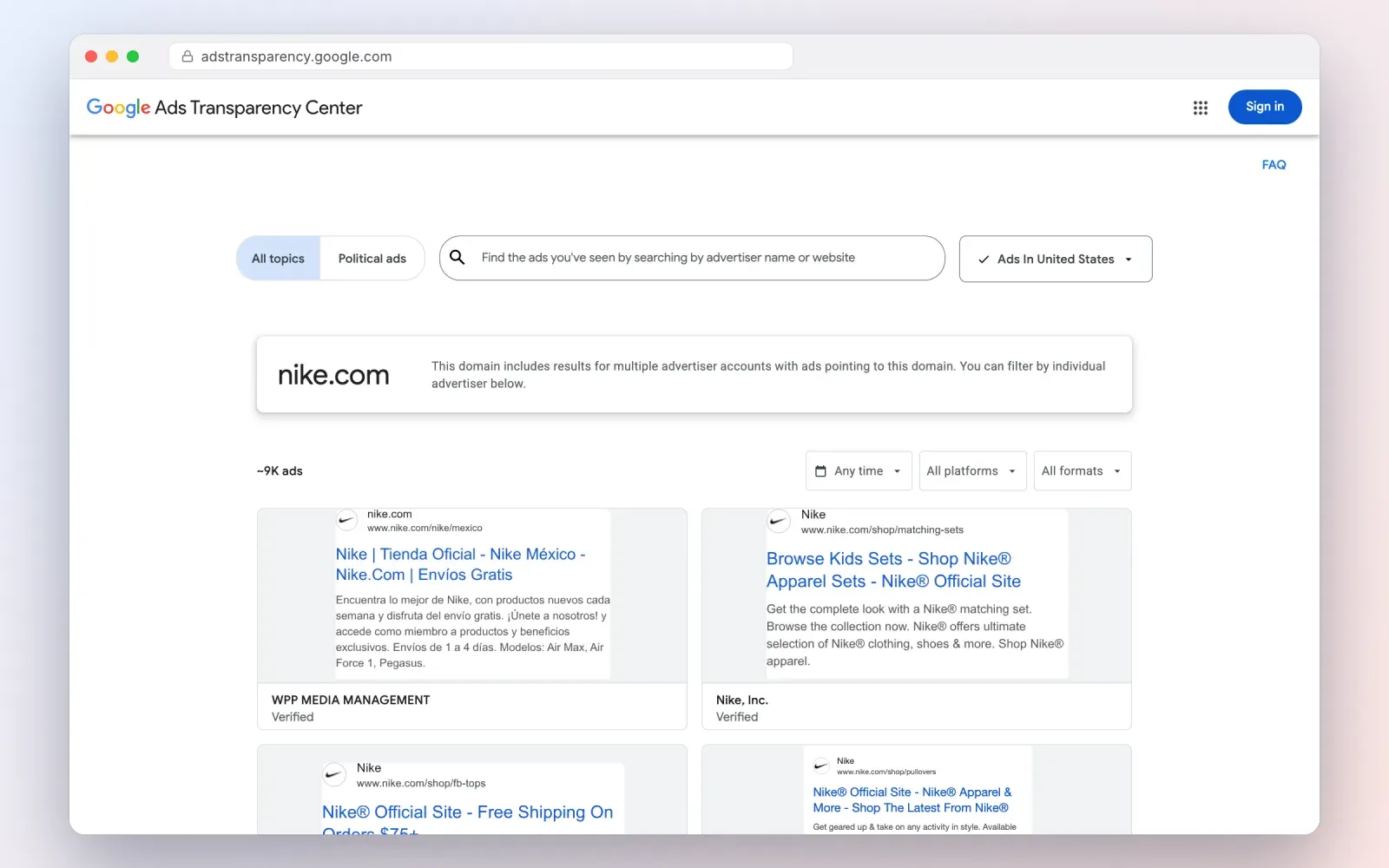
What it is. Google's library of ads from verified advertisers across Search, YouTube, Display and Gmail. You can search by advertiser name or website, choose a region and filter by date, platform and format.
Price. Free.
What stands out. It is the easiest way to see the exact search ads and YouTube ads a competitor runs, including the last date each ad was shown. Searching a domain groups every advertiser account that points to it, which reveals resellers and agencies running ads for a brand.
Limits. No keywords, no positions, no spend and no performance data. You see the creative, not the strategy behind it, which is why paid search tools such as Semrush exist.
Best for. Checking competitors' Google and YouTube creative before you write your own ads.
4. LinkedIn Ad Library
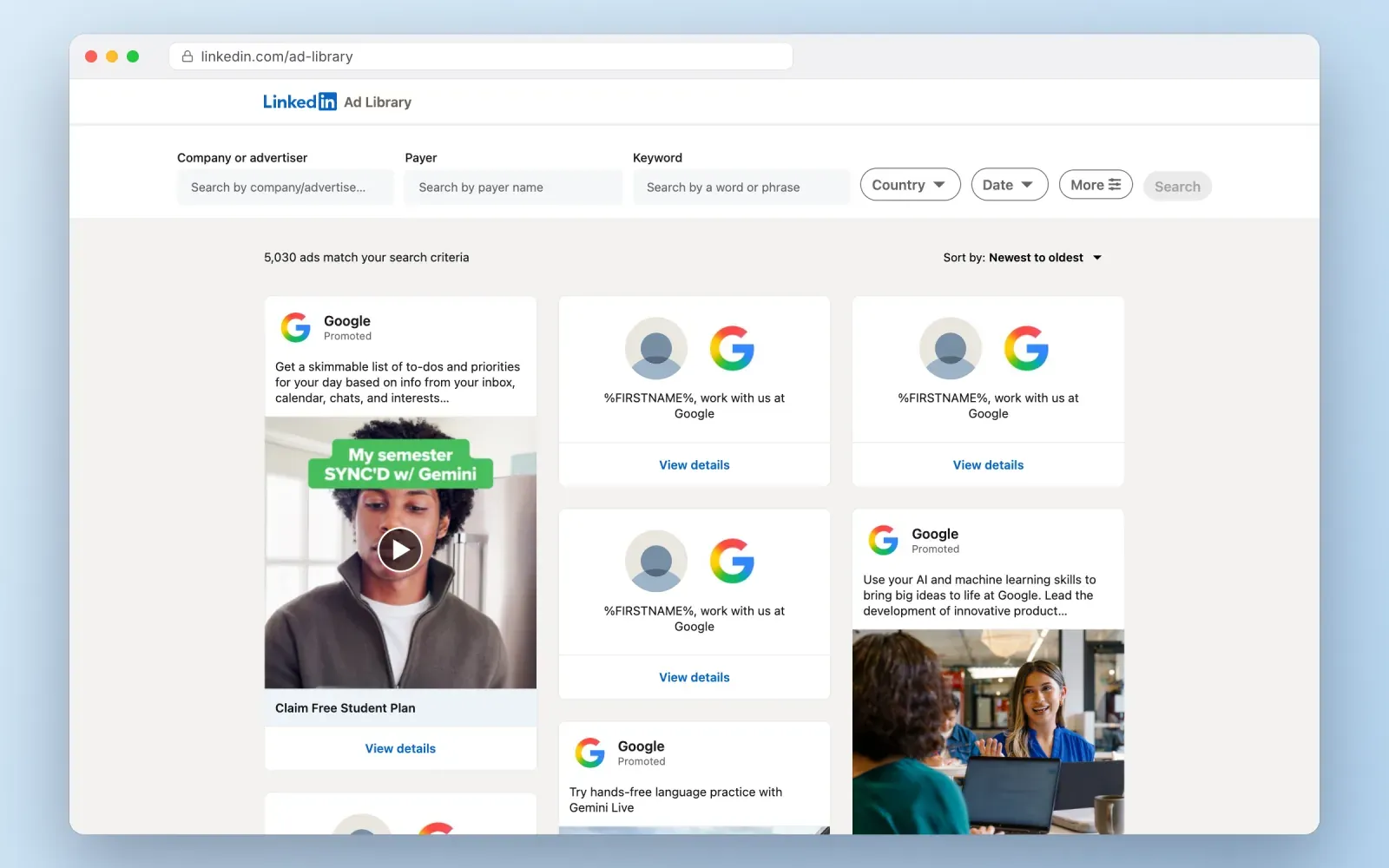
What it is. LinkedIn's public library of ads, searchable by company, payer, keyword, country and date. It keeps ads for a year after their last impression, with coverage starting in June 2023.
Price. Free.
What stands out. For ads targeted at the EU, it shows impression ranges, a country breakdown and targeting parameters. For B2B companies, it is the only reliable free view of how competitors present demos, webinars, white papers and free trials.
Limits. Basic filters and no performance data outside the EU details.
Best for. B2B and SaaS marketers studying offers and messaging on LinkedIn.
Paid adspy tools worth considering
Paid tools add what the official libraries lack: history after an ad stops, filters such as days running and engagement, landing page and store data, alerts, saving and team workflows. Here are the ones worth your trial.
5. Minea
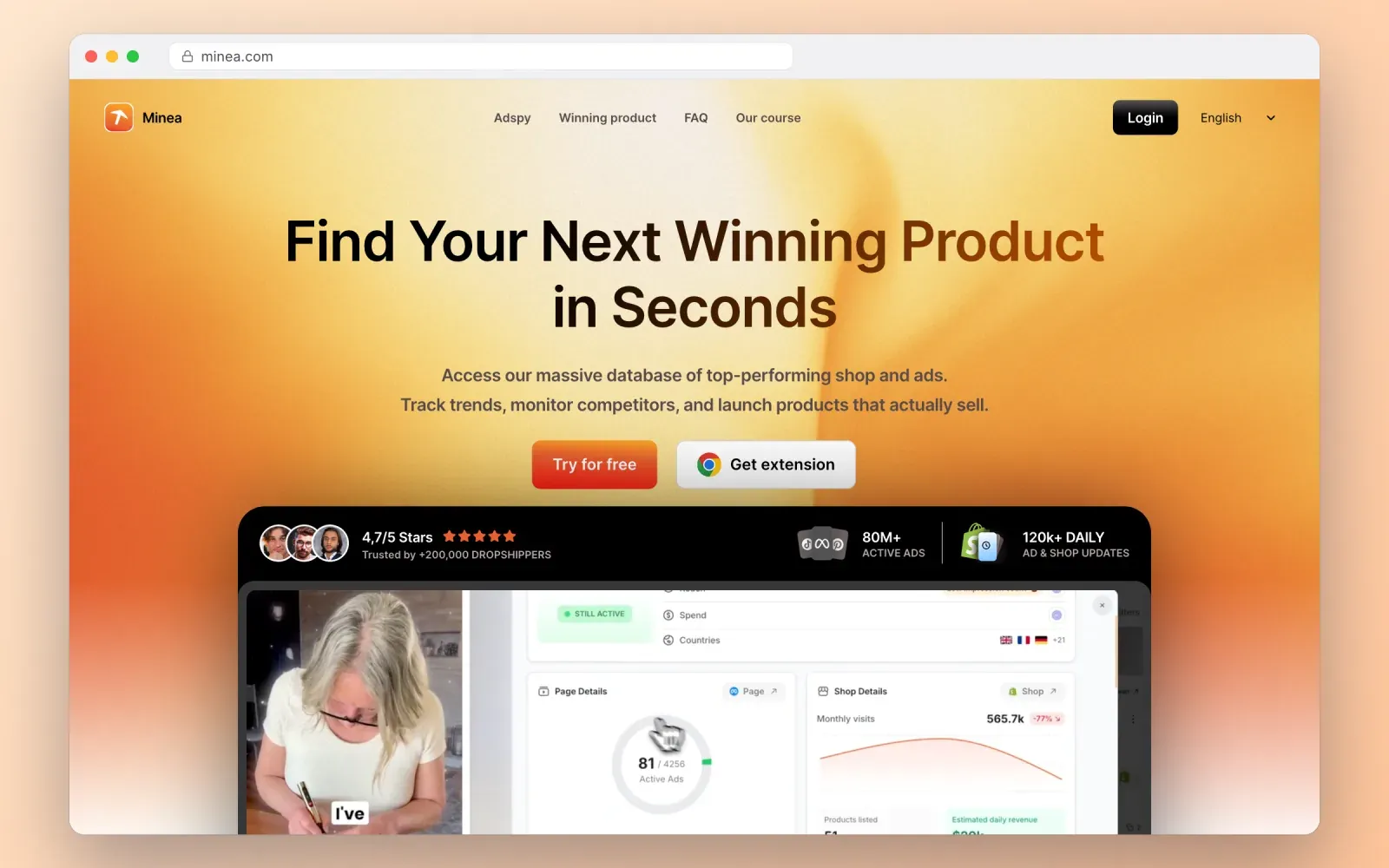
What it is. A French-founded product research and adspy platform built for ecommerce and dropshipping. It combines an ad library with winning product lists, shop tracking, a brand tracker and influencer placement tracking.
Price. Starter $49 a month, Premium $99, Business $199, with lower prices on quarterly billing. You can register for free before choosing a plan.
Platforms. Meta and TikTok ads, plus influencer content. The vendor lists other networks such as Pinterest and Snapchat as coming soon.
What stands out. The product-first approach. Instead of starting from an ad, you start from a product and see its ads, the shops selling it, estimated traffic and sales, and how the trend evolves. AI ad analysis, transcripts, image search and a Chrome extension speed up research. The vendor claims more than 200,000 users.
Limits. Store revenue figures are estimates, and the vendor's own pages give different database sizes depending on where you look. It is less useful if you do not sell physical products.
Best for. Dropshippers and ecommerce sellers looking for products to test.
6. PiPiAds
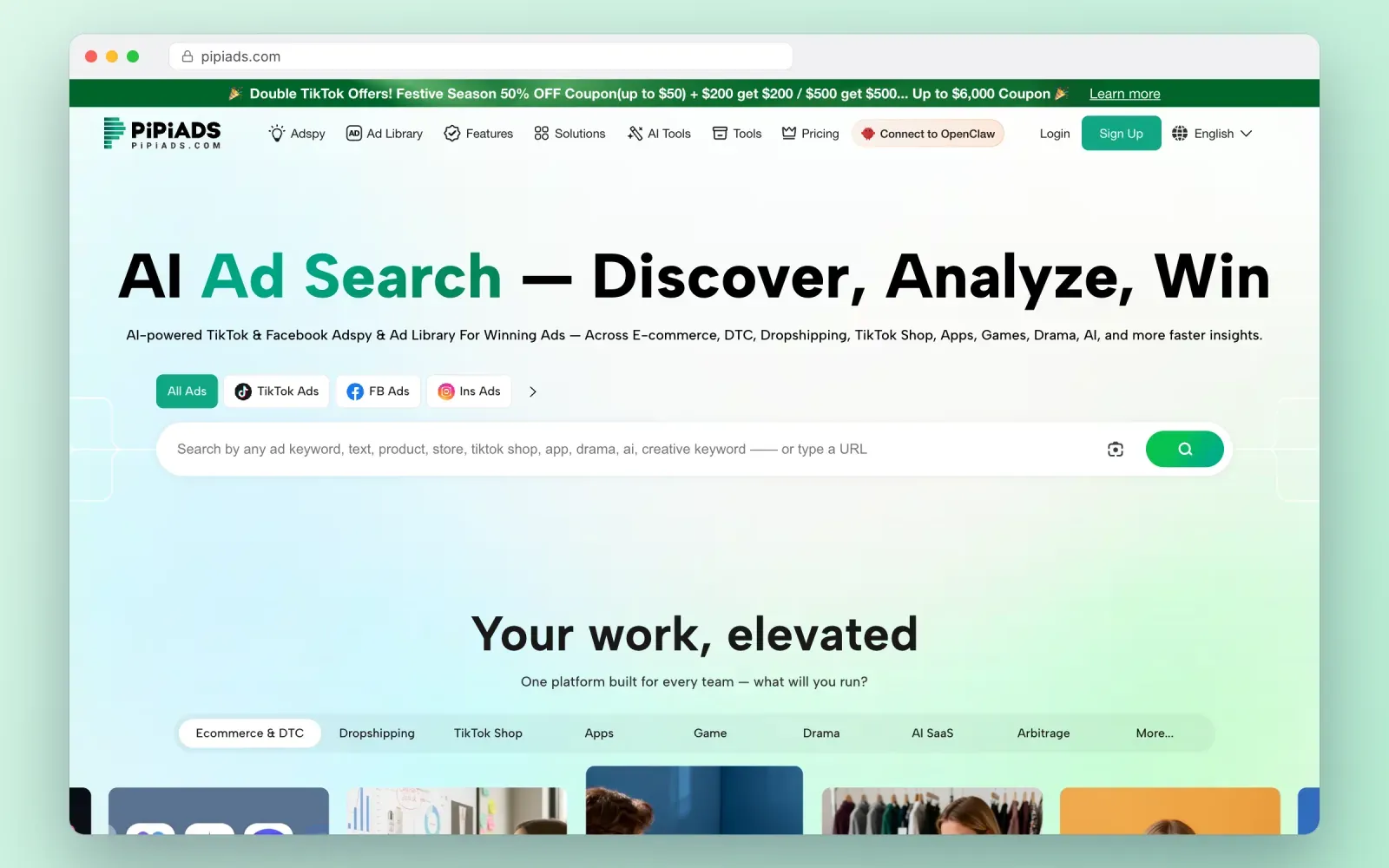
What it is. One of the best-known TikTok adspy tools, now also covering Facebook and the wider Meta ecosystem, with modules for TikTok Shop, apps, games and short drama.
Price. Since August 2025, PiPiAds uses credits. Basic is $49 a month on a promotional price (list $69) with 30,000 credits, Advanced $99 (list $159) with 100,000 credits, and annual billing lowers the cost further. Browsing a list costs 1 credit per item and opening an ad's details costs 20. The free trial gives 500 credits.
Platforms. TikTok, Facebook, Instagram, the Audience Network, Messenger and Threads.
What stands out. Strong TikTok filters, an ad tracker for advertisers you follow, product and store rankings, image search, and AI tools that transcribe and translate ad scripts. TikTok Shop data is useful if you sell there.
Limits. The credit system means heavy research can burn through a plan faster than you expect. Logins are limited to one device per account, which complicates team use on the cheaper plans.
Best for. Ecommerce brands and dropshippers whose main channel is TikTok.
7. BigSpy
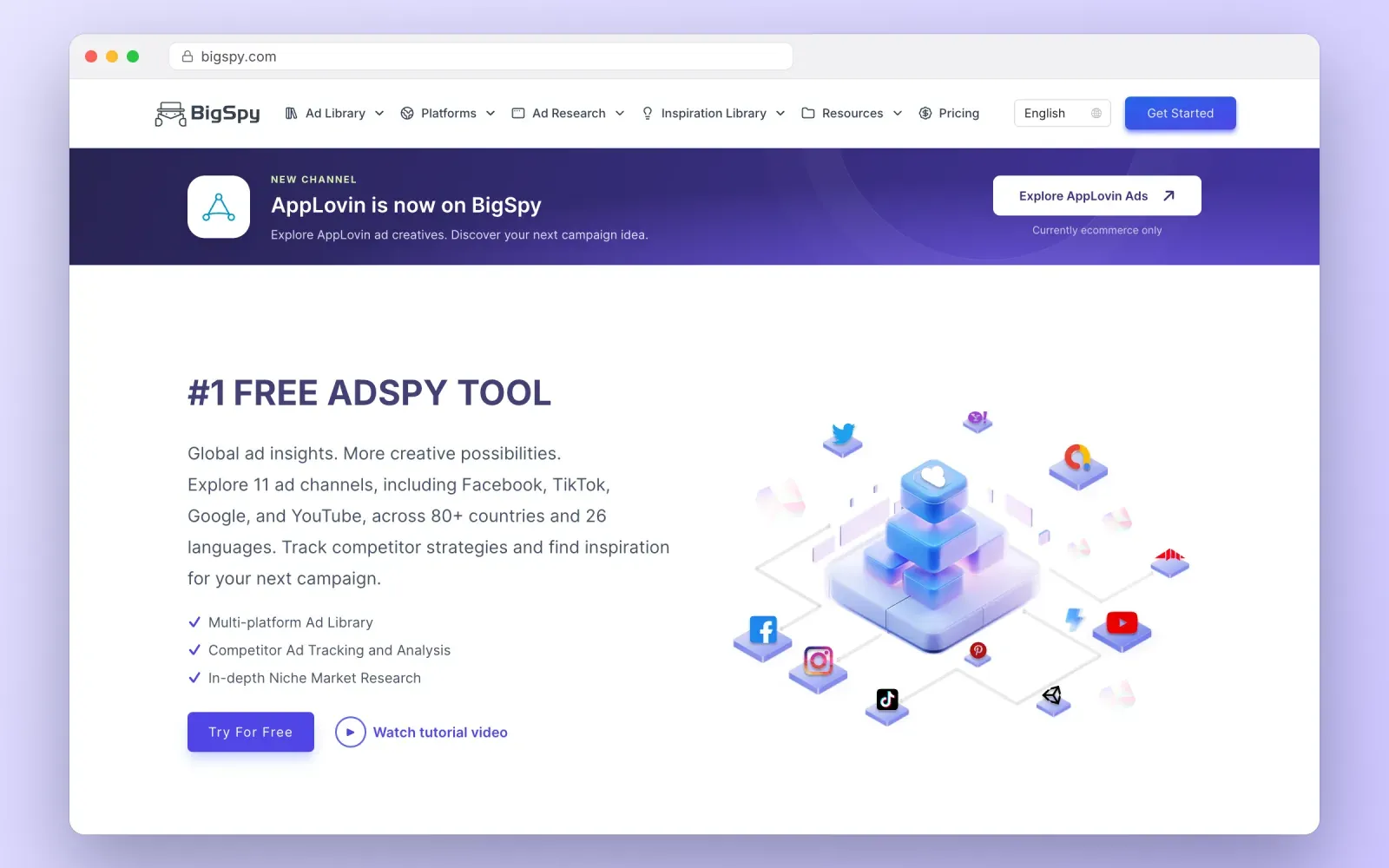
What it is. A multi-platform ad library that has existed for years and now covers Facebook, Instagram, TikTok, YouTube, Google Ads, X, Pinterest, Yahoo, Unity, Pangle and AppLovin, depending on the plan.
Price. Starter $69 a month ($49 billed yearly), Growth $159 ($119 yearly), Scale $399 with five seats, and Ultimate $499. Older reviews that mention plans at $9 or $19 a month describe pricing that no longer exists.
Platforms. Facebook and Instagram on Starter, then TikTok, YouTube, Google, X and Pangle from Growth, and Pinterest, Yahoo and Unity on Ultimate.
What stands out. Breadth, including app and playable ads, which makes it a good fit for mobile app marketers. Creative downloads, landing pages, AI search and subscriptions to advertisers or domains are included.
Limits. The entry plan only covers Meta, so multi-platform research requires Growth or above. The interface shows a lot at once and takes some getting used to.
Best for. Marketers and app developers who want many networks in one place on a mid-sized budget.
8. PowerAdSpy
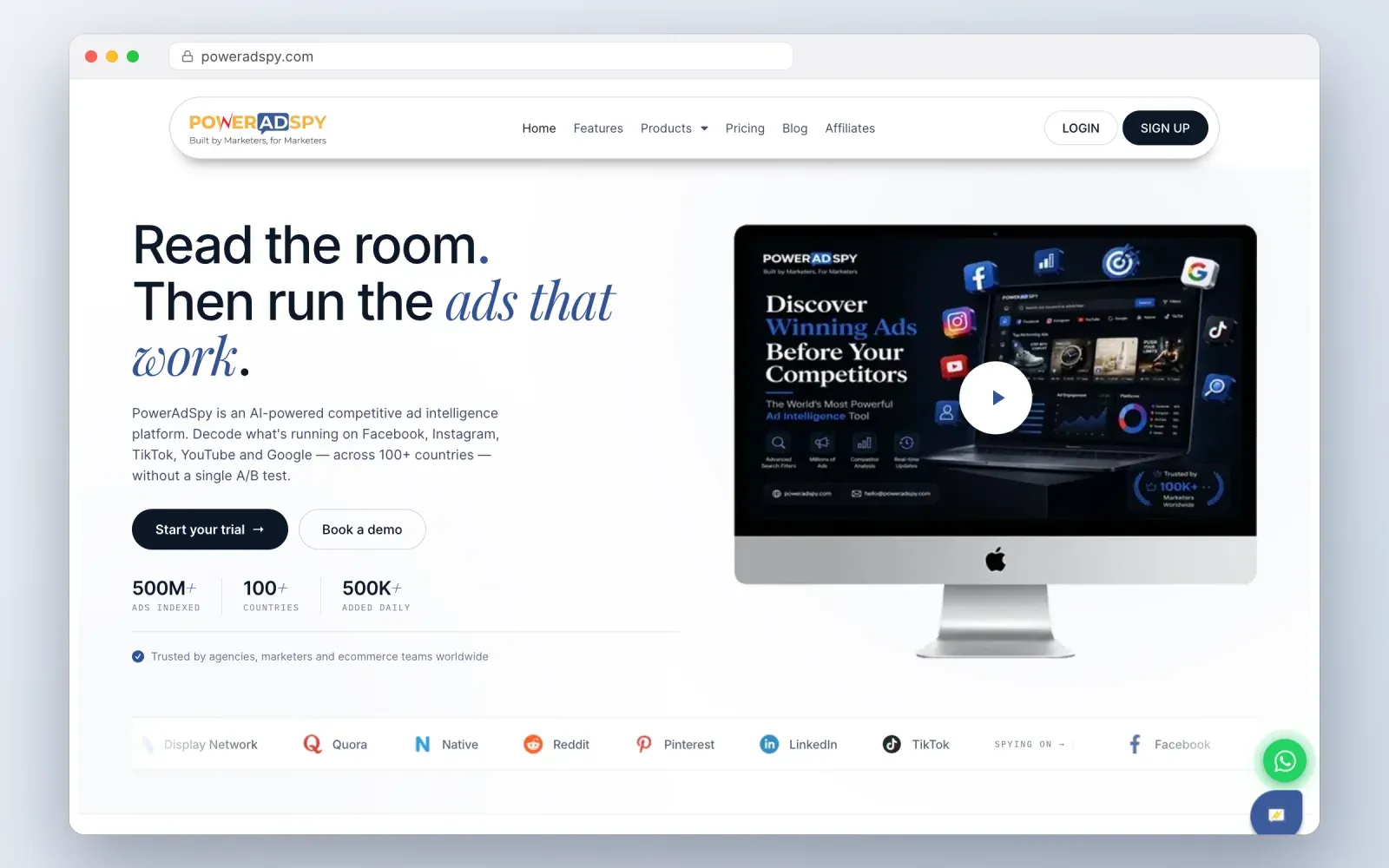
What it is. A multi-network adspy tool covering up to 11 networks: Facebook, Instagram, Google Display and Search, YouTube, Pinterest, native networks, LinkedIn, TikTok, Quora and Reddit.
Price. Basic $69 a month or $27 a month billed yearly, Standard $99 or $39 yearly, Platinum $279, and Palladium $399 or $119 yearly. A 3-day trial costs $1 on Basic and $7 on the other plans, and it converts to a monthly subscription if you do not cancel.
Platforms. Facebook and Instagram on Basic, with more networks added at each tier. All 11 networks require Palladium.
What stands out. Annual pricing is unusually low for the coverage. Search by keyword, advertiser or domain, more than 40 filters, AI breakdowns of hooks and calls to action, watchlists, alerts and estimated budgets on higher plans.
Limits. The network list you see on the homepage is spread across tiers, so check which plan includes the channels you need. The vendor's database figures vary across its own pages.
Best for. Agencies and multi-channel advertisers who can commit to an annual plan.
9. AdSpy
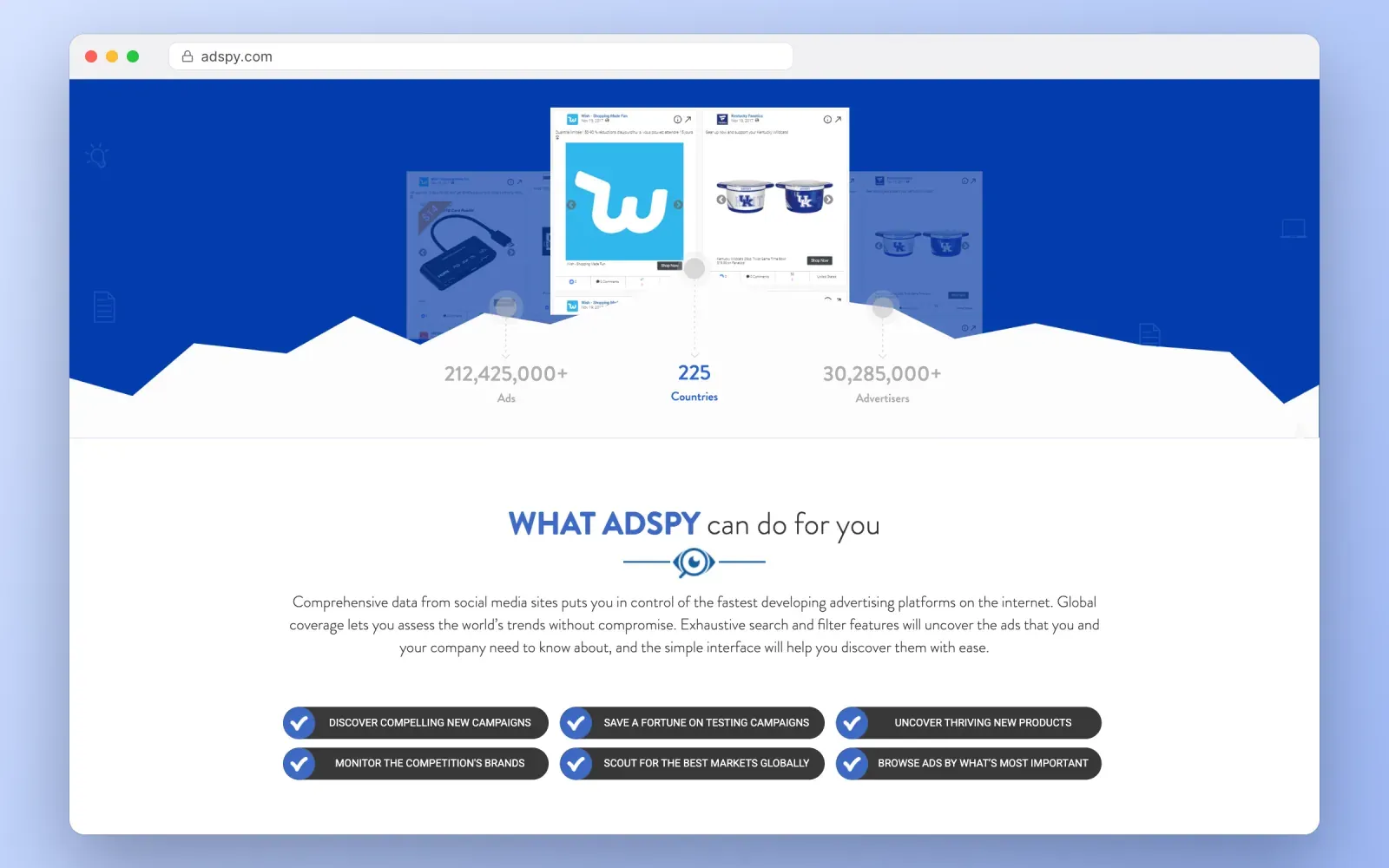
What it is. One of the oldest Facebook and Instagram adspy tools, with a single plan and a very deep search engine.
Price. $149 a month, with what the vendor describes as virtually unlimited usage.
Platforms. Facebook and Instagram only.
What stands out. You can search inside ad text and inside comments, filter by affiliate network and offer ID, search landing page technology and see estimated demographics. The vendor claims more than 212 million ads from over 30 million advertisers in 225 countries.
Limits. No other platforms, no free trial, and an interface that feels older than newer tools.
Best for. Affiliates and media buyers who work mainly on Meta and want to dig through comments and offers.
10. Foreplay
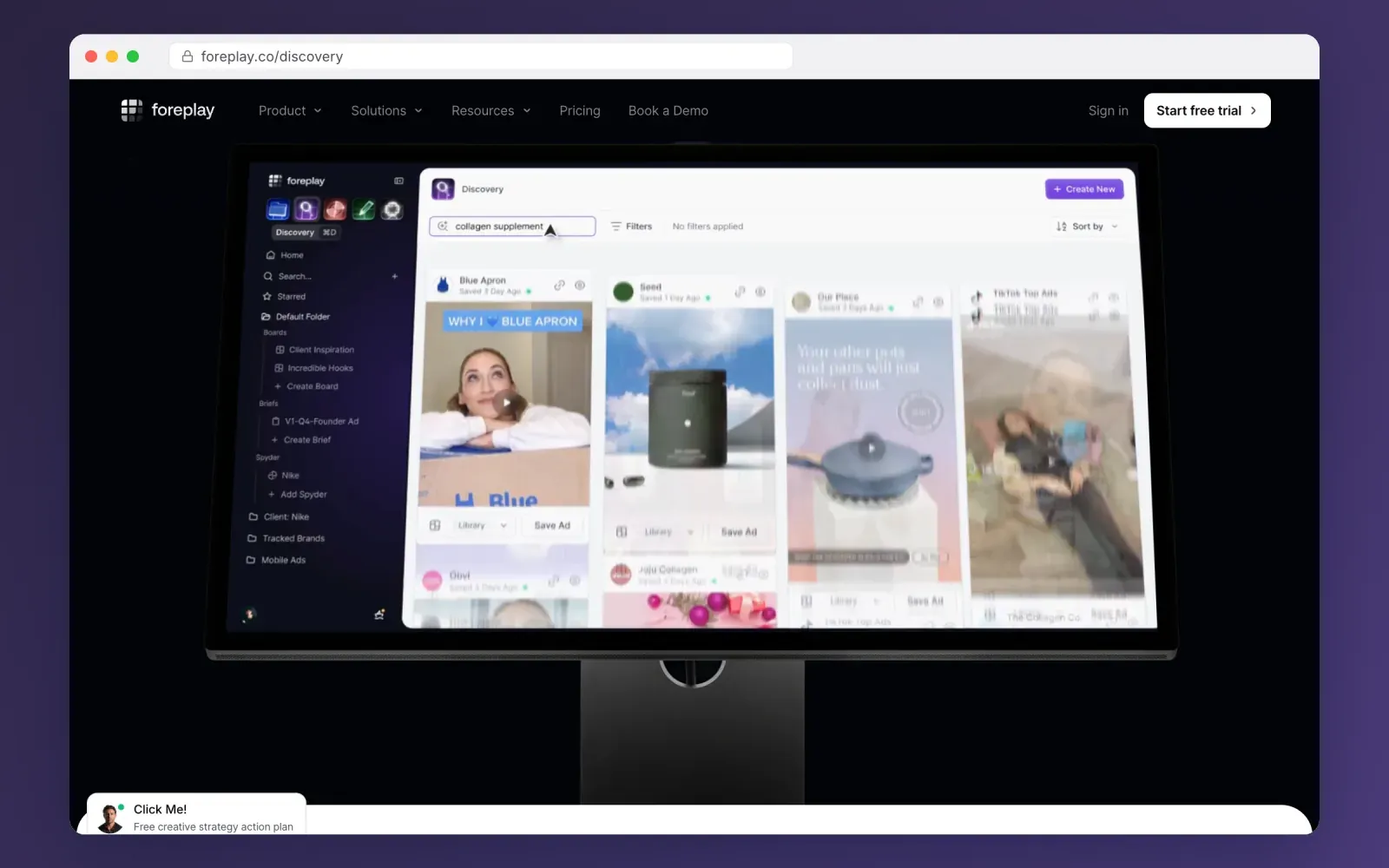
What it is. A creative workflow platform for ad teams. It started as a swipe file that saves ads from the Meta Ad Library and now includes ad search, competitor tracking, creative analytics and briefs.
Price. Basic $59 a month ($49 yearly) for one user, Workflow $175 ($149 yearly) for five users, Agency $459 ($389 yearly) for ten users. There is a 7-day free trial with a card and a 14-day money-back guarantee on monthly plans.
Platforms. Its Chrome extension saves ads from the Meta Ad Library, Instagram, the TikTok Ad Library and Top Ads, TikTok organic, the LinkedIn Ad Library, YouTube Shorts and the Google Transparency Center. Lens connects to your own Meta and TikTok ad accounts.
What stands out. Organization. Boards, tags, team sharing, a Discovery search the vendor says draws on more than 100 million ads, Spyder for 24/7 tracking of competitors' ads, and Briefs to turn saved ads into production briefs for designers and creators.
Limits. It is built around saving and briefing more than discovering products or estimating sales.
Best for. DTC brands, creative strategists and agencies that produce many ads and need a shared swipe file.
11. Trendtrack
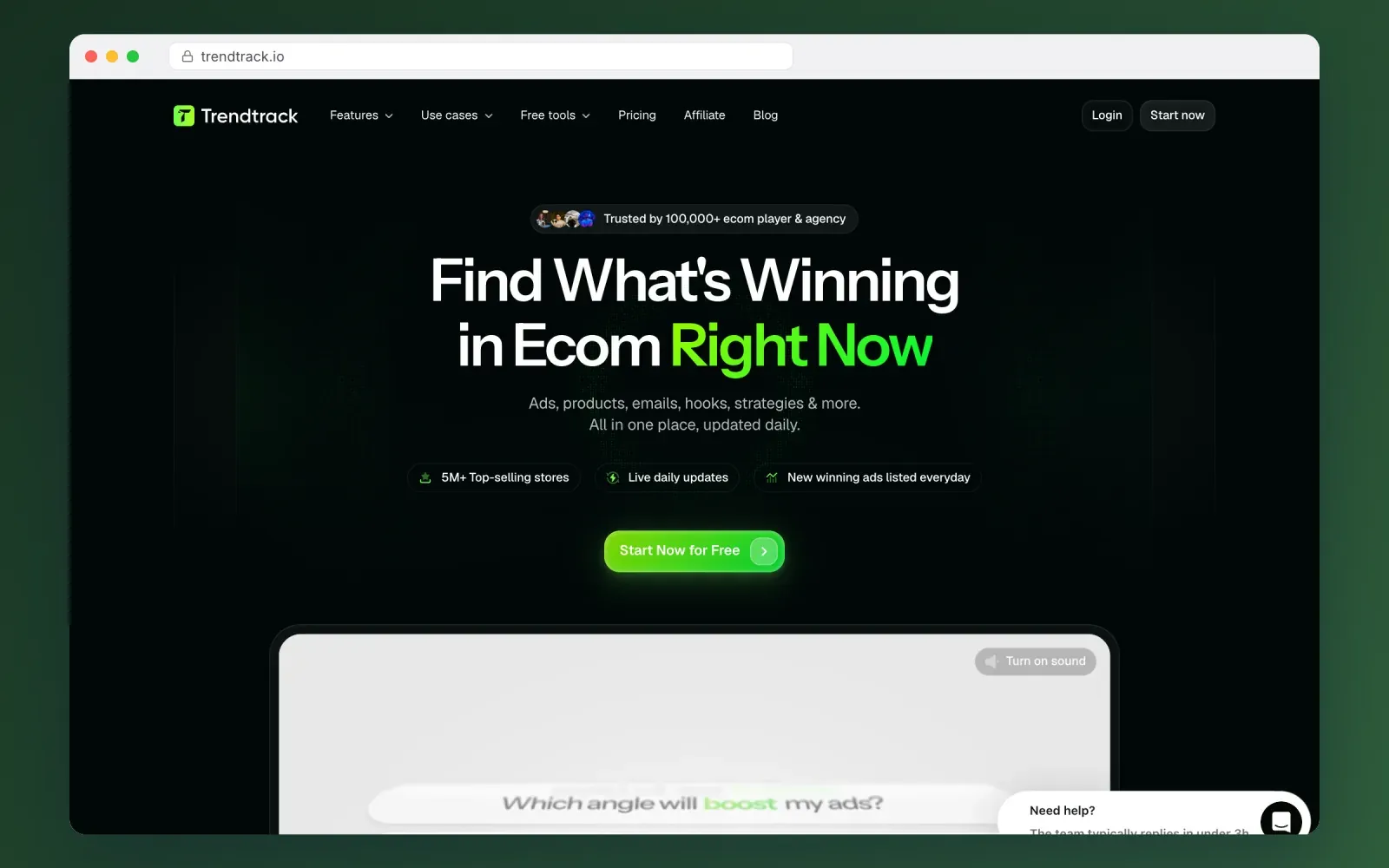
What it is. An ecommerce intelligence platform that combines Shopify store tracking with ad libraries for Meta, Google and TikTok, European transparency data and an email library.
Price. Starter about $34 a month, Pro about $62 and Business about $111 when billed annually, with monthly and quarterly options at higher rates. You can start for free.
Platforms. Meta, Google and TikTok ads, Shopify stores and marketing emails.
What stands out. It connects the ads to the business behind them: the store's products, theme and apps, traffic estimates, new launches and email flows. A Chrome extension shows store data while you browse. The vendor claims more than 250 million ads and several million stores.
Limits. Revenue and traffic figures are estimates, and the pricing page mixes dollar and euro symbols, so confirm the currency at checkout. It is aimed at Shopify ecommerce rather than services or apps.
Best for. Ecommerce brands and agencies who want store, ad and email intelligence in one place.
12. AdPlexity
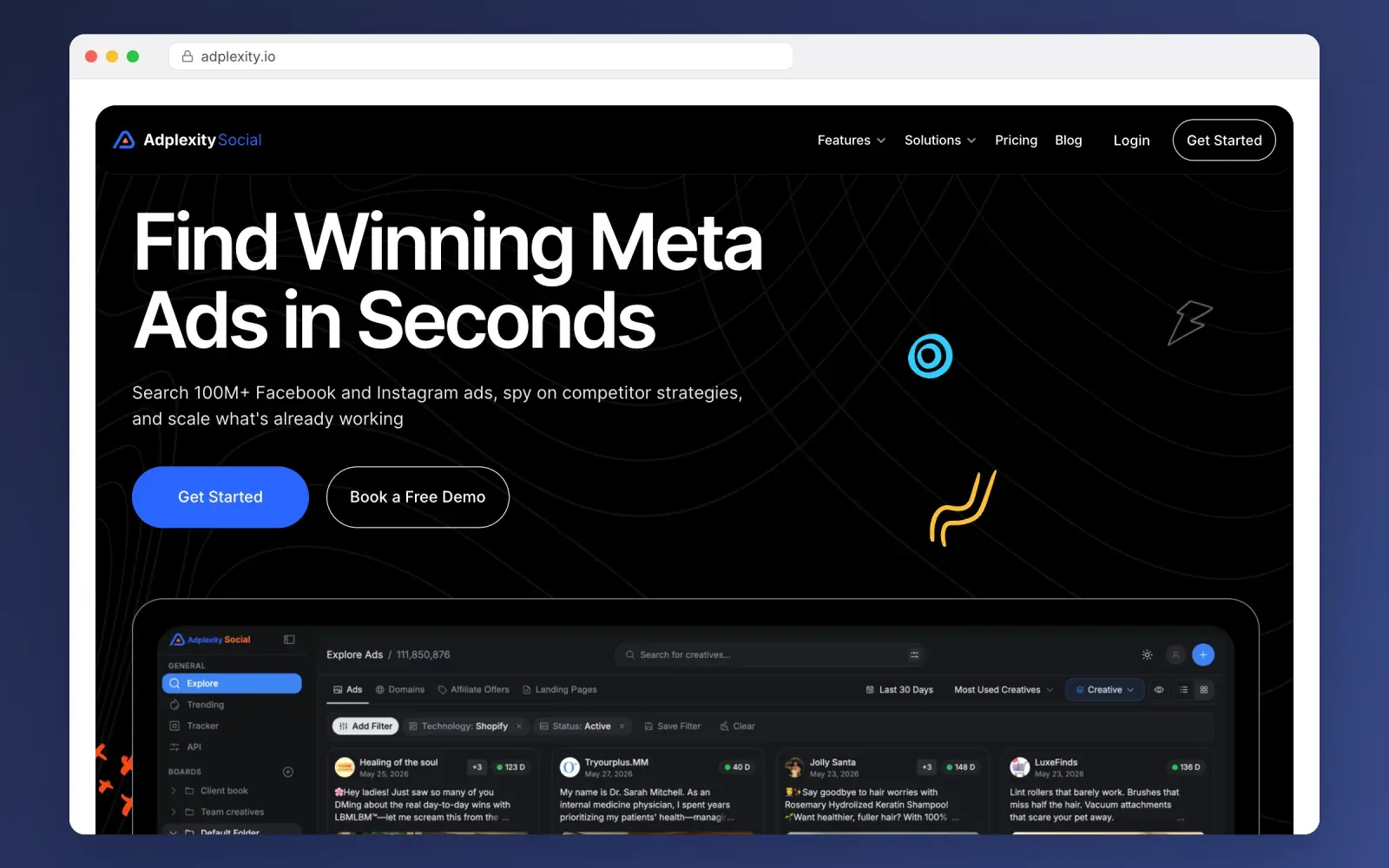
What it is. A family of separate tools for professional affiliates and media buyers, each covering one traffic type: Social, Native, Push, Desktop, Mobile and Adult.
Price. Each product is a separate subscription. Social costs $99 a month ($79 yearly), Push $149, Desktop and Mobile $199 each, and Native $249. There is no free trial, only a demo.
Platforms. Facebook and Instagram on Social, more than 30 native networks such as Taboola, Outbrain and MGID on Native, plus push, pop and mobile networks.
What stands out. Depth on traffic sources that most tools ignore, landing page downloads, nested search, scheduled reports and newer AI research features. The vendor claims more than 200 million ads across its products, refreshed hourly.
Limits. Buying several traffic types gets expensive fast, and the tools are built for experienced media buyers rather than beginners.
Best for. Affiliates running native, push or mobile campaigns.
13. Anstrex
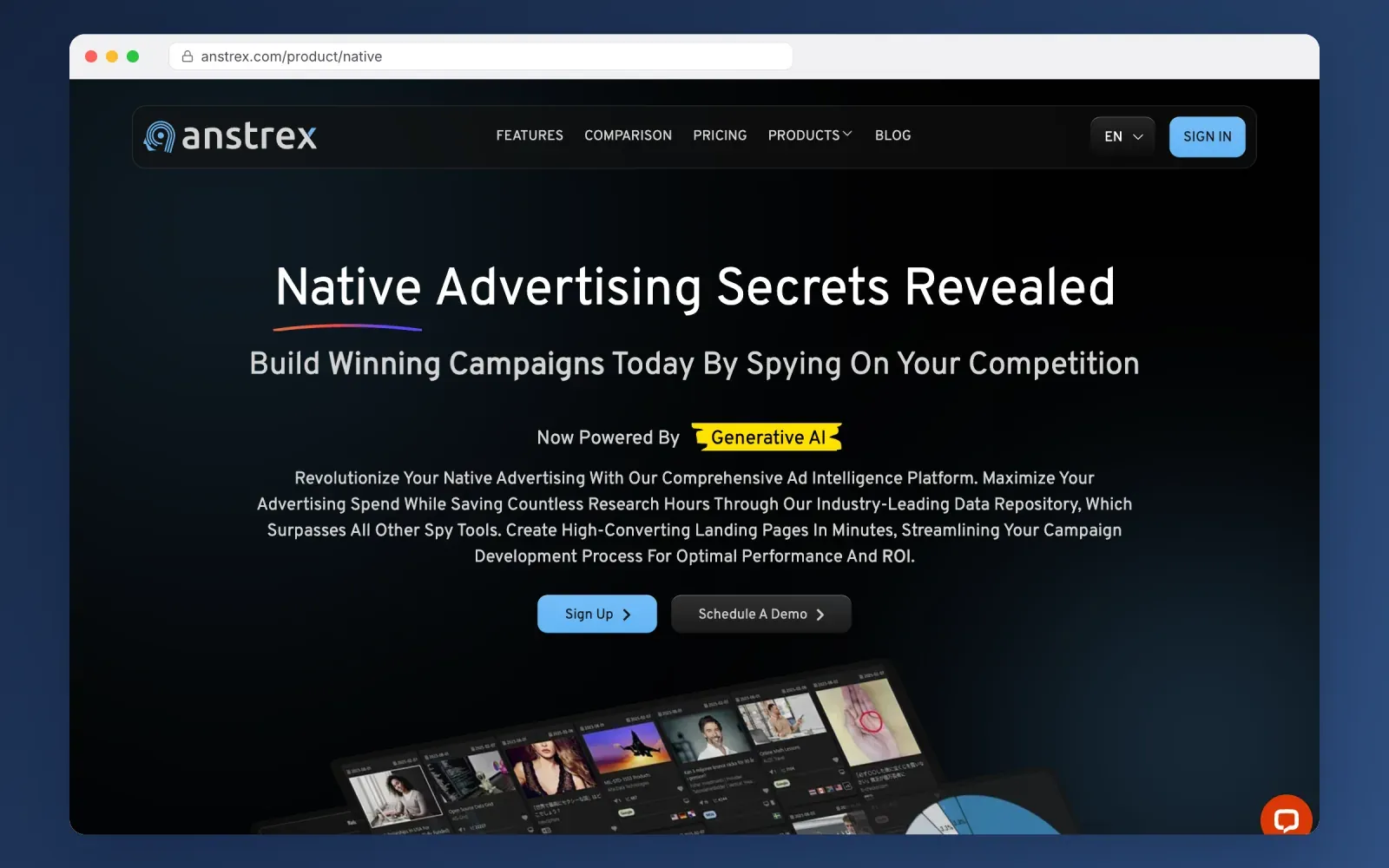
What it is. A cheaper alternative to AdPlexity focused on native, push and pop traffic, with a TikTok library called InStream.
Price. Native $79.99 a month, Push $89.99, Pops $89.99 and InStream $39.99, with bundle discounts. There is no free trial.
Platforms. Around 30 native networks including Taboola, Outbrain, MGID and Revcontent, push and pop networks, and TikTok through InStream.
What stands out. A landing page ripper that lets you download a page and deploy an edited version to your own hosting, Boolean search, redirect chain search and alerts.
Limits. No trial and no refunds for dissatisfaction, so watch the demo videos carefully before buying. The landing page ripper is a research aid. Publishing a competitor's page with minor edits can infringe copyright, so use it to study structure only.
Best for. Affiliates who want native and push data on a smaller budget.
14. Semrush Advertising Research
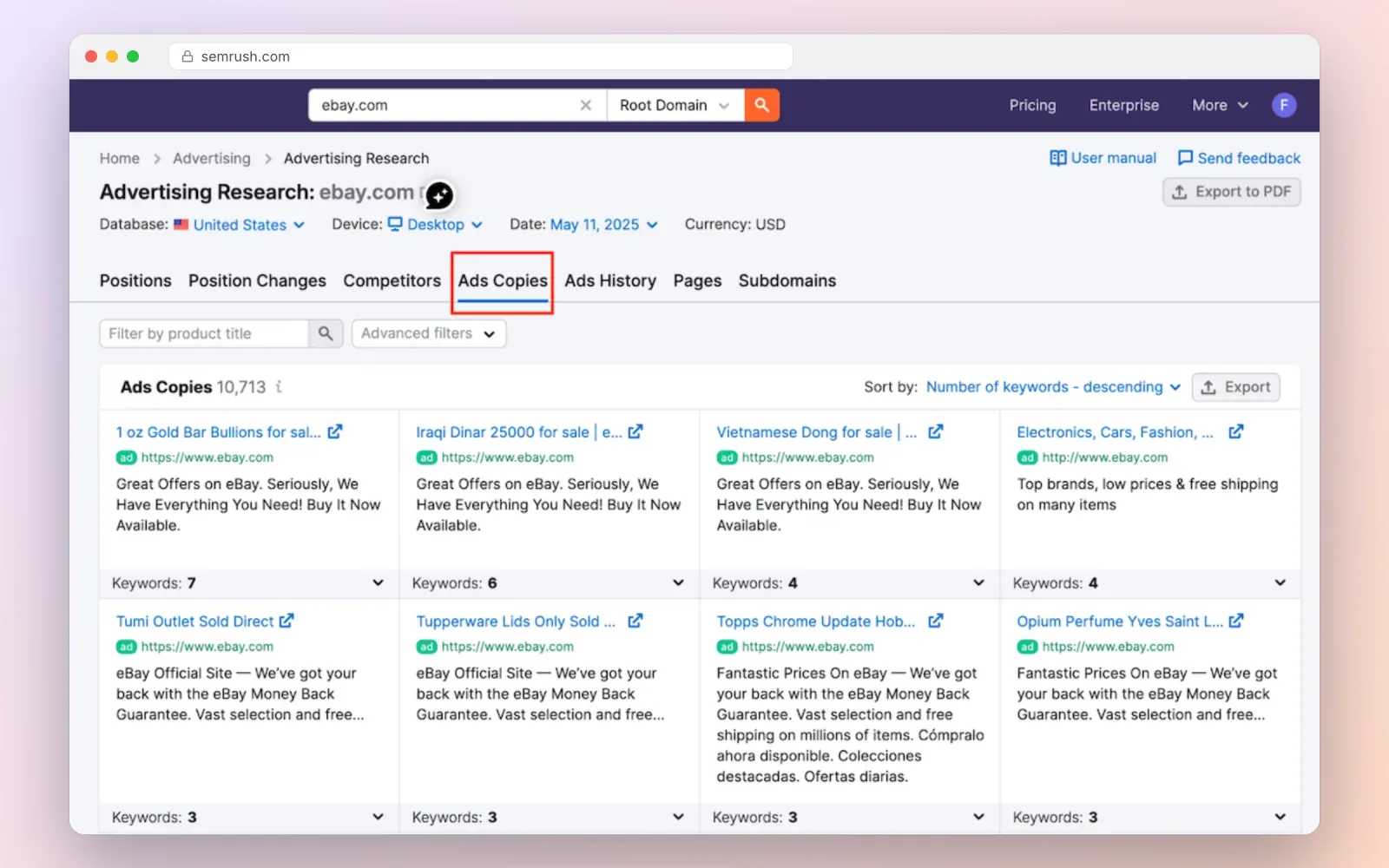
What it is. The paid search part of Semrush, which shows the keywords a competitor bids on in Google, their positions, ad copies, ad history back to 2012, landing pages and estimated paid traffic.
Price. The Advertising Toolkit costs $99 a month, and the Pro version with AdClarity for display, social and video ads costs $220 a month. Both have a 7-day free trial. The full SEO suite is priced separately.
Platforms. Google Search and Shopping, with display, social and video through AdClarity.
What stands out. Keyword-level insight that no ad library gives you. You can see which search terms a competitor has paid for over months, how their ad copy changed and which pages they send traffic to.
Limits. Traffic and cost figures are estimates. It is not a creative swipe tool for social video.
Best for. PPC managers and businesses that spend on Google Search.
15. Adbeat
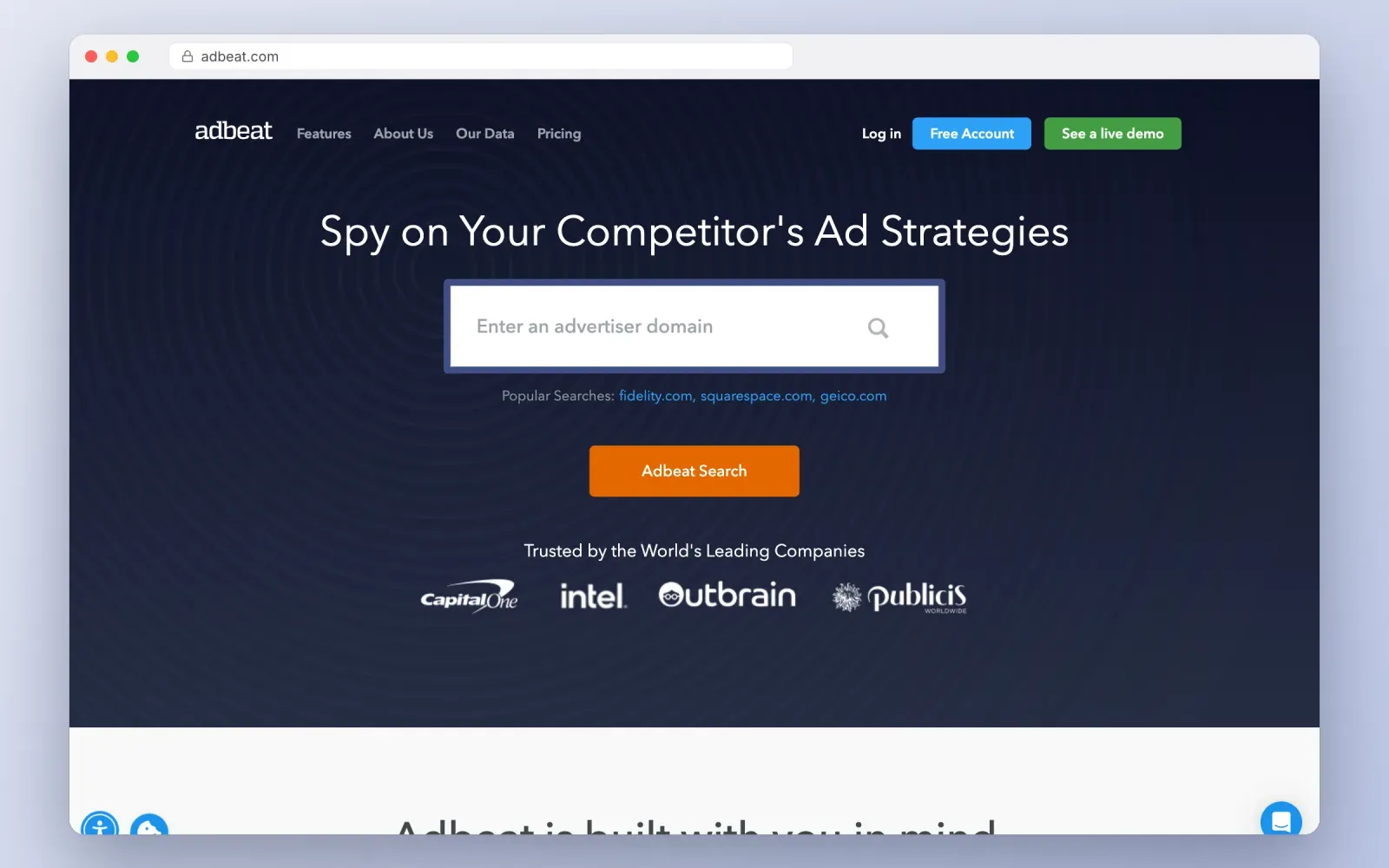
What it is. A display and native ad intelligence tool that tracks advertisers, publishers and creatives across 145 display networks and exchanges and 29 native networks.
Price. Adbeat Basic is free with limited data. Pro Standard costs $249 a month with 90 days of history, and Pro Advanced $399 with 12 months of history. Enterprise adds longer history and video.
Platforms. Display and native, desktop and mobile web, in 35 countries.
What stands out. Publisher-level data, meaning you see where a competitor's display ads appear, plus estimated spend on the top plan, alerts and comparisons between advertisers.
Limits. Expensive for small businesses, and not built for social media ads.
Best for. Display and native media buyers, agencies and ad-tech sales teams.
Two more tools worth knowing
Similarweb offers an Ads Intelligence suite with display, social and paid search data on top of its well-known traffic estimates. It has no public prices and sells through custom quotes, which puts it in enterprise territory.
Atria started as an ad library and now positions itself as an AI creative engine. It extracts hooks and personas from competitor ads, writes scripts and grades your own ads. Plans start at $129 a month billed annually with five seats, and you can start for free with 1,000 credits. It suits brands that want inspiration and production in the same tool.
The best adspy tool for each situation
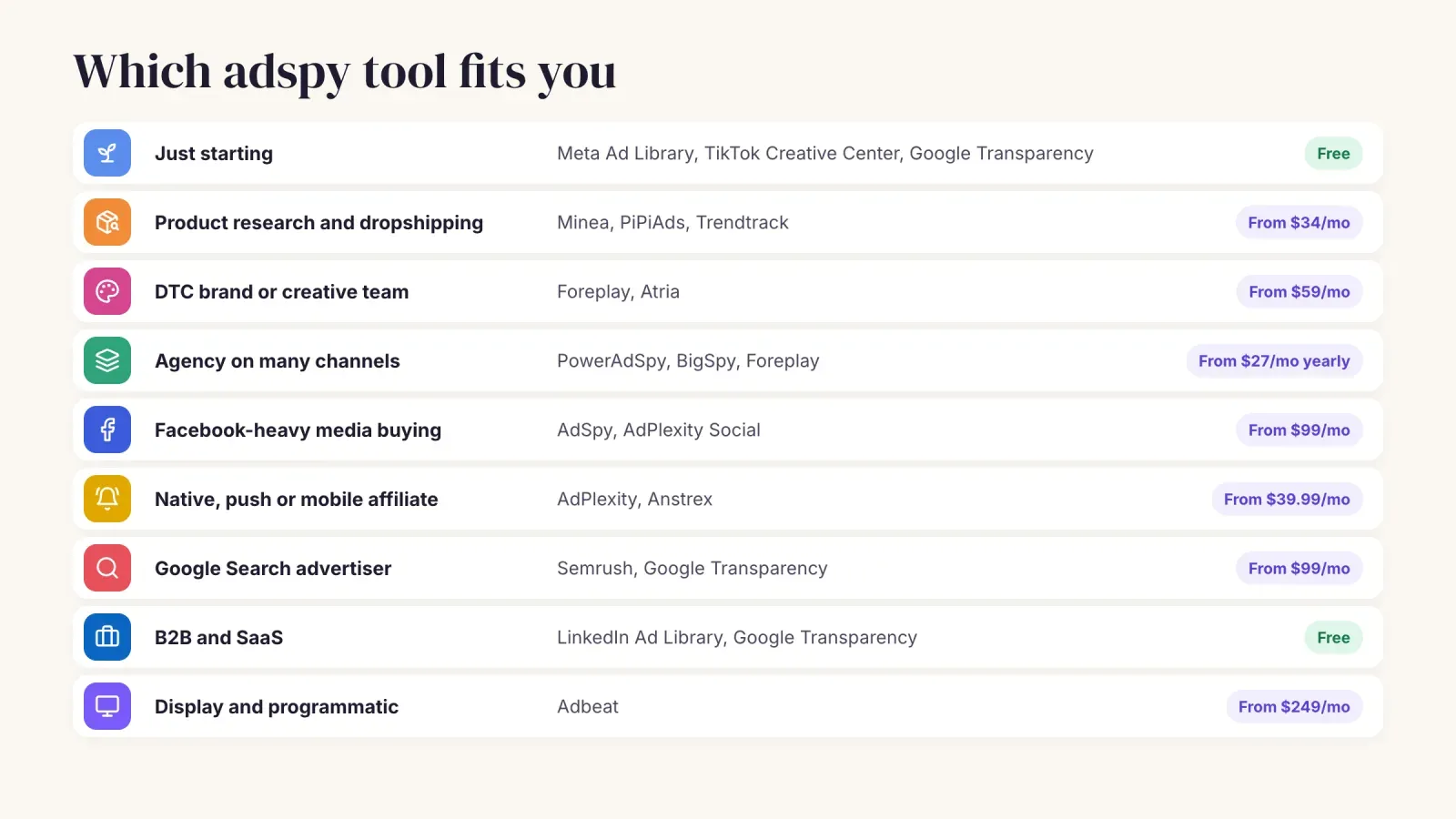
If you are just starting. Use the free libraries for a month: Meta Ad Library, TikTok Creative Center and Google Ads Transparency Center. Keep a simple research log. You will quickly learn which filters you miss, which tells you which paid tool to try.
For dropshipping and product research. Minea if you start from products, PiPiAds if your main channel is TikTok, Trendtrack if you want to understand the stores behind the ads.
For DTC brands and creative teams. Foreplay for saving, organizing and briefing. Atria if you also want AI to help produce creatives.
For agencies managing several channels. PowerAdSpy on an annual plan or BigSpy Growth for breadth, plus Foreplay for the team workflow.
For Facebook-heavy media buyers. AdSpy for its search inside text and comments, or AdPlexity Social.
For affiliates on native, push or mobile traffic. AdPlexity if budget allows, Anstrex if it does not.
For Google Search advertisers. Semrush Advertising Research, combined with the free Google Ads Transparency Center.
For B2B and SaaS. The LinkedIn Ad Library and Google Ads Transparency Center first, then Semrush for search.
For display and programmatic. Adbeat.
How to use an adspy tool without copying
A spy tool is only as good as the question you ask it. Here is a workflow that turns browsing into decisions.
- Write one research question. "Which offers do candle brands in France run this month?" is useful. "Show me good ads" is not.
- Filter for longevity. Limit results to your country and language, then look for ads running for at least 30 days. In most markets, longevity is the most reliable signal of profitability you can see from outside.
- Save 15 to 20 examples. Note for each one the hook, the promise, the proof, the format, the offer and the landing page.
- Look for patterns. Which angles appear again and again? Which proof types? Which price points and bundles?
- Study the destination. Click through to the landing page or store. Note the price, the delivery promise, the reviews, the guarantee and how the page continues the ad's promise.
- Turn patterns into hypotheses. For example, "demonstration videos outperform lifestyle images in this category". Then create three to five original ads that test that idea with your own product, voice and visuals.
- Test small and measure. Start with a modest daily budget, compare against your own benchmarks and keep what works.
The line to respect is simple. Patterns, structures and market insights are free to learn from. A competitor's images, videos, scripts, logos, product names and landing page copy belong to them. Copying them is risky legally, and it also makes your brand forgettable. Our guide to the best ad hooks shows how to write original openings once you know which angles work.
Is a paid adspy tool worth it?
Do the maths for your own situation instead of trusting promises. A practical way is to compare the tool's cost with the cost of the tests it helps you avoid.
Suppose you spend $3,000 a month on ads and each creative or product test costs around $200 before you can judge it. If a $99 tool helps you skip just one losing test a month, it has already paid for itself twice. If it also helps you find one winning angle a quarter, the return is much larger.
On the other hand, if you spend less than $500 a month on ads, the free libraries will usually give you enough material, and your money is better spent on the ads themselves. A paid plan makes sense when one of these is true: you test many products or creatives every month, you manage several clients, you work on channels the free libraries do not cover well, such as native or push, or your team wastes hours organizing screenshots.
Whatever you choose, start with a trial or a single month, use it intensively with a clear research question, and cancel if it does not change at least one decision.
Common mistakes with adspy tools
Treating estimates as facts. Revenue, spend and traffic figures are modelled. Use them to compare, not to plan your budget.
Chasing the biggest database. A smaller database with better filters and fresher data beats a huge one you cannot search well.
Copying winners too late. By the time a product has 30 advertisers, the easy window has usually closed. Look for early momentum instead.
Ignoring the landing page. Half of a winning ad's success is the page it sends people to. Study the offer, the price and the proof after the click.
Researching without testing. Hours of browsing do not replace a $100 test. Set a limit on research time and move to action.
Paying for channels you do not use. Check which plan includes the networks you need before subscribing.
Frequently asked questions
What is the best adspy tool? There is no single best tool for everyone. The Meta Ad Library and TikTok Creative Center are the best free starting points. Among paid tools, Minea and PiPiAds suit product research, Foreplay suits creative teams, BigSpy and PowerAdSpy suit multi-platform research, AdPlexity and Anstrex suit native and push affiliates, and Semrush suits Google Search advertisers.
Is there a free adspy tool? Yes. The Meta Ad Library, TikTok Creative Center and Commercial Content Library, Google Ads Transparency Center and LinkedIn Ad Library are all free. Adbeat also has a free Basic plan, and several paid tools offer trials or free credits.
Is using an adspy tool legal? Looking at publicly visible ads is legal, and the platforms publish their own libraries for transparency. Reusing a competitor's images, videos, text or landing pages is a different matter and can infringe copyright and trademarks.
Can an adspy tool show a competitor's ad spend? Not precisely. Political ads in the Meta Ad Library show spend ranges, and some paid tools estimate budgets, but commercial ad spend is not public. Treat any figure as a rough estimate.
Which adspy tool is best for TikTok? For free, the TikTok Creative Center's Top Ads and the Commercial Content Library in Europe. Among paid tools, PiPiAds is the most TikTok-focused, while Minea and BigSpy also cover TikTok.
How often should I check competitor ads? Weekly is enough for most small businesses. Check more often around launches, seasonal peaks such as Black Friday, or when a competitor clearly changes strategy.
How long should an ad run before I consider it a winner? As a rule of thumb, ads running for more than 30 days are worth studying, and ads running for more than 60 days with several versions are usually profitable for that advertiser. Context matters, since big brands sometimes keep branding ads live regardless of results.
Turn your research into sales
An adspy tool shows you what the market already tested. The last step is yours: create original ads from those insights and send every click to a page that keeps the ad's promise. Create your free Roctify page to turn your link in bio into a storefront for your products, bookings and digital downloads, with 0% transaction fees on every plan, so the traffic your new ads earn becomes customers. If you plan a seasonal push, our breakdown of Black Friday adverts that worked is a good next read.