Ask five social media tools for the best time to post on Instagram and you will get five different answers. One study says 5 a.m. Another says Wednesday at noon. A third says Thursday at 9 a.m., and a fourth recommends late afternoons. They are all based on millions of real posts, and they are all partly right.
The reason is that "best time" depends on what you measure, who your followers are and what you post. This guide brings the four biggest 2026 studies together, explains why they disagree, and gives you a simple method to find the optimum time to post on Instagram for your own account in about two weeks. You will also find the best times by day, by format and by industry, how to handle followers in several time zones, and the mistakes that make good posts disappear.
The short answer
If you need a starting point today, here is what the 2026 data agrees on.
- Best days: Tuesday, Wednesday and Thursday. Midweek posts get the most engagement in almost every study.
- Weakest days: Saturday, followed by Sunday for most accounts.
- Two strong windows: early morning (around 5 to 9 a.m. local time), when competition in the feed is low, and late morning to early evening (around 11 a.m. to 6 p.m.), when the most people are online.
- Reels: they keep earning views for days, so timing matters less than the first three seconds. Late evening and early morning both perform well.
- Stories: post around 6 to 8 a.m. and 7 to 9 p.m., when people check their phones during commutes and in the evening.
Treat these times as your first test, not as a rule. The optimum time to post on Instagram for a bakery in Lyon is not the same as for a fitness coach in Los Angeles, and your own data will beat any average within a few weeks.
What four 2026 studies say about the best time to post on Instagram
Four companies that schedule posts for millions of accounts publish yearly studies. Here is what each one found, in its own words.
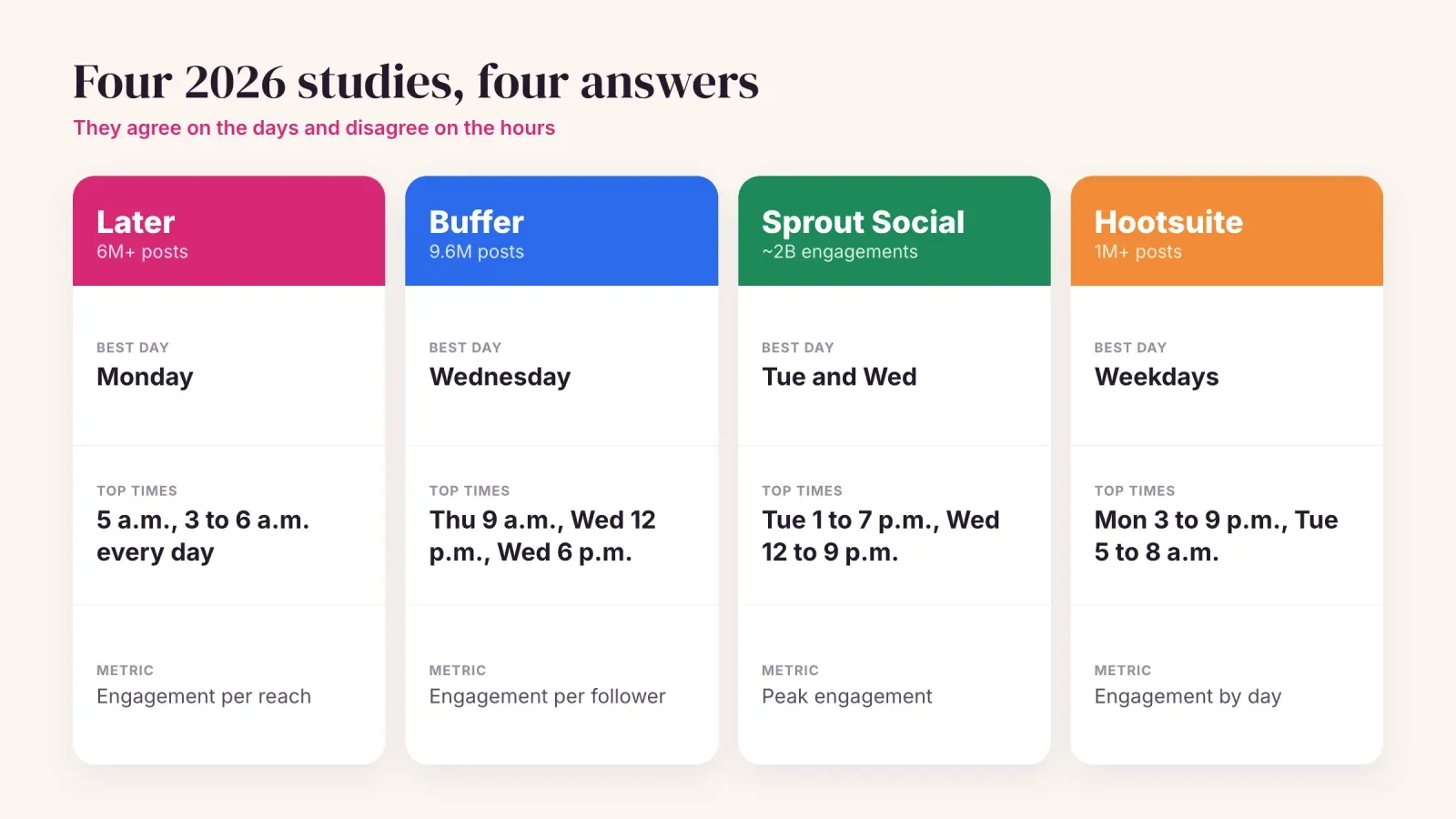
Later, based on more than 6 million posts. Later analyzed feed posts, carousels and Reels published between January and October 2024 and normalized every post to the audience's local time zone. Its headline result is surprising: 5 a.m. is the best time to post, and content published between 3 and 6 a.m. performs above average every day of the week. Monday is its best day, Saturday its worst. For Reels, Later found midnight to 6 a.m. on Monday to be the strongest window, and for carousels, 5 a.m. on Tuesday.
Buffer, based on 9.6 million posts. Buffer's 2026 analysis puts the top three slots at Thursday at 9 a.m., Wednesday at 12 p.m. and Wednesday at 6 p.m. Wednesday is its best single day, followed by Thursday and Tuesday, and evening hours between 6 and 11 p.m. perform strongly on most weekdays.
Sprout Social, based on nearly 2 billion engagements across about 307,000 profiles. Sprout found the highest engagement on Tuesdays and Wednesdays. Its windows are Monday 2 to 4 p.m., Tuesday 1 to 7 p.m., Wednesday from noon to 9 p.m. with an extra bump around 11 p.m., and Thursday noon to 2 p.m. Friday shows no clear peak, and weekends are the weakest days.
Hootsuite, based on more than 1 million posts in 118 countries. Hootsuite recommends Monday 3 to 9 p.m., Tuesday 5 to 8 a.m. and 3 to 7 p.m., Wednesday at 5 p.m., Thursday 4 to 5 p.m., Friday at 4 p.m., Saturday at 11 a.m. and 5 p.m., and Sunday noon to 3 p.m.
Put side by side, the studies agree on the days and disagree on the hours. That disagreement is not noise. It tells you something useful about how Instagram works.
Why the studies disagree on the hour
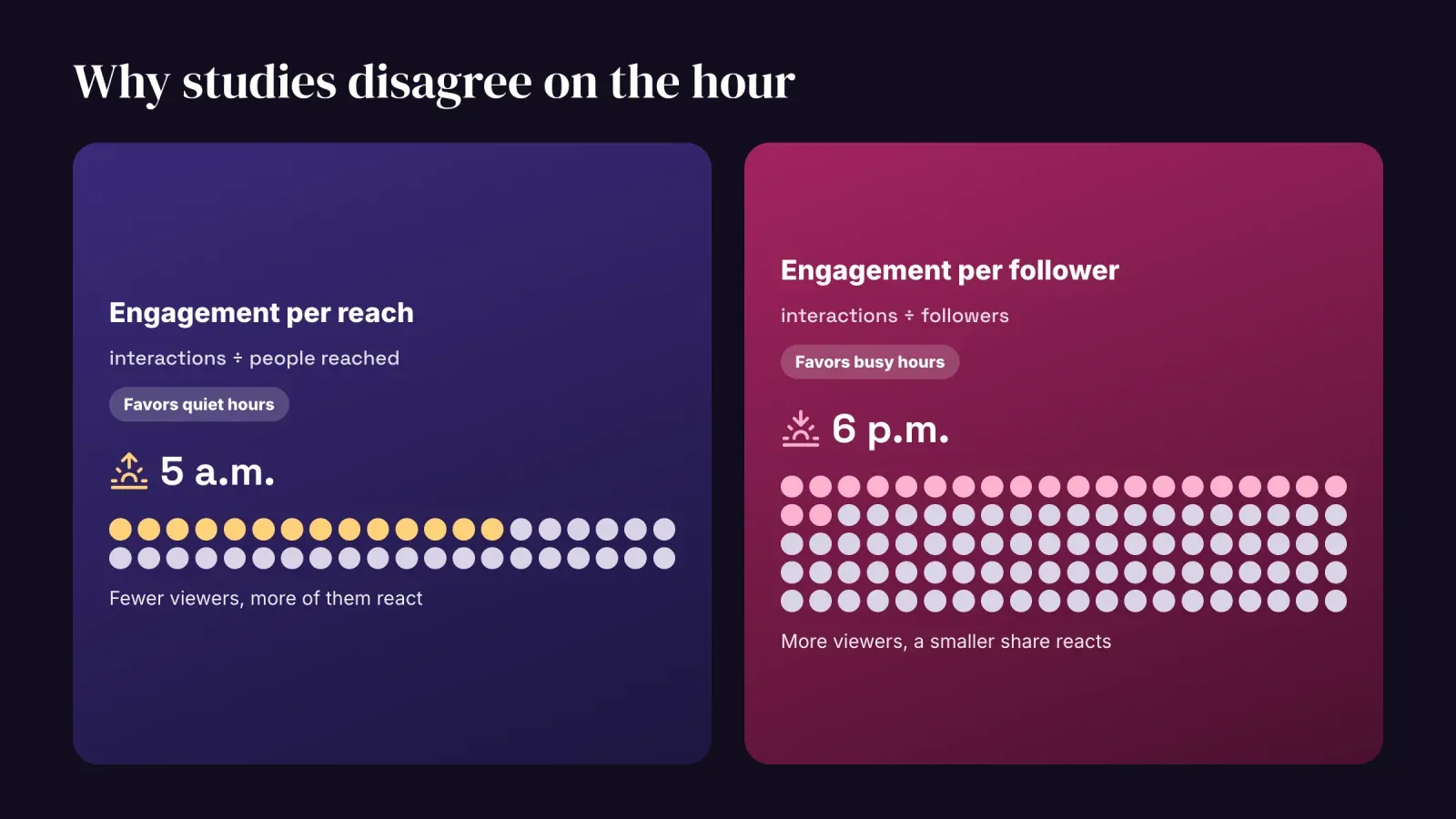
The main difference is the metric each study uses.
Engagement per follower divides likes, comments, shares and saves by the number of followers. It favors the hours when most people are online, because more of your followers see the post. Studies built on this metric, like Buffer's, point to midday and evening.
Engagement per reach divides the same interactions by the number of people who actually saw the post. It favors quiet hours, because the few people who see a 5 a.m. post are often your most loyal followers, and there is less competition in their feed. Studies built on this metric, like Later's, point to early morning.
Both are true at the same time. Posting at 5 a.m. gives each viewer a higher chance of interacting. Posting at 6 p.m. gives you more viewers. Which one you want depends on your goal. If you want the highest share of your community to react, early morning works. If you want the most people to see a launch, a peak hour often wins.
Three other factors explain the rest of the gap.
- The accounts in each sample. Tools used by agencies and big brands do not see the same audiences as tools used by small creators.
- The formats. Reels, carousels and single images behave differently, and a study heavy in one format leans toward its best times.
- Time zones. Some studies normalize to the audience's local time, others to the account's. A 9 a.m. result means different things in each case.
Best time to post on Instagram by day
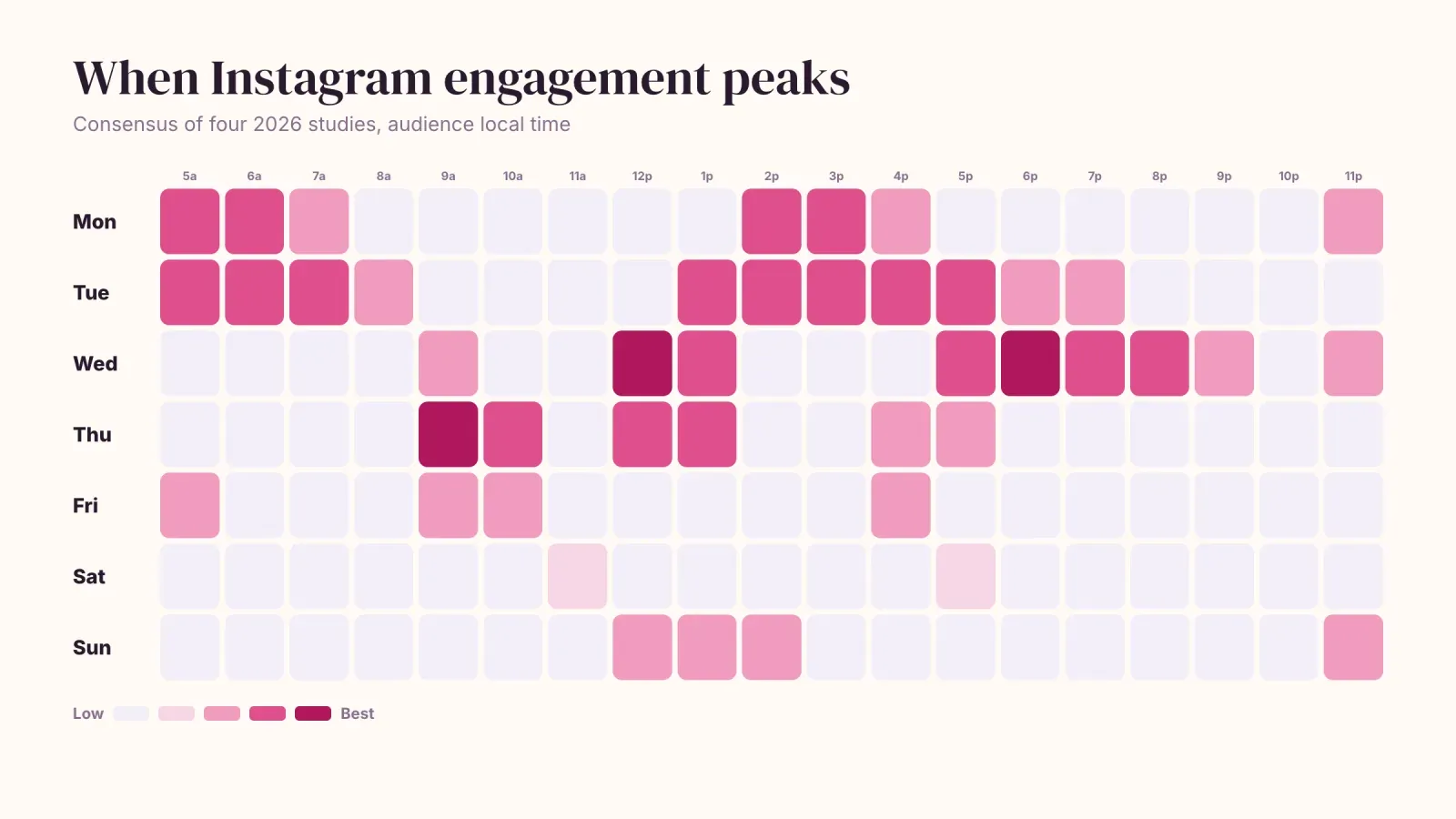
Combining the four studies gives a practical schedule. Times are in your audience's local time.
- Monday. Early morning (5 to 7 a.m.) or mid-afternoon (2 to 4 p.m.). Monday late evening, around 11 p.m., also works for audiences that scroll before bed.
- Tuesday. One of the best days. Early morning (5 to 8 a.m.) or early afternoon to early evening (1 to 7 p.m.).
- Wednesday. Often the best day overall. Noon is the safest slot, and late afternoon to evening (5 to 9 p.m.) is strong too.
- Thursday. Morning (9 a.m.) and early afternoon (noon to 2 p.m.) perform well.
- Friday. Engagement drops after lunch as people log off. Post in the morning or around 4 p.m.
- Saturday. The weakest day for most accounts. If you post, aim for late morning (11 a.m.) or 5 p.m., and save your important posts for midweek.
- Sunday. Quiet but not dead. Noon to 3 p.m., or late evening for audiences who plan their week on Sunday night.
Best time to post by format
Instagram ranks each format in its own way, so the optimum time to post on Instagram changes with what you publish.
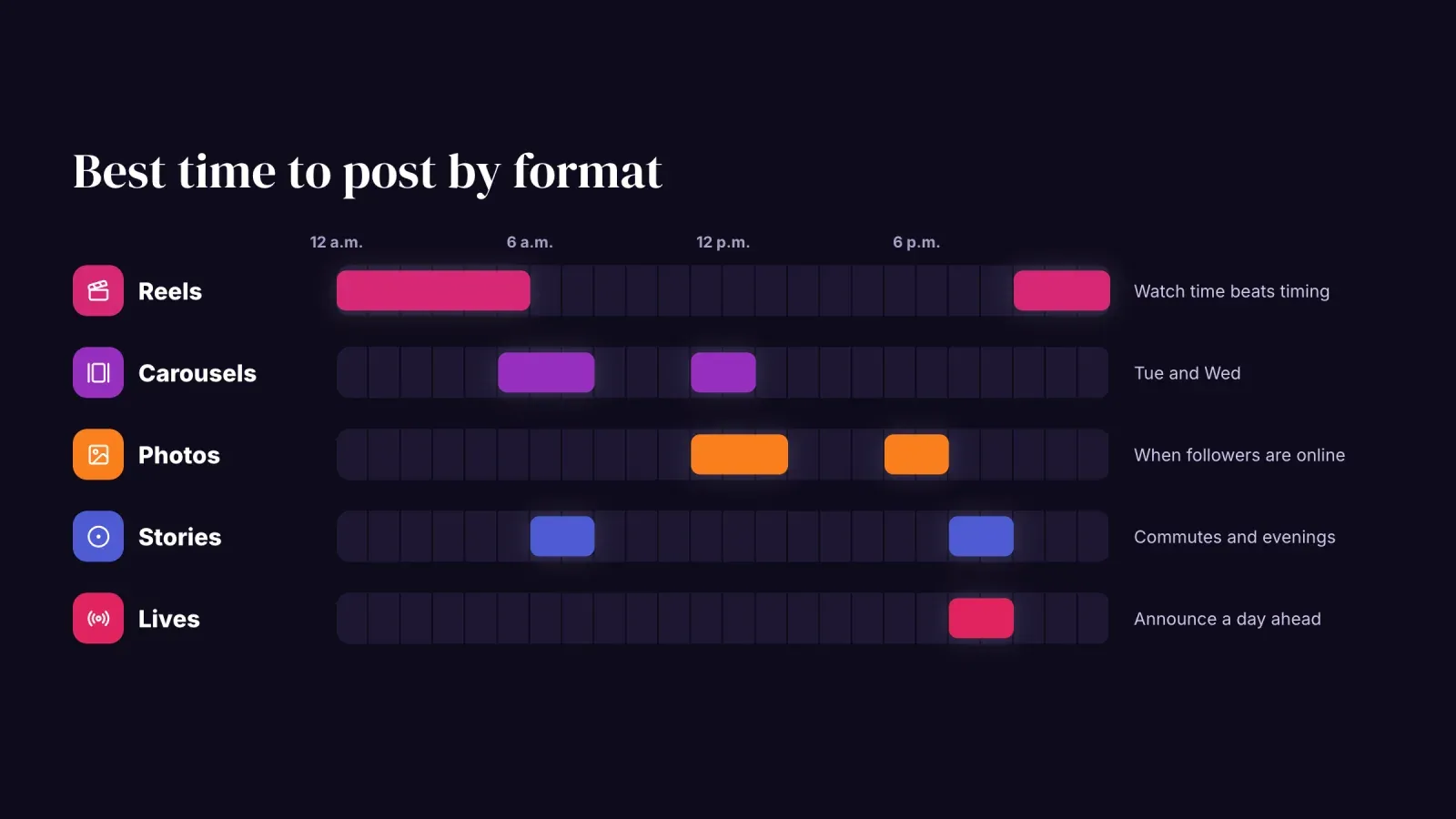
Reels. Reels are shown to people who do not follow you, and they can keep collecting views for days or weeks. Later's data shows strong results for Reels posted between midnight and 6 a.m., especially on Mondays, because they gather early signals from a small loyal audience before the morning rush. What matters most is watch time and sends: Instagram's head, Adam Mosseri, has said that watch time, likes per reach and sends per reach are the three most important ranking signals. A great Reel posted at an average time beats an average Reel posted at the perfect time.
Carousels. A carousel is read, swiped and saved, so it suits moments when people have a few minutes. Early morning and lunchtime on Tuesday and Wednesday work well. Carousels often get a second wave of reach a day later, when Instagram shows them again with the next slide.
Single photos. Photos depend more on your followers than on discovery. Post when your followers are most active, which is usually midday or early evening on weekdays.
Stories. Stories disappear after 24 hours and appear at the top of the app, so the first hours count. Post the first Story of the day in the early morning, around 6 to 8 a.m., and add more in the evening, between 7 and 9 p.m., when people watch Stories in bulk.
Lives. Announce the time at least a day in advance in a Story and a post. Evenings between 7 and 9 p.m. on weekdays and Sunday afternoons usually bring the largest live audiences.
Best time to post on Instagram by industry
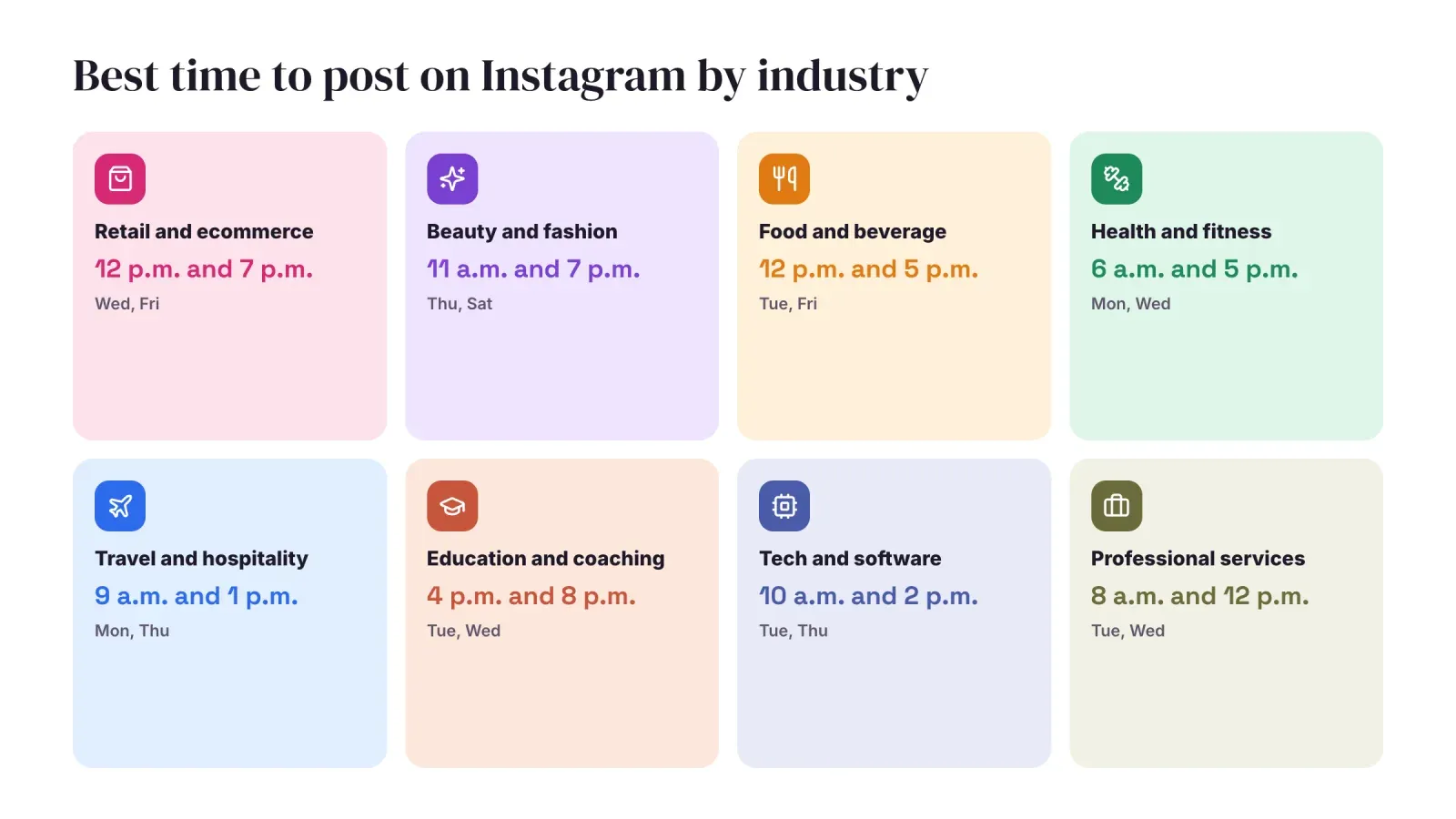
Your followers' daily routine depends on your sector. These windows come from Later's and Hootsuite's industry breakdowns and match what most small businesses observe. Use them as a first hypothesis.
- Retail and ecommerce. Lunchtime (around 12 p.m.) and evening (around 7 p.m.), especially Wednesday and Friday, when people browse during breaks and after work.
- Beauty and fashion. Late morning (11 a.m.) and evening (7 p.m.), with Thursday and Saturday as good days for outfit and routine content.
- Food and beverage. Lunchtime and early evening (12 p.m. and 5 p.m.), when people think about what to eat. Friday is a strong day for restaurants and recipes.
- Health and fitness. Early morning (6 a.m.) and late afternoon (5 p.m.), around workouts and commutes.
- Travel and hospitality. Morning and early afternoon (9 a.m. and 1 p.m.) on Monday and Thursday, when people plan trips and weekends.
- Education and coaching. Late afternoon and evening (4 p.m. and 8 p.m.) on Tuesday and Wednesday, after work and school.
- Tech and software. Work hours (10 a.m. and 2 p.m.) on Tuesday and Thursday.
- Professional services. Early morning and lunch (8 a.m. and 12 p.m.) on Tuesday and Wednesday.
Best time to post by account size
Later's data also suggests that account size changes the best time. Smaller accounts, between 1,000 and 5,000 followers, did best on weekdays around 5 p.m., when their mostly local followers are finishing work. Accounts between 5,000 and 500,000 followers did best late at night, around 11 p.m. to midnight on Sundays and Mondays, while the largest accounts, above 500,000 followers, did best on Monday at 10 a.m.
The logic is simple. Small accounts have close, local audiences who behave like friends. Larger accounts reach people across countries and schedules, so they benefit from posting when competition is lowest.
How to find your optimum time to post on Instagram
Averages are a starting point. Your own optimum time to post on Instagram is hidden in your account's data, and finding it takes about two weeks.
Step 1. Check when your followers are online
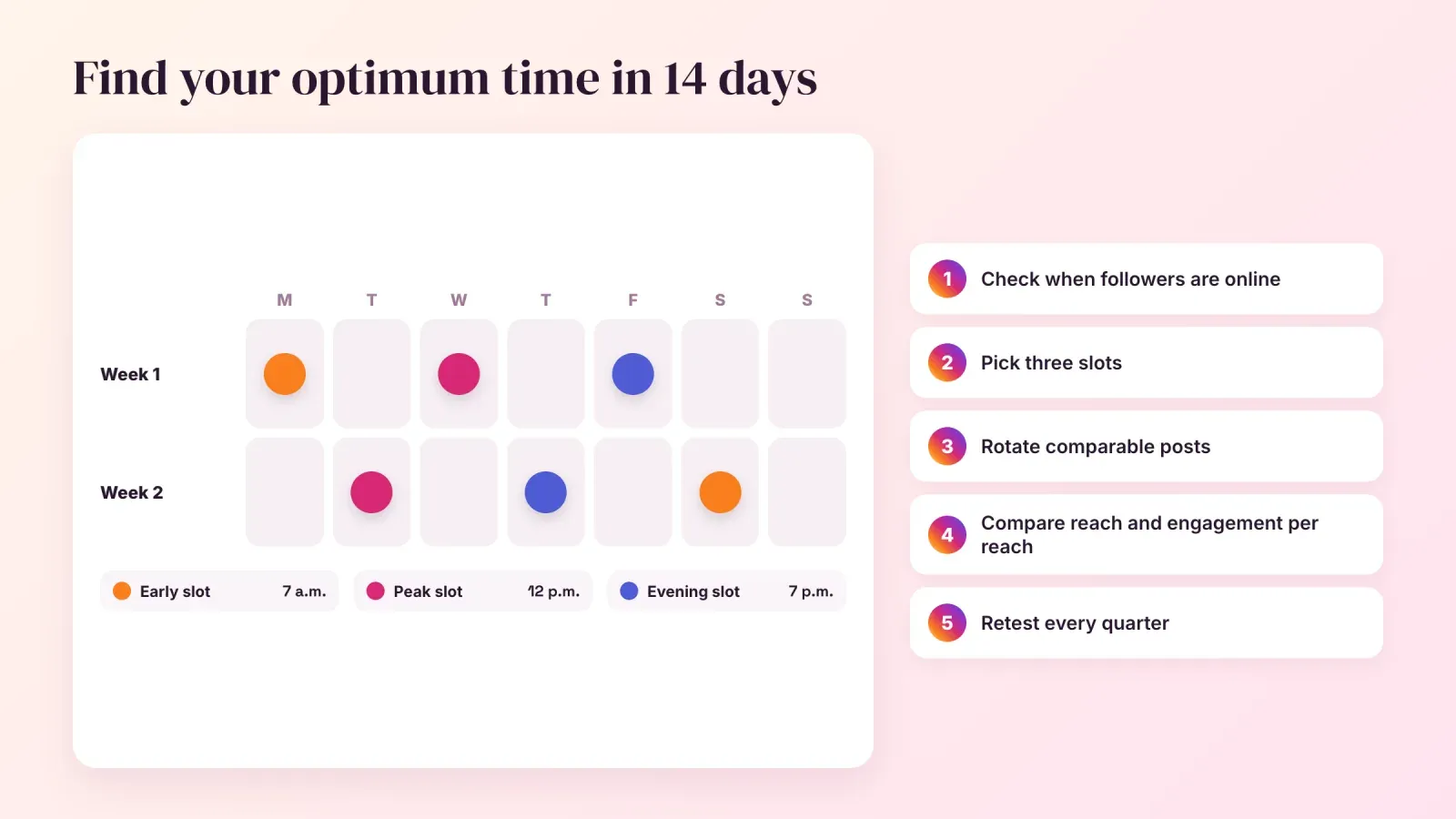
Switch to a professional account (creator or business) if you have not already. Open your profile, tap "Professional dashboard", then go to your account insights and the section about your followers. Scroll to the part that shows when your followers are most active. Instagram shows activity by day and by hour, in the time zone of your phone. You need at least 100 followers to see this data.
Write down the two or three hours with the highest activity on weekdays and the busiest day. These are your first candidates.
Step 2. Pick three time slots to test
Choose three slots that do not overlap, for example:
- An early slot, about two hours before your followers' peak, such as 7 a.m.
- A peak slot, at the hour your followers are most active, such as 12 p.m.
- An evening slot, such as 7 p.m.
Step 3. Post comparable content for two weeks
For 14 days, rotate your posts between the three slots. Keep the content as comparable as possible: the same format, similar topics and similar quality. If you post four times a week, each slot gets about three posts.
Step 4. Compare the right metrics
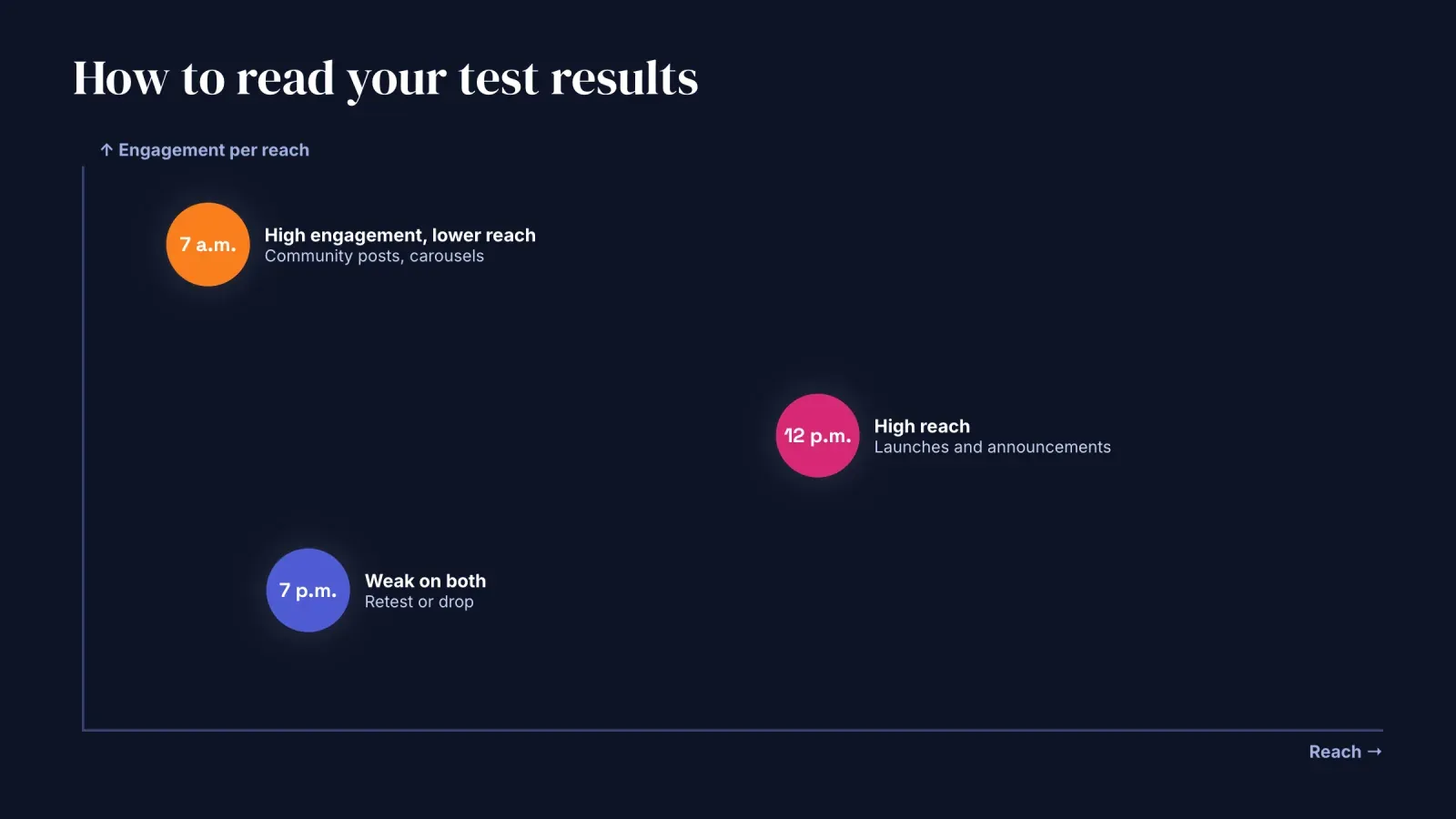
After 24 hours, note for each post its reach, its interactions (likes, comments, shares and saves) and, for Reels, its plays and average watch time. Then calculate interactions divided by reach. Compare the average of each slot rather than single posts, since one viral post can distort the picture.
- The slot with the highest reach is your best time for launches and announcements.
- The slot with the highest engagement per reach is your best time for community content, questions and carousels.
- If one slot wins on both, you have found your optimum time.
Step 5. Retest every quarter
Audiences change with seasons, school holidays, your growth and Instagram's own updates. Repeat a lighter version of the test every three months, and always after a big change in your audience, such as a viral post that brings followers from another country.
How to handle followers in several time zones
If your followers live in several countries, start with the largest group. Instagram's audience insights show the top countries and cities of your followers.
- One dominant zone. If more than 60% of your followers live in one time zone, post for them and ignore the rest.
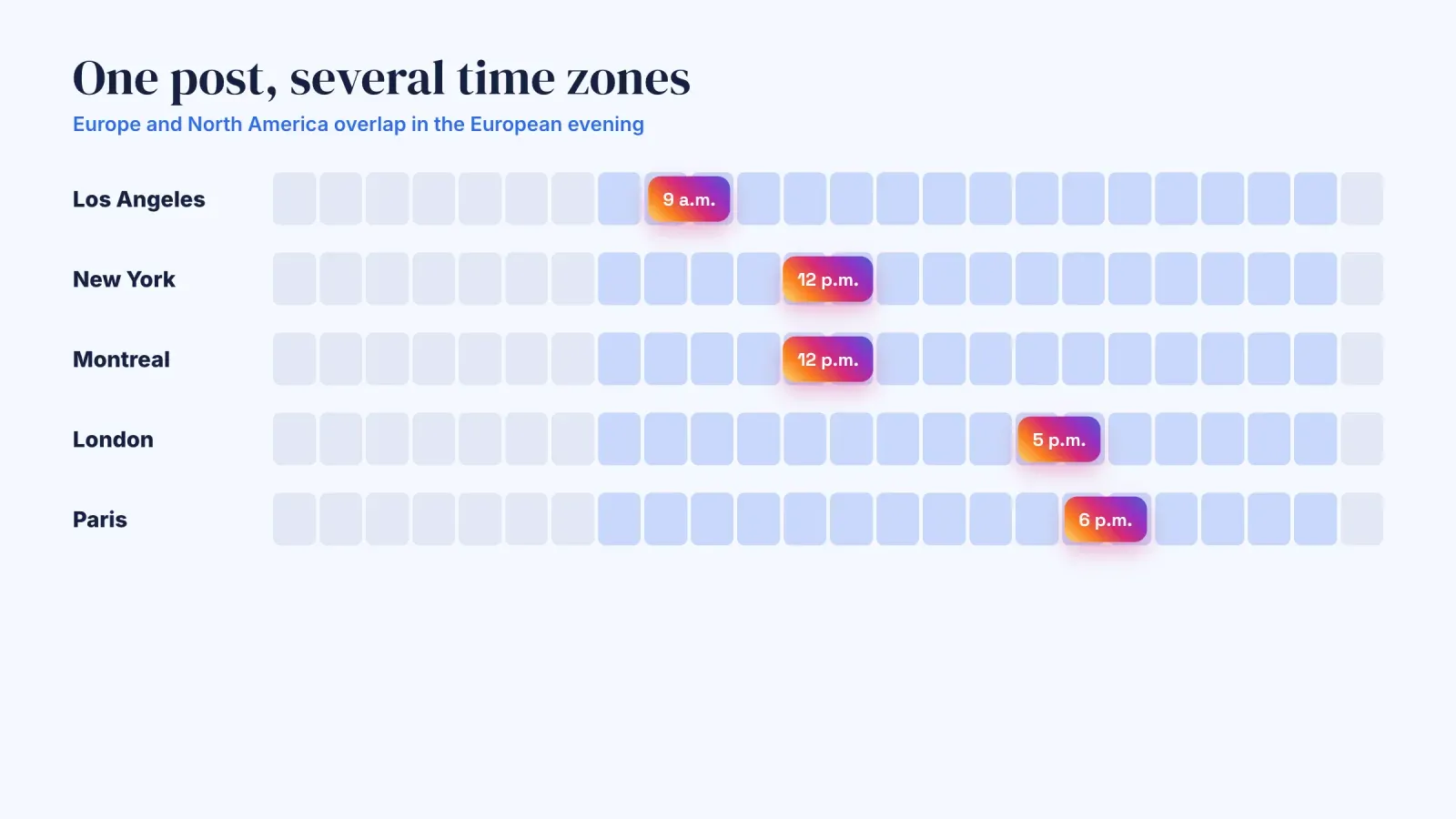
- Two zones close together. Find the overlap. For an audience split between Paris and London, 8 a.m. in London is 9 a.m. in Paris. For the US, 9 a.m. in Los Angeles is noon in New York.
- Zones far apart. Europe and North America overlap best in the European evening, which is the American morning. 6 p.m. in Paris is 12 p.m. in New York and 9 a.m. in Los Angeles.
- Use formats with a long life. Reels and carousels keep collecting views for days, so they suit international audiences better than Stories.
- Schedule. Instagram lets professional accounts schedule posts and Reels up to 75 days ahead, so you can publish at 6 a.m. in another country without waking up.
How often you should post
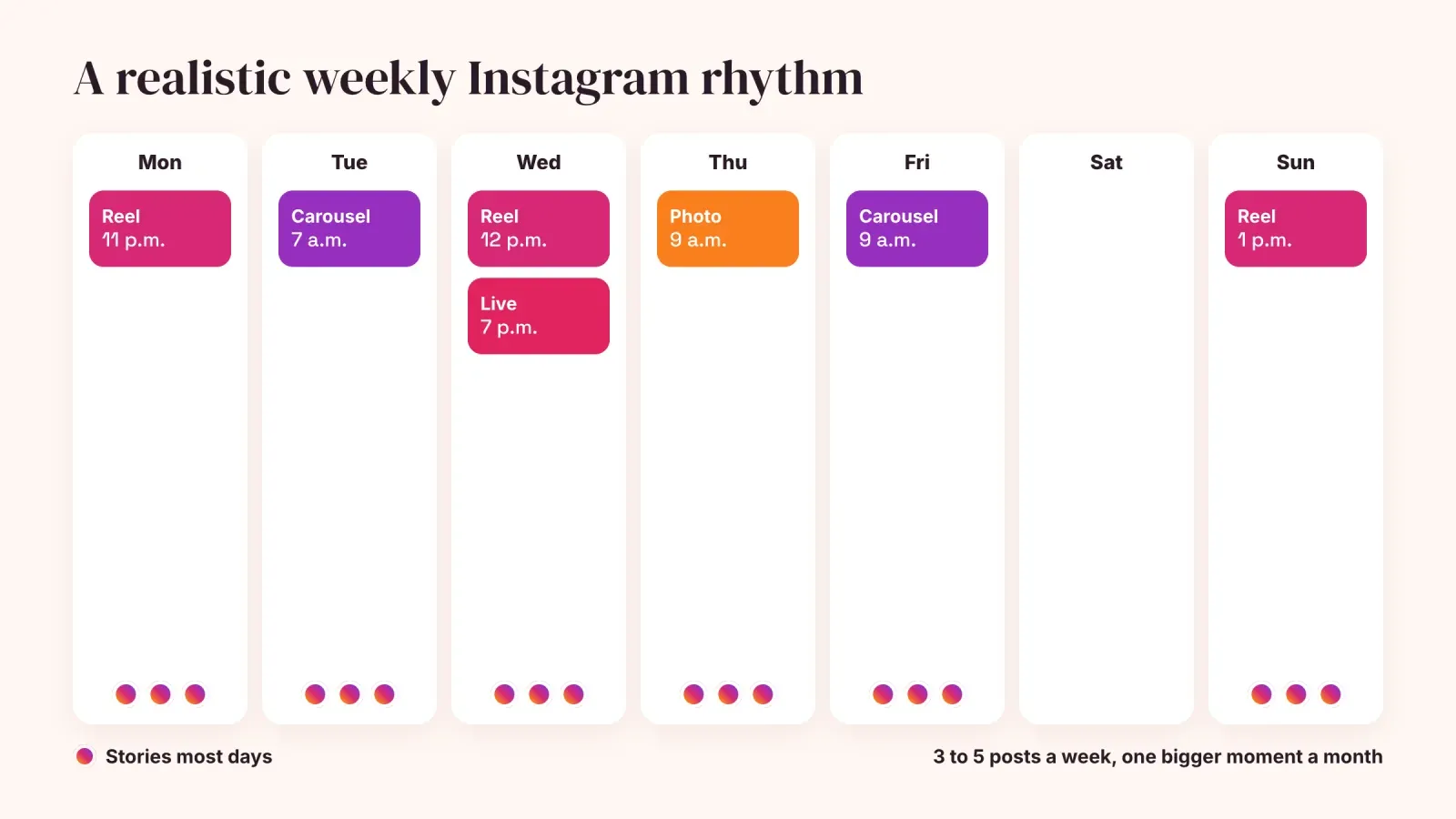
Timing works best on top of a steady rhythm. Buffer's analysis of more than 2 million posts found that accounts posting three to five times a week grew their followers faster than those posting once or twice, and that engagement per post did not drop much at that pace. For most small brands and creators, a realistic schedule looks like this:
- 3 to 5 feed posts or Reels a week, placed on your best days and slots.
- Stories most days, even two or three quick ones.
- One planned bigger moment a month, such as a launch, a live or a giveaway, placed on your strongest day and time.
Consistency also trains your audience. If your followers learn that a new recipe or a new drop arrives every Wednesday at noon, they come looking for it.
What matters more than the time you post
Time gives a post a better start. It does not save a weak post. A few things weigh more.
- The hook. The first second of a Reel or the first slide of a carousel decides whether people stop. Our guide to ad hooks that stop the scroll works just as well for organic content.
- Watch time and sends. Instagram rewards content that people watch to the end and send to friends. Ask yourself who your reader would forward the post to.
- Early replies. Stay available for 30 to 60 minutes after posting. Answering comments quickly starts conversations, and conversations bring more reach.
- Original content. Instagram has said it favors original content over reposts, so make your own rather than recycle viral clips.
- A clear next step. If you want sales, the post must point somewhere. Mention the link in your bio and make sure it leads to the right product. Our guide on how to change the link in your Instagram bio shows how to update it in seconds.
Common mistakes
Chasing the exact minute. The difference between 11:45 and 12:15 is noise. Think in windows of one to two hours.
Copying a study's times without checking your audience. A 5 a.m. slot can work brilliantly for one account and fail for another whose followers are night owls.
Judging a slot on one post. One great post at 7 p.m. does not make 7 p.m. your best time. Compare averages over several posts.
Posting and disappearing. The first hour after posting is when replies and early engagement matter most. Do not post right before a meeting.
Treating all formats the same. Reels, carousels, photos and Stories have different best times. Test them separately.
Never retesting. What worked last spring may not work this autumn. Check your insights every quarter.
Frequently asked questions
What is the best time to post on Instagram in 2026? The studies agree on Tuesday, Wednesday and Thursday as the best days. For hours, early morning (5 to 9 a.m.) gives the highest engagement per viewer, while late morning to early evening (11 a.m. to 6 p.m.) gives the most viewers. Test both windows on your account.
What is the optimum time to post on Instagram for a small account? For accounts under about 5,000 followers, weekday evenings around 5 to 7 p.m. local time often work well, because small audiences tend to be local and check Instagram after work. Confirm it with the activity data in your professional dashboard.
What is the best day to post on Instagram? Wednesday is the most common winner, followed by Tuesday and Thursday. Saturday is the weakest day in most studies.
What is the worst time to post on Instagram? Late Saturday night and the early hours of Thursday perform worst in Later's data, and Friday afternoons and weekends are weak in most studies. More generally, avoid posting when you cannot reply to comments for the next hour.
When should I post Reels? Reels keep earning views for days, so timing matters less than the content. Late evening and early morning work well because the Reel gathers early signals before the morning rush. Focus on the first three seconds and on watch time.
Does the time I post really affect reach? Yes, but less than the content itself. A good time gives a post a stronger first hour, which helps Instagram decide whether to show it to more people. A weak post stays weak at any time.
Should I post at the same time every day? A consistent schedule helps your audience know when to expect you and makes your results easier to compare. Keep two or three regular slots rather than one fixed minute.
Do the times apply to my time zone? Most studies normalize times to the audience's local time. If your followers live in your own time zone, use the times as they are. If they are spread across countries, plan for your largest group.
Turn the right timing into sales
The best time to post brings people to your profile. What happens next depends on your link in bio. Create your free Roctify page to turn that link into a storefront with built-in checkout for your products, digital downloads and offers, with 0% transaction fees on every plan, so the followers your well-timed posts attract can buy in a few taps. Our guide to turning followers into customers with your link in bio shows how to set it up.