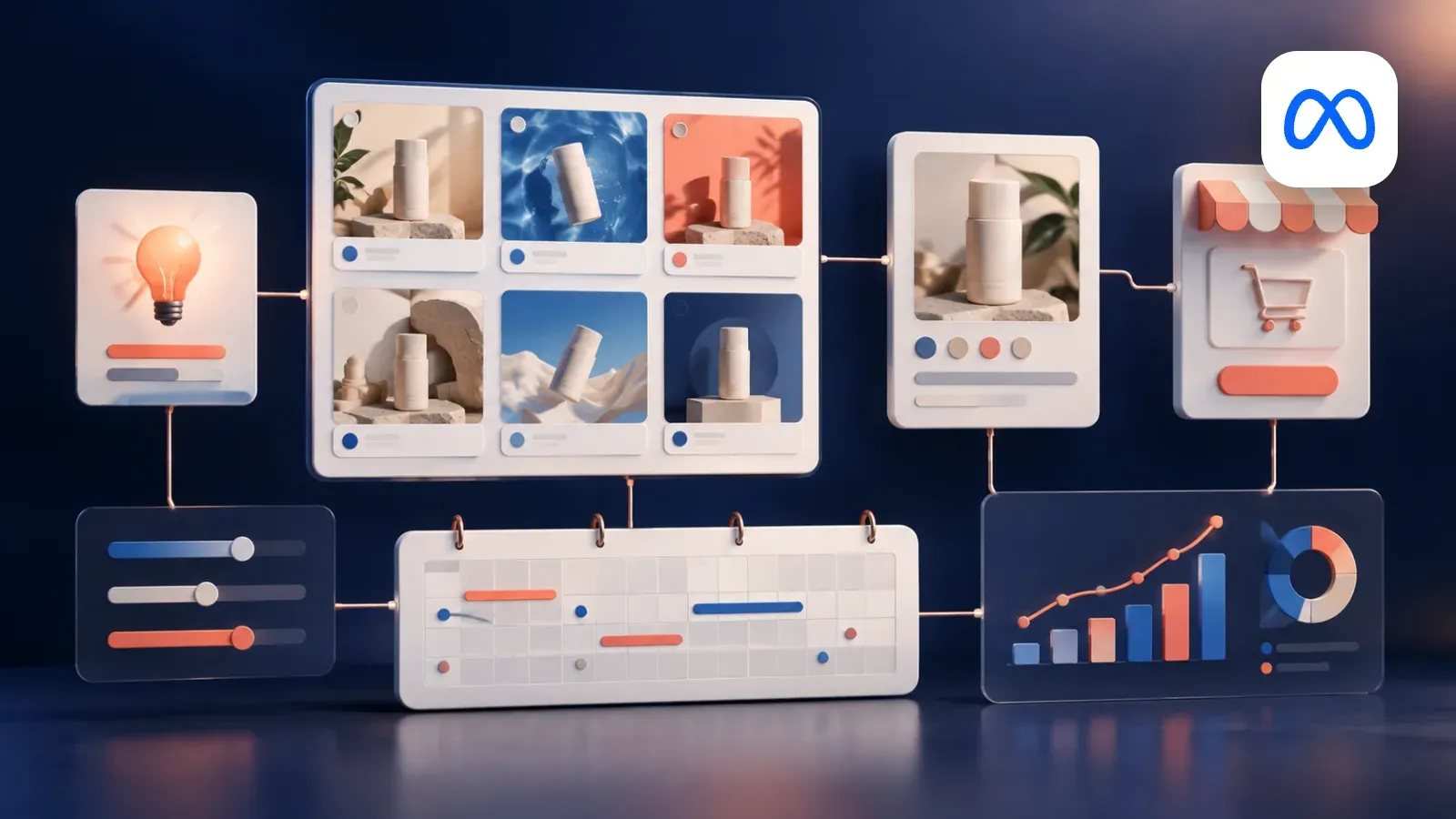
Meta ad research is one of the fastest ways to understand how brands compete for attention. The public Meta Ad Library lets you search ads by advertiser or keyword, then look at the creative, the copy, the delivery dates and the Meta surfaces where an ad appeared, such as Facebook, Instagram, Messenger or the Audience Network. That makes it a great tool for learning what a market is saying. It is not a shortcut for reproducing someone else's campaign.
The distinction matters. Copying a competitor's images, script, product claims or brand voice is legally risky and rarely makes your business more memorable. People scroll past ads that look like everything else. Researching patterns, on the other hand, gives you raw material for better questions. Which customer problem appears again and again? Which offer formats are common in your category? Do long-running campaigns lead with a demonstration, a testimonial or a founder story? Where does the ad send people after the click?
This guide gives you a repeatable way to turn public ad research into original marketing. You will define a focused question, build a small research set, record context in a simple research log, extract patterns without treating them as proof of performance, turn those patterns into creative hypotheses, and connect the final campaign to a storefront or product page that converts the attention you earn. You will also find three worked examples, the most common mistakes, a weekly routine, a checklist and answers to frequent questions.
What Meta ad research can and cannot tell you
Start with the right expectation. Public ads are signals, not a window into a competitor's dashboard. For active commercial ads, the Meta Ad Library shows the creative, the ad copy, the advertiser, the date the ad started running and the placements across Meta technologies. For ads about social issues, elections or politics, and for ads delivered in the European Union, more transparency information is available, such as reach estimates or targeting details. Meta also states that new ads and updates generally appear in the library within about 24 hours.
What you usually cannot see for a standard commercial ad is just as important. You will not find exact revenue, conversion rate, cost per purchase, profit margin, the full targeting logic or the internal reason a campaign was paused. An ad that has been running for weeks may be a positive clue, but it is not proof that the campaign is profitable. It could support awareness, retargeting, recruitment, a seasonal launch or a test you cannot see. Some brands simply forget to switch old ads off.
So use the library to understand the market conversation. It can reveal recurring pain points, the visual language of a category, the level of offer detail buyers expect, the kind of proof competitors lean on and the routes they use from an ad to a landing page. Your own analytics remain the authority on what works for your business.
1. Begin with a focused research question
The easiest way to waste an afternoon is to type a broad term and scroll. A useful research session starts with one decision you need to make. For example:
- Which first three creative angles should we test for a new product?
- How do established brands explain this product category to beginners?
- What kinds of proof do customers seem to expect before they buy?
- Which offer structures are competitors using for a seasonal launch?
- How do brands in our niche talk about price, shipping and returns?
Write your question at the top of your research log. Then choose a narrow market, a country and a product category. If you sell handmade notebooks in France, research French and nearby European stationery brands before comparing yourself with global fashion retailers. If you sell coaching, study the offer and the audience stage of other coaches, not only their design style.
Next, build a shortlist of 10 to 20 advertisers. Include direct competitors, a few aspirational brands that are a step ahead of you, and some adjacent businesses that solve the same customer problem differently. Searching by brand name is often more productive than searching a generic phrase, because it shows you a coherent set of variations from one advertiser instead of a random mix.
2. Search the Meta Ad Library the right way
Open the library at facebook.com/ads/library. You do not need an ad account or a Facebook login to browse commercial ads, which makes it easy to share the process with a teammate or a freelancer.
Set the country deliberately. Ads are often localized, and the same brand can run completely different messages in France, the United States and Canada. Choose the ad category that matches your goal, usually "All ads" for commercial research. Then search either for an advertiser name or for a tightly defined customer phrase such as "sourdough starter kit" rather than "bread".
Once you have results, use the filters to narrow the set. Filtering by platform helps you separate Instagram-first creative from Facebook-first creative. Filtering by media type lets you compare videos and images. Filtering for active ads keeps you focused on what brands are running now, while including inactive ads helps you see how a message evolved over the past months. The start date on each ad tells you how long it has been live.
Save examples only when they help answer your research question. It is tempting to collect everything that looks good. Resist it. A research set of 20 to 40 relevant ads is far more useful than 300 screenshots you will never review.
3. Record context in a research log
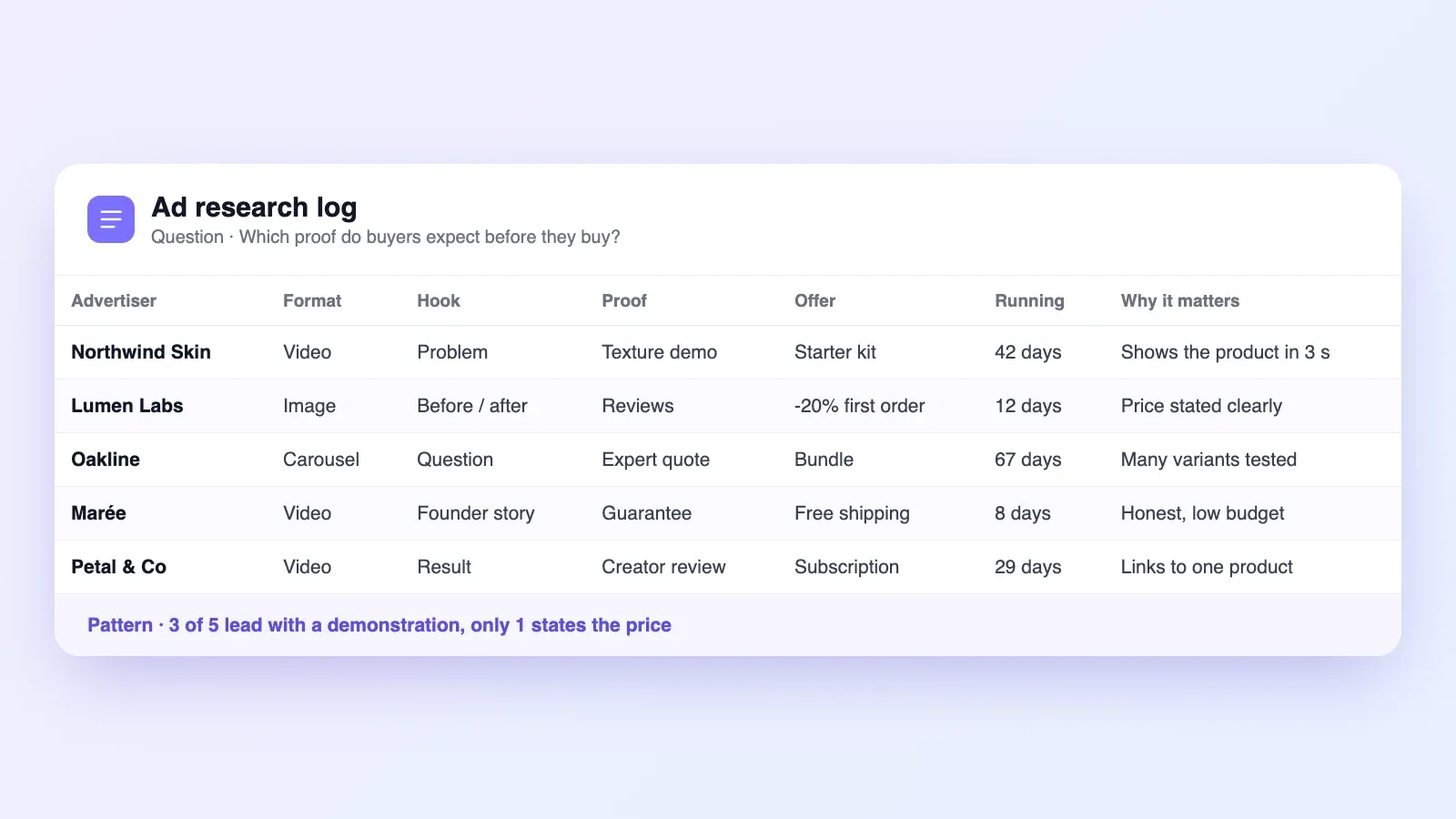
For every ad you keep, capture more than a screenshot. A screenshot without context loses most of its value within a week, because you will forget why you saved it. Keep a simple research log in a spreadsheet or a shared document with one row per ad and a few consistent columns.
Useful columns are the advertiser, the date you checked, the market, the format, the opening line or first frame, the customer problem, the claimed outcome, the type of proof, the offer, the call to action, the destination URL, how long the ad has been running and a short note about why it caught your attention. If you see several variants from the same advertiser, record them as a group. Variations are often more useful than a single polished ad, because they show which elements the brand keeps testing and which ones it never changes.
Do not save an ad just because it looks expensive. A beautiful ad can still be irrelevant to your budget, your audience, your product or your stage of growth. Likewise, do not assume a simple creator-style video is easy to copy. Its strength may come from the creator's credibility, a specific community or years of brand familiarity that you do not have yet.
4. Look for patterns across the set
Once you have 20 to 40 relevant examples, stop browsing and start grouping. The goal is not to identify "the winning ad". It is to identify repeated choices that deserve a test in your own context.
Group the ads by these components:
- Hook. A question, a surprising claim, a problem, a before and after, a demonstration or a story.
- Proof. A review, a creator's experience, a product demonstration, an expert explanation, a data point or a guarantee.
- Offer. A single product, a bundle, a free resource, a discount, a waitlist, a booking or a subscription.
- Format. A static image, a video, a carousel, a product catalog ad, a founder-led clip or a customer-led clip.
- Landing page promise. What the ad says the visitor will get after tapping.
Now look for contrasts as well as repetition. If every brand opens with a discount, a strong product demonstration could make your ad feel more useful. If every ad uses polished studio footage, an honest founder explanation may stand out. Category conventions tell you what the audience already recognizes. Your differentiation comes from deciding which conventions to keep and which ones to challenge.
Count what you see. Writing "12 of 30 ads open with the problem, 8 open with the result, 10 open with the product" turns a vague impression into something you can discuss with your team and revisit later.
5. Separate a pattern from someone else's expression
This is the line that keeps research valuable and keeps you out of trouble. You may learn that short demonstrations, clear comparisons or customer proof are common in a category. Those are patterns, and patterns are free to use. You should not lift a competitor's images, voiceover, exact headline, logo treatment, product names or distinctive creative concept. Those are expressions that belong to that business.
The legal side is real. Images, videos and copywriting are protected by copyright. Brand names, logos and slogans can be protected as trademarks. In France, courts can also sanction "parasitisme", which is the act of taking advantage of a competitor's investment and reputation without permission, even when no copyright or trademark is involved. Meta's own advertising standards prohibit ads that infringe third-party intellectual property, and a copied ad can be reported and removed. Original work avoids all of this.
The practical method is to translate each observation into a neutral principle. Instead of writing "use Brand X's video", write "show the product solving the problem within the first three seconds". Instead of "repeat their 25% off message", write "test whether a concrete first-purchase incentive removes hesitation for this audience". Instead of copying a testimonial, identify the doubt it answers and collect an authentic customer story of your own.
This approach also makes your campaigns stronger. A copied idea starts from the competitor's customer and positioning. An original hypothesis starts from yours.
6. Turn observations into three original hypotheses
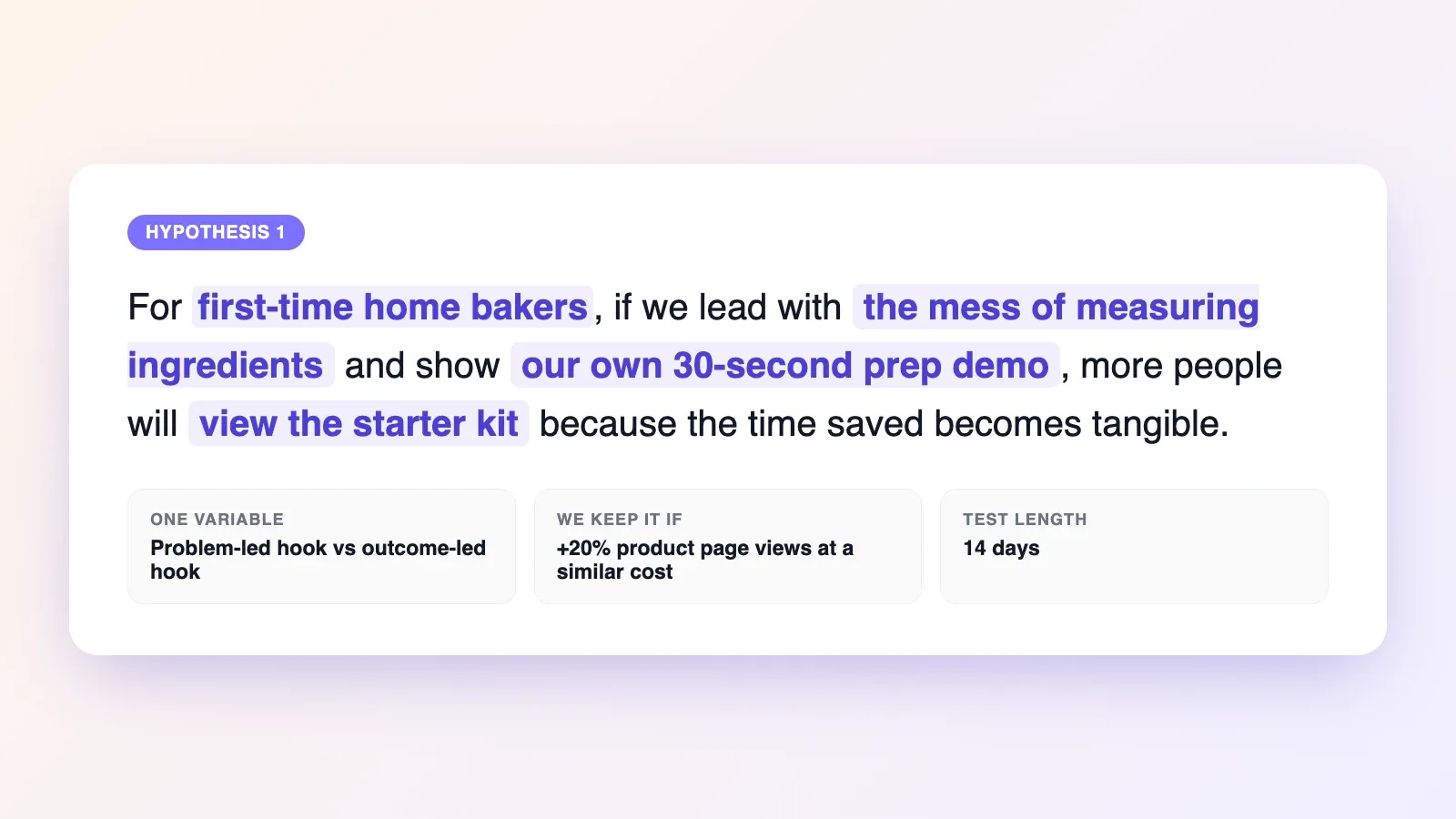
You do not need 25 ideas from a research session. Three well-defined hypotheses are enough for a disciplined test. Use this format:
For [audience], if we lead with [our original angle] and show [our proof], more people will [desired action] because [reason].
For example: "For first-time home bakers, if we lead with the mess created by measuring ingredients and show our own 30-second preparation demo, more people will view the starter kit because the time-saving benefit becomes tangible." The idea may be informed by a pattern you observed, but the scenario, the proof, the product and the voice are entirely yours.
Give each hypothesis one main variable. Do not change the hook, the offer, the visual style and the landing page at the same time, then declare the best ad a winner. You would not know why it won. Start with one controlled contrast, such as a problem-led hook against an outcome-led hook, a video against a static image, or a bundle against a single starter product.
Decide in advance how long the test will run and what result would make you continue. Writing "we keep the new hook if it brings at least 20% more product page views at a similar cost" protects you from reading random noise as a trend.
7. Align the ad with the destination
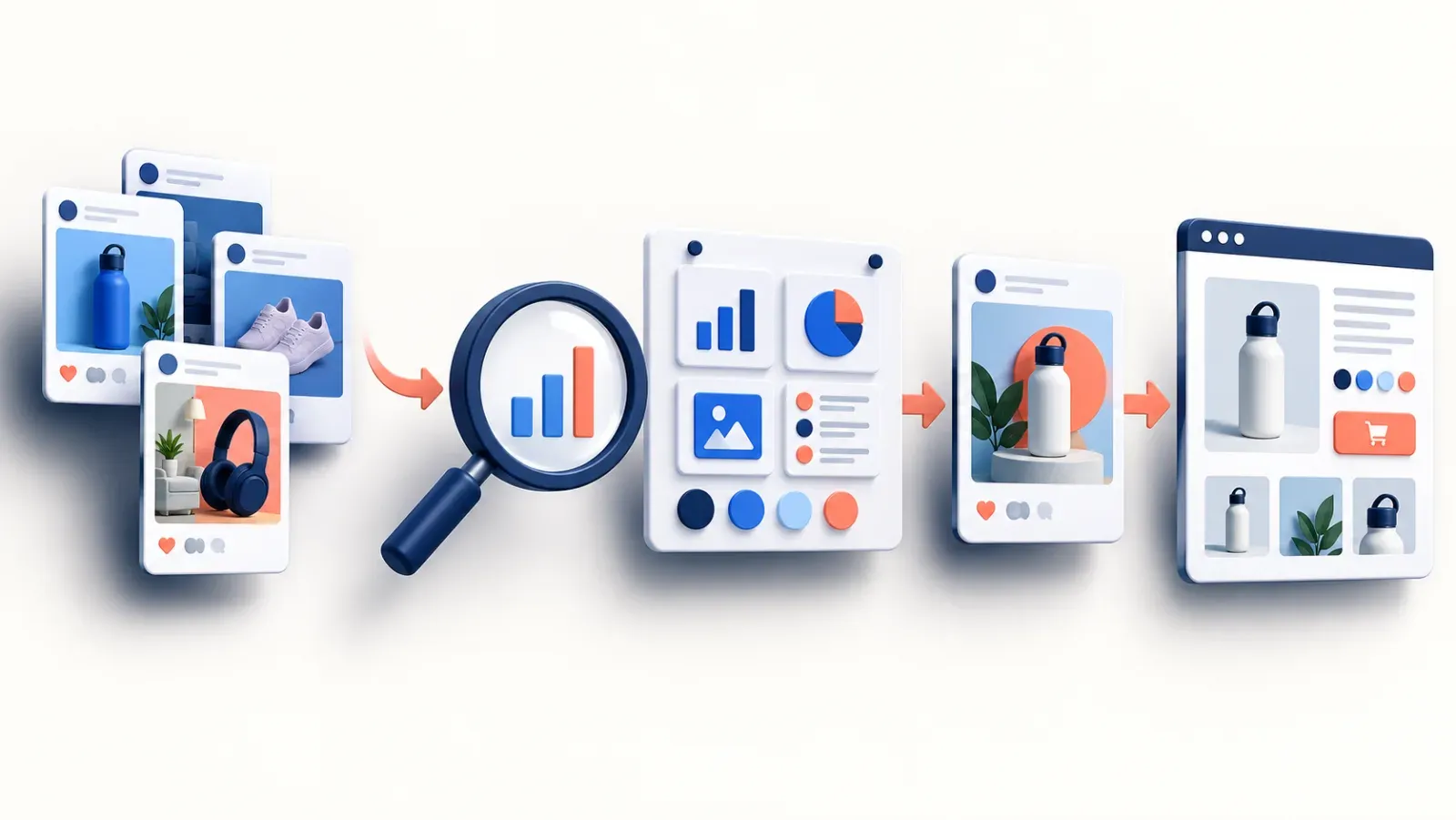
An ad earns a click. Your landing page earns the customer's trust. If the ad promises a quick solution but sends people to a generic home page with 20 unrelated products, you create friction at the exact moment intent is highest.
Make the landing experience repeat the campaign's promise. The product or collection from the ad should be visible immediately, with the same visual and the same words. The page should answer the questions the ad raises: what it is, who it is for, what is included, what it costs, when it arrives and what to do next. If you send social traffic to a link in bio page, put the campaign offer at the top instead of asking visitors to hunt through a list of equal links.
Speed matters as much as message. Most Meta traffic arrives on a phone, often on a mobile connection. A page that takes six seconds to load loses a large part of the people you just paid to bring. Keep the page light, use compressed images and make the main button visible without scrolling.
Roctify lets you build that destination from the same catalog you use everywhere else. Product pages, a link in bio storefront, bookings and digital products share one source of truth, so you can test a new ad angle without recreating the offer in a separate tool. What matters is the match between the ad and the page, not the number of pages in the funnel.
8. Measure your own evidence
Once your campaign is live, switch from competitor research to first-party evidence. Review the customer journey at least once a week:
- Reach and link clicks. Did the creative earn enough qualified attention to justify more testing?
- Product or offer page views. Did the destination make the ad's promise clear enough for people to continue?
- Checkout starts or booking intent. Did people see enough value to take a serious next step?
- Completed purchases. Did the offer, the price and the checkout support a decision?
- Email signups. Did visitors who were not ready to buy choose to stay in touch?
Use the results to improve one part of the journey at a time. A high click-through rate with few product views suggests a message mismatch or a slow page. Strong product views with few checkout starts may point to unclear value, price or delivery details. Good checkout starts with weak completion can signal unexpected costs or a payment problem. Treat these as hypotheses to investigate, not automatic diagnoses.
Keep a note of each change and its result next to your research log. After a few months, you will have your own evidence base, which is worth far more than any competitor's ad.
Three worked examples
A skincare brand launching a serum. The research question was "which proof do buyers expect in this category". Out of 30 ads saved from 12 brands, 18 used before and after photos, 7 used dermatologist quotes and only 5 showed the texture of the product on skin. The brand decided not to follow the before and after convention, which also raises compliance questions for cosmetic claims. It tested a close-up texture video with a founder explaining the formula against a customer testimonial video. The texture video brought more product page views, and the testimonial converted better once on the page, so both were kept at different stages.
An online course creator. The question was "how do competitors present price for a course around 200 euros". Most ads hid the price and pushed a free webinar. The creator tested an ad that stated the price clearly, with a short list of what was included, against a webinar ad. The transparent ad brought fewer clicks but a much higher share of buyers, and far fewer refund requests.
A local bakery with online orders. The question was "which offer drives weekend pre-orders". Research showed that nearby bakeries mostly posted beautiful product photos without a clear next step. The bakery tested an ad with a deadline ("order before Thursday for Saturday pick-up") linked directly to a pre-order page. The clear deadline and the direct link did more than a nicer photo.
In each case, the research did not provide the answer. It provided a better question and a clear contrast to test.
Common mistakes to avoid
Reading duration as success. An ad running for three months may be profitable, or it may be an ad nobody has switched off. Use duration as one clue among others.
Copying the format without the context. A creator video works for a brand with a community of creators. A founder story works when the founder is visible elsewhere. Borrow the principle, then check that it fits your reality.
Researching the wrong market. Ads for the United States can mislead a business selling in France. Prices, tone, delivery expectations and regulations differ.
Saving without tagging. A folder of untagged screenshots is almost useless. The research log is what turns examples into insight.
Testing everything at once. Changing five variables in one test gives you a result you cannot explain or repeat.
Forgetting the landing page. Many campaigns fail after the click. Research competitors' destinations as carefully as their ads.
A 45-minute weekly routine
You can make this process sustainable with one short session each week. Spend 10 minutes updating your advertiser list and saving only relevant new ads. Spend 15 minutes tagging examples by hook, proof, format and offer in your research log. Spend 10 minutes writing one observation and three possible explanations. Use the final 10 minutes to choose one original campaign or page test for the following week.
Over time, this becomes a library of market language and customer questions rather than a folder of screenshots you never open. Keep the source, the date and the "why it matters" note with every example. It will help you notice real shifts, such as a category moving from feature-heavy messaging to proof-heavy messaging, without turning every new ad into a false trend.
Research checklist
Before your next session, check that you have:
- One precise research question written down.
- A chosen country, category and shortlist of 10 to 20 advertisers.
- A research log with consistent columns.
- Between 20 and 40 relevant ads, tagged by hook, proof, offer and format.
- Patterns written as neutral principles, never as copies.
- Three original hypotheses, each with one main variable.
- A landing page that repeats the promise of the ad.
- A simple measurement plan decided before the launch.
Frequently asked questions
Is it legal to look at competitors' ads in the Meta Ad Library? Yes. The library is public and was created precisely for transparency. Looking at ads, noting patterns and learning from them is legal. Reproducing protected images, videos, copy or brand elements is not.
Do I need a Facebook account to use the Ad Library? No. You can browse commercial ads without logging in. An account is only needed for some advanced features.
Can I see how much a competitor spends on an ad? Not for standard commercial ads. Spend and reach ranges are shown for ads about social issues, elections or politics, and some reach information is available for ads delivered in the European Union.
How many ads should I analyze? Between 20 and 40 relevant ads from 10 to 20 advertisers is usually enough to see patterns without drowning in examples.
How often should I do this research? A short weekly session is more useful than a big quarterly review, because you notice changes as they happen and keep your hypotheses fresh.
Should I use AI to write ads based on competitors' ads? Use AI to help you structure your notes or draft variations of your own ideas. Do not feed it a competitor's ad and ask for a rewrite. The result is still a copy, and it will sound generic.
Build a better campaign from public signals
The best use of Meta ad research is curiosity with boundaries. Public ads show you how a market frames problems and presents offers. They cannot replace your customer research, your brand's point of view or your own conversion data. Start with a precise question, record context rather than isolated screenshots, identify patterns, write original hypotheses and send traffic to a page that keeps the ad's promise.
That workflow protects your brand and gives every campaign a clearer reason to exist. When you are ready to turn an original angle into a focused storefront, product page, booking flow or link in bio page, create your free Roctify page and make the next step easy for the people your ads reach, with 0% transaction fees on every plan.