A supplier misses a delivery, a video goes viral overnight, a big customer asks for a custom bundle, or your sales suddenly drop on a Tuesday for no clear reason. None of these situations fit into your normal weekly routine, yet each one needs a decision, a report, a meeting or a small project. That is ad hoc work, and every business does it, from a one-person shop to a global company.
This guide gives you a clear ad hoc business definition, explains where the term comes from, and shows the main forms ad hoc work takes, from ad hoc reports and meetings to committees, projects and freelancers. You will also find concrete examples for small online businesses and creators, the advantages and risks of working this way, and a simple system to manage ad hoc requests without letting them take over your week.
Ad hoc business definition
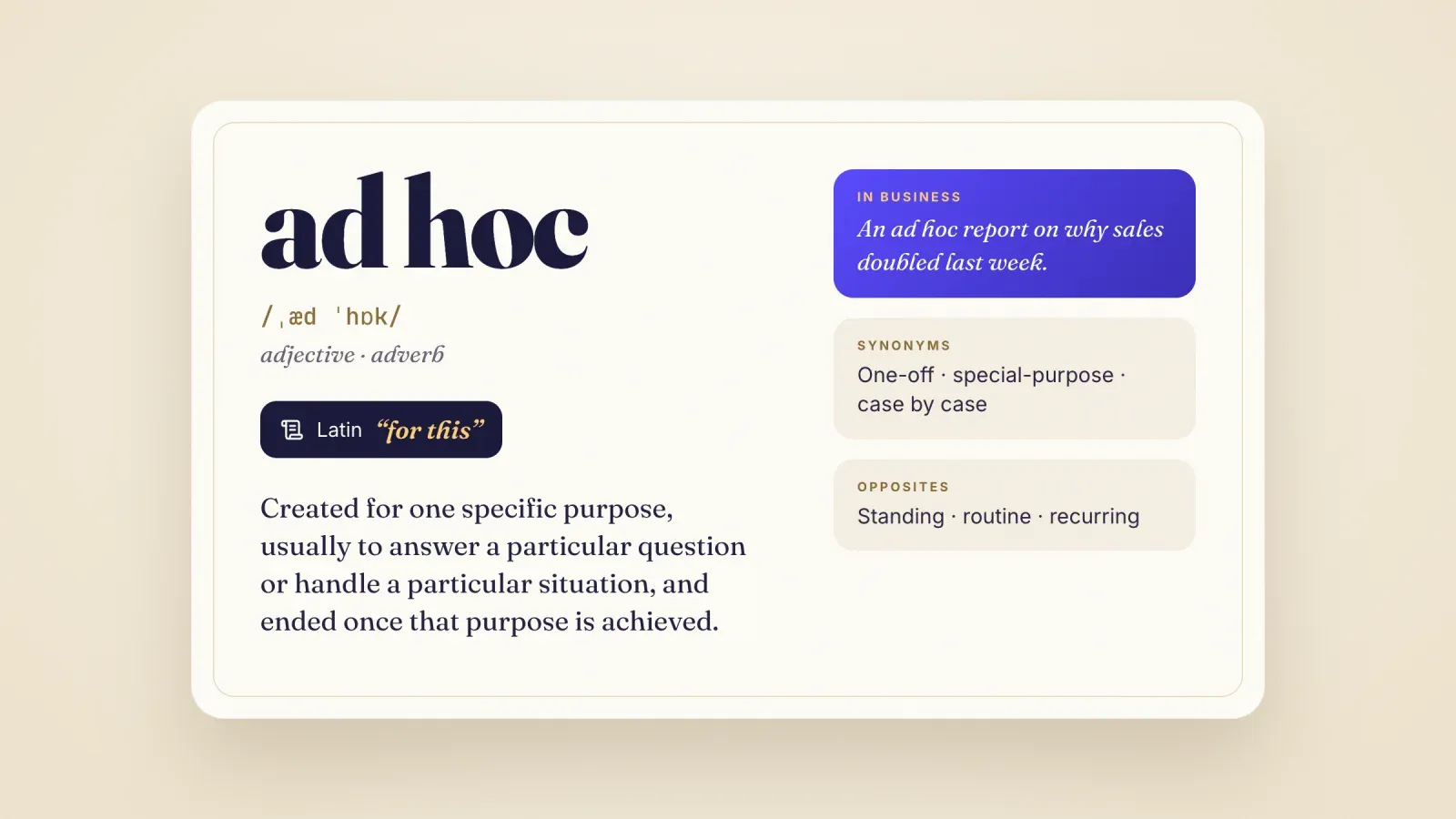
In business, ad hoc describes a decision, report, meeting, team or project created for one specific purpose, usually to answer a particular question or handle a particular situation. Once that purpose is achieved, the ad hoc solution ends. It sits outside the routine processes that a company repeats every day, week or month.
The phrase comes from Latin and means "for this", or more fully "for this purpose". It is pronounced "ad hock". In everyday English it can be used as an adjective ("an ad hoc meeting", "an ad hoc report") or as an adverb ("the team was assembled ad hoc").
A short way to remember the ad hoc business definition is this. Routine work answers questions you ask every time. Ad hoc work answers a question you are asking right now.
An important nuance is that ad hoc does not always mean improvised or last minute. Some ad hoc work is reactive, like an emergency meeting after a website outage. Other ad hoc work is planned in advance, like a temporary committee formed three months before a trade show or a one-time sales event scheduled for an anniversary. What makes it ad hoc is its single purpose and limited life, whatever the timing.
Key characteristics of ad hoc work
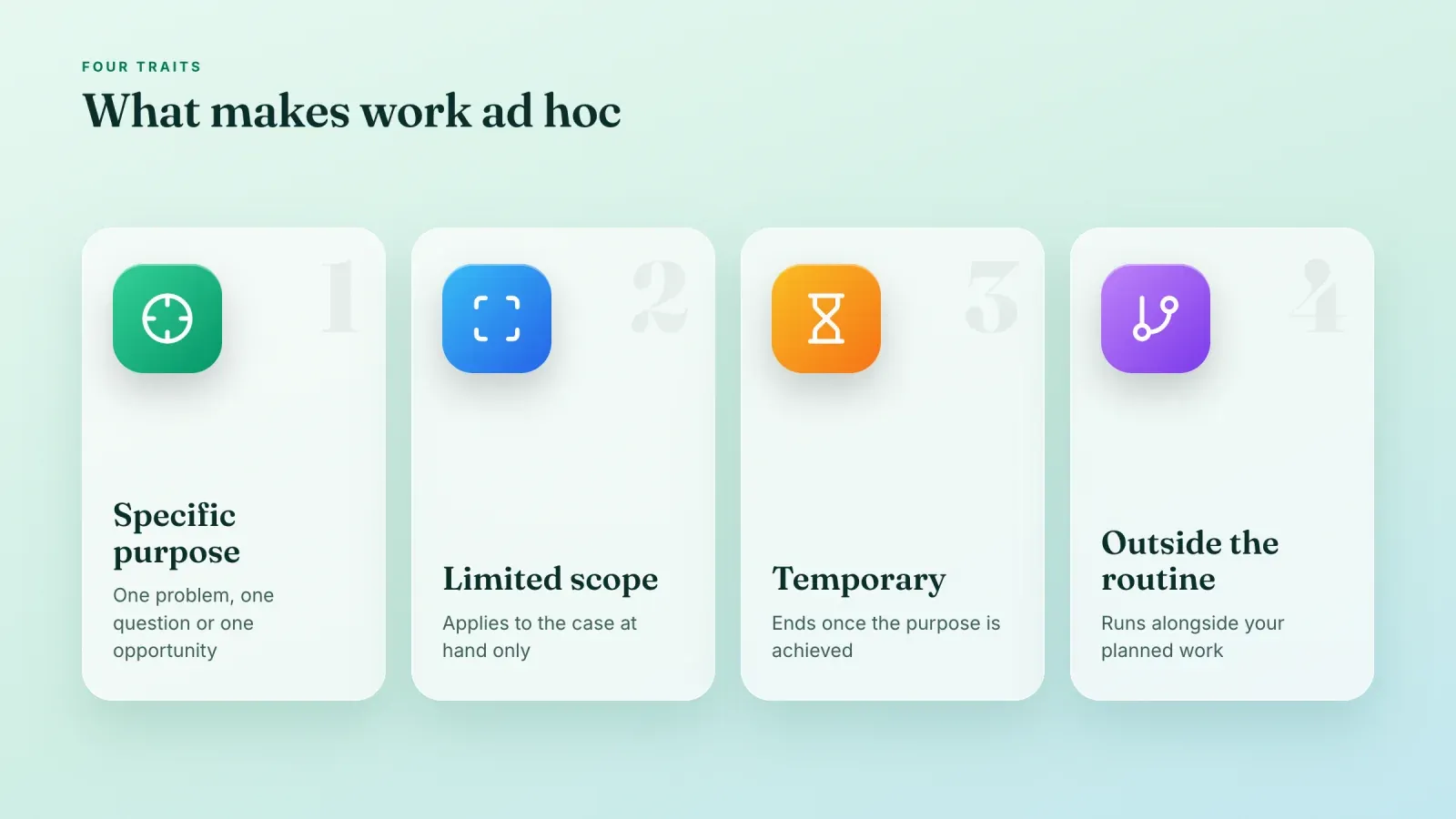
Whatever form it takes, ad hoc work shares four characteristics.
A specific purpose. It exists to solve one problem, answer one question or seize one opportunity. "Why did refunds double last month?" is an ad hoc question. "How are refunds trending?" is a routine one.
A limited scope. The decision or process applies to the case at hand only. An ad hoc discount for a disappointed customer does not change your pricing policy for everyone.
A temporary life. Ad hoc teams disband, ad hoc reports are read and archived, ad hoc projects close. If something keeps running indefinitely, it has become a process.
A place outside the routine. Ad hoc work happens alongside your normal workflow, which is why it can be both useful and disruptive. It borrows time, people and money from planned work.
Ad hoc vs planned work
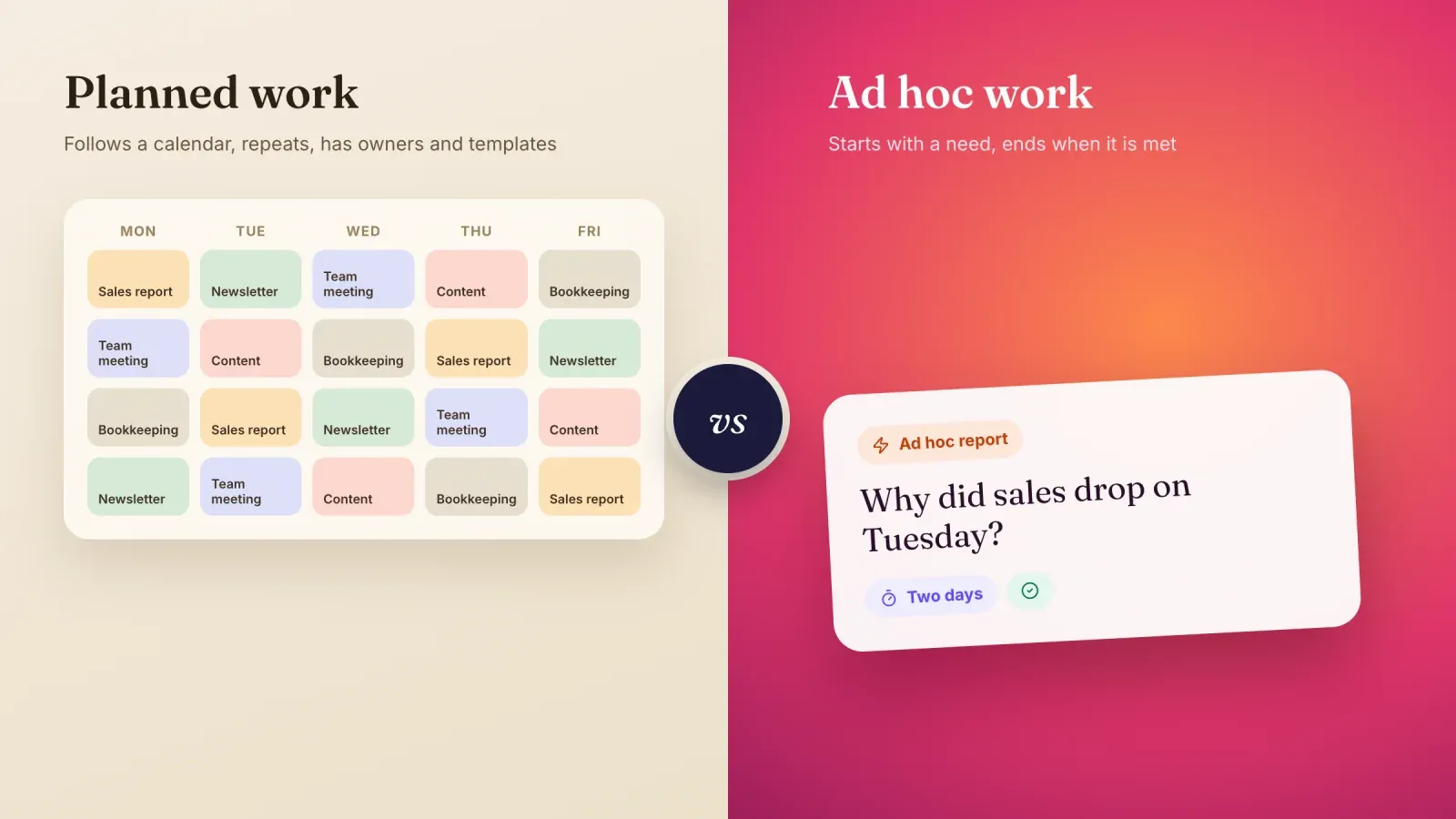
To understand ad hoc work, it helps to compare it with its opposite, the planned or standing work that keeps a business running.
- Purpose. Planned work serves ongoing goals, like publishing three posts a week or closing the books every month. Ad hoc work serves a single, immediate goal.
- Timing. Planned work follows a calendar. Ad hoc work starts when a need appears and stops when it is met.
- Structure. Planned work uses documented processes, templates and owners. Ad hoc work usually starts with a blank page and borrows people from several roles.
- Output. Planned work produces recurring outputs, such as weekly dashboards. Ad hoc work produces one-off outputs, such as a single analysis or a decision.
- Examples. A weekly sales report, a monthly newsletter or a standing team meeting are planned. A report on one product's sudden success, a crisis call or a task force for a product recall are ad hoc.
Healthy businesses need both. Planned work gives stability and efficiency. Ad hoc work gives speed and flexibility when reality does not follow the plan.
Ad hoc in different business contexts
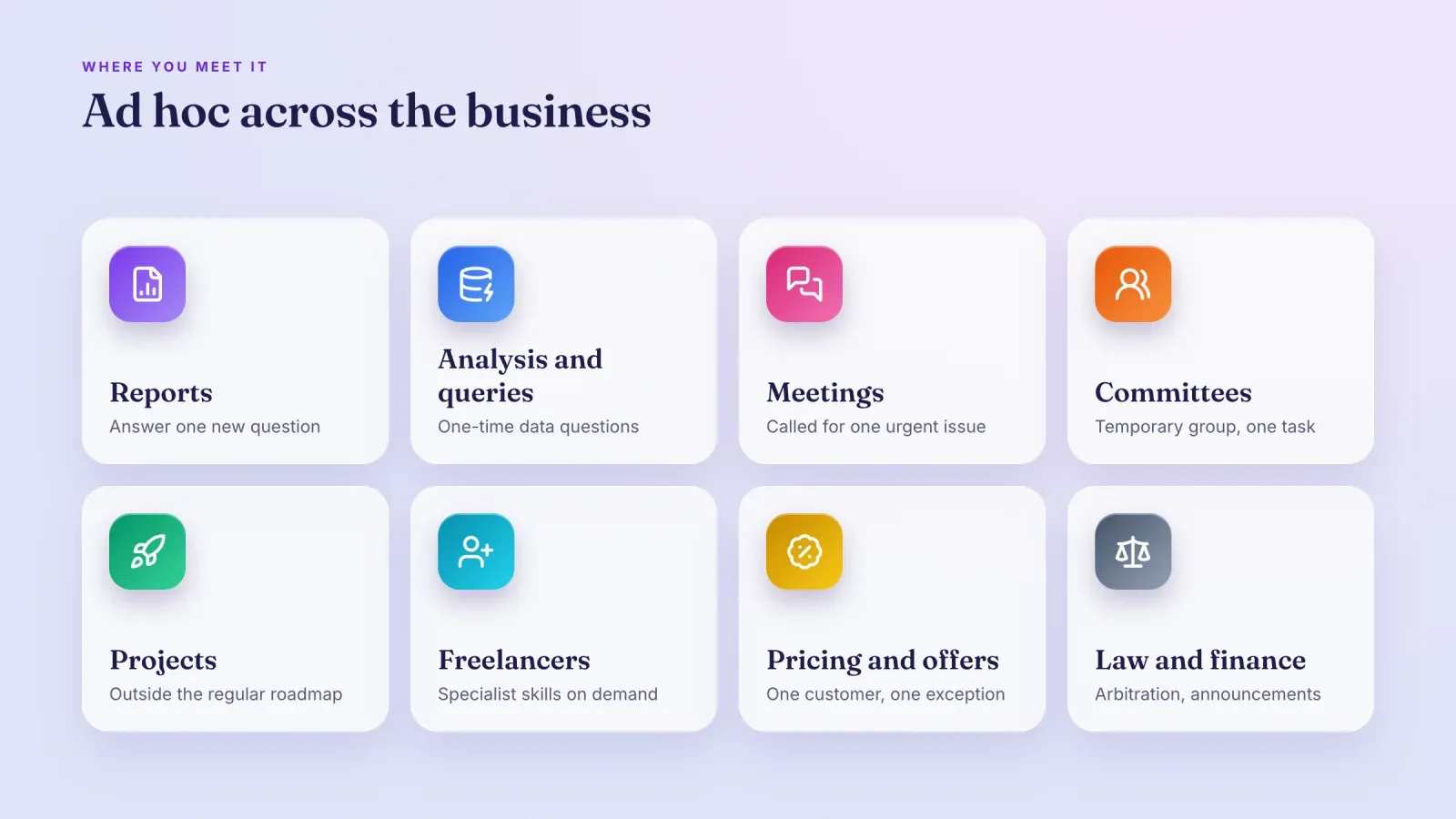
The word appears in many areas of business. Here are the most common uses and what each one means in practice.
Ad hoc reports and analysis
An ad hoc report is created to answer a question that your regular dashboards do not cover. Your weekly report might show that revenue rose 40%, while an ad hoc report digs into why. Was it one product, one traffic source, one country or one influencer mention? Once you have the answer, the report has done its job.
In data teams, you will also hear about ad hoc analysis and ad hoc queries, which are one-time questions asked of a database or analytics tool instead of a predefined report. Modern analytics tools and AI assistants have made ad hoc analysis much easier, since you can often ask a question in plain language and get a chart in seconds.
Ad hoc meetings
An ad hoc meeting is called outside the regular schedule to deal with a specific issue, such as a payment provider outage, a negative press article, a conflict between team members or an unexpected partnership offer. Good ad hoc meetings are short, invite only the people needed to decide, and end with clear actions.
Ad hoc committees
An ad hoc committee is a temporary group formed to handle one task, such as organizing an event, choosing a new software tool or reviewing a policy. In associations, boards and public bodies, ad hoc committees are common and are dissolved once they deliver their recommendations. The opposite is a standing committee, which exists permanently, like a finance or audit committee.
Ad hoc projects
An ad hoc project addresses a specific problem or opportunity outside the regular roadmap. Launching a weekend flash sale after a competitor closes, migrating to a new email tool after a price increase or creating a limited collection for a collaboration are typical ad hoc projects. Even when they are small, they work best with a named owner, a deadline and a budget.
Ad hoc teams
An ad hoc team, sometimes called a task force or tiger team, brings together people from different roles for one mission. A marketer, a developer and a customer support agent might work together for two weeks to fix a checkout problem, then return to their normal work.
Ad hoc hiring and freelancers
Businesses often bring in outside help ad hoc, such as a freelance designer for a rebrand, a lawyer for one contract or a developer for a specific integration. This gives you specialist skills without creating a permanent position. Many creators and small brands work almost entirely this way, with a small network of freelancers they call on when a project needs them.
Ad hoc pricing and offers
An ad hoc discount, refund or custom quote is a pricing decision made for one customer or one situation. It can save a relationship or close a deal, but if you make too many exceptions, customers start expecting them and your pricing loses its meaning.
Ad hoc in law and finance
In legal and financial language, ad hoc often refers to arrangements set up for one case. Ad hoc arbitration is a dispute resolution process organized by the parties themselves for a single dispute, without an arbitration institution managing it. An ad hoc announcement is a disclosure that a listed company must publish when important, price sensitive information appears outside its normal reporting calendar.

Ad hoc examples for small online businesses and creators
When you run a small business, you are often the committee, the decision-maker and the project team at the same time. Here are realistic examples of ad hoc work in that context.
A product goes viral. A customer posts a video of your candle and it reaches two million views. You need an ad hoc plan for the next 72 hours. Check stock, pause ads that send traffic to sold out items, add a pre-order option, prepare a reply for comments and update your shipping times.
A brand deal arrives. A company offers you a sponsored post with a one-week deadline. You create an ad hoc mini project with a brief, a draft, a review round and a publishing date, then go back to your normal content schedule.
Sales drop suddenly. Your revenue falls 30% in three days. An ad hoc report compares traffic, conversion rate, average order value and checkout errors to find the cause. Often the answer is simple, like a broken link in bio or an expired discount code.
A custom order request. A follower asks for 50 personalized items for a wedding. You build an ad hoc quote, a special timeline and maybe a dedicated payment link for that customer only.
A platform changes its rules. A social network changes its algorithm or limits the number of hashtags. You run an ad hoc review of your content strategy to adjust your posts.
A collaboration with another creator. You agree to launch a joint product. A small ad hoc team with a shared document, a calendar and clear roles keeps both sides aligned until launch day.

Advantages of ad hoc solutions
Working ad hoc has real benefits when it is used for the right situations.
Speed. You do not need to wait for the next planning cycle. An ad hoc decision lets you act while the opportunity or problem is still fresh.
Tailored answers. Ad hoc work is built for one specific case, so the solution fits that case closely instead of following a general rule that may not apply.
Flexibility. Ad hoc teams and projects can change direction as you learn more. This is useful in uncertain situations where the facts evolve every day.
Focused resources. Instead of reorganizing the whole business, you concentrate time, money and attention on the most urgent issue for a limited period.
Access to specialist skills. Hiring a freelancer or forming a cross-functional group gives you expertise exactly when you need it, without long-term costs.
Collaboration across roles. Ad hoc teams mix people who do not usually work together. That can spark new ideas and build relationships that help long after the project ends.
Disadvantages of ad hoc solutions
The same features that make ad hoc work useful also create risks.
Short-term thinking. Ad hoc fixes often treat the symptom instead of the root cause. If you keep making ad hoc refunds for late deliveries, the real problem, maybe your carrier or your stock planning, remains.
Disruption of planned work. Every ad hoc request takes time from something else. Too many interruptions and your important projects slip week after week.
Confusion over roles. When nobody clearly owns an ad hoc task, people duplicate work, wait for each other or assume someone else is handling it.
Scope creep. A quick ad hoc analysis can grow into a two-week investigation if no one defines what "done" means.
Poor documentation. Ad hoc work is rarely written down. When the same situation comes back, you start from zero instead of reusing what you learned.
A reactive culture. If most of your time goes to urgent ad hoc tasks, strategy disappears. You end up running the business from your inbox instead of from a plan.
When ad hoc work should become a process
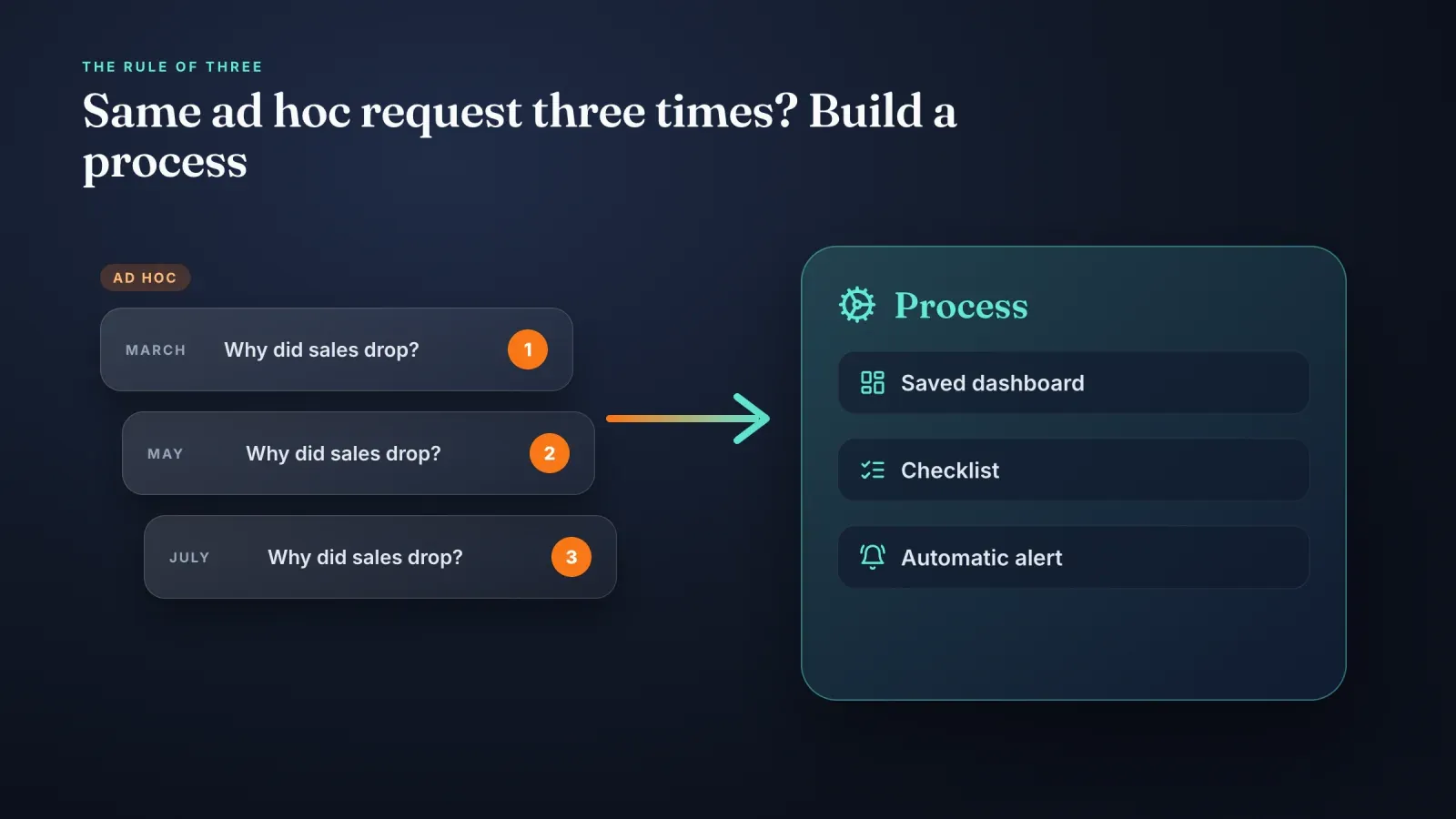
A simple rule helps many small teams. If you handle the same type of ad hoc request three times, it is time to turn it into a process.
For example, if you have built three ad hoc reports on why sales dropped, create a standard checklist or dashboard that shows the same indicators automatically. If you have answered the same wholesale request three times, create a wholesale price sheet and a short form. If you keep calling ad hoc meetings about stock shortages, set up low inventory alerts and a weekly stock review.
Turning repeated ad hoc work into a process saves time, reduces errors and frees your attention for the situations that are truly new. Automation tools, templates and saved replies are often enough. Keep ad hoc work for the real exceptions, and let processes handle the problems that come back every month.
How to manage ad hoc requests
You cannot avoid ad hoc work, but you can manage it. Here is a simple system that works for solo founders and small teams.
1. Create one entry point. Collect ad hoc requests in a single place, such as a form, a shared board or a dedicated channel. Requests scattered across email, DMs and messages are easy to forget and hard to compare.
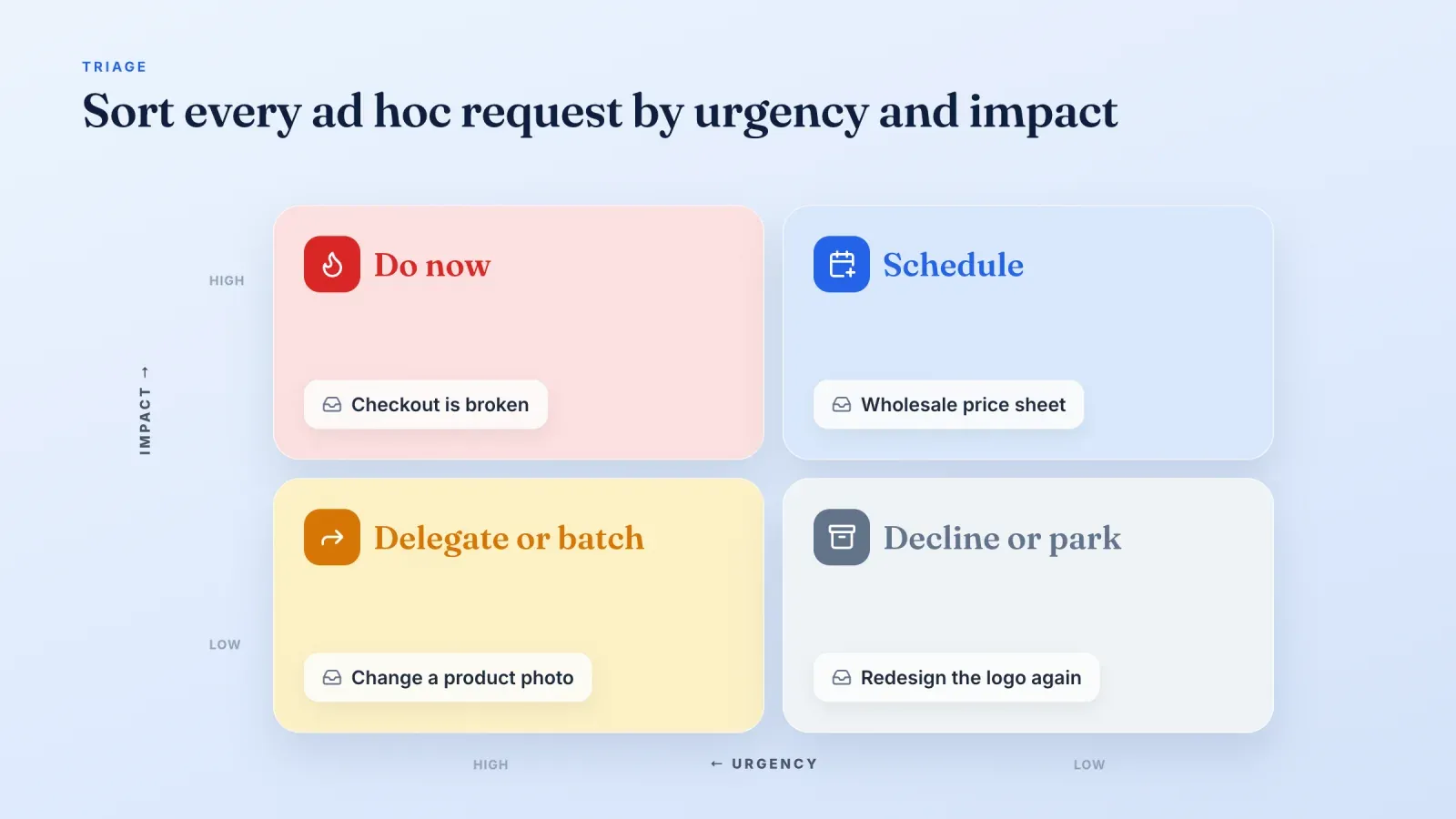
2. Sort by urgency and impact. For each request, ask two questions. How urgent is it, and how much does it matter for revenue, customers or reputation? Urgent and important requests get handled now. Important but not urgent requests get scheduled. Urgent but low impact requests can be delegated or handled quickly. Requests that are neither can be declined or postponed.
3. Define the scope in five lines. Before starting, write down the purpose (the question to answer), the deadline, the owner, what success looks like and the budget or time limit. This short scope card prevents most of the problems of ad hoc work.
4. Name one decision-maker. Ad hoc work moves fast, so someone needs the authority to make calls without waiting for consensus. For a solo business, that is you. In a team, choose the person closest to the problem with enough authority over the affected area.
5. Timebox the work. Decide in advance how much time the ad hoc task deserves. A two-hour limit on an analysis forces you to focus on the most useful answer.
6. Document and review. When the work ends, write three lines. What happened, what you decided and what you would do next time. Store these notes in one place. Over time they become a playbook, and they help you spot the repeated requests that should become processes.
7. Protect planned work. Block time in your calendar for your most important planned projects and treat those blocks like meetings. Ad hoc work can fill the rest.
Simple tools for ad hoc work
You do not need complex software to handle ad hoc work well. A few simple tools cover most needs.
A request form or board. A free form, a shared spreadsheet or a board in a project management app gives every request the same fields, such as who asked, what is needed, by when and why it matters.
A shared calendar. When several people work on ad hoc projects, a shared calendar shows who is busy, which deadlines overlap and when planned work is protected.
Saved replies and templates. Many ad hoc situations involve the same type of message, like a custom order quote, a delay notice or a partnership reply. A small library of templates turns a 30 minute task into a five minute one.
Analytics you can question quickly. Choose tools that let you filter and compare data without a specialist. The faster you can answer "what changed?", the shorter your ad hoc reports become.
Alerts and automations. Low stock alerts, failed payment notifications and simple automated workflows catch problems early, before they turn into urgent ad hoc work.
A decision log. A single document listing past ad hoc decisions, with the date, the reason and the result, helps you stay consistent and avoid reopening the same debates.
How to use "ad hoc" correctly
A few practical notes on the term itself.
Spelling. The standard form is two words, "ad hoc". "Adhoc" in one word is a common mistake. Before a noun, you will sometimes see a hyphen ("an ad-hoc meeting"), but most style guides prefer no hyphen.
In a sentence. "We set up an ad hoc committee to choose the new packaging." "The report was produced ad hoc for the board." "Our approach to pricing has been too ad hoc, so we created clear rules."
Synonyms. Depending on the context, you can use one-off, special-purpose, impromptu, improvised, temporary, makeshift or case by case.
Opposites. Standing, routine, recurring, systematic, planned or permanent.
Tone. "Ad hoc" is neutral when it describes something created for a purpose. It becomes negative when it suggests a lack of planning, as in "the company's ad hoc approach to security".
Common mistakes with ad hoc work
Treating every request as urgent. Not every ad hoc request deserves immediate action. Sorting by impact protects your focus.
Starting without a clear question. An ad hoc report without a precise question produces pages of data and no decision.
Forgetting to close. Ad hoc teams and projects should end officially, with a short summary. Otherwise they linger and consume time.
Repeating the same fix. If the same ad hoc solution appears again and again, the underlying process is missing.
Making exceptions public by accident. An ad hoc discount for one customer can spread quickly on social media. Decide in advance what you are willing to offer and to whom.
Frequently asked questions
What is the ad hoc business definition? In business, ad hoc describes a decision, report, meeting, team or project created for one specific purpose and usually ended once that purpose is achieved. It operates outside routine processes.
What does ad hoc mean literally? Ad hoc is a Latin phrase meaning "for this" or "for this purpose".
What is an example of ad hoc in business? An ad hoc report analyzing why sales suddenly increased, an ad hoc meeting after a website outage, or an ad hoc committee formed to organize a single event.
Is ad hoc work always unplanned? No. Some ad hoc work is reactive, but it can also be planned in advance, like a temporary committee for an upcoming event. What makes it ad hoc is its single purpose and limited duration.
What is the difference between ad hoc and standing committees? An ad hoc committee is temporary and created for one task. A standing committee is permanent and handles an ongoing area, such as finance or audit.
Is ad hoc good or bad for a business? Both. It brings speed and flexibility for unusual situations, but too much ad hoc work leads to short-term thinking, interruptions and repeated mistakes.
How do you write ad hoc correctly? As two words, "ad hoc", usually without a hyphen. "Adhoc" in one word is incorrect.
Spend less time on ad hoc fixes
Many ad hoc tasks in a small online business come from scattered tools, like a broken link, a payment problem or a custom order handled by hand. Create your free Roctify page to put your products, digital downloads and offers behind one link in bio with built-in checkout and 0% transaction fees on every plan, so fewer emergencies reach your inbox. To build a stronger base for your business, read our guide on how to sell more on social media.