Most people who search for passive income find the same thing, a long list of ideas with no way to choose between them. Sell a course, buy a rental, start a podcast, invest in dividend stocks, rent out your parking spot. All of these can work. The problem is that they ask for completely different things. Some need $50,000 of capital, some need two years of content, some need a skill you already have and a free weekend.
This guide takes the opposite approach. Instead of 50 ideas, you get a method. You'll see how to audit what you can realistically invest, choose one model that fits, validate it before you build it, set it up so it runs without you, and bring in traffic that keeps coming months after you stop pushing. You'll also find a comparison of the most common passive income ideas, a realistic 12-month timeline, the tax basics to know before your first sale and the mistakes that keep "passive" income very active.
If you only want the definition and the math behind it, our glossary entry on passive income covers it. If you already know you want to sell digital products, our guide to digital products that sell lists more than 30 ideas with prices. This article sits between the two, and shows you how to go from zero to a first stream that pays.
What passive income really means
Passive income is money that does not depend on the hours you work each week. You do the work once, upfront, and the result keeps earning after you move on. An ebook written in January can sell in November. A YouTube tutorial filmed two years ago can still bring in ad revenue today. A dividend fund pays you whether you check it or not.
What passive income almost never means is "no work". Every stream has two phases.
- The build phase, where you trade time or money for an asset. Writing the course, recording the videos, buying the shares, renovating the apartment.
- The maintenance phase, where the asset earns and you spend a few hours a month keeping it healthy. Answering emails, updating content, rebalancing a portfolio, fixing a broken link.
The goal is to make the second phase as small as possible compared to the income it brings. A course that earns $1,500 a month for four hours of support is very passive. A rental that earns $1,500 a month but calls you every week for repairs is much less so, even if the bank statement looks the same.
That's why the honest name for most streams is semi-passive. Keeping that in mind from the start protects you from the biggest disappointment in this space, which is building something for six months and finding out it needs as much attention as a part-time job.
Passive income ideas by what you invest
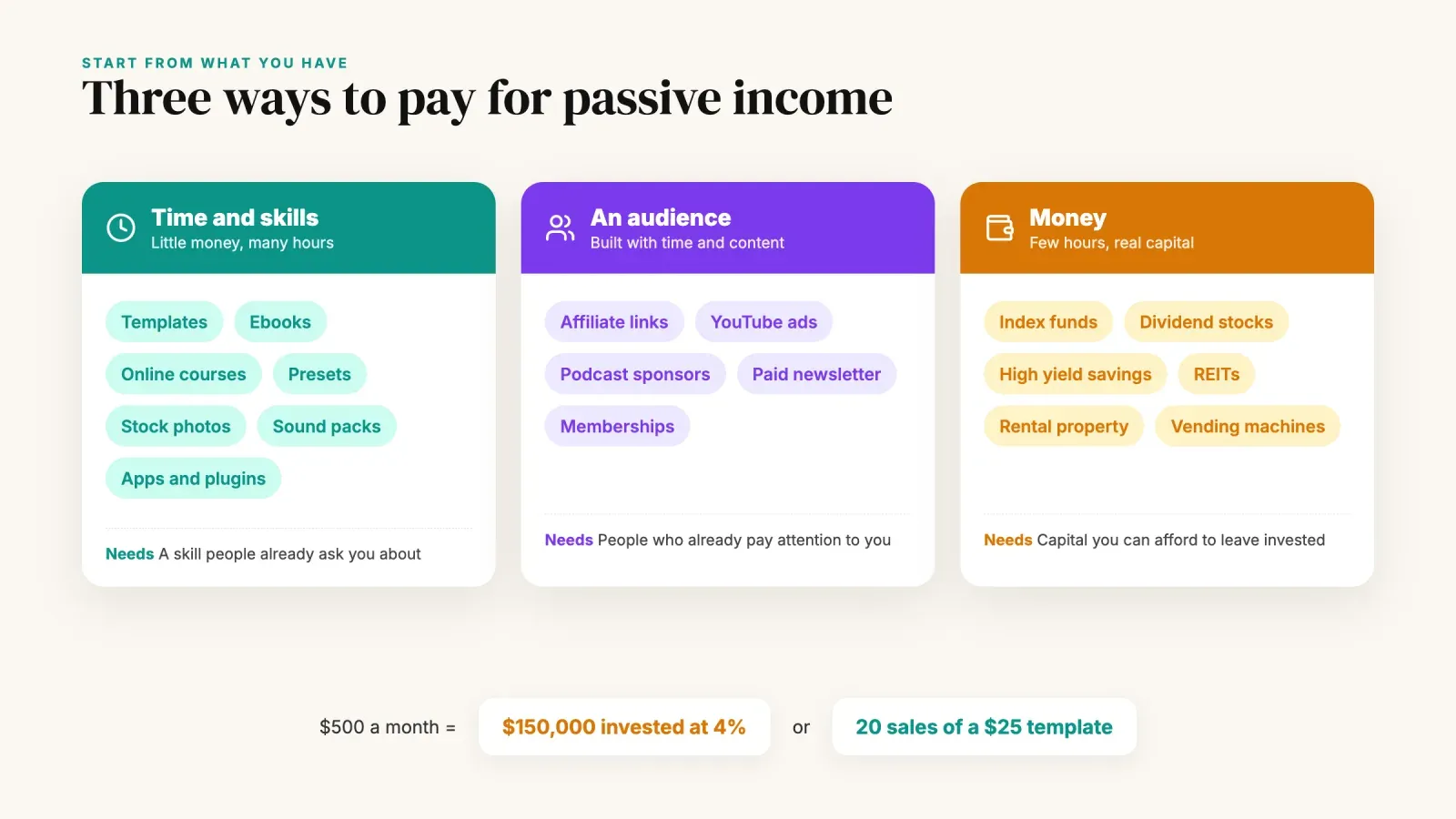
Every passive income idea is paid for with one of three resources, or a mix of them. Sorting ideas this way is the fastest way to eliminate the ones that don't fit your life.
- Ideas paid with time and skills. Digital products, online courses, templates, ebooks, stock photos, music and sound packs, plugins and apps. Very little money needed, often under $100 to start. The cost is your hours.
- Ideas paid with an audience. Affiliate marketing, YouTube and podcast ad revenue, sponsorships, paid newsletters, memberships. These need people who already pay attention to you, which is itself built with time.
- Ideas paid with money. Dividend stocks and index funds, high yield savings, bonds, real estate and REITs, vending machines, buying existing websites. Little time needed, but the income is proportional to the capital you put in.
Here is a simple way to see the trade-off. To earn $500 a month from a dividend fund yielding 4%, you need about $150,000 invested. To earn $500 a month from a $25 template, you need 20 sales a month, which a creator with a few thousand engaged followers can reach in a few months. Neither path is better. They simply suit different starting points.
If you have more time than money, start with the first two groups. If you have more money than time, the third group is more realistic. Most people end up combining both, using income from a skill-based stream to fund investments later.
1. Audit what you can really invest
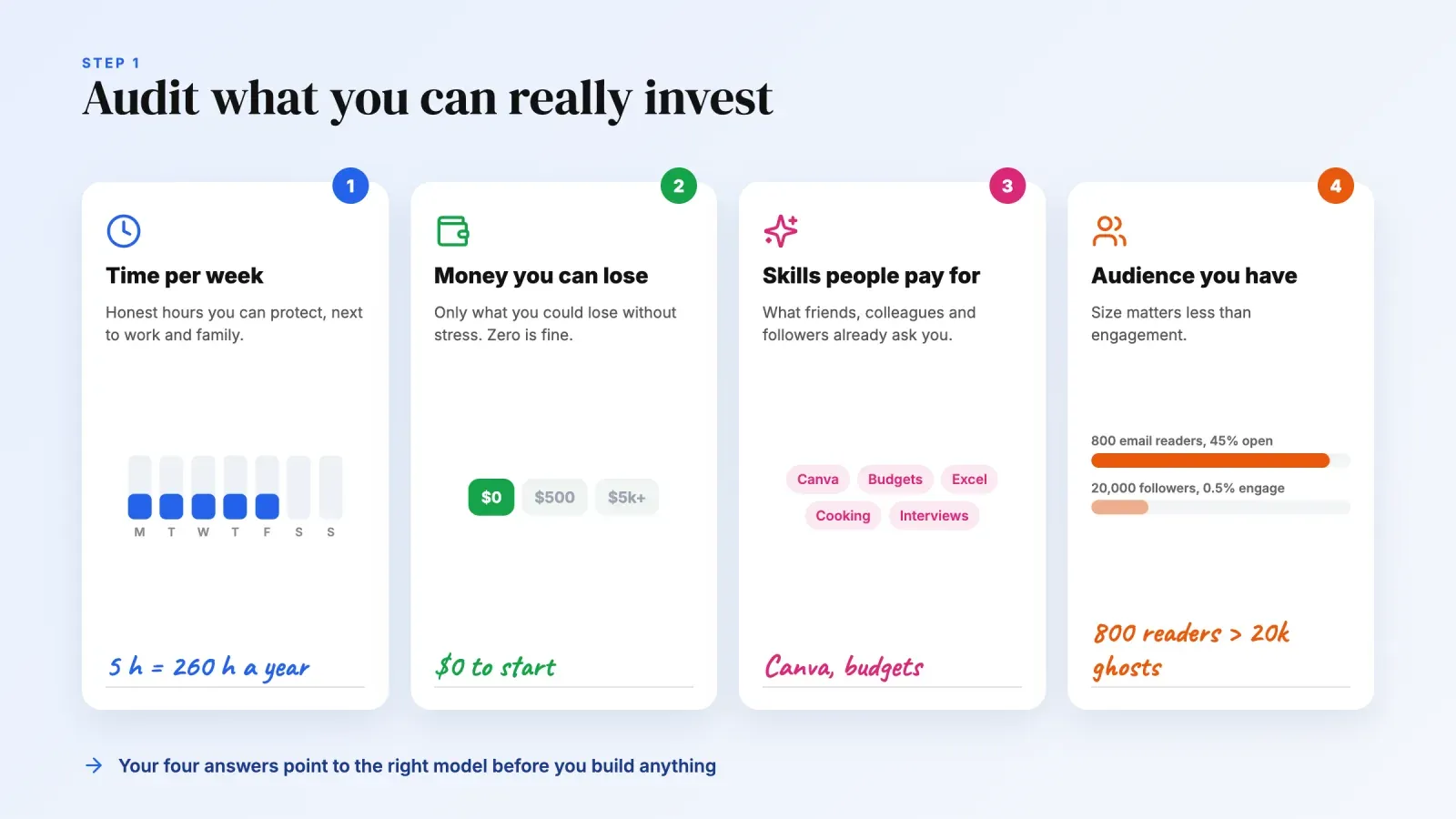
Before choosing an idea, write down four numbers. This takes 15 minutes and saves months of building the wrong thing.
Time per week. Be honest. If you have a full-time job and a family, it might be five hours, not twenty. Five focused hours a week is 260 hours a year, which is enough to build a course, a template shop or a small content library. Plan around the real number, not the one you wish you had.
Money you can lose. Count only money you could lose without stress. Passive income is a long game, and money you'll need in six months should not be in a rental deposit or a stock portfolio. For many people this number starts close to zero, which is fine. It points you toward skill-based ideas.
Skills people pay for. List what friends, colleagues or followers already ask you about. Building spreadsheets, cooking on a budget, editing photos, preparing for job interviews, training for a half marathon, setting up a home studio. Paid knowledge usually hides in the questions people already ask you for free.
Audience you already have. Followers on Instagram or TikTok, an email list, a YouTube channel, a LinkedIn network, even a local community. Note the size and, more importantly, the engagement. A list of 800 people who open your emails is worth more than 20,000 followers who never comment.
Once you have these four numbers, the right direction is usually obvious. Lots of time and a skill but no audience? Start with a product sold on a marketplace like Etsy or a stock site, where buyers already search. A skill and an engaged audience? Sell your own digital product or course through your link in bio. Capital and little time? Look at index funds or dividend ETFs first, and talk to a qualified advisor.
2. Choose one model that fits your audit
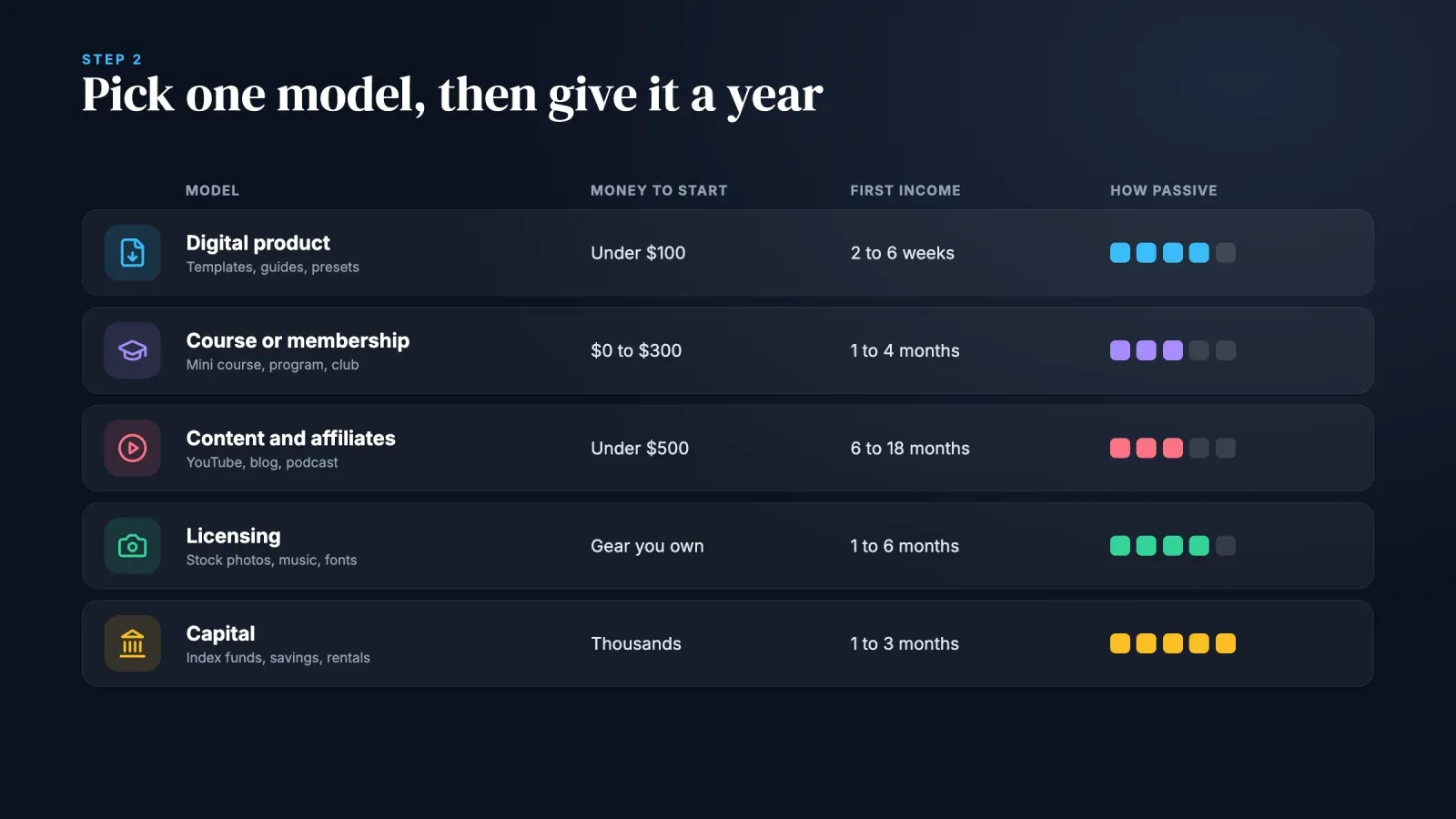
Beginners often launch three streams at once, a blog, a course and a dividend portfolio, and end up with three half-built projects. Pick one model and give it six to twelve months. Here are the five model families, with what each needs and what you can reasonably expect.
Sell a digital product. Templates, ebooks, guides, presets, printables, sound packs. You create the file once and every sale is delivered automatically. Typical prices range from $9 to $49. A first product can be ready in two to four weekends. This is the most accessible passive income model for anyone with a skill. Our list of digital products that sell gives detailed ideas and price ranges per category.
Package what you know as a course or membership. An online course sells for more, from $49 for a mini course to several hundred dollars for a complete program. A membership site adds recurring revenue, usually $5 to $50 a month. Both take longer to build, and memberships need fresh content, so they are the least passive of this group.
Earn from content and recommendations. Blog posts, YouTube videos and podcasts can earn from ads, sponsorships and affiliate marketing for years after publication. On YouTube, creators in the Partner Program receive 55% of the ad revenue from their long-form videos, once they reach 1,000 subscribers and 4,000 public watch hours in a year. Affiliate commissions range from 1% to 10% on Amazon to 20% to 50% on software and online courses. The catch is time, because content often takes a year or more before it earns significantly.
License your creative work. Stock photos, video clips, illustrations, fonts, music and audiobooks. You upload once, and every download or stream pays a royalty. Rates vary a lot by platform, so compare them before you commit a large library. Volume matters here. A few photos earn almost nothing, a library of 2,000 well-tagged ones can earn steadily.
Put capital to work. Index funds, dividend stocks, high yield savings accounts, money market funds, bonds, REITs and rental properties. These are the most truly passive streams once set up, but the income is limited by the amount invested and every option carries risk. Nothing in this article is financial advice. For larger sums, speak with a licensed professional in your country.
If you're unsure, start with a digital product. It needs almost no money, it teaches you how to find buyers, write a sales page and deliver automatically, and those skills transfer to every other model.
3. Validate the idea before you build it
The most expensive passive income mistake is spending three months building something nobody buys. Validation means getting proof of demand before the real work starts. You can do it in one or two weeks.
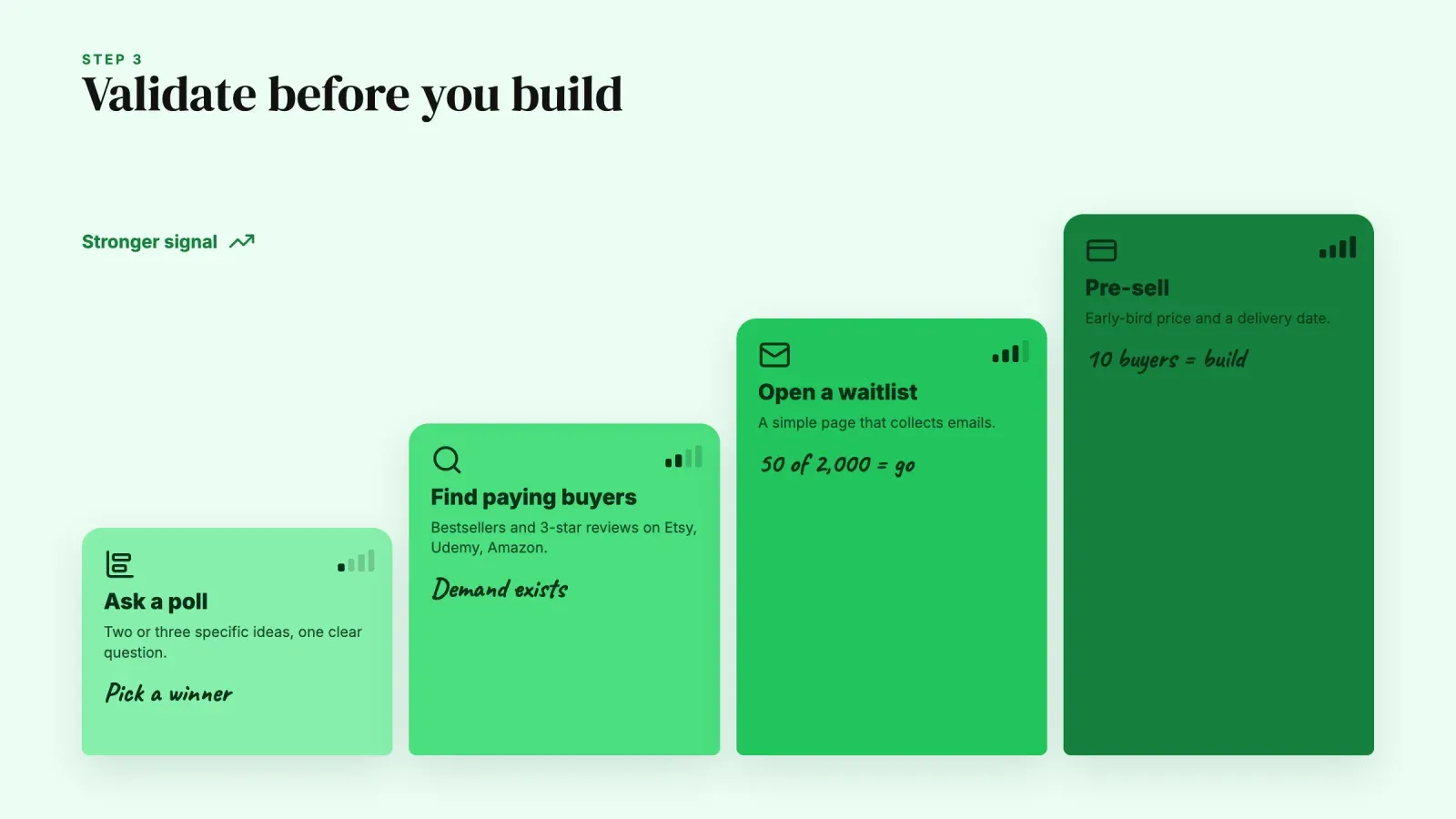
Ask a specific question. Post a poll or a Story asking your audience which of two or three ideas would help them most. "Would you want a Notion budget template or a 30 day meal prep guide?" gets better answers than "Would you buy something from me?"
Look for proof that people already pay. Search Etsy, Gumroad, Udemy or Amazon for your topic. Competition is good news. It means buyers exist. Read the reviews of the bestsellers, especially the three star ones, because they tell you what buyers wish had been included.
Collect emails with a waitlist. Create a simple page describing what you'll make and ask people to join the waitlist. If 50 people out of 2,000 followers sign up, that's a good signal. If five sign up, change the angle before building anything. A waitlist also gives you your first email list, which is the most valuable asset in this whole plan.
Pre-sell when you can. The strongest validation is money. Offer an early-bird price, for example $19 instead of $29, for people who buy before launch, and set a delivery date. If ten people pay, build it. If nobody does, refund the few who did and test a different idea. Pre-sales feel scary, but they turn a guess into a fact.
Keep a simple threshold in mind. If you can't get ten people to say a firm yes, or five people to pay, the idea needs work. It's far better to learn that after two weeks than after six months.
4. Build the asset once, and build it small
Once the idea is validated, create the smallest version that solves the problem well. This is your minimum viable product. A focused 25 page guide that people finish beats a 200 page book they never open. A 12 lesson course beats a 60 lesson course that takes you a year.
A few rules make the build phase faster.
- Set a deadline and a scope. Write down what's in version one and what waits for version two. Protect the deadline.
- Reuse what you've already made. Your best posts, client emails and notes are raw material. Many first products are organized versions of content the creator already published for free.
- Use simple tools. Google Docs or Canva for guides, Notion for templates, your phone and a cheap microphone for video lessons. Equipment rarely decides whether a product sells.
- Design for evergreen. Avoid content that expires quickly, like screenshots of an app interface that changes every quarter, or dated references. The longer the product stays accurate, the more passive it is.
For investments, the build phase looks different but follows the same logic. Set up the account, choose a simple diversified fund, automate a monthly transfer and stop there. Complexity is the enemy of passive.
5. Automate payments, delivery and follow-up
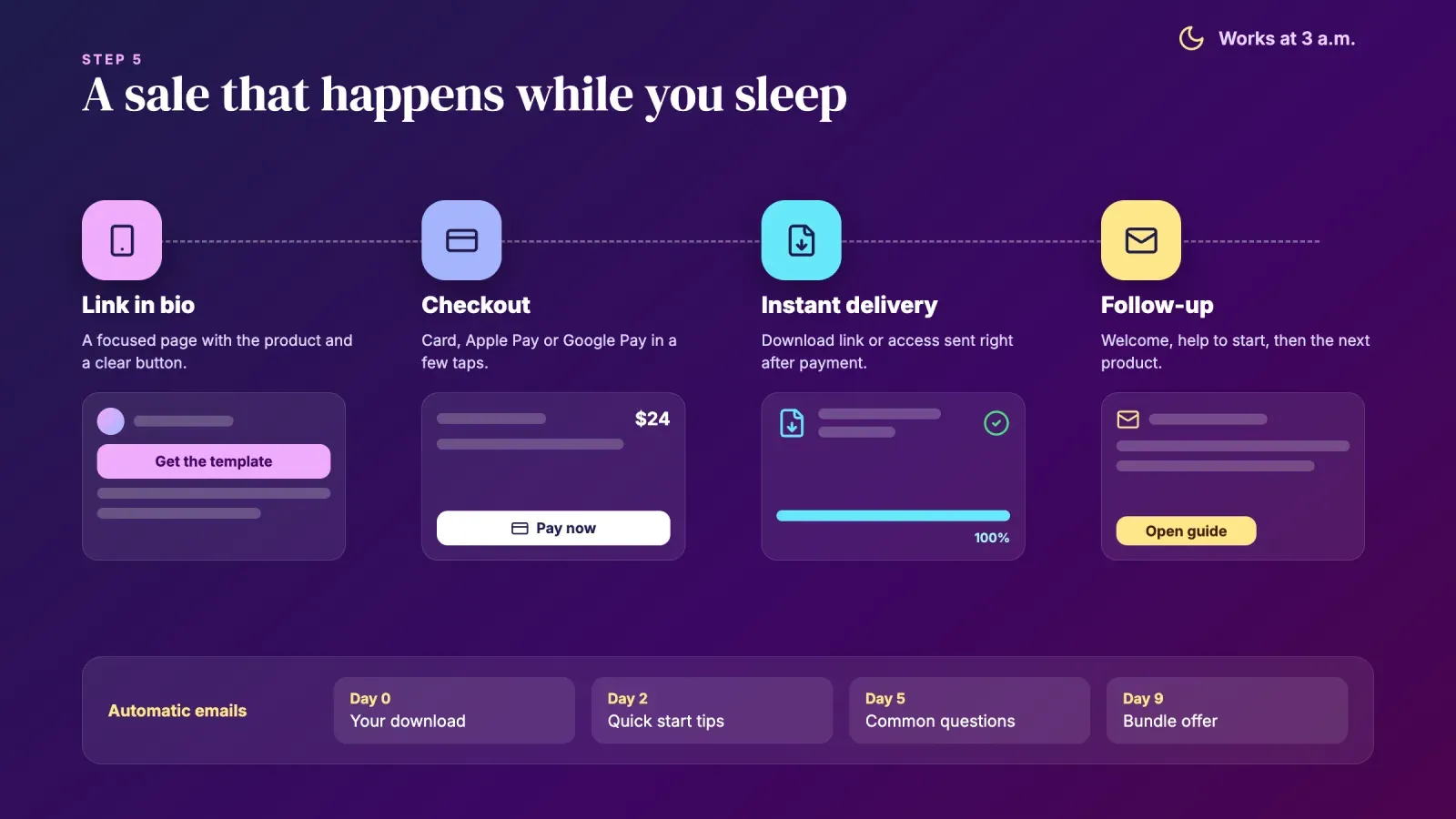
An asset only becomes passive when a sale can happen while you sleep, without you touching anything. That means four pieces work on their own.
Checkout. Buyers need to pay in a few taps, on mobile, with cards and wallets like Apple Pay or Google Pay. Every extra step loses buyers. A clean checkout page is worth more than any marketing trick.
Instant delivery. The file, course access or license key should arrive automatically after payment, by download link and email. Manual delivery is the first thing that turns a passive product into a chore.
Follow-up emails. A short automated sequence welcomes buyers, helps them get started and, after a few days, suggests your next product. Many creators earn a meaningful share of revenue from these emails alone, because people who bought once are the most likely to buy again.
Support that answers itself. A clear FAQ on the product page and in the welcome email handles most questions before they arrive. A clear refund policy avoids disputes.
With Roctify, your link in bio page doubles as a store. You can list digital downloads, courses and bookings, take payments and deliver files automatically after purchase, with 0% transaction fees on every plan. Whatever tool you choose, test the full journey yourself before launch. Buy your own product on your phone and check every email you receive.
6. Build traffic that keeps coming without you
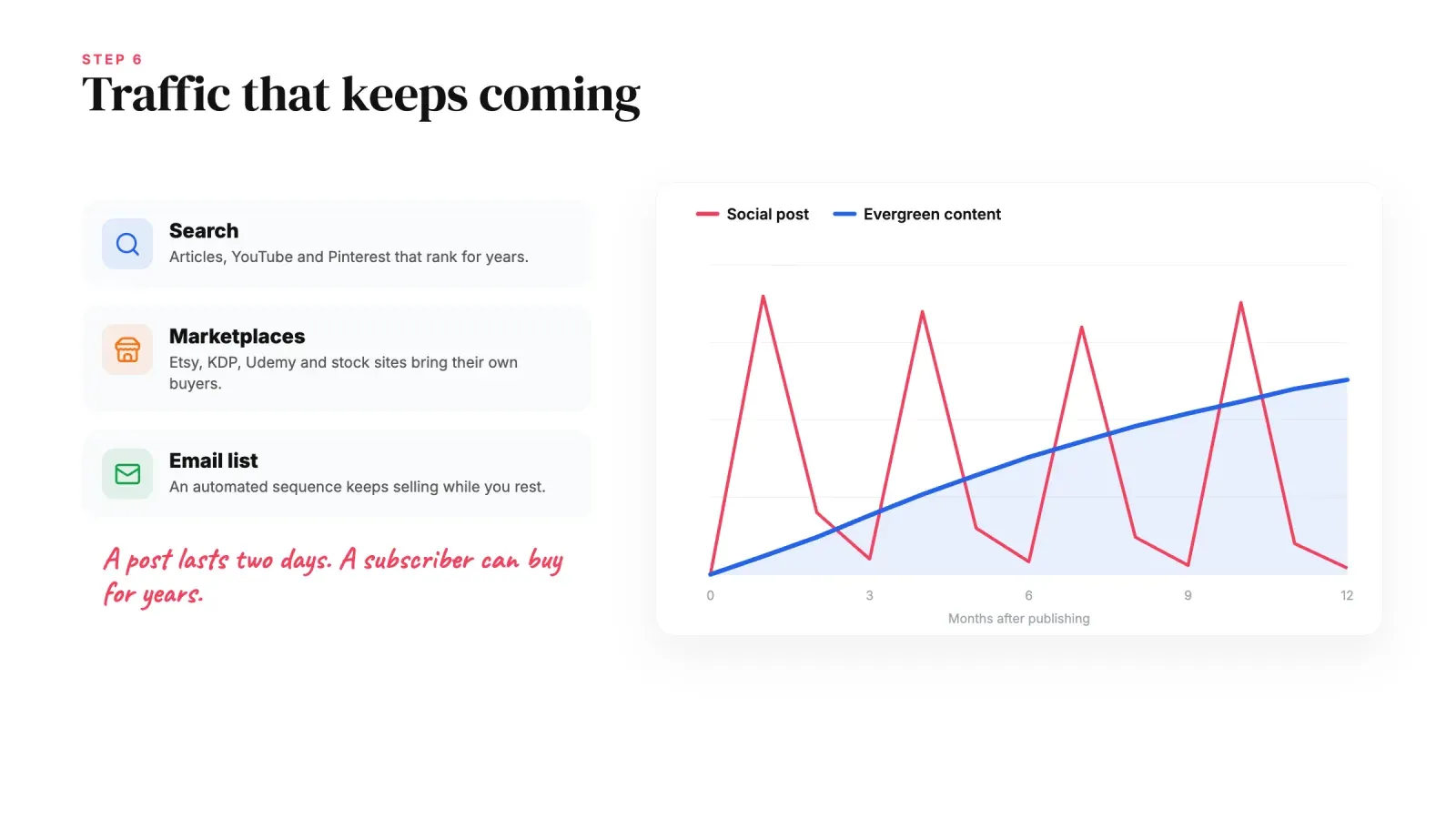
This is the step most guides skip, and it's the one that decides whether income stays passive. A product with no traffic earns nothing. A product that depends on you posting every day is a job. What you want is traffic that keeps arriving from things you did months ago.
There are three main sources of that kind of traffic.
Search. Blog posts, YouTube videos and Pinterest pins can rank for years. Someone searching "budget template for couples" in 2027 can find a video you posted in 2026 and click through to your product. This is the slowest source to build and the most passive once it works. Aim for evergreen content that answers questions your buyers type into search engines.
Marketplaces. Etsy, Amazon KDP, Udemy, stock sites and app stores bring their own buyers. You pay a commission, but you don't have to find every customer yourself. Many creators use marketplaces for discovery and their own store for repeat buyers, where they keep more of each sale.
Your email list. Social media reach goes up and down with every algorithm change. An email list belongs to you. Every new subscriber can receive the same automated sequence that introduces your best product, which means your list keeps selling even when you take a month off social media.
Social media still matters, especially at the start. The trick is to make every post point somewhere durable. Instead of "link in bio" leading to a random page, send people to a focused page with your product, a free lead magnet and an email signup. A post lasts two days. A subscriber can buy for years.
7. Measure, maintain and add a second stream
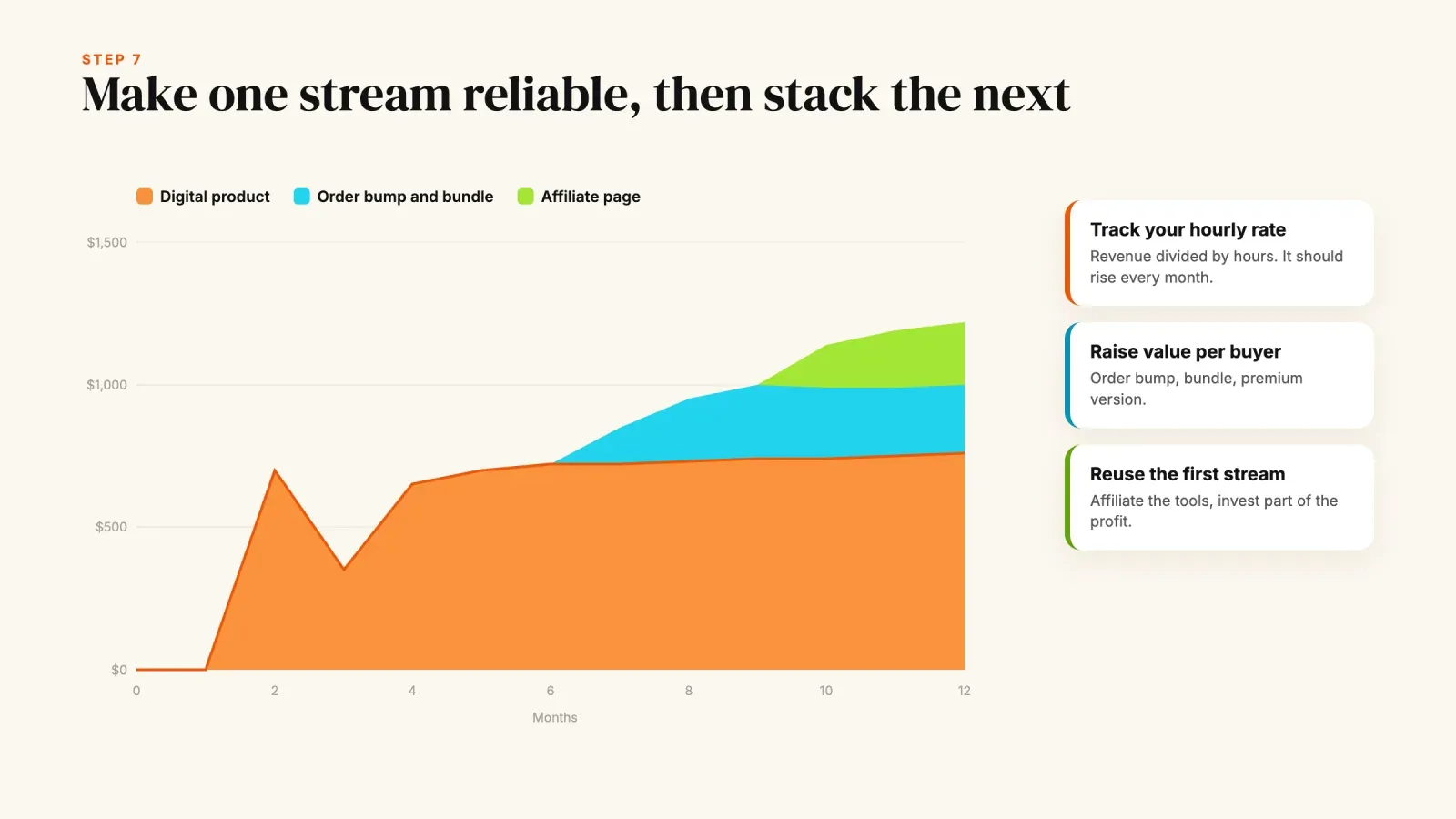
Once the first stream earns, resist the urge to start five more. First make it reliable, then stack the next one on top.
Track a few numbers each month. Visitors to your product page, conversion rate, revenue, refunds, and the hours you spent on the stream. That last one is the most important. Divide revenue by hours and you get your real hourly rate. If it's going up month after month, the stream is becoming more passive. If it's flat, something still depends too much on you.
Schedule maintenance. Block one or two hours a month to update content, answer questions, fix broken links and refresh your sales page. Small regular care keeps a product selling for years. Neglect slowly kills it.
Raise the value of each buyer. Add an order bump at checkout, create a bundle, or launch a premium version for people who want more. Increasing what each customer spends is easier than finding new customers.
Then add a second stream that reuses the first. The best second stream feeds on what you already built. A template seller can add an affiliate page for the tools the templates use. A course creator can add a YouTube channel that teaches free lessons and points to the course. Once both earn, part of that income can go into an index fund, which turns skill-based income into capital-based income over time.
Passive income ideas compared
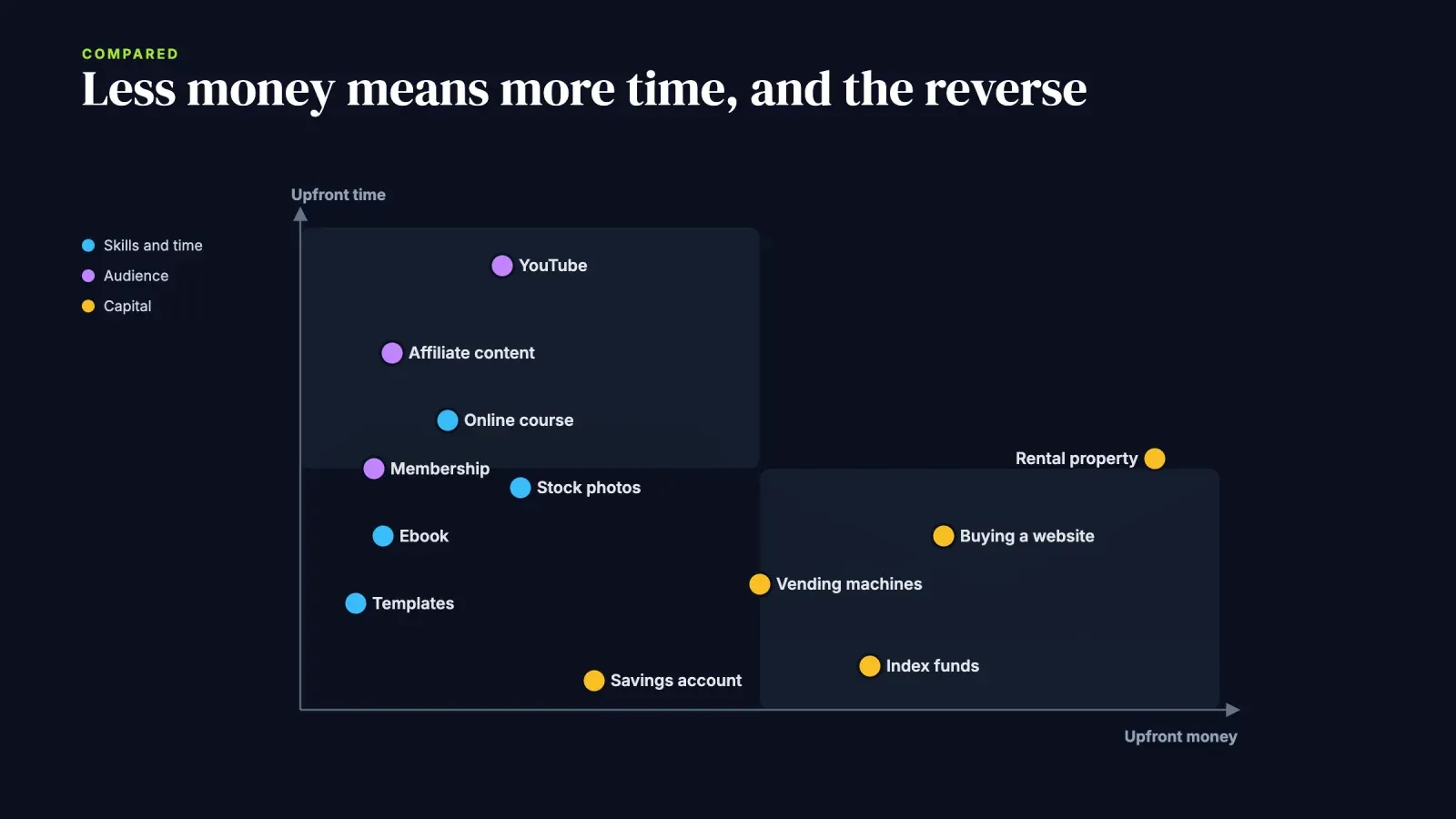
The table below compares common passive income ideas on what they really ask from you. Figures are typical ranges seen by creators and small investors, not promises.
| Idea | Upfront time | Upfront money | Time to first income | Ongoing work |
| --- | --- | --- | --- | --- |
| Templates and printables | 10 to 40 hours | Under $50 | 2 to 6 weeks | Low |
| Ebook or guide | 30 to 80 hours | Under $100 | 1 to 3 months | Low |
| Online course | 60 to 150 hours | $0 to $300 | 2 to 4 months | Medium |
| Membership | 40 hours, then monthly | Under $100 | 1 to 2 months | High |
| Affiliate content | 100+ hours | Under $100 | 6 to 12 months | Medium |
| YouTube channel | 200+ hours | $0 to $500 | 6 to 18 months | Medium |
| Stock photos or music | 100+ hours | Gear you own | 1 to 6 months | Low |
| Dividend or index funds | A few hours | Thousands of dollars | 1 to 3 months | Very low |
| High yield savings | One hour | Any amount | One month | Very low |
| Rental property | 50+ hours | Tens of thousands | 3 to 12 months | Medium to high |
| Vending machines | 20+ hours | $2,000 to $5,000 per machine | 1 to 2 months | Medium |
| Buying a website | 30+ hours | $1,000 to $50,000+ | Immediate | Medium |
Two patterns stand out. First, the ideas with the lowest money requirement have the highest time requirement, and the reverse. Second, the ideas with the fastest first income are digital products and cash savings, which is why they make good first steps for most people.
A realistic 12-month passive income timeline
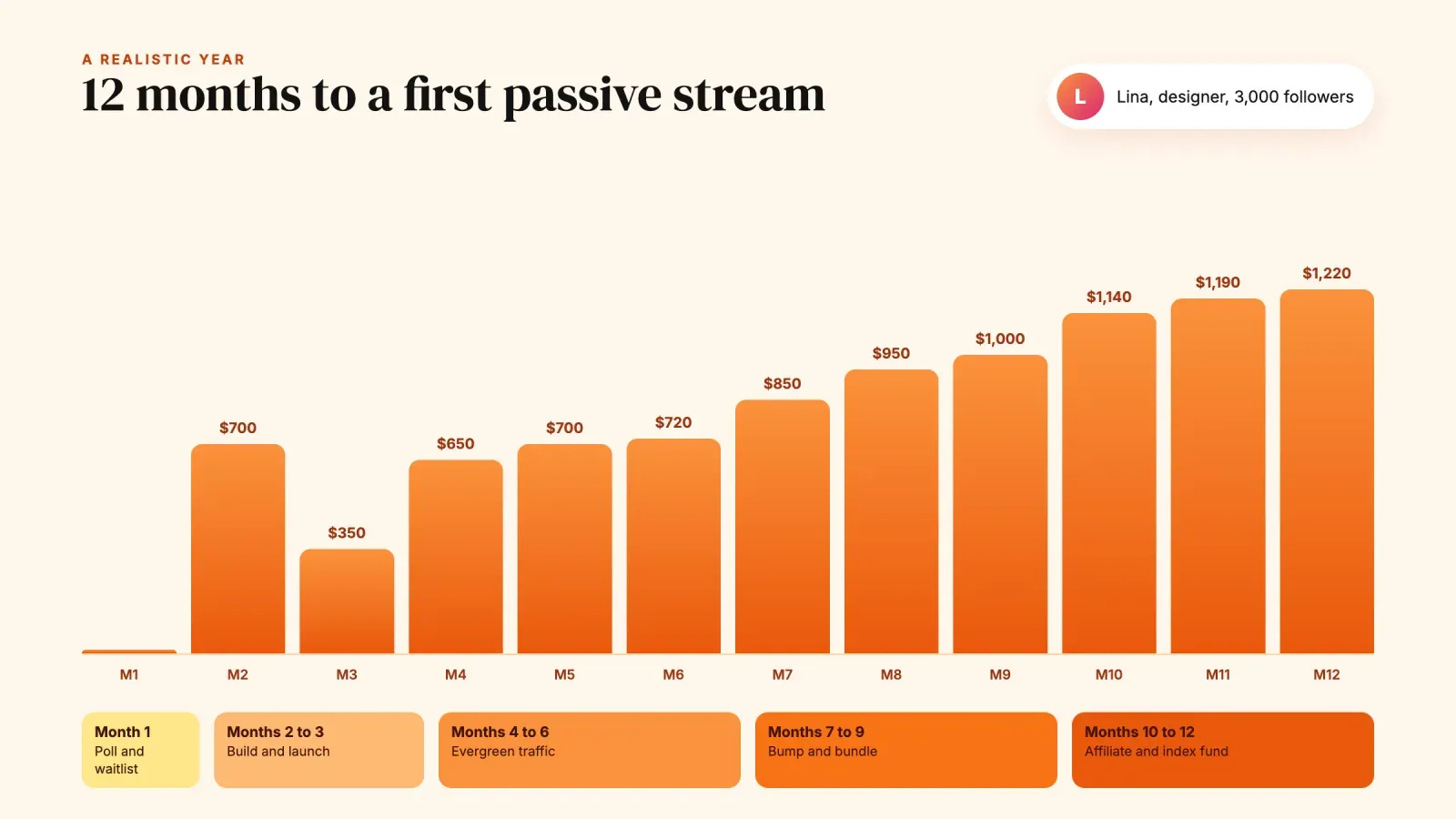
Here is what the method looks like for a typical creator with five to eight hours a week and about 3,000 followers. Let's call her Lina, a graphic designer who posts Canva tips on Instagram.
Month 1. Audit and validation. Lina notices followers keep asking how she plans her posts. She runs a poll with three options and the content calendar template wins clearly. She opens a waitlist and 70 people sign up in ten days.
Months 2 and 3. Build and launch. She builds a Canva and Notion content calendar pack, sets the price at $24 and offers $17 to the waitlist. 41 people buy in launch week, about $700. She sets up automatic delivery and a three email welcome sequence.
Months 4 to 6. Traffic that lasts. Instead of posting about the product every day, she publishes two tutorials a month on YouTube and Pinterest about planning content, each pointing to a free checklist that grows her email list. Sales settle at 25 to 35 a month without launches, around $700 a month.
Months 7 to 9. More value per buyer. She adds a $9 caption pack as an order bump and a $49 bundle. Average order value rises from $24 to $31. Monthly revenue reaches about $1,000 for roughly five hours of work a month.
Months 10 to 12. Second stream and first investment. She creates an affiliate page listing the tools she uses, which adds $150 to $250 a month, and starts moving $300 a month into a broad index fund.
After a year, Lina earns around $1,200 a month from work she mostly did months earlier. It's not life-changing money yet, but it grows without new hours, and the second year starts from a base instead of from zero. Most real results look like this. Slow at first, then steadily compounding.
Taxes and legal basics before your first sale
Passive income is taxable income. Getting the basics right from day one is much easier than fixing them later. This section is general information, so check the rules in your country or ask an accountant.
- Declare what you earn. In the United States, net self-employment income of $400 or more in a year generally means filing and paying self-employment tax. In France, many creators start under the micro-entrepreneur status and declare their revenue to the Urssaf. Other countries have their own thresholds.
- Watch VAT on digital sales. In the European Union, digital products sold to consumers are taxed at the VAT rate of the buyer's country once your cross-border EU sales pass €10,000 a year. The One Stop Shop (OSS) scheme lets you declare everything in one place. Some platforms act as the merchant of record and handle VAT for you.
- Respect copyright and licenses. Use fonts, photos, music and templates you have the right to resell. Read the license of every asset you include in a product.
- Disclose affiliate links. Most countries require you to tell your audience when you earn a commission. A short line like "I earn a commission if you buy through this link" is enough in most cases.
- Keep investment income separate. Dividends, interest and rental income follow their own tax rules, often different from business income.
Set aside a percentage of every sale for taxes in a separate account from the first euro or dollar. Many creators use 25% to 30% as a safe default until they know their real rate.
Mistakes that keep passive income active
Most passive income projects don't fail because the idea was bad. They fail because of a few predictable mistakes.
Chasing the idea instead of the fit. Rental properties look great on social media, but they don't fit someone with $2,000 in savings. Dropshipping looks easy, but it needs constant ad testing. Start from your audit, not from what's trending.
Building before validating. Months of work on a product nobody asked for is the single most common failure. Two weeks of polls, waitlists and pre-sales prevents it.
Relying on one platform. If all your sales come from one social network and your account gets restricted, your income stops overnight. Build an email list and your own page early.
Underpricing. A $3 ebook needs ten times more sales than a $29 one to earn the same. Low prices also attract more refund requests and support emails. Price on the value of the result, not on the number of pages.
Ignoring maintenance. Outdated screenshots, broken links and unanswered emails slowly reduce sales. A monthly hour of care keeps a product earning for years.
Expecting fast results. Most skill-based streams take three to twelve months to produce steady income. People who stop at month three never see month twelve. Decide in advance how long you'll give a project before judging it.
Falling for get-rich-quick offers. Promises of $10,000 a month in 30 days with no skills usually sell a course about selling courses. Real passive income is built slowly, with work you can explain to anyone.
FAQ about creating passive income
How can I create passive income with no money?
Start with your skills. Digital products like templates, guides and presets, stock photos and affiliate content need almost no money, only time. Free tools like Canva, Google Docs and Notion are enough to build a first product, and a free link in bio store is enough to sell it.
How much money do I need to make $1,000 a month in passive income?
With investments, it depends on the yield. At 4%, you need about $300,000 invested to earn $1,000 a month. With a digital product, you need about 40 sales a month of a $25 product, which depends on your audience and traffic rather than your capital. That's why most people build skill-based income first.
What is the easiest passive income to start?
For most people, a simple digital product sold to an audience you already have. It costs almost nothing, can be ready in a few weekends and teaches the skills every other stream needs. For people with savings and no time, a high yield savings account or a broad index fund is simpler still.
How long does it take to build passive income?
Expect one to three months for a first digital product sale, three to twelve months for steady product income, and one to two years for content like YouTube or blogs to earn meaningfully. Investment income starts quickly but grows slowly unless you keep adding capital.
Is passive income really passive?
Rarely at the start. Every stream needs an intense build phase and then a few hours of maintenance a month. The aim is to make those hours small compared with the income. A good test is to calculate your real hourly rate each month and check that it keeps rising.
Do I need a website to earn passive income?
No. Many creators sell digital products, courses and affiliate recommendations from a link in bio page, which works as a lightweight website with a store. A full website helps later if you want to rank in search with articles, but it isn't required to make your first sale.
Is passive income taxable?
Yes. Product sales, affiliate commissions, ad revenue, dividends, interest and rent are all taxable in most countries. Declare them, set aside money for taxes from the first sale and ask a local accountant about the best status for your situation.
Start with one stream and let it compound
Creating passive income is less about finding the perfect idea and more about following a method. Audit what you can invest, pick one model that fits, validate it with real people, build a small version, automate the sale and delivery, and point your content toward traffic that lasts. Then measure, maintain and stack the next stream on top of the first.
The first stream is always the hardest. It's also the one that teaches you everything the next ones need.
Create your free Roctify page to sell your first digital product, course or booking straight from your link in bio, with instant delivery after payment and 0% transaction fees on every plan.